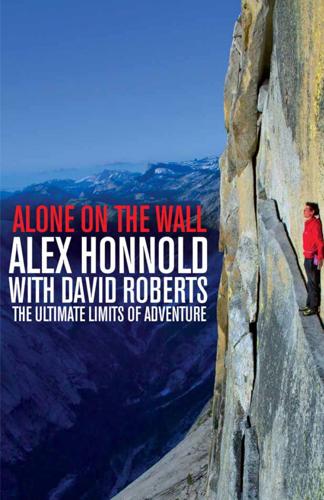
Alone on the Wall: Alex Honnold and the Ultimate Limits of Adventure
by Alex Honnold and David Roberts · 2 Nov 2015 · 265pp · 77,084 words
the discovery of George Mallory’s body on Mount Everest. His most recent book is Alone on the Ice (Norton, 2013). ALONE ON THE WALL Alex Honnold with David Roberts MACMILLAN To my family, for always supporting me along an unconventional path Contents CHAPTER ONE MOONLIGHT CHAPTER TWO A VERY PRIVATE HELL
…
execute what I’d visualized, every handhold and foothold on the long way to the top of the wall. AT THE END OF MARCH 2008, Alex Honnold was little known beyond the small circle of his friends. Seven years later, at the age of thirty, he is probably the most famous climber
…
Yosemite. And since 2013, Alex has expanded his horizons to mountaineering, where he’s already doing things no one else has managed to pull off. Alex Honnold, in short, is a climbing visionary, of the sort who comes along maybe once in a generation. He’s also smart, funny, a man with
…
other art. Ironically, then, trad climbing is more “sporting” than sport climbing—and more daring and dangerous. But free soloing is another whole game. When Alex Honnold performs one of his long free solos, he does away altogether with ropes, with a partner to catch his fall, with pro of any kind
…
the directors at Sender Films, sat up and took notice. A new phenom of the climbing world had emerged on the stage. At twenty-two, Alex Honnold was just getting started. CHAPTER TWO A VERY PRIVATE HELL Once I told Chris Weidner about Moonlight Buttress, I should have known the word would
…
big walls. Interspersed with this action are sound bites from Alex’s peers. Says Cedar Wright, one of Alex’s best friends, “When you meet Alex Honnold, you’re gonna be like, ‘Huh, this guy is a bumbling, dorky, awkward goofball.’ Until he steps on the rock, and then he’s literally
…
competed in four marathons, clocking a best time of three hours and twenty-five minutes. As Pearson recalled in 2010, “I’d never heard of Alex Honnold. A friend invited me to Reel Rock, but I almost didn’t go. We arrived late. Alex was just one of many characters in the
…
on water.” Another veteran weighed in: “Having done all 3 routes, this just makes me sick.” Many of the responders expressed simple admiration. “Long live Alex Honnold,” cheered one. “Another amazing send by a super nice dude!” John Long, the Stonemaster who would bear on-screen witness to Alex’s genius in
…
abashed. “That’s not me anymore,” he insisted. “I think back then I was pretty aggro. I thought I had something to prove.” By 2015, Alex Honnold evidently has little still to prove. Yet his intensity shows no signs of ebbing. Something still drives him to a kind of perfection on rock
…
dangerous, and they only become more so when what you are famous for is risking your life. If he’s not careful, we could admire Alex Honnold to death. That’s a fair concern, but it’s not like I haven’t dealt with this pressure ever since folks started noticing what
…
Peter Croft and Dave Schultz cut the mark to 6:40. As mentioned in previous chapters, Peter Croft was one of the climbers a young Alex Honnold most admired, because of the bar he set with his solo climbs. Alex’s free solos of Astroman and the Rostrum in a single day
…
of El Toro, with a pencil stub Alex scribbled a note that a later visitor photographed. It read: 1/14/14 Solo!! In two hours Alex Honnold Great day out!! (Two hours on the fifteen-pitch climb, another hour to scramble to the summit of El Toro.) The Camp 4 film closes
…
critics. For the La Sportiva website, he wrote up a recent triumph of free soloing. It didn’t help that the editors titled the piece “Alex Honnold—What a Day!” He began the piece: “On March 14th I free soloed three classic routes in Zion in a 12-hour day. It was
…
a young kid pops on the screen, to Logan’s comment: “Back then, he was a shy, skinny kid with big ears.” “The Ascent of Alex Honnold,” as CBS titled its segment, skillfully intercuts climbing footage with tête-à-tête exchanges, some of them powerfully blunt. Logan asks, “Do you get an
…
behavior. So much so that they produced a 60 Minutes Overtime pastiche of outtakes, titled “Dude: The Quirky World of Alex Honnold.” The subhead read: “For 60 Minutes producer Jeff Newton, shooting Alex Honnold’s death-defying rock climbing was only part of the challenge. Jeff and the whole crew also had to learn
…
with the news. In December 2013, Outside ran a feature about the upcoming event. Grayson Shaffer’s reporting was judicious, but the title and subtitle—“Alex Honnold Isn’t Afraid of Skyscrapers” and “Climbing’s biggest name makes his bid for international stardom by risking death on live TV”—smacked of tabloid
…
time goal, Alex. Bravo”), there were murmurs of disappointment. For perhaps the first time in his career, the pithy phrase selling out was associated with Alex Honnold. Wrote one Outside commenter, “What sucks is the greatest climber who ever lived now has to resort to climbing a building for cash? . . . It might
…
& Five Horrendous Life Experiences.” The online teaser summarizing the video goes on in the same vein: “Any terrible idea is worth repeating . . . especially if like Alex Honnold and Cedar Wright you have a terrible memory and seem to remember your last ‘sufferfest’ as not too bad.” And it salutes the “goofy duo
…
his art but unconcerned about legality or other people’s opinions. Dean Potter will live on through all of us whom he inspired. Acknowledgments From Alex Honnold My biggest thanks must go to David Roberts, without whom this book would not exist. He did all the heavy lifting in trying to shape
…
, Molly Birnbaum, and Matt Hale (who also helped me immensely with the photo selection and procurement). Finally, I owe my deepest debt and gratitude to Alex Honnold himself. When I first hung out with him at Smith Rock in 2010, as I researched a profile for Outside magazine, I was at once
…
Parker, Chris, ref1 Paso Marconi, Patagonia, ref1 Patagonia, ref1, ref2 Peacock, Pete, ref1 Pearson, James, ref1, ref2, ref3, ref4, ref5, ref6 Pearson, Stacey, relationship with Alex Honnold, ref1, ref2, ref3, ref4, ref5, ref6, ref7, ref8, ref9, ref10 pendulums, ref1, ref2, ref3, ref4, ref5, ref6 Phoenix, Yosemite, Honnold’s free soloing of, ref1
…
New Wharf Road, London N1 9RR Associated companies throughout the world www.panmacmillan.com ISBN 978-1-4472-8267-9 Copyright © Alex Honnold and David Roberts, 2015 The right of Alex Honnold and David Roberts to be identified as the author of this work has been asserted in accordance with the Copyright, Designs and
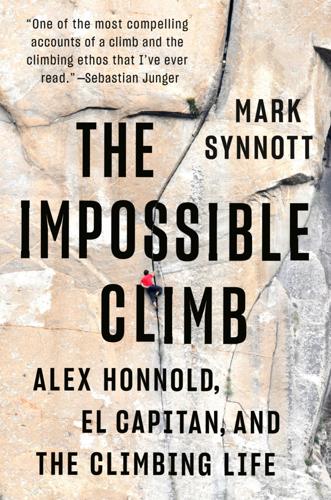
The Impossible Climb: Alex Honnold, El Capitan, and the Climbing Life
by Mark Synnott · 5 Mar 2019 · 389pp · 131,688 words
D colophon are registered trademarks of Penguin Random House LLC. LIBRARY OF CONGRESS CATALOGING-IN-PUBLICATION DATA Names: Synnott, Mark, author. Title: The impossible climb : Alex Honnold, El Capitan, and the Climbing Life / Mark Synnott. Description: New York, New York : Dutton, [2018] Identifiers: LCCN 2018007271 | ISBN 9781101986646 (hardcover) | ISBN 9781101986653 (ebook) Subjects
…
I couldn’t think of a single person who hadn’t fallen at least once on the way up. So what in the world was Alex Honnold thinking? El Capitan is 3,000 feet of sheer, gleaming, glacier-polished wall. And he planned to attempt it alone. Untethered. With no equipment. No
…
was treading to the edge. Like most climbers, I had an unwritten list of the people who seemed to be pushing it too hard—and Alex Honnold was at the top. By the time I met him, most of the other folks on my list had already met an early demise (and
…
my arguments with the same skill and flair with which he dispatched finger cracks and overhangs. What it all came down to was that for Alex Honnold, a life lived less than fully is a fate worse than dying young. I looked over at my two sons, still peering through the tram
…
mind for the past few months. “Well, there is this one idea I’ve been playing with,” he said. And then he told Hayes about Alex Honnold, the world’s greatest free soloist. He didn’t mention El Capitan, because at that moment he had no idea Alex was thinking about the
…
proud, to say I still do. I guess you could say that I’ve been lucky that my path in life happened to intersect with Alex Honnold’s and Jimmy Chin’s, and with those of a whole bunch of other people who helped lay the foundation for what was going to
…
overlooked? And there, in the musty reading room of the local library, a trajectory was firmly set. CHAPTER THREE A Vision of the Stonemasters’ Lightning Alex Honnold was screwed. He had climbed hundreds of feet up the frozen gully, lured in by the initial low angle and the softness of the snow
…
truth. * * * — AT FIRST, everyone thought it was an April Fools’ Day joke. The rumor bouncing around the climbing community on April 1, 2008, was that Alex Honnold had free soloed the Moonlight Buttress. It was not the kind of route that anyone would ever solo. It’s a 1,200-foot monolith
…
a giant smiley face. Tied to its end, one hundred feet away to my right, another Alex (it was 1999, and I hadn’t met Alex Honnold yet), the world’s premier alpinist, Alex Lowe, was spread-eagled between slender pinnacles of granite. The opposing outward force of Alex’s hands and
…
Crazy Kid. CHAPTER SIX The Secret Weapon, Mr. Safety, and Xiao Pung Where’s your helmet?” I asked. “Uhhh, I don’t have one,” replied Alex Honnold sheepishly. “What do you mean? You forgot it back in camp?” Before I finished my question, I knew the answer. “Uhhh, no. I mean I
…
chair and opened a bottle of duty-free vodka. Taking my first sip, I heard a knock on the door. Through the peephole I saw Alex Honnold standing in the hallway wearing nothing but a pair of boxer shorts. I invited him in, and he took a seat on the bed. It
…
one. There were, of course, commercial considerations. The North Face planned to use Jimmy Chin’s photography from the expedition for a national advertising campaign. Alex Honnold, who had never been on an expedition before, was to be the new poster boy, it seemed. The firm needed photos of him in action
…
knew as well as I did that the choice of climbing partners is critical. In this case, all signs certainly pointed to the fact that Alex Honnold and I were not operating on the same wavelength. I had always put climbers in one of two categories: those who’d had the wake
…
, it would mean drilling a ladder of bolts up the wall. No one wanted to see that happen, least of all an impatient and pacing Alex Honnold, waiting to be let out of his cage. Time for the secret weapon, I said to myself as I reeled in the rope for Alex
…
we set off from the base? Conrad had been right when he told me that I would learn a lot from climbing with “the kid.” Alex Honnold had reminded me of the old climbing proverb: “There are old climbers and there are bold climbers, but there are no old bold climbers.” He
…
develop the theme of young and old. We all said basically the same thing: It had been motivating to climb with a young gun like Alex Honnold. Every jaw-dropping lunge, every inhuman pull—even every rookie mistake—had served as a potent reminder that the fire that we saw inside Alex
…
had even contributed to the end of his marriage with Steph. They weren’t officially divorced yet, but they would be soon. And now this Alex Honnold kid had stolen the show. He was the new face of extreme sport, the guy all the sponsors wanted to associate with. Dean’s career
…
speculated that a basic structure in his brain was broken. And so I wondered if he was asking himself the same question I was: Is Alex Honnold’s brain wired differently than the rest of ours, or has he found a way to master life’s most primal emotion? * * * — I COULD NOT
…
everyone, myself included, felt so compelled to probe for an explanation of how Alex can do what he does. Anyone who climbs and knows of Alex Honnold’s exploits has had the “how does he do it” conversation with their partners between burns at the climbing gym or sitting around the bar
…
make most men melt. Jaime is older, more reserved, and I wondered if she might be wary of her little sister dating a guy like Alex Honnold (I would later learn this to be the case). We sat down at a table in the living area, and they told me that they
…
sat in the middle of a row toward the back. Her friend, an avid climber, had asked her if she wanted to go to see Alex Honnold. “Who?” Sanni had just started climbing in September in a local gym called Vertical World and had never heard of
…
Alex Honnold or any other professional climbers. * * * — TOWARD THE END OF THE PROGRAM, a man stood up and said, “Several years ago you mentioned that one of
…
to his hotel at a decent hour, where he hoped to watch some Harry Potter before bed. In each book, he wrote the same thing, “Alex Honnold,” followed by two words that sum up his philosophy on life: “Go Big.” Alex told me that at one such event, a buxom woman arrived
…
store to buy some chips. Still, my mind struggled to process what I had just heard. In my years of climbing and hanging out with Alex Honnold, I’ve learned that when he mentions he might do something, he’s already made up his mind he is doing it. And, of course
…
solo Freerider. There were five different teams attempting to free climb the route, and it must have been obvious to them what was going on: Alex Honnold, being filmed by Jimmy Chin and Mikey Schaefer, rehearsing the crux pitches of Freerider, a route he had already done multiple times. Why else would
…
plane.” A minute later an invitation to a Google doc popped up in my e-mail. The first line read: YOSEMITE NATIONAL PARK—Renowned climber Alex Honnold died Tuesday after he fell while attempting to become the first person ever to scale the iconic 3,000-foot granite wall known as El
…
a smartphone.” Some people thrive under the pressure of knowing their every move is being recorded for posterity, but there are others—and I think Alex Honnold and Henry Barber are in this category—who don’t feel comfortable performing in front of a camera, at least not when they’re operating
…
. It reminded me of a kid ringing the bell after climbing the greased pole at the fair—a tiny reveal of what it meant for Alex Honnold to free solo a route properly. Then he dropped back on his arms, downclimbed a few feet, and traversed across an overhanging face onto an
…
front. I later found out that Cody was a student of Alex’s mom’s at American River College. I wondered if Cody knew that Alex Honnold was using his notebook for his list of things to do before free soloing El Capitan. “There’s no ventilation in here, huh?” I said
…
that bolt,” said Alex, “and from there you can reach this hold.” The guy looked bewildered. He didn’t acknowledge that he knew it was Alex Honnold coaching him. But he knew. Everyone knows Alex. These days, there probably isn’t a climber anywhere who wouldn’t recognize him. Between his long
…
do some rock climbing. Before the trip she sent out an e-mail to members of the American Alpine Club. It started out: “This is Alex Honnold’s mom. Also a climber. I’ll be climbing in the northeast this summer and I’m hoping to find some partners.” In November, a
…
a harrowing descent in a storm. © Jared Ogden From left to right: Conrad Anker, Jimmy Chin, and Alex Honnold on the approach to Low’s Gully on Mount Kinabalu in Borneo. © Mark Synnott A young Alex Honnold on the flanks of Mount Kinabalu. This was Honnold’s first international climbing expedition. © Mark Synnott Jimmy
…
Synnott Sandstone towers on the Ennedi Plateau in Chad. The author led the first climbing expedition to this area in 2010. The team, which included Alex Honnold and James Pearson, climbed the first ascents of twenty towers, leaving thousands more for future generations of climbers. © Mark Synnott While exploring a canyon toward
…
was accosted by knife-wielding bandits. This image is a screen grab from Renan Ozturk’s video of the encounter. © Renan Ozturk, Camp 4 Collective Alex Honnold, the author, and Hazel Findlay in Devil’s Bay on the south coast of Newfoundland, Canada, in 2011. Despite terrible weather they managed to climb
…
attempt to free solo El Capitan in the fall of 2016. © Mark Synnott One of the many Berber bridges in the Taghia Gorge. © Mark Synnott Alex Honnold and Tommy Synnott. © Hampton Synnott The author (left) trick-or-treating in Yosemite Village with Tommy Caldwell. © Hampton Synnott Dierdre Wolownick
…
, Alex Honnold’s mom, on Sunnyside Bench, about a week before Alex’s first attempt to free solo El Capitan. Wolownick was not aware of her son’
…
van below his legs. © Mark Synnott Author’s Note The idea for this book grew out of an assignment for National Geographic magazine to cover Alex Honnold’s free solo of El Capitan. At the time of this writing, that article is scheduled to be published in March 2019. Some of the
…
page, where Alex describes himself as a “gangly-looking” dude. This is quoted from Joseph Hooper’s Men’s Journal article, “The Radical Calm of Alex Honnold.” Some of the stories in this book took place many years ago. I re-created the tales of my youth in Chapter Two mostly from
…
Eight benefitted immensely from Joseph Hooper, who shared his notes with me from his reporting for his Men’s Journal article “The Radical Calm of Alex Honnold.” This material was critical for me in re-creating the story of Tommy Caldwell and Kevin Jorgeson topping out the Dawn Wall. Other sources for
…
, it’s happening,” was told to me secondhand and confirmed by Alex. It also appears in J. B. MacKinnon’s piece for The New Yorker, “Alex Honnold’s Perfect Climb.” Acknowledgments Out of all the people who helped bring these chapters to fruition, no one had a bigger impact than my friend
…
I can return the favor. I am also extremely grateful to National Geographic magazine and my editor, Peter Gwin, for assigning me to report on Alex Honnold’s historic free solo of El Capitan. Without National Geographic’s support and belief in the importance of this story, the book that you are
…
Alex’s impossible climb will be of keen interest to anyone who has read this book. There would have been no story to tell without Alex Honnold. Thank you, Alex, for your friendship, for being who you are, for your inspiration and support, and for trusting me to get this right. I
…
LeDoux, Jane Joseph, Henry Barber, Nik Wallenda, Forest Altherr, and Jeff Ball, all of who generously gave of their time to help me better understand Alex Honnold and some of the other characters in this book. And a huge thank-you to all the people who contributed visuals: Corey Rich, Austin Siadak
…
, partner, and friend; Conrad Anker, for opening the door for me to pursue climbing full-time, for his mentorship, and for suggesting that I bring Alex Honnold on that expedition to Borneo. Alex Lowe was my idol as a young climber, and despite our falling out on Great Trango Tower, I still
The Rise of Superman: Decoding the Science of Ultimate Human Performance
by Steven Kotler · 4 Mar 2014 · 330pp · 88,445 words
predicting limits is so difficult—because we’re about to be able to take control of the one aspect of performance that trumps all others.” ALEX HONNOLD AND HALF DOME If we do want to take a stab at predicting future limits, one place to turn is the sport of rock climbing
…
base and baseline for reality got tipped toward the impossible a little ahead of the general action and adventure sports curve. In other words, meet Alex Honnold. Alex Honnold started climbing at indoor gyms in 1996, when he was eleven years old. At nineteen, Honnold moved outdoors, where he soon developed a preference for
…
progression. The general reaction is “Sure, that’s amazing, but just imagine what Schaar’s going to be able to do when he’s twenty.” Alex Honnold is the answer to that question. He’s climbing’s version of Tom Schaar, only all grown up. He was born into a world where
…
generous help of Laird Hamilton, Dean Potter, JT Holmes, Jeremy Jones, Travis Rice, Ian Walsh, Chris Miller, Danny Way, Doug Ammons, Tao Berman, Mike Horn Alex Honnold, Dave Kalama, Miles Daisher, Jon Devore, Andy Farrington, Mike Swanson, Travis Pastrana, Tom Schaar, Kirk Krack, and Mandy-Rae Cruickshank, this book would not have
…
times the speed of Moore’s Law: Peter Diamandis and Steven Kotler, Abundance: The Future Is Better Than You Think (Free Press, 2011). 183 meet Alex Honnold: Honnold quotes and details came from a series of interviews conducted by the author between March 2013 and July 2013. Peter Croft and Dean Potter
…
you talk about what the next”: Jimmy Chin, AI, March 2013. 186 first person in history to solo Half Dome: “NG LIVE!: Free Soloing with Alex Honnold,” National Geographic Live. See: http://video.nationalgeographic.com/video/specials/nat-geo-live-specials/chin-bonus-nglive. finishing the route in one hour twenty-two
Transcend: The New Science of Self-Actualization
by Scott Barry Kaufman · 6 Apr 2020 · 678pp · 148,827 words
comprise the need for social exploration, an important form of exploration for growth and learning among such a social species as human beings. ADVENTURE SEEKING Alex Honnold is self-described as a “professional adventure rock climber.” Sometimes referred to by others as Alex “No Big Deal” Honnold, he has been free soloing
…
Personality Assessment, 87(3), 305–16. 24. 60 Minutes (2011, December 27). The ascent of Alex Honnold. Retrieved from https://www.cbsnews.com/news/the-ascent-of-alex-honnold-27-12-2011/. 25. Synnott, M. (2015). Legendary climber Alex Honnold shares his closest call. National Geographic. Retrieved from https://www.nationalgeographic.com/adventure/adventure-blog/2015
…
/12/30/ropeless-climber-alex-honnolds-closest-call. 26. Synnott, Legendary climber Alex Honnold shares his closest call. 27. Chen, C., Burton, M., Greenberger, E., & Dmitrieva, J. (1999). Population migration and the variation of dopamine D4 receptor (DRD4) allele
…
frequencies around the globe. Evolution and Human Behavior, 20(5), 309–324. 28. Synnott, Legendary climber Alex Honnold shares his closest call. 29
…
. wwwAAASorg. (2018, April 5). Alex Honnold’s amygdala: Analyzing a thrill-seeker’s brain [Video file]. Retrieved from https://www.youtube.com/watch?v=ib7SS49Kk-o. 30
Dopamine Nation: Finding Balance in the Age of Indulgence
by Anna Lembke · 24 Aug 2021
late for work because I wait for the next one, and the one after that. I actually enjoy meeting people I’ll never see again.” * * * — Alex Honnold, now world-famous for climbing the face of Yosemite’s El Capitan without ropes, was found to have below-normal amygdala activation during brain imaging
…
the fMRI machine to get pictures taken of his “fearless brain,” which also tells us that fear tolerance doesn’t necessarily translate across all experiences. Alex Honnold and my patient David have been climbing different parts of the same fear mountain. Just as Honnold’s brain adapted to climbing a rock face
…
where he remained for the next fifty minutes, to bring his core body temperature back to normal. Without this intervention, he surely would have died. Alex Honnold’s ascent of El Capitan seems like the ultimate technology-eschewing human accomplishment. No ropes. No gear. Just one person against gravity in a death
…
. 3 (2017): 210–21, https://doi.org/10.9758/cpn.2017.15.3.210. “I’ve done so much soloing”: Mark Synnott, The Impossible Climb: Alex Honnold, El Capitan, and the Climbing Life (New York: Dutton, 2018). rats run until they die: Chris M. Sherwin, “Voluntary Wheel Running: A Review and Novel
…
, https://gizmodo.com/all-the-gear-an-ultramarathon-legend-brings-with-him-on-1736088954. “memorizing thousands of intricate hand and foot sequences”: Mark Synnott, “How Alex Honnold Made the Ultimate Climb without a Rope,” National Geographic online, accessed July 8, 2020, https://www.nationalgeographic.com/magazine/2019/02
…
/alex-honnold-made-ultimate-climb-el-capitan-without-rope. “Overtraining syndrome”: Jeffrey B. Kreher and Jennifer B. Schwartz, “Overtraining Syndrome: A Practical Guide,” Sports Health 4, no.
…
://books.google.com/books?id=iSxsAAAA-MAAJ&printsec=frontcover&source=gbs_ge_summary_r&cad=0#v=onepage&q&f=false 2. Synnott, Mark. “How Alex Honnold Made the Ultimate Climb without a Rope.” National Geographic online. Accessed July 8, 2020. https://www.nationalgeographic.com/magazine/2019/02
…
/alex-honnold-made-ultimate-climb-el-capitan-without-rope. Synnott, Mark. The Impossible Climb: Alex Honnold, El Capitan, and the Climbing Life. New York: Dutton, 2018. Taussig, Helen B. “ ‘Death’ from Lightning and the Possibility
The Push: A Climber's Search for the Path
by Tommy Caldwell · 15 May 2017
Cap in a day, and even Kyrgyzstan—and it’s a style that seemed the most natural to me. • • • In 2008, a lanky kid named Alex Honnold came seemingly out of nowhere and blew the lid off the climbing world with two big wall free solos that were taller, harder, and more
…
the way she does if I were a different man, someone whose mind didn’t burn with the desire to travel through barren landscapes. • • • After Alex Honnold and I did our big free climbing linkup in Yosemite, I started to wonder what it would be like to take those speed-climbing tactics
…
’t being completely honest with myself or with Becca. I think that what rattled her the most was that my partner was going to be Alex Honnold. He was famous for his cavalier view of risk, and Becca knew he wasn’t going to tighten up his program just because he was
…
. I had no idea what bringing a baby into this scene would be like. Over the next few weeks, the climber formally known as Badass Alex Honnold became Uncle Alex. He carried Fitz on his shoulders, making goofy faces and delighting in his little laughs. “Dude, you’re going to be so
…
, avoid added pressure. January 2 feels surprisingly mundane. The three of us chat and surf the Web. Brett is still with us filming the action. Alex Honnold jumars up to say hello. He brings us shelled pistachios and chocolate, and jokes that the route looks scrappy and low angle. After an hour
…
days, explanations about climbing and its nuances, and even a reader question-and-answer about climbing and El Cap, with answers from “celebrity climbers” like Alex Honnold and my ex-wife, Beth. One day they run a photo of me standing in the portaledge in only my Dr. Seuss–striped long underwear
…
people gather around Tom Evans’s telescope. Few of the people are climbers, so the news stations seem to be interviewing anyone they can find. Alex Honnold gets approached by a female reporter from the Bay Area’s ABC affiliate. She asks if he is familiar with El Capitan. “Yeah, I’m
…
know if I could deal. He’s been stuck on this pitch for seven days. I try to take the pressure off by acting all Alex Honnold about the situation, This is no big deal. But we both know we can’t live like veal in these hanging bags forever, and that
…
had fulfilled a desire to explore limits, but had somehow left me longing for something deeper. We kept climbing, and I thought of Chris Sharma, Alex Honnold, and Corey Rich. I thought of my close friendships that had been forged through climbing. I thought of my mom and dad, and Becca, Fitz
…
in Patagonia. On El Capitan’s Dihedral Wall. The line of the Dawn Wall. With Becca on the Dawn Wall. We married in 2012. With Alex Honnold on the iconic Fitz Traverse in Patagonia. Kevin Jorgeson, my partner on the Dawn Wall. Twelve hundred feet off the deck in our portaledge on
Tools of Titans: The Tactics, Routines, and Habits of Billionaires, Icons, and World-Class Performers
by Timothy Ferriss · 6 Dec 2016 · 669pp · 210,153 words
track or album on repeat, which can act as an external mantra for aiding focus and present-state awareness. Here are just a few examples: Alex Honnold, free solo climbing phenom: The Last of the Mohicans soundtrack Rolf Potts, author of Vagabonding and others: ambitones like The Zen Effect in the key
Into the Ice: The Northwest Passage, the Polar Sun, and a 175-Year-Old Mystery
by Mark Synnott · 14 Apr 2025 · 443pp · 140,219 words
years, and my apprenticeship was close to complete. In my first book, The Impossible Climb, I’d written about my old friend and climbing partner Alex Honnold and his 2017 free solo ascent of El Capitan in Yosemite. When people asked for his autograph, he often appended it with the words “Go
…
frog, when I saw Renan and a Venezuelan climber named Federico “Fuco” Pisani gearing up for one last search. It was well after dark when Alex Honnold and I watched them set off across a narrow, vegetated ledge, and I noticed that they were not carrying a rope. Renan told me later

Hedge Fund Market Wizards
by Jack D. Schwager · 24 Apr 2012 · 272pp · 19,172 words
happened to me (I know because she tells me so, and she has never been wrong) Lara Logan: Do you feel the adrenaline at all? Alex Honnold: There is no adrenaline rush. . . . If I get a rush, it means that something has gone horribly wrong. . . . The whole thing should be pretty slow
…
and controlled. . . . —Excerpt of 60 Minutes interview (October 10, 2011) with Alex Honnold, acknowledged to be the best free-soloing climber in the world, whose extraordinary feats include the first free-solo climb up the northwest face of

Lonely Planet Mongolia (Travel Guide)
by Lonely Planet, Trent Holden, Adam Karlin, Michael Kohn, Adam Skolnick and Thomas O'Malley · 1 Jul 2018
sure to look out for white etchings on the rock walls – markings from ibex hooves scraping the face as they climb, like a four-legged Alex Honnold, to the ridge above. The surrounding hills offer opportunities for some fine, if strenuous, day hikes where more ibexes and argali sheep roam the ridge