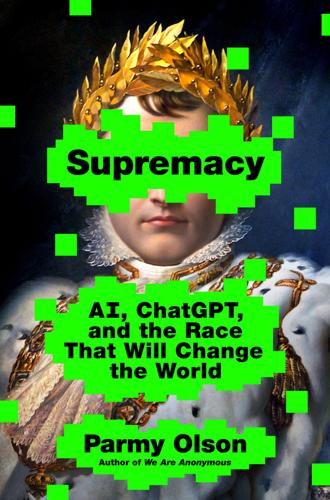
Supremacy: AI, ChatGPT, and the Race That Will Change the World
by Parmy Olson · 284pp · 96,087 words
one of the Google canteens, two floors below the office of Larry Page, the twenty-five-year-old Ukrainian was spitballing with two other researchers, Ashish Vaswani and Jakob Uszkoreit. His lunch mates also didn’t like following the conventions of other scientists in the building. Vaswani was hungry to work on
…
of caution, but more than anything, the company was obsessed with maintaining its reputation and the status quo. Soon, Google was going to experience what Ashish Vaswani describes as a “biblical moment.” As Google continued printing money from its advertising business, OpenAI was taking what looked like a monumental step toward AGI
The AGI Chronicles
by Kevin Roose · 481pp · 151,124 words
the paper. But when they did, Aidan Gomez—a young Brain intern, working under Łukasz Kaiser, who had joined the project late—got drawn first. Ashish Vaswani, a more senior Brain researcher, argued that his name should be listed first. Another author, Noam Shazeer, who thought he had made the biggest contributions
…
instead. See “Elon Musk Names OpenAI,” Internal Tech Emails, https://www.techemails.com/p/elon-musk-names-openai. Google published the details in a paper: Ashish Vaswani et al., “Attention Is All You Need,” arXiv, June 12, 2017, https://arxiv.org/abs/1706.03762v1. “I was like, ‘Oh my god, this is
Code Dependent: Living in the Shadow of AI
by Madhumita Murgia · 20 Mar 2024 · 336pp · 91,806 words
in scientific discovery, the one that spurred this latest artificial intelligence advance came from a moment of serendipity. In early 2017, two Google research scientists, Ashish Vaswani and Jakob Uszkoreit, were in a hallway of the search giant’s Mountain View campus, discussing a new idea for how to improve machine translation
We Are as Gods: A Survival Guide for the Age of Abundance
by Peter H. Diamandis and Steven Kotler · 13 Apr 2026 · 225pp · 76,418 words
Transformer Revolution: 2017–2023 In the summer of 2017, in a quiet corner of Google Brain—Google’s AI think tank—in Mountain View, California, Ashish Vaswani and a team of researchers were wrapping up what seemed like a small side project. They documented their findings in a brief paper with a
…
, September 6, 2025, https://fortune.com/2025/09/06/godfather-of-ai-geoffrey-hinton-massive-unemployment-soaring-profits-capitalist-system/. “Attention Is All You Need”: Ashish Vaswani et al., “Attention Is All You Need,” Advances in Neural Information Processing Systems (NIPS 2017) 30 (2017): 5998–6008, https://papers.nips.cc/paper/7181
The Singularity Is Nearer: When We Merge with AI
by Ray Kurzweil · 25 Jun 2024
how transformers work, and the original technical paper, see Giuliano Giacaglia, “How Transformers Work,” Towards Data Science, March 10, 2019, https://towardsdatascience.com/transformers-141e32e69591; Ashish Vaswani et al., “Attention Is All You Need,” arXiv:1706.03762v5 [cs.CL], December 6, 2017, https://arxiv.org/pdf/1706.03762.pdf. BACK TO NOTE
The Thinking Machine: Jensen Huang, Nvidia, and the World's Most Coveted Microchip
by Stephen Witt · 8 Apr 2025 · 260pp · 82,629 words
a word that had appeared many paragraphs earlier might provide a contextual clue to what the next word meant. Polosukhin and Uszkoreit were joined by Ashish Vaswani, another Google researcher, and by early 2017 the three had built a rudimentary English-to-German translator based on the self-attention mechanism. Polosukhin and
On the Edge: The Art of Risking Everything
by Nate Silver · 12 Aug 2024 · 848pp · 227,015 words
Post, May 17, 2023, washingtonpost.com/technology/2023/05/16/sam-altman-open-ai-congress-hearing. GO TO NOTE REFERENCE IN TEXT “Attention Is All”: Ashish Vaswani et al., “Attention Is All You Need,” arXiv, August 1, 2023, arxiv.org/abs/1706.03762. GO TO NOTE REFERENCE IN TEXT most rapidly adopted
Empire of AI: Dreams and Nightmares in Sam Altman's OpenAI
by Karen Hao · 19 May 2025 · 660pp · 179,531 words
REFERENCE IN TEXT Sutskever would get up: A photo of Sutskever at the event. GO TO NOTE REFERENCE IN TEXT In August 2017, that changed: Ashish Vaswani, Noam Shazeer, Niki Parmar, Jakob Uszkoreit, Llion Jones, Aidan N. Gomez et al., “Attention Is All You Need,” in NIPS ’17: Proceedings of the 31st