Carl Malamud
description: American technologist, author and public domain advocate (1959-)
14 results
The Idealist: Aaron Swartz and the Rise of Free Culture on the Internet
by Justin Peters · 11 Feb 2013 · 397pp · 102,910 words
you have to be willing to take to the caves. * * * IN 1991, when both the Internet and Aaron Swartz were still young, a man named Carl Malamud launched a guerilla open access campaign of his own. The International Telecommunication Union, a nonprofit group that promulgates global telecommunications standards, agreed to let Malamud
…
drive core [sic]?” inquired Aaron Swartz. “Any particular things we should be sure to capture with the pacer docs?”55 * * * AARON Swartz had long admired Carl Malamud. In 2002, when he was fifteen, Swartz spotlighted Malamud on his blog as “today’s featured superhero,” lauding him as “an unstoppable technical and social
…
collapse. Aaron sounded embarrassed.”60 Embarrassed though he may have been, Swartz had no intention of changing his ways. This attitude complicated his collaboration with Carl Malamud. Throughout his career as a data liberation activist, Malamud had always taken care to work strictly within the bounds of the law, both as a
…
unified interface.” Swartz’s personal website, the FBI observed, “includes a section titled ‘Aaron Swartz: a lifetime of dubious accomplishments.’ ” The FBI agents reported that Carl Malamud had “published an online manifesto about freeing PACER documents,” and that the exploits of Malamud, Swartz, and the thumb drive corps had been covered in
…
to talk with Swartz in person. Swartz wasn’t at home, but the FBI agent spoke with his mother, who was spooked enough to send Carl Malamud a frantic e-mail and Twitter message informing him what had happened. (“tell your mother that twitter is *not* the right way to reach me
…
email: me@aaronsw.com. Many, many thanks,” read a January 10 post on Swartz’s Twitter account.5 “Do you know Kevin Guthrie?” Swartz asked Carl Malamud on February 6. (Guthrie was the president of JSTOR’s parent organization, ITHAKA.) “no, but I’m a big fan of Arlo and Woody,” Malamud
…
-government/EzIgMgVHy1o. 13 Aaron Swartz, TheInfo.org, crawled on April 26, 2009, https://web.archive.org/web/20090426012606/http://theinfo.org/. 14 Aaron Swartz to Carl Malamud, December 31, 2007, https://public.resource.org/aaron/pub/msg00054.html. 15 Aaron Swartz to Open Government mailing list, March 8, 2008, https://public.resource
…
ideas to present and future generations,” Solvitur ambulando, January 15, 2013, http://www.ibiblio.org/bess/?p=285. 26 Malamud, Exploring the Internet, ix. 27 Carl Malamud, “The ITU Adopts a New Meta-Standard: Open Access,” Interoperability Report 5, no. 12 (December 1991), https://public.resource.org/scribd/2556197.pdf. 28 Malamud
…
, no. 12 (December 1991), 21. 31 Malamud, Exploring the Internet, ix. 32 Sharon Fisher, “ITU Standards Program to End,” Communications Week, December 23, 1991. 33 Carl Malamud, “ITU Decision Turns Back the Clock,” Communications Week, December 23, 1991, 14. 34 Malamud, Exploring the Internet, x. 35 Peter H. Lewis, “In 1996, a
…
Times, March 14, 1995, http://www.nytimes.com/1995/03/14/business/in-1996-a-world-s-fair-to-be-held-in-cyberspace.html. 36 Carl Malamud, “Lifting every voice,” St. Petersburg Times, March 7, 1993. 37 Malamud, World’s Fair, 94. 38 Ross Kerber, “What Cost Public Information?” Washington Post, June
…
8, 2007, https://web.archive.org/web/20071112035705/http://www.uscourts.gov/Press_Releases/libraries110807.html. 52 Carl Malamud in The Internet’s Own Boy (2014), at 32:05. 53 “16 Frequently Asked Questions.” 54 Carl Malamud to Aaron Swartz, September 4, 2008, 2:59 p.m., https://public.resource.org/aaron/pub/msg00180
…
.html. 55 Aaron Swartz to Carl Malamud, September 4, 2008, 2:57 p.m., https://public.resource.org/aaron/pub/msg00179
…
.html. 56 Aaron Swartz, “today’s featured superhero: Carl Malamud,” Aaron Swartz: The Weblog, June 16, 2002, http://www.aaronsw.com/weblog/000345. 57 Aaron Swartz, “Introducing web.resource.org,” Aaron Swartz: The Weblog, July
…
2, 2002, http://www.aaronsw.com/weblog/000381. 58 Carl Malamud to Aaron Swartz, June 25, 2002, 8:13 p.m., https://public.resource.org/aaron/pub/msg00001.html. 59 US Courts, “Pilot Project: Free Access
…
(#aaronswnyc part 2),” go to hellman, January 25, 2013, http://go-to-hellman.blogspot.com/2013/01/the-four-crimes-of-aaron-swartz.html. 61 Carl Malamud to Aaron Swartz, September 4, 2008, 7:40 p.m., https://public.resource.org/aaron/pub/msg00195.html. 62 Aaron Swartz to
…
Carl Malamud, September 4, 2008, 10:41 p.m., https://public.resource.org/aaron/pub/msg00196.html. 63 Carl Malamud to Aaron Swartz, September 4, 2008, 7:43 p.m., https://public.resource.org/aaron/pub/msg00197
…
.html. 64 Carl Malamud to Aaron Swartz, September 22, 2008, 7:26 p.m., https://public.resource.org/aaron/pub
…
/msg00298.html. 65 Aaron Swartz to Carl Malamud, September 22, 2008, 10:37 p.m., https://public.resource.org/aaron/pub/msg00299.html. 66 Aaron Swartz, “Guerilla Open Access,” Raw Thought, September 20,
…
,” Free Software Foundation, September 29, 2008, https://www.fsf.org/blogs/membership/sfd2008blog. 68 Aaron Swartz to Carl Malamud, October 1, 2008, 1:12 p.m., https://public.resource.org/aaron/pub/msg00327.html. 69 Carl Malamud to Aaron Swartz, September 30, 2008, 5:31 p.m., https://public.resource.org/aaron/pub/msg00319
…
.html. 74 “Aaron Swartz’s FBI File,” Firedoglake, February 19, 2013, http://news.firedoglake.com/2013/02/19/aaron-swartzs-fbi-file/. 75 Ibid. 76 Carl Malamud to Aaron Swartz, April 14, 2009, 11:02 a.m., https://public.resource.org/aaron/pub/msg00689.html. 77 Aaron Swartz to
…
Carl Malamud, April 14, 2009, 12:52 p.m., https://public.resource.org/aaron/pub/msg00693.html. 78 Aaron Swartz to Carl Malamud, April 15, 2009, 8:56 p.m., https://public.resource.org/aaron/pub/msg00712.html
…
. 79 Carl Malamud to Aaron Swartz, April 15, 2009, 9:01 p.m., https://public.resource.org/aaron/pub/msg00713
…
by the FBI,” Raw Thought, October 5, 2009, http://www.aaronsw.com/weblog/fbifile. 81 Carl Malamud to Aaron Swartz, January 26, 2009, 6:47 p.m., https://public.resource.org/aaron/pub/msg00509.html. 82 Carl Malamud to Aaron Swartz, January 27, 2009, 11:10 a.m., https://public.resource.org/aaron/pub
…
/msg00511.html. 83 Carl Malamud to Aaron Swartz, January 27, 2009, 11:55 a.m., https://public.resource.org/aaron/pub
…
19, 2012, http://www.aaronsw.com/weblog/books2011. 3 Norton, “Life Inside the Aaron Swartz Investigation.” 4 Swartz FOIA, 528–92. 5 Ibid., 1590. 6 Carl Malamud to Aaron Swartz, February 6, 2011, 6:38 p.m., https://public.resource.org/aaron/pub/msg00825.html. 7 Swartz FOIA, 731. 8 Ibid., 728
The Perfect Thing: How the iPod Shuffles Commerce, Culture, and Coolness
by Steven Levy · 23 Oct 2006 · 297pp · 89,820 words
the existence of any digital music player— someone was using the Internet as if it were a mixture of broadcasting and the VCR. This was Carl Malamud, an itinerant tech writer working in Washington, D.C. He was an early Internet proselytizer who in 1992 had just returned from going around the
…
and J. Gabriel Boylan painstakingly fact-checked the manuscript. Brooke Hammerling and Julie Panebianco helped with music industry connections. Thanks also to J. J. Jacobi, Carl Malamud, Bruce Schneier, and John MarkofF. My agent. Flip Brophy, not only supplied the usual good advice but the perfect place to work during crunch time
WikiLeaks and the Age of Transparency
by Micah L. Sifry · 19 Feb 2011 · 212pp · 49,544 words
Pieces, Loosely Joined, speaking at Personal Democracy Forum June 20091 If the transparency movement in the United States has a modern father, his name is Carl Malamud. In the early 1990s, Malamud was running a nonprofit called the Internet Multicasting Service. A small controversy arose between public-interest advocates and the Securities
…
standards. In December 2007, I was privileged to be one of thirty open government advocates who gathered in Sebastopol, California, for a meeting hosted by Carl Malamud and Tim O’Reilly to develop a set of principles for “open government data.” Our group, which included Josh Tauberer of GovTrack.us, Tom Steinberg
…
here www. youtube.com/watch?v=o3qSDLF6lU4. 2 John Markoff, “Plan Opens More Data to the Public,” The New York Times, October 22, 1993. 3 Carl Malamud, “By the People,” Address to the Government 2.0 Summit, Washington D.C., September 9, 2009, http://public.resource.org/people. 4 John Markoff, “Group
We Are the Nerds: The Birth and Tumultuous Life of Reddit, the Internet's Culture Laboratory
by Christine Lagorio-Chafkin · 1 Oct 2018
. Some of Swartz’s idols were already on the case. Brewster Kahle of the Internet Archive was interested in “freeing” information, particularly government court cases. Carl Malamud, a freedom-of-information advocate Swartz had admired since his teenage years, had founded a nonprofit group called Public.Resource.Org. In 2008 Malamud put
…
, January 14, 2013. Brewster Kahle of the Internet Archive: Brewster Kahle, speaking at a memorial to Aaron Swartz, January 24, 2013. Malamud emailed him back: Carl Malamud archives, Aaron Swartz email message 299, https://public.resource.org/aaron/pub/msg00299.html. “You definitely went over the line
…
”: Carl Malamud archives, Aaron Swartz email message 319, https://public.resource.org/aaron/pub/msg00319.html. federal agents were conducting: John Schwartz, “An Effort to Upgrade a
WTF?: What's the Future and Why It's Up to Us
by Tim O'Reilly · 9 Oct 2017 · 561pp · 157,589 words
job for other institutions, such as government. 7 GOVERNMENT AS A PLATFORM MY FASCINATION WITH THE INTERSECTION OF GOVERNMENT and technology began with my friend Carl Malamud, a longtime advocate for technology in the public interest. In 1993, early in the history of the World Wide Web, Carl was helping Sun Microsystems
…
next generation Internet platform was a data platform, and I had noticed that government was the source of much of that data. The work that Carl Malamud had kicked off a decade earlier was just the tip of the iceberg. Google Maps, whose interactive JavaScript (“Ajax”) interface was one of the WTF
…
, one of my first visits was with Eric Schmidt, then Google’s CEO, whom I’d known since the days that we both worked with Carl Malamud back in 1993. I knew Eric had spent a lot of time in Washington, and I thought he’d have good advice. He did, but
…
. That’s the difference between the vending machine and the platform. This idea also echoes one of the “Eight Principles of Open Government Data” that Carl Malamud, Harvard law professor Larry Lessig, and I, together with a group of about thirty other open data activists, had published after a working group meeting
…
/library/view/site-reliability-engineering/9781491929117/ch01.html. CHAPTER 7: GOVERNMENT AS A PLATFORM 125 “subsidized access to data they were willing to pay for”: Carl Malamud, “How EDGAR Met the Internet,” media.org, retrieved March 30, 2017, http://museum.media.org/edgar/. 126 freely available on the Internet: Steven Levy, “The
The Transparent Society: Will Technology Force Us to Choose Between Privacy and Freedom?
by David Brin · 1 Jan 1998 · 205pp · 18,208 words
thank those who lent a kind (and critical) eye to early drafts of this book. These good folks include Stefan Jones, John Gilmore, Steve Jackson, Carl Malamud, Roger Clarke, Oliver Morton, John Perry Barlow, Bruce Murray, Bruce Sterling, Chris Peterson, Robin Hanson, Xavier Fan, Martha Minow, Ann Florini, Peter Swire, Michael Foale
Open Standards and the Digital Age: History, Ideology, and Networks (Cambridge Studies in the Emergence of Global Enterprise)
by Andrew L. Russell · 27 Apr 2014 · 675pp · 141,667 words
and large, OSI technology is ugly in comparison to Internet technology.” Rose was by no means alone in his ritualistic disparagement of OSI. For example, Carl Malamud, in his 1992 “technical travelogue” of networking in twenty-one countries across the world, suggested that trying to implement OSI over slow, low-quality lines
…
: The MIT Press, 1998), 229–262. 43 Marshall Rose, The Open Book: A Practical Perspective on OSI (Englewood Cliffs, NJ: Prentice-Hall, 1990), 591–592; Carl Malamud, Exploring the Internet: A Technical Travelogue (Englewood Cliffs, NJ: Prentice- Hall PTR, 1992), 191. 44 Lyman Chapin, quoted in Gary Malkin (1990), “Who’s Who
Chokepoint Capitalism
by Rebecca Giblin and Cory Doctorow · 26 Sep 2022 · 396pp · 113,613 words
insignificant to infringe, or that it’s in the public domain—as is the case where copyright has expired. The president of Public.Resource.Org, Carl Malamud, told us they received over three hundred Content ID matches on some six thousand government videos they posted to YouTube and proved all but two
…
, Daniel Gilbert, Jane C. Ginsburg, Jake Goldenfein, David Goodman, Evan Greer, Amanda Harcourt, Matt Hawn, Gwen Hinze, Justine Hyde, Jennifer Jenkins, Olivia Lanchester, Aurora Lucien, Carl Malamud, Paris Marx, Susan May, Corynne McSherry, Michelle Meagher, James Meese, Rev. Moose, Lisa Morrison, Daniel Olszewski, Lizzie O’Shea, James Parker, Liz Pelly, Palmyre Pessiot

This Is for Everyone: The Captivating Memoir From the Inventor of the World Wide Web
by Tim Berners-Lee · 8 Sep 2025 · 347pp · 100,038 words
lively, intelligent and connected, with wonderful enthusiasm. Aaron’s approach to opening government data was more direct than my own. In 2008, in collaboration with Carl Malamud, an advocate of the public domain, Aaron had downloaded much of the database of US federal court records known as PACER. Even though it was
What's Yours Is Mine: Against the Sharing Economy
by Tom Slee · 18 Nov 2015 · 265pp · 69,310 words
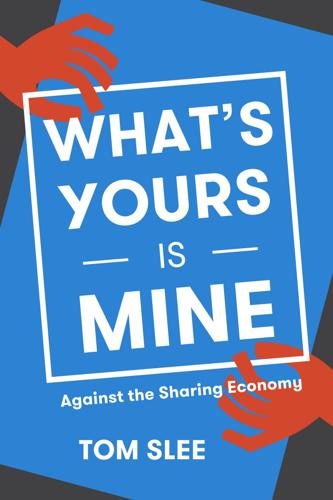
to focus on empowering the powerless, but too often empowers the already-empowered. Many would trace the origins of the open government data movement to Carl Malamud’s efforts to make available public domain information such as laws and regulations from various levels of government, and to put the US Securities and
Peers Inc: How People and Platforms Are Inventing the Collaborative Economy and Reinventing Capitalism
by Robin Chase · 14 May 2015 · 330pp · 91,805 words
Data for the Public Good
by Alex Howard · 21 Feb 2012 · 25pp · 5,789 words

The Boy Who Could Change the World: The Writings of Aaron Swartz
by Aaron Swartz and Lawrence Lessig · 5 Jan 2016 · 377pp · 110,427 words
Tubes: A Journey to the Center of the Internet
by Andrew Blum · 28 May 2012 · 314pp · 83,631 words