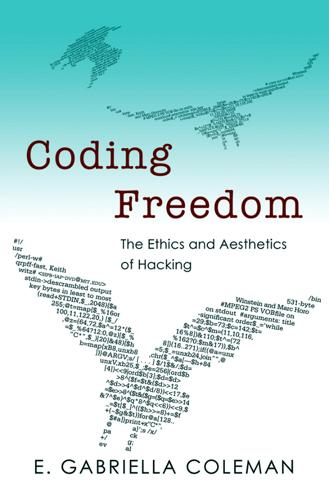
Coding Freedom: The Ethics and Aesthetics of Hacking
by E. Gabriella Coleman · 25 Nov 2012 · 398pp · 107,788 words
of piracy would add 430,000 jobs in the United States, worth five billion dollars in wages (Benkler 1999, 423). In 1999, after hackers released DeCSS (a short program used by Linux enthusiasts to circumvent DVD access control), the MPAA sued various programmers and publishers for publishing this program. In Norway
…
that source code is speech but also demonstrated it: the extensive haiku was in fact a transcoding of a short piece of free software called DeCSS, which could be used to decrypt access controls on DVDs in violation of current copyright laws. Schoen did not write this poem simply to be
…
clever. His work was part of a worldwide wave of protests following the arrest of DeCSS’ coauthor, Johansen, and the lawsuits launched against some of those who published the software. In this chapter, I examine how F/OSS developers like Schoen
…
On October 6, 1999, a sixteen-year-old Johansen used a mailing list to release a short, simple software program called DeCSS. Written by Johansen and two anonymous developers, DeCSS unlocks a piece of encryption by the name of CSS (short for content scramble system), a form of Digital Rights Management (DRM
…
on a device that has not been approved by the DVD Copy Control Association (DVD CCA), the organization that licenses CSS to hardware manufactures. Before DeCSS, only computers using either Microsoft’s Windows or Apple’s OS could play DVDs; Johansen’s program allowed Linux users to unlock a DVD’s
…
DRM to play movies on their computers. Released under a free software license, DeCSS soon was being downloaded from hundreds or possibly thousands of Web sites. In the hacker public, the circulation of
…
DeCSS would transform Johansen from an unknown geek into a famous “freedom fighter”; elsewhere, entertainment industry executives saw his program as criminal and sought Johansen’s
…
the MPAA sent cease-and-desist letters to more than fifty Web site owners and Internet service providers, requiring them to remove links to the DeCSS code for its alleged violation of trade secret and copyright laws, and in the United States, the DMCA. Passed in 1998 to “modernize” copyright for
…
Goldstein), claiming violation of the DMCA.12 Corley would fight the lawsuits, appealing to 2600’s journalistic free speech right to publish DeCSS. As frequently happens with censored material, the DeCSS code at this time was unstoppable; it spread like wildfire. Simultaneously, the international arm of the MPAA urged prosecution of Johansen
…
. Programmers could write and publish strong encryption on the grounds that software was speech. F/OSS advocates, seeing the DeCSS case as a similar situation, hoped that the courts just might declare DeCSS worthy of First Amendment protection. Consider the first message posted on dvd-discuss—a mailing list that would soon
…
attract a multitude of programmers, F/OSS developers, and activist lawyers to discuss every imaginable detail concerning the DeCSS cases: I see the DVD cases as the natural complement to Bernstein’s case. Just as free speech protects the right to communicate results about
…
belief is deeply troubling, and worse endangers the very interests it seeks to protect.13 There were, it turned out, significant differences between Bernstein and DeCSS. In the Bernstein case, hackers were primarily engaged spectators. Furthermore, many free software advocates were critical of Bernstein’s decision to copyright, and so tightly
…
control, all of his software. In the DeCSS and DVD cases, by contrast, many F/OSS hackers became participants by injecting into the controversy notions of free software, free speech, and source code
…
software but also their more basic right to produce F/OSS. As the following call to arms reveals, many hackers understood the attempt to restrict DeCSS as an all-out assault: Here’s why they’re doing it: Scare tactic. [ … ] I know a lot of us aren’t political enough—but
…
world of F/OSS production only in the last decade. Hackers moved to organize politically. Many Web sites providing highly detailed information about the DMCA, DeCSS, and copyright history went live, and the Electronic Frontier Foundation launched a formal “Free Jon Johansen” campaign. All this was helping to stabilize the growing
…
vocabulary of freedom, and Bernstein’s fight introduced a far more legally sophisticated idea of the First Amendment for software, it was only with the DeCSS case that a more prolific and specific language of free speech would come to dominate among F/OSS developers, and circulate beyond F/OSS proper
…
. In the context of F/OSS development in conjunction with the DeCSS case, the conception of software as speech became a cultural reality. Much of the coherence emerged through reasoned political debate. Cleverness—or prankstership—played a
…
developer and editor of one of the first Internet zines, Pigdog, circulated a decoy program that hijacked the name DeCSS, even though it performed an entirely different operation from Johansen’s DeCSS. Prodromou’s DeCSS stripped cascading style sheets data (i.e., formatting information) from HTML pages: Hey, so, I’ve been really
…
mad about the recent spate of horrible witch hunts by the MPAA against people who use, distribute, or even LINK TO sites that distribute DeCSS, a piece of software used for playing DVDs on Linux. The MPAA has got a bee in their bonnet about this
…
DeCSS. They think it’s good for COPYING DVDs, which, in fact, it’s totally useless for. But they’re suing everybody ANYWAYS, the bastardos! Anyways,
…
Pigdog Journal and helped with the big flier campaign here in SF [ … ] , but I feel like I should do something more, like help redistribute the DeCSS software. There are a lot of problems with this, obviously. First and foremost, Pigdog Journal is a collaborative effort, and I don’t want to
…
on the rest of the Pigdoggers just because I’m a Free Software fanatic. DeCSS is Born So, I decided that if I couldn’t distribute DeCSS, I would distribute DeCSS. Like, I could distribute another piece of software called DeCSS, that is perfectly legal in every way, and would be difficult for even
…
the DVD-CCA’s lawyers to find fault with. [ … ] Distribute DeCSS! I encourage you to distribute DeCSS on your Web site, if you have one. [ … ] I think of this as kind of an “I am Spartacus” type thing. If lots
…
of people distribute DeCSS on their Web sites, on Usenet newsgroups, by email, or whatever, it’ll provide a convenient layer of fog over
…
the OTHER DeCSS. I figure if we waste just FIVE MINUTES of some DVD-CCA Web flunkey
…
’s time looking for DeCSS, we’ve done some small service for The Cause.16 Thousands of developers posted Pigdog’s
…
DeCSS on their Web sites as flak to further confuse law enforcement officials and entertainment industry executives, since
…
technology. Dozens of these developers (including Johansen) received cease-and-desist letters demanding they take down a version of DeCSS that was completely unrelated to the decryption DeCSS. Clever re-creations of the original DeCSS source code (originally written in the C programming language) using other languages (such as Perl) also began to
…
—the point being to demonstrate the difficulty of drawing a sharp line between functionality and expression in software.17 Touretzky, an expert witness in the DeCSS case, said as much in the introductory statement to his gallery: If code that can be directly compiled and executed may be suppressed under the
…
the line be drawn? This web site was created to explore this issue.18 Here is a short snippet (about one-fifth) of the original DeCSS source code written in the C programming language: void CSSdescramble(unsigned char *sec,unsigned char *key) { unsigned int t1,t2,t3,t4,t5,t6; unsigned
…
for crafting poetic code because longer expressions can be condensed into much terser, sometimes quite elegant (although sometimes quite obfuscated) statements. And indeed the original DeCSS program, composed of 9,830 characters, required only 530 characters in Perl: #!/usr/bin/perl -w # 531-byte qrpff-fast, Keith Winstein and Marc Horowitz
…
an epic haiku—456 individual stanzas written over the course of just a few days. Schoen, who was inspired by the clever re-creations of DeCSS compiled in the gallery, wrote the poem to deliver a stark and clear political message. The author asserts that source code is not a metaphor
…
or similar to expression but rather is expression, and he makes this point by re-creating the original DeCSS program as a poem. This bit of poetry is now well known among hackers as an exemplary hack for displaying the cleverness that hackers collectively
…
content, or is it just the effects they see?” The author then launches into a long mathematical description of the forbidden CSS code represented in DeCSS. The expert explains the “player key” of CSS, which is the proprietary piece that enacts the access control measures: So this number is once again
…
fervent Free Dmitry campaign. Sklyarov’s arrest and related court hearings also prompted conversations built on those initiated by Johansen’s arrest and the resultant DeCSS lawsuits. But the Free Dmitry campaign was organized more swiftly, was more visible, and directly attacked Adobe, the company that had urged the US Department
…
writes free software (including programs that subvert DRM technologies) as well as a blog, So Sue Me, and is admired among F/OSS hackers. The DeCSS lawsuits were decided between 2001 and 2004, and even though the courts were persuaded that the
…
DeCSS was a form of speech, they continued to uphold copyright law and deemed DeCSS unfit for First Amendment protection. In one of the 2600 cases, Universal City Studios Inc. v. Reimerdes, Judge Lewis A. Kaplan went
…
what is not yours and not freely offered to you is stealing.”21 Many developers and hackers were deeply disappointed with these decisions, which equated DeCSS with theft, and were shocked about how narrow the consequences of Bernstein turned out to be. Many developers, however, emboldened and galvanized by the collective
…
they organized or witnessed, continued to assert, in passionate and often considerable legal detail, a different narrative to that of piracy and stealing. Schoen, the DeCSS haiku author who questioned the cultural assumptions and stereotypes at play with Judge Kaplan’s doctrinal reasoning, published one of the most incisive accounts: It
…
repudiate Kant’s theory of ethics but instead rejects his theory of action. CHAPTER 5: CODE IS SPEECH 1. http://www.cs.cmu.edu/~dst/DeCSS/Gallery/decss-haiku.txt (accessed October 22, 2009). 2. This comparison can only be made to do so much work. The law, being written in a
…
15, 2008). 15. http://lwn.net/2000/0727/bigpage.php3 (accessed November 20, 2008). 16. http://www.pigdog.org/decss/ (accessed February 5, 2009). 17. http://www-2.cs.cmu.edu/?dst/DeCSS/Gallery/ (accessed November 10, 2008). 18. Ibid. 19. http://cryptome.org/mpaa-v-2600-bac.htm (accessed April 23
…
the Study of Speech. New York: Harcourt Brace. Schoen, Seth. 2001. How to Decrypt a DVD: In Haiku Form. http://www.cs.cmu.edu/~dst/DeCSS/Gallery/decss-haiku.txt (accessed October 2, 2008). Scholz, Trebor. 2008. Market Ideology and the Myth of Web 2.0. First Monday 13 (3). http://firstmonday
…
; Social Contract of, 2, 83, 124, 128, 130–34, 144, 146–77, 158; Technical Committee of, 139–40. See also conference; meritocracy; Murdock, Ian; trust DeCSS, 85, 161, 170–77, 181–82. See also Schoen, Seth Deep Hack Mode, 13 defamiliarization, politics of, 203, 205 Defcon, 31, 179 democracy, 63, 64
…
Jackson, Michael, 27 Jaffe, Adam, 66, 67 jazz poetics. See poetics of hacking Johansen, Jon Lech, 86, 161, 162, 170–73, 180, 181. See also DeCSS joking. See humor jurisgenesis, 124 Kant, Immanuel, 157, 221n23 KDE, 44, 75, 167 Kelty, Chris, 58, 68, 76, 123, 127, 189, 198, 209 kernel, 43
The Best of 2600: A Hacker Odyssey
by Emmanuel Goldstein · 28 Jul 2008 · 889pp · 433,897 words
MPAA and friends), the encryption key (CSS) that was supposed to be kept secret wasn’t very well protected. Its release allowed programs (such as DeCSS) to successfully perform the decryption. And in so doing, it became possible to play a DVD on any machine, in any part of the world
…
them. This is what really bothered the industry. We were literally hand-picked out of the thousands of other web sites that had mirrored the DeCSS code. By taking a hacker magazine to court, the MPAA figured the decision would already be made in the judge’s eyes. It was an
…
detractors. Here then is a sampling of some of the fun as it unfolded, including one of many alternative ways we tried to spread the DeCSS code: in actual English language words. The Next Chapter (Spring, 2000) It’s over. And yet, it’s just beginning. We’ve always known that
…
concerning linking from one site to another. The MPAA has tried to get us to remove our links to other sites that still have the DeCSS files by filing even more court papers against us. This time, major media not owned by the corporations suing us such as The New York
…
ends), at the Federal Courthouse in New York. We hope to see many of you there. Check www.2600.com for updates and any changes. DeCSS in Words (Autumn, 2000) By CSS The decryption of data on a DVD encoded through the CSS algorithm can be broken down into three steps
…
all of these different things were somehow related and extremely relevant to where we are headed. Many see it as a bad thing that the DeCSS trial dominated our time as much as it did. Unfortunately, there was never a choice. Like a dangerous disease, it had to be fought with
…
without access to the Net and who may have missed it in the media, the MPAA was granted a permanent injunction against our posting the DeCSS code that allows DVDs to be played on alternative platforms such as Linux. The main thrust of the MPAA’s argument was that this would
…
a direct result of this is the tremendous growth of activism in our community. The Free Kevin movement started us in this direction and the DeCSS case gave us a real push. This in turn has gotten many more people involved and helped to solidify ties between communities that have always
…
enough to satisfy the MPAA or future cases that involve the DMCA. At press time, we have removed all links to sites that contain the DeCSS code as per the judge’s incredibly misguided ruling. However, we have not removed a listing of those sites. Listing is not the same as
…
all related causes, are the only hope we have for averting this catastrophe. Signs of Hope (Spring, 2001) As our appeal of last year’s DeCSS case draws closer (at press time it was set to be heard by the Second Circuit Court of Appeals in early May), we realize how
…
money to get what they want. In another very public display in early March, cartoonist Aaron McGruder devoted his popular comic strip Boondocks to the DeCSS controversy. For three days, characters struggled to understand the baffling ruling of Judge Kaplan this past August, which forced 2600 to keep the source code
…
he’s going with this.” On a different day, the entire strip was replaced with the words: “CENSORED. This comic contains numerous references to the DeCSS code used to bypass the Content Scrambling System of DVDs, which, by order of Judge Lewis Kaplan, is illegal to reproduce in any way. We
…
forward. And of course, technological rebellion continues. We’ve seen people come up with shorter and more creative methods of bypassing CSS—everything from a DeCSS haiku to a 434 byte C program to a seven line Perl script. There’s even a prime number that is identical to the gzip
…
risks. And we’re fortunate beyond words to have such an amazing support network that is still growing and developing. Because no matter how the DeCSS appeal turns out, you can bet there will be more fights in our future. If they open half as many eyes as this case has
…
in so doing, we have found many others who feel the same. Although we recently lost the Second Circuit Court of Appeals decision in the DeCSS case, our legal team made the most compelling argument possible. We still strongly believe that computer source code is speech and is entitled to all
…
right place at the right time. We were happy to learn that a Norwegian appeals court recently upheld a decision clearing the author of the DeCSS program of any charges, despite the wishes of the MPAA and the proponents of the DMCA in this country. In the last couple of years
…
were and what we believed in. There were many thousands that the Motion Picture Association of America could have taken to court for hosting the DeCSS code on their web sites. But we somehow epitomized everything the MPAA was against and this made us the perfect target for them. Merely existing
…
, 307–310 crystal-controlled transmitters, 354 CSB (Cellemetry Service Bureau), 436 CSNet (Computer Science network), 149–152 CSS encryption key creative methods for bypassing, 593 DeCSS code in words, 584–585 DVD industry and, 574 CTCSS (continuous tone coded squelch system), 366–367 CTR (click-through-ratio), Google AdWords, 796–797
…
DEBUG menu, hacking soda machines, 721–722 DEC (Digital Equipment Corporation), 124–125, 129–130 DECCO (DEfense Commercial Communications Office), 31 decoding setup, pagers, 346 DeCSS case appeal, 591 DVD industry and, 574 losing appeal decision, 595 overview of, 584–585 political commentary on, 593 verdict, 588–591 dedicated lines, MCI
…
Universe convention, 271–272 style of, 217–218 DVB-S digital standard, satellite TV, 762 DVD CCA (Copy Control Association), 576–577 DVD industry DeCSS code and, 574 DeCSS verdict, 588–591 MPAA lawsuit, 576–580 E E. (Escherichia) coli, 821–823 E911 (Enhanced 911), 681–683 EARN (European Academic| Research Network
…
, 427 manipulating, 425–426 E.F. Johnson transceivers, 104 EFF (Electronic Frontier Foundation) defining, 501–503 formation of, 492 suit against Secret Service, 511 supporting DeCSS trial, 587–589 supporting Digital Telephony Bill, 561 Effective Radiated Power (ERP), 86 ego boost, of hackers, 213–215, 229, 233 EIA (Electronic Industries Association
…
and 2600 . see Secret Service and 2600 meetings Steve Jackson wins lawsuit, 511 violence, vandals and victims, 566–569 lawsuits, 2000 and beyond, 573–599 DeCSS trial, 584–585, 587–589 freedom of speech, 594–596 H2K conference, 589–591 Kevin Mitnick, 586–587 litigation madness of, 580–584 MPAA lawsuit
…
of, 509–510 statement from, 497 Legions of the Underground (LoU), 260 Letter Sorting Machine (LSM), USPS, 374–375, 377 LFSRs (Linear Feedback Shift Registers), DeCSS code, 584–585 LG cell phones, 747–748 94192bindex.qxd 6/3/08 3:29 PM Page 853 Index LHS (Left Hand Side), RFC822 mail
…
facts and rumors, 509–510 indictment against, 494–495 views from a Fed, 384–385 line reversal, pay phones, 38 Linear Feedback Shift Registers (LFSRs), DeCSS code, 584–585 linear LNBs, 763 Link Access Protocol for D-channel, modified (LAPDm), GSM, 431 LinNeighborhood program, 742–743 linux-wlan-ng drivers, 739
…
Association of America. see MPAA (Motion Picture Association of America) Motorola, 363 motors, surveillance tape recorders, 361 MPAA (Motion Picture Association of America) DeCSS code and, 574 DeCSS trial verdict, 587–591 lawsuit against 2600 and others, 576–577 opposition to motions of, 583 people realizing true motives of, 591, 593 MSC
…
Office Standards Advisory Group) pager setup, 346–347 point-of-sale (POS) hacking hardware, 709–711 readers, 610 Points of Presence (POPs), 303 political commentary, DeCSS case, 593 pop culture, 1990s crime waves, 266–268 entertainment. see entertainment, 1990s hacker conventions, 271–276 media. see media, in 1990s overview of, 233
The Future of Ideas: The Fate of the Commons in a Connected World
by Lawrence Lessig · 14 Jul 2001 · 494pp · 142,285 words
to criticize a corporation. Coders can release code that censors the Net, and efforts to release the list of censors are censored by the law. DeCSS THE LAWYERS for Mattel relied directly upon copyright law. But there was another tack they might have taken—one that will prove much more important
…
that would crack CSS, so that DVDs could be played on other machines. And when open source coders developed such a program, they called it DeCSS. DeCSS disabled the encryption system on a DVD disk. It turned out that CSS itself was a terribly poor encryption technology. And once the system had
…
been cracked, it became possible to play DVD content on other computers. With DeCSS, DVD disks could be played on any machine. Now again, DeCSS didn't make it any easier to copy DVDs than before. There's no reason you can't simply copy
…
to your friends. All that CSS did was ensure that you played the movie on a properly licensed machine. Thus, DeCSS didn't increase the likelihood of piracy.20 All that DeCSS did was (1) reveal how bad an existing encryption system was; and (2) enable disks presumptively legally purchased to be
…
played on Linux (and other) computers. But upon the release of DeCSS, the industry went nuts. Within six weeks, four lawsuits had been filed in four separate jurisdictions, seeking under many legal theories the quashing of this
…
code.21 Within three weeks of the filing of the suits, two injunctions had been entered against people who posted DeCSS code and even against journalists who linked to DeCSS.22 Once again, as with CPHack, the legal system had been fired up to silence this dangerous code. The core case
…
here was tried in New York. The defendants were many. Some had linked to the sites carrying DeCSS. Others had written articles about the sites and had linked to the links. And others were active distributors of
…
the business of selling pirated movies. And at no time in the case did the plaintiffs demonstrate that any movies had been pirated because of DeCSS. Instead, the sole claim in the case was that these defendants were in the business of distributing code that cracked an encryption system, and hence
…
violation of the anticircumvention provisions of the DMCA. The district court judge in the New York case issued an immediate injunction stopping the distribution of DeCSS. After a long trial, he issued an opinion making permanent that injunction. The opinion making the injunction permanent rejected the argument that “fair use” entitled
Hacking Capitalism
by Söderberg, Johan; Söderberg, Johan;
was the prosecution against Jon Johansen in 2002. He was a Norwegian teenager singled out by law enforcement agencies for distributing a program known as DeCSS.34 The program decrypts a DVD disc that has previously been encrypted with the Content Scrambling System (CSS). One motive for hackers to remove CSS
…
able to run DVD discs on GNU/Linux machines, though the added benefit of enabling unauthorised copying of DVDs surely contributed to the popularity of DeCSS. Jon Johansen, however, had bought his DVDs and he did not distribute illegal copies. In short, he had not violated the Norwegian copyright law. Still
…
Corely, alias Emmanuel Goldstein, is a publisher of the legendary hacker magazine 2600: The Hacker Quarterly. The magazine had posted the source code of the DeCSS utility. Eight motion picture studios filed suit against him under the anti-circumvention provision in the DMCA. Both a district court and an appeal court
…
barred the 2600: The Hacker Quarterly from publishing the DeCSS code and from linking to websites with the source code.35 But the controversy provoked a mass posting of the
…
DeCSS code on the Internet and it was even printed on t-shirts and chanted in songs.36 The court system had no means to prevent
…
, no.8. (2001). 34. Contrary to the reports in media, Jon Johansen was not the author of the program. The naming rights for writing the DeCSS is claimed by a hacker collective to which Jon Johansen was affiliated, the Masters of Reverse Engineering (MoRE). Allegedly, they were provided with the cracked
…
-named, German hacker. 35. Richard Spinello, Regulating Cyberspace—The Policies and Technologies of Control (Westport, Conn.: Quorum Books, 2002). 36. The mass exposure of the DeCSS code was partly in response to a related legal case. The motion picture studios and the DVD Copy Control Association filed suit against hundreds of
…
people under Californian trade secret law for posting DeCSS or linking to websites with the source code. This claim was overturned since the information was public and no longer a trade secret. Alex Eaton
…
Cygnus 32–34 Darknet 97 Davies, Donald 195 n.5 Debian 123 Debian-women 30 Debord, Guy 103, 211 n.9 Decompiling 195 n.16 DeCSS see DVD-Jon Deleuze, Gilles 135, 213 n.12, 215 n.34 Denial-of-service attacks 1, 193 n.3 Derrida, Jacques 57, 149, 153

The End of Ownership: Personal Property in the Digital Economy
by Aaron Perzanowski and Jason Schultz · 4 Nov 2016 · 374pp · 97,288 words
target. A Norwegian teenager named Jon Johansen solved the puzzle of CSS, the DRM on DVDs, in 1999. He then wrote a simple program called DeCSS, which decrypted the content of any DVD. Johansen’s goal was to enable DVD playback for users of Linux operating systems. Although there were plenty
…
-compatible program on the market. That meant those Linux users who had lawfully purchased DVDs couldn’t watch them on their desktops or laptops. When DeCSS was subsequently published across the Internet for the world to see, it caught the attention of Eric Corley, a journalist and publisher of 2600: The
…
years, 2600 served as a news outlet and forum for the hacker community, broadly defined. Corley wrote a story about DeCSS and published it on his website, along with the DeCSS code and links to other sites hosting the code. As he would reiterate later in court, Corley added the code to
…
“in a journalistic world, ... you have to show your evidence.”11 Eight movie studios quickly filed suit against Corley and others, claiming that by publishing DeCSS they trafficked in technologies that circumvented DRM in violation of section 1201. The defendants pointed to a number of non-infringing uses
…
DeCSS made possible. They included the time-shifting so crucial in Sony and the backups found lawful in Vault. Even more intuitively, they argued that DVD
…
had previously failed in the courts. Breaking DRM was unlawful, regardless of the reason. Personal property rights had to give way to copyright owner control. DeCSS was banned, and other courts soon followed suit.12 A Failure, at Best Given these decisive early legal victories, copyright holders could be forgiven for
…
, 31 Contracts consideration, 66 duty to read, 70, 174 formation, 65–70 unconscionability, 69, 174–175 Consumer surplus, 80 Content Scramble System (CSS), 127–128 DeCSS, 131–132 Copy/work distinction, 36–38 Copyright Act section 109, 73, 168, 179 section 117, 42, 63–64, 73, 129, 163, 177, 179, 183
Coders: The Making of a New Tribe and the Remaking of the World
by Clive Thompson · 26 Mar 2019 · 499pp · 144,278 words
, working with two other coders, the 15-year-old Norwegian Jon Lech Johansen created (and then linked to a copy online) the open source software DeCSS. It stripped the DRM from DVDs so you could watch them on Linux computers. For coders, this was a big deal: The Hollywood firms had
…
not for Linux machines, and tons of programmers used Linux. Finally, using Johansen’s software, hackers could watch movies on their Linux laptops! Some rewrote DeCSS in other computer languages, and hackers and website owners worldwide began eagerly sharing them online, including one named Andrew Bunner. The hacker magazine 2600 published
…
the source code for DeCSS online and linked to sites that were distributing it. Then the hammer of the law came down. In 2000, a group representing movie studios sued
…
the publisher of 2600 under the new law, claiming it was illegal to distribute the DeCSS source code; after all, when you ran the code, it became a tool that circumvented DRM. Andrew Bunner, too, was charged with distributing the
…
DeCSS code, along with a handful of other webmasters. Meanwhile, over in Norway, a complaint from the US entertainment industry convinced Norwegian police to interrogate and
…
,” The Register, December 14, 2001, accessed October 7, 2018, https://www.theregister.co.uk/2001/12/14/case_against_dmitry_sklyarov_dropped/. open source software DeCSS: J. S. Kelly, “Meet the Kid behind the DVD Hack,” CNN, January 31, 2000, accessed August 19, 2018, http://www.cnn.com/2000/TECH/computing
…
://archive.nytimes.com/www.nytimes.com/library/tech/00/07/biztech/articles/31rite.html. to criminalize programming: John Leyden, “2600 Withdraws Supreme Court Appeal in DeCSS Case,” The Register, July 4, 2002, accessed August 19, 2018, https://www.theregister.co.uk/2002/07/04/2600_withdraws_supreme_court_appeal; “Teen Cleared
…
break points in, ref1 ENIAC Girls and, ref1 mental style and, ref1 personality types and, ref1 sense of accomplishment in, ref1 De Castro, Luis, ref1 DeCSS, ref1 deep learning, ref1 Alpha Go and, ref1 applications of, ref1 EU regulation requiring explanation of decisions impacting citizens’ lives, ref1 at Facebook, ref1 at
The Wealth of Networks: How Social Production Transforms Markets and Freedom
by Yochai Benkler · 14 May 2006 · 678pp · 216,204 words
a suit by the eight Hollywood studios against a hacker magazine, 2600. The studios sought an injunction prohibiting 2600 from making available a program called DeCSS, which circumvents the copy-protection scheme used to control access to DVDs, named CSS. CSS prevents copying or any use of DVDs unauthorized by the
…
vendor. DeCSS was written by a fifteen-year-old Norwegian named Jon Johanson, who claimed (though the district court discounted his claim) to have written it as
…
part of an effort to create a DVD player for GNU/Linux-based machines. A copy of DeCSS, together with a story about it was posted on the 2600 site. The industry obtained an injunction against 2600, prohibiting not only the posting of
…
DeCSS, but also its linking to other sites that post the program--that is, telling users where they can get the program, rather than actually distributing
…
of the twenty-year-old mode of movie distribution: videos and DVDs. As recently as the year 2000, when the Hollywood studios were litigating the DeCSS case, they represented to the court that home video sales were roughly 40 percent of revenue, a number consistent with other reports. 174 The remainder
…
they are attacking the owner of the brand. One well-known example occurred when Verizon Wireless was launched. The same hacker magazine involved in the DeCSS case, 2600, purchased the domain name "verizonreallysucks.com" to poke fun at Verizon. In response to a letter requiring that they give up the domain
…
, 791-795 Davis, Nick, 398-399, 445, 464 Dawkins, Richard, 513 De Solla Price, Derek, 441 De Tocqueville, Alexis, 342 De minimis digital sampling, 777 DeCSS program, 734 Dean, Howard, 463 Decentralization of communications, 31-34, 123 Deci, Edward, 187 Defining price, 214-219 Demand for information, consumer, 364 Demand-side
Free Ride
by Robert Levine · 25 Oct 2011 · 465pp · 109,653 words
illegal to sell a DVD copying device at Walmart, and it gives some consumers pause. “Every time people want to use [the DVD copying program] DeCSS, they have to download it, they have to worry about viruses, and perhaps a twinge of guilt goes through their brain,” says Fox’s senior
…
16, 1997). 24. This became H.R. 2281, the Digital Millennium Copyright Act. 25. This became S. 2037, the Digital Millennium Copyright Act. 26. The DeCSS code was released online by Jon Lech Johansen, who became known as DVD Jon. He wrote it with several online collaborators who preferred to remain
Rebel Code: Linux and the Open Source Revolution
by Glyn Moody · 14 Jul 2002 · 483pp · 145,225 words
to watch their DVDs under GNU/Linux. This case is particularly interesting because DVD software for both GNU/Linux and Windows (called css-auth and DeCSS, respectively) has been released under the GNU GPL. As such it can—and has—been copied all over the world; this puts the film industry
…
multiprocessor support for Linux Crusoe processor Cryptozilla Currie, Peter Cutler, Dave Cygnus Solutions Daemon Dawes, David D’Cruze, Patrick Debian (computer program) de Icaza, Miguel DeCSS Delivermail (computer program) Dell Demetriou, Chris de Raadt, Theo Digital (company) Ditzel, Dave Document Object Model (DOM) Domain Name System (DNS) Dougan, Cort Duck Pond

The Future of the Internet: And How to Stop It
by Jonathan Zittrain · 27 May 2009 · 629pp · 142,393 words
on their systems. Consider, for example, the technical ease with which an OS maker could disable functionality on a tethered PC of software such as DeCSS, which enables decryption of DVDs, and for which distributors of software have been successfully sued. Any vendor of tethered software could be pressured to take
Free as in Freedom
by Sam Williams · 16 Nov 2015
Dmitri Skylarov. In 2000, Moglen also served as direct counsel to a collection of hackers that were joined together from circulating the DVD decryption program deCSS. Despite the silence of his main client in both cases, Moglen has learned to appreciate the value of Stallman's stubbornness. "There have been times
The Idealist: Aaron Swartz and the Rise of Free Culture on the Internet
by Justin Peters · 11 Feb 2013 · 397pp · 102,910 words
DMCA to issue an injunction preventing Eric “Emmanuel Goldstein” Corley, publisher of the hacker magazine 2600, from posting to his website a decryption program called DeCSS, and from linking to other websites that hosted the program. The Second Circuit, on appeal, upheld the district court’s injunction. 12 Sandra A. Sellers
The Art of UNIX Programming
by Eric S. Raymond · 22 Sep 2003 · 612pp · 187,431 words
Act has already been used to prosecute software developers who were doing things the media moguls disliked (the most notorious cases, of course, involve the DeCSS software that enables playing of encrypted DVDs). Contemplated schemes like the so-called Trusted Computing Platform Alliance and Palladium threaten[163] to make open-source
Who Owns This Sentence?: A History of Copyrights and Wrongs
by David Bellos and Alexandre Montagu · 23 Jan 2024 · 305pp · 101,093 words
, and so the D.M.C.A. stamped on such clever evasions. Jon Lech Johansen, the part-inventor of the by-pass program known as DeCSS, was acquitted after several trials in Norway, but in the U.S. injunctions against his device were obtained.187 This was the first time that