Nature's Metropolis: Chicago and the Great West
by
William Cronon
Published 2 Nov 2009
Buckingham, The Eastern and Western States of America (n.d.), 267. 27.Charles Fenno Hoffman, A Winter in the West: Letters Descriptive of Chicago and Vicinity in 1833–4 (1835), Fergus Historical Series, no. 20 (1882), 24–29. 28.Robert Fergus, Fergus’ Directory of the City of Chicago, 1839 (1876), 37. 29.Buckingham, Eastern and Western States, 262. 30.Cleaver, History of Chicago, 84. 31.Frederick Jackson Turner, The Frontier in American History (1920; reprint, 1962), 11. 32.Turner emphasized the supposedly progressive evolutionary stages of isolated frontier development in his most famous essays, but his monographic writings pay more attention to the role of cities, commerce, and speculators in the West. See especially chap. 5 of his Rise of the New West, 1819–1829 (1906). I assess Turner’s legacy more fully (and rather more favorably) in “Revisiting the Vanishing Frontier: The Legacy of Frederick Jackson Turner,” WHQ 18 (1987): 157–76; and in “Turner’s First Stand: The Significance of Significance in American History,” in Richard Etulain, ed., Writing Western History: Essays on Classic Western Historians (1991). 33.On the history of this episode, see Bray Hammond, Banks and Politics in America from the Revolution to the Civil War (1957); and Robert V.
…
Not all the boosters’ later arguments were part of Chicago’s land craze; some were absent for reasons (having to do with the railroads) that will only become apparent in the next chapter. Nonetheless, the general idea of a city growing to wealth and power by dominating its hinterland’s development was undoubtedly much on people’s minds during the speculation of the 1830s. 95.Frederick Jackson Turner to Arthur M. Schlesinger, May 5, 1925, reprinted in Wilbur R. Jacobs, ed., The Historical World of Frederick Jackson Turner with Selections from His Correspondence (1968), 163–65; see also Arthur M. Schlesinger, “The City in American History,” MVHR 27 (1940–41): 43. 96.Again, I speak here of the early Turner, whose “The Significance of the Frontier in American History” attempted to “explain” American history in terms of the frontier experience.
…
Steffen, “Some Observations on the Turner Thesis: A Polemic,” Papers in Anthropology 14 (1973): 16–30; Jackson K. Putnam, “The Turner Thesis and the Westward Movement: A Reappraisal,” WHQ 7 (1976): 377–404; Richard Jensen, “On Modernizing Frederick Jackson Turner: The Historiography of Regionalism,” WHQ 11 (1980): 307–22; Limerick, Legacy of Conquest; Peter Novick, That Noble Dream: The “Objectivity Question “ in the American Historical Profession (1988), 86ff.; and Richard White, “Frederick Jackson Turner,” in John R. Wunder, ed., Historians of the American Frontier: A Bio-Bibliographical Sourcebook (1988), 660–81. 9.I have argued that this is likely to be the most enduring and useful aspect of Turner’s frontier thesis in my essays “Revisiting the Vanishing Frontier,” and “Turner’s First Stand.” 10.The standard guide to Wisconsin’s vegetation, and one of the best such state studies in the country, is Curtis, Vegetation of Wisconsin.
Seapower States: Maritime Culture, Continental Empires and the Conflict That Made the Modern World
by
Andrew Lambert
Published 1 Oct 2018
Roland, et al., The Way of the Ship. 64. F. J. Turner, ‘The Significance of the Frontier in American History’, in J. M. Faragher, ed., Rereading Frederick Jackson Turner, New Haven, CT, and London: Yale University Press, 1998, pp. 30–60, at pp. 33, 43 and 59. It was hardly surprising that a man named for President Andrew Jackson, the arch-exponent of continental expansion, should develop this argument. 65. Faragher, ed., ‘Introduction’, Rereading Frederick Jackson Turner, p. 10. 66. Mahan to Jameson, 21 July 1913: R. Seager and D. D. Macguire, Letters and Papers of Alfred Thayer Mahan, 3 vols., Annapolis, MD: USNIP, 1975, Vol. 3, pp. 504–5; Seager, Alfred Thayer Mahan, p. 596.
…
In the homogenisation of identity the ocean, already a minor theme in the north-east, effectively disappeared, along with the navy and the ocean-going merchant marine.63 America still used naval power for diplomacy and the promotion of trade, most famously in 1852 when Commodore Perry ‘opened’ Japan, but it did so in a maritime world dominated by the Royal Navy, in an era dominated by internal concerns. After 1815 the frontier controlled the shaping of American culture and identity. In 1898 Frederick Jackson Turner observed: ‘The existence of an area of free land, its continuous recession, and the advance of American settlement westward explains American development.’ Jackson’s frontier had the same impact on American culture as the Mediterranean had on the Greeks.64 The open frontier and the lure of free land explain why the United States diverged from the maritime culture of the early English/British settlers.
…
Macguire, Letters and Papers of Alfred Thayer Mahan, 3 vols., Annapolis, MD: USNIP, 1975, Vol. 3, pp. 504–5; Seager, Alfred Thayer Mahan, p. 596. Mahan and Turner knew each other: ibid., pp. 438–9, and Seager and Macguirem, Vol. 3, pp. 240 and 244. Turner lectured at the United States Naval War College, the home of Mahan’s sea power thesis from 1903. R. A. Billington, Frederick Jackson Turner: Historian, Scholar, Teacher, New York: Oxford University Press, 1973, p. 486. 67. Henry John Temple, Second Viscount Palmerston (1784–1865), served in government from 1805 to 1828, and as Foreign Secretary 1830–41, 1846–51, and Prime Minister 1855–65. 68. Lambert, ‘Winning without Fighting, p. 177. 69.
This America: The Case for the Nation
by
Jill Lepore
Published 27 May 2019
The nation’s most decorated historians—the men who delivered presidential addresses at the annual meetings of the American Historical Association during those years—had little interest in protesting racial injustice, or forced assimilation, or female disenfranchisement, or immigration restriction. More often, they favored these practices. In “The Significance of the Frontier in American History” in 1893, Frederick Jackson Turner talked about the frontier as a line between “savagery” and “civilization” where democracy was forged in violence. In The Winning of the West (1889–1896), Theodore Roosevelt told the story of American history as the story of white men’s conquest over native peoples, four volumes chronicling what he sometimes called “the great epic feat in the history of our race.”
…
-Mexico border and check migrants for papers authorizing their entry for purposes of employment, making deportation of anyone deemed an “illegal alien” U.S. policy, for the first time in American history. Somehow, long after the end of the Civil War, the Union seemed to be losing to the Confederacy. In 1925, in a little-known answer to his far more famous “The Significance of the Frontier in American History,” Frederick Jackson Turner wrote an essay called “The Significance of Sections in American History.” Given the persistence of sectionalism, American nationalism had been southernized, Turner argued. “The significance of the section in American history is that it is the faint image of a European nation and that we need to reexamine our history in light of this fact,” he wrote, describing Congress as not unlike the League of Nations, a League of Sections.
The Age of Illusions: How America Squandered Its Cold War Victory
by
Andrew J. Bacevich
Published 7 Jan 2020
As a milestone in American intellectual history, Fukuyama’s essay belongs in the category of writings that capture something essential about the moment in which they appear, while simultaneously shaping expectations about what lies ahead. Other distinguished examples include Alfred Thayer Mahan’s “The United States Looking Outward,” Frederick Jackson Turner’s “The Significance of the Frontier in American History,” and the poet Rudyard Kipling’s “The White Man’s Burden.” Predating Fukuyama’s essay by a century, each in its own way made an impact that greatly outweighed whatever literary merit it possessed. Separately and together they promoted the use of American power on an increasingly expansive scale.
…
“Whether they will or no, Americans must now begin to look outward.”21 For Mahan, looking outward meant that the United States should set aside any reluctance to involve itself in world affairs and assert its rightful place among the established imperial powers, a change in orientation necessarily requiring, in his estimation, the building of a great navy. In Washington, as the end of the nineteenth century approached, Mahan’s message resonated. Here was an inkling of a strategy suited for a political class that was itself increasingly restless. The interests of Frederick Jackson Turner (1861–1932) were scholarly rather than strategic. Yet the historical insight that made his reputation complemented the advocacy of Captain Mahan. In 1893, just as Mahan was emerging as a full-fledged celebrity, the young Professor Turner, then teaching at the University of Wisconsin, gave a lecture that vaulted him to comparable fame.
…
Buckley, “Capitulation in Peking,” National Review (February 28, 1972). 20. For an important and underappreciated accounting, incorporating both second thoughts and sober reflection, see Derek Leebaert, The Fifty-Year Wound (New York, 2002). 21. Alfred Thayer Mahan, “The United States Looking Outward,” Atlantic (December 1890). 22. Frederick Jackson Turner, “The Significance of the Frontier in American History” (1893). 23. Rudyard Kipling, “The White Man’s Burden” (1899). 24. Francis Fukuyama, “The End of History?” National Interest (Summer 1989). 25. “X” [George F. Kennan], “The Sources of Soviet Conduct,” Foreign Affairs (July 1947). 26.
The New Class Conflict
by
Joel Kotkin
Published 31 Aug 2014
But without preserving the prospect of progress for the working and middle classes, capitalism, in this as in earlier times, may lose both its moral compass and its base for popular support. Is the American Dream Dead? In his classic 1893 essay, “The Significance of the Frontier in American History,” Frederick Jackson Turner spoke of “the expansive character of American life.” Turner proclaimed that even as the physical frontier was shrinking, Americans would likely look elsewhere to find “a new field of opportunity.”67 For all its limitations, the “expansive” spirit of America generated a century or more of relentless technological improvements, the gradual creation of a mass middle class, and the integration of ever more diverse immigrants into the national narrative.
…
The Forgotten Country The Clerisy’s war on suburbia resonates with themes that go back to the earliest periods of our history. Opposition to an expansive frontier by those in the centers of power and influence has been a recurring theme in American history, dating back to the country’s origins, as Frederick Jackson Turner noted. They start with the early attempts of the British imperial authorities, and later those of the tidewater South and the mercantilist Northeast, to constrain the movement west. These efforts failed in earlier periods, including pre-revolutionary efforts of America’s British overlords.
…
Department of Transportation, Research and Innovative Technology Administration, Transportation Implications of Telecommuting, http://ntl.bts.gov/DOCS/telecommute.html; Dan Schawbel, “How Millennials Will Shape the Future of Work,” Pando Daily, September 3, 2013, http://pando.com/2013/09/03/how-millennials-will-shape-the-future-of-work. 66. Alexis de Tocqueville, Democracy in America, vol. 1, trans. Henry Reeve (New York: Bantam, 2002), p. 213. 67. Frederick Jackson Turner, The Significance of the Frontier in American History (New York: Frederick Unger, 1973), pp. 57–58. 68. Ibid, pp. 58–59. Chapter 2: Valley of the Oligarchs 1. eBizMBA.com, “Top 15 Most Popular Social Networking Sites,” http://www.ebizmba.com/articles/social-networking-websites. 2.
The New Urban Crisis: How Our Cities Are Increasing Inequality, Deepening Segregation, and Failing the Middle Class?and What We Can Do About It
by
Richard Florida
Published 9 May 2016
On the decline in American innovation and productivity more broadly, see Robert J. Gordon, The Rise and Fall of American Growth (Princeton, NJ: Princeton University Press, 2016). 4. Krugman, “Ideology and Investment.” 5. Frederick Jackson Turner, “The Significance of the Frontier in American History,” Paper presented at American Historical Association meeting, Chicago, July 12, 1893, World Columbian Exposition, http://nationalhumanitiescenter.org/pds/gilded/empire/text1/turner.pdf; Frederick Jackson Turner, The Frontier in American History (New York: Henry Holt, 1921); Kenneth Jackson, Crabgrass Frontier: The Suburbanization of the United States (New York: Oxford University Press, 1987). 6.
…
For infrastructure to really put the economy back on its feet, it must be part of a broader strategy for clustered, urbanized growth. The New Urban Crisis is a significant turning point in American history. In many ways, it marks the final closing of the vast American frontier. “Since the days when the fleet of Columbus sailed into the waters of the New World,” Frederick Jackson Turner declared in his famous 1893 speech before the American Historical Association, “the people of the United States have taken their tone from the incessant expansion which has not only been open but has even been forced upon them.” America’s western frontier had finally closed, he said, and the nation’s foundational epoch had come to an end.
How to Hide an Empire: A History of the Greater United States
by
Daniel Immerwahr
Published 19 Feb 2019
The closest he got was when he encountered a party of four or five armed Sioux on the hunting trail. They assured him that they were peaceful, he aimed his rifle at them, and they fled, swearing at him. “The frontier proper has come to an end,” mused a dejected Roosevelt in 1892. He wasn’t the only one to have that thought. A year later, the young historian Frederick Jackson Turner offered a similar reflection, stating it as a hypothesis, known today as the massively influential “frontier thesis.” The frontier, Turner argued, had been the great regenerating force in U.S. life—the source of democracy, individualism, practicality, and freedom. And yet, Turner noted, according to the census, the frontier had disappeared as of 1890.
…
“The world is nearly all parcelled out, and what there is left of it is being divided up, conquered, and colonised,” lamented the British arch-imperialist Cecil Rhodes. The global frontiers had been closed. * * * Roosevelt might have taken this as cause for despair. Yet just as he was reading Frederick Jackson Turner’s warnings about the end of the frontier, he was also studying the work of another historian, Captain Alfred Thayer Mahan, of the Naval War College. Mahan’s lengthy 1890 treatise, The Influence of Sea Power upon History, was hardly a page-turner, but it contained a powerful suggestion. If, according to Turner, the land was closed, Mahan noted that the seas were open.
…
As he saw it, the brief participation of African Americans in politics had left a wound “incomparably deeper, incomparably more difficult to undo” than the war itself had. These were not casual opinions. They formed a large part of the fifth volume of his History of the American People (1902). With its publication Wilson became, as Frederick Jackson Turner saw it, “the first southern scholar of adequate training and power who has dealt with American history as a whole.” Other reviewers shared Turner’s admiration for Wilson’s history, yet they couldn’t help but notice the author’s fondness for the Ku Klux Klan, an organization whose mission, in Wilson’s words, was “to protect the southern country from some of the ugliest hazards of a time of revolution.”
Can Democracy Work?: A Short History of a Radical Idea, From Ancient Athens to Our World
by
James Miller
Published 17 Sep 2018
Despite President Jackson’s cavalier disregard for the rule of law—he simply ignored the Supreme Court’s 1832 decision (in Worcester v. Georgia) holding that the Cherokee Indians constituted a nation with sovereign rights—his reputation as a great American democrat only grew with the passage of time. By the turn of the twentieth century, in the eyes of the preeminent progressive historian Frederick Jackson Turner, he was the very epitome of an era, designated by the phrase “Jacksonian Democracy,” and associated by Turner with the belief that “the self made man had a right to his success in the free competition which Western life afforded.” (It didn’t hurt that Alexis de Tocqueville had visited America when Jackson was president—he briefly met the great man—so that his famous Democracy in America at first glance supported the idea that “Jacksonian democracy” was somehow central to the American experience.)
…
The result was perverse: by mobilizing commoners against an entrenched elite (just as democratic leaders had done in Athens), and by trying to turn the quadrennial vote for the most powerful figure in the federal government into a national plebiscite (institutions and practices unknown in the polis), this personification of egalitarian aspirations came to wield executive powers that perforce risked overshadowing the political initiatives of the ordinary citizens who had chosen him as their tribune. Frederick Jackson Turner recognized the essential paradox: “Jacksonian democracy flourished, strong in the faith of the intrinsic excellence of the common man, in his right to make his own place in the world, and in his capacity to share in government. But while Jacksonian democracy demanded these rights, it was also loyal to leadership as the very name implies.
…
Remini, Andrew Jackson, vol. 2, The Course of American Freedom, 1822–1832 (New York: Harper, 1981), 147–148. “mighty democratic uprising”: Frederick A. Ogg, The Reign of Andrew Jackson (New Haven: Yale University Press, 1919), p. 114; “soaring turnouts”: Wiebe, Self-Rule, 180–181. “the self made man had a right to his success”: Frederick Jackson Turner, “The West and American Ideals,” The Washington Historical Quarterly 5, no. 4 (October 1914): 251. “Jacksonian democracy flourished”: Ibid. Early that morning, Tocqueville and Beaumont: See George Wilson Pierson, Tocqueville and Beaumont in America (New York: Oxford University Press, 1938), pp. 179ff., for these and other details about Tocqueville’s Fourth of July in Albany.
American Secession: The Looming Threat of a National Breakup
by
F. H. Buckley
Published 14 Jan 2020
Gun lovers could settle in Virginia, opponents in Maryland, and people would sort themselves out by voting with their feet. States that indulge in a taste for discrimination would likely be punished on migration markets, and states with superior laws would be rewarded. That was the insight behind Frederick Jackson Turner’s “frontier thesis.”24 Turner described a process in which western states and territories, with fewer geographical advantages, competed for people through liberal laws and democratic institutions. When Wyoming became a U.S. territory in 1868 it had a shortage of women, and so the territorial legislature, as a way of attracting more, gave women the right to vote in 1869, which is why it eventually became known as the Equality State.
…
II, c. 11 (UK). 21 Government of Ireland Act, 1920, 10 & 11 Geo. V, c. 67 (UK). 22 Vriend v. Alberta, 1 S.C.R. 493 [1998]. 23 Alan Wolfe, One Nation, After All: What Middle-Class Americans Really Think About God, Country, Family, Racism, Welfare, Immigration, Homosexuality, Work, the Right, the Left, and Each Other (New York: Viking, 1998). 24 Frederick Jackson Turner, The Frontier in American History (Mineola, N.Y.: Dover, 1996). 25 Pauline Maier, American Scripture: Making the Declaration of Independence (New York: Vintage, 1997). See also Michael Kammen, A Machine That Would Go of Itself: The Constitution in American Culture (New York: St. Martin’s, 1994); Yael Tamir, Liberal Nationalism (Princeton, N.J.: Princeton University Press, 1993).
The Men Who United the States: America's Explorers, Inventors, Eccentrics and Mavericks, and the Creation of One Nation, Indivisible
by
Simon Winchester
Published 14 Oct 2013
The irony stems from the argument that the frontier mentality, if such a thing truly exists, still plays a nourishing—and controversial—role at the intellectual roots of much of today’s American foreign policy. The famous argument, put forward in an 1895 paper by a University of Wisconsin history professor, Frederick Jackson Turner, held that there was an immense social significance in the simple existence of the frontier—that ever-westward-shifting margin between civilized society in the East and the untamed savagery and wilderness to the West. Kansas City, the city that rose from one of the campsites of the Lewis and Clark Expedition, became a classic, if momentary, point of frontier contact: on its eastern side were traders, trappers, farmers, settlers, surveyors, villages, and towns; on its western side were empty prairies, nomads, lawlessness, and an unprotected and shelterless void of stony plains, tornadoes, and starvation.
…
Strength, power, might—the ability to tame rather than to persuade, the tendency to demand rather than request, the tendency to shoot rather than to talk—these were all tendencies compounded by the frontier experience, uniquely different building blocks employed in the making of the modern American. The Western myth, the legends of the cowboy, the cinematic and entertainment-park allure of concepts like Frontierland—all of these were born from this single simple (some would say simplistic) thesis offered by Frederick Jackson Turner. In the century since the publication and promulgation of his views, Turner has been attacked roundly and mercilessly for ignoring such matters as race, gender, and regionalism. Yet what has gone essentially unanswered still remains: just why do Americans believe they are so different, so exceptional?
…
Why the notion of Manifest Destiny? And why, indeed, did Thomas Jefferson believe so keenly in the idea that America should and could and in time would extend herself from sea to shining sea, and accordingly dispatch Lewis and Clark to see if and how this could be achieved? Was all of this, as Frederick Jackson Turner would later argue, rooted in that same peculiar experience, shared by all, born in the process of the steady closing of the frontier? Some may consider it injudicious to conflate, on the one hand, John Winthrop’s inspirational city-on-a-hill sermon of 1630 and the tenets of the frontier thesis with, on the other, the notion of conducting Manifest Destiny at home and so many interfering adventures abroad.
The State and the Stork: The Population Debate and Policy Making in US History
by
Derek S. Hoff
Published 30 May 2012
Current inattention aside, Americans took part in a robust discussion about the prospect of overpopulation since before the creation of the United States. And indeed, historians have long studied the influence of America’s unique demography—and anxieties about it—on the American fabric. Most famously, University of Wisconsin historian Frederick Jackson Turner argued in 1893 that the recent “closing” of the frontier threatened American democracy; recourse to the cheap lands in the lightly populated West had provided an egalitarian safety valve to the teeming populations of the growing nation. But the approach by modern historians has been more piecemeal, with a tendency to address population ideas only to the extent that they intersect with obvious topics of demographic importance, such as immigration.
…
Ely, arguably America’s most famous economist at the turn of the century and one of the liberal founders of the American Economic Association, argued in 1893, “All countries tend to fullness, and newness always disappears in time.”2 Unless the US tamed its population growth, Ely warned, “in a comparatively short period there would not be standing room on the surface of the earth for all the people.”3 Ely wrote the same year that his friend historian Frederick Jackson Turner proffered his famous “frontier thesis,” which posits that American democracy and the birth of the modern population debate 45 individualism were forged through the steady recourse to “free land” in the West.4 Summarizing the history of American population thought a half century later, Duke University economist Joseph Spengler, a leading actor in population policy debates from the 1920s to 1970s, wrote: “In the closing period covered by our study, 1890–1910, Malthusianism was defended by almost every [American] economist of note.”5 This chapter shows, however, that Malthusianism was actually on shaky ground in fin de siècle America.
…
In the mid nineteenth century, demographer Dennis Hodgson has observed, Charles Darwin “used Malthus’s idea of excess reproduction fueling a fight for survival to develop an explanation of biological change.”32 In turn, the Social Darwinists refitted Darwin to the social sphere and relied upon a crude form of Malthusianism to rail against government intervention.33 Well before Frederick Jackson Turner’s frontier thesis, for example, Sumner suggested that Americans enjoyed a high standard of living and freedom because they were relatively few. “Inferences as to the law of population drawn from the status of an under-populated country,” he noted, “are sure to be fallacious.”34 Indeed, Sumner considered the twin laws of population and diminishing returns the driving forces of human progress, “the iron spur which has driven the race on to all which it has ever achieved.”35 Fewer people meant a less brutal struggle for survival and less true progress.36 The liberal institutionalists, however, generally embraced the possibilities of population growth.
When It All Burns: Fighting Fire in a Transformed World
by
Jordan Thomas
Published 27 May 2025
GO TO NOTE REFERENCE IN TEXT environmental historian William Cronon: William Cronon, “The Trouble with Wilderness; Or, Getting Back to the Wrong Nature,” Environmental History 1, no. 1 (1996): 7–28, https://doi.org/10.2307/3985059. GO TO NOTE REFERENCE IN TEXT “Never again,” historian Frederick Jackson Turner: Frederick Jackson Turner, The Significance of the Frontier in American History (Madison, WI: Silver Buckle Press, 1984). GO TO NOTE REFERENCE IN TEXT “The forest reserves”: Theodore Roosevelt, “State of the Union Addresses of Theodore Roosevelt,” Gutenberg.org, https://www.gutenberg.org/files/5032/5032-h/5032-h.htm.
…
“I owe more than I can ever express to the West,” he wrote some years later. While Roosevelt imagined the forests as cathedrals of nature, others saw potential for lucrative profits. Following the genocide of Indigenous people, the lands of the West had been opened for exploitation. “Never again,” historian Frederick Jackson Turner proclaimed in 1893, “will such gifts of free land offer themselves” to the American people. But “American people” really meant the industrialists who ruled the rest of the economy—timber barons, mining magnates, oil tycoons, and railroad monopolists. These industrialists had already leveled the forests of Maine and Michigan, churned through the Appalachian hardwoods, and now had their sights set on the white pines of the northern Rockies and the redwoods of the California coast.
Stuck: How the Privileged and the Propertied Broke the Engine of American Opportunity
by
Yoni Appelbaum
Published 17 Feb 2025
This is the familiar story of American migration, with new arrivals pushing back the frontier and settling in the plains. “There is land enough in America for the inhabitants of all Europe,” Edward Everett said in 1852. And then, quite suddenly, it seemed as if there weren’t. * * * By the time Frederick Jackson Turner stood up to deliver the conference paper that changed the world, his audience was half-asleep. The mercury outside had neared ninety degrees on that mid-July day in 1893, and though it had cooled a little by 8:00 p.m. when the historians began their presentations in Hall 3 of the Columbian Exposition, the air inside was stifling.
…
GO TO NOTE REFERENCE IN TEXT “Perhaps there is nothing”: Simon Ansley Ferrall, A Ramble of Six Thousand Miles Through the United States of America (London: Effingham Wilson, 1832), 167. GO TO NOTE REFERENCE IN TEXT “Migration has become almost”: John Mason Peck, A New Guide for Emigrants to the West (Boston: Gould, Kendall & Lincoln, 1836), 111. GO TO NOTE REFERENCE IN TEXT “All was motion and change”: Frederick Jackson Turner, The Frontier in American History (New York: H. Holt, 1920), 354–55. GO TO NOTE REFERENCE IN TEXT “Westward the course of empire”: Elizabeth Kiszonas, “Westward Empire: George Berkeley’s ‘Verses on the Prospect of Planting of Arts’ in American Art and Cultural History” (PhD diss., University of Arkansas, 2019).
…
Wishart, The Last Days of the Rainbelt (Lincoln, Neb.: Bison Books, 2013), 66–67. GO TO NOTE REFERENCE IN TEXT In 1900, under a new: Twelfth Census of the United States: Population (Washington, D.C.: Census Office, 1901), 1: xxxiv. GO TO NOTE REFERENCE IN TEXT In a series of essays: Frederick Jackson Turner, “Studies of American Immigration,” Chicago Record-Herald, Sept. 25 and Oct. 16, 1901, quoted in Edward N. Saveth, American Historians and European Immigrants, 1875–1925 (New York: Columbia University Press, 1948), 128–33. GO TO NOTE REFERENCE IN TEXT Recent scholarship has put: In just a single decade after Porter declared America had run out of unsettled territory, the amount of farmland under cultivation increased by a third, from 620 million to 840 million acres.
The Abandonment of the West
by
Michael Kimmage
Published 21 Apr 2020
Adam Tooze, The Deluge: The Great War, America and the Remaking of Global Order, 1916–1931 (New York: Viking, 2014), 27. 5. House of Representatives Act quoted in Bushman, America Discovers Columbus, 161. On Woodrow Wilson in Columbus, Ohio, see Herring, From Colony to Superpower, 431. 6. Frederick Jackson Turner, “four centuries,” quoted in Robert Muccigrosso, Celebrating the New World: Chicago’s Columbian Exposition of 1893 (Chicago: I. R. Dee, 1993), 124. Frederick Jackson Turner, “growth of nationalism,” quoted in David F. Burg, Chicago’s White City of 1893 (Lexington: University Press of Kentucky, 1976), 258–259. 7. Harriet Monroe, “dost thou hear?” quoted in Burg, Chicago’s White City of 1893, 104.
…
The fountain was elaborate, a huge boat flanked by statues of Fame and Time. Famous over time, the remembered Columbus was transformed into a symbol of America, a center of industrial power, art and democracy. At the World’s Fair, Columbus and Columbia were also inchoate symbols of American foreign policy. The historian Frederick Jackson Turner indicated this obliquely in the lecture he gave in Chicago during the fair. He noted the closing of the frontier: “And now, four centuries from the discovery of America, the frontier was gone, and with its going has closed the first period of American history.” (In this same lecture, Turner dissociated the United States from Europe, contending that “the growth of nationalism and the evolution of American political institutions were dependent upon the advance of the frontier.”)
The Great Wave: The Era of Radical Disruption and the Rise of the Outsider
by
Michiko Kakutani
Published 20 Feb 2024
That image is very attractive to Americans. It’s part of the national unconscious. It’s practically in our genetic code.” * * * — No country has folklore more deeply invested in the myth of the heroic outsider than the United States, given its revolutionary origins and veneration of the frontier, which, the historian Frederick Jackson Turner famously argued, indelibly shaped Americans’ sense of identity—their prizing of individuality and freedom and independence. The legends surrounding the frontiersman Daniel Boone (and quite probably Davy Crockett, too) would help inspire Natty Bumppo in James Fenimore Cooper’s Leatherstocking Tales—a loner and “pathfinder,” without parents or a wife or children, who lives on the edge of the frontier, knowing his way of life is doomed by the relentless advance of civilization.
…
Throughout American history, he argued, technological and artistic breakthroughs proliferated because settlers were freed from the traditions of the Old World and were forced by isolation and the geographic vastness of the continent to forge new identities for themselves based on the pioneer virtues of resourcefulness and self-reliance. This is a variation, of course, on Frederick Jackson Turner’s famous and chauvinistic frontier thesis (1893), but Boorstin went on to examine the other factors that turned America into a kind of laboratory for experiments and innovation: most notably, an “openness to novelty and change,” an outpouring of energy and new ideas brought here by successive waves of immigrants, and the “new confusions” and cultural reconfigurations created when the “imported ways” of these outsiders crashed up against those of their neighbors.
America's Bank: The Epic Struggle to Create the Federal Reserve
by
Roger Lowenstein
Published 19 Oct 2015
In the Senate, the Democrats gained twelve seats, enough to combine with Republican insurgents and effectively control the upper chamber. Thus, the entire Congress was suddenly tilted toward the progressives. Democrats also picked up a stack of governorships, including that of Woodrow Wilson in New Jersey. The leftward shift in the electorate seemed to reflect a more general upheaval in American society. As the historian Frederick Jackson Turner remarked the following month, “It is hardly an exaggeration that we are witnessing the birth of a new nation in America.” This nation counted over 90 million people, of whom more than a third were immigrants or the offspring of immigrants, largely eastern and southern Europeans, and of whom 8 million belonged to labor unions.
…
And not only had the Second Bank shown potential, according to Wilson; it had “proved itself” to be “a great commanding bank.” For a student of American government, these were strong words. It is worth noting that even then—some eight years before Wilson ran for elective office—he confided to the historian Frederick Jackson Turner, “I was born a politician and must be at the task for which by means of my historical writing, I have all these years been in training.” Most bankers had not read Wilson’s scholarly writings, but they were aware of his reputation for thoughtfulness. It was known that he had declined to support the silver campaign of Bryan in 1896.
…
That Aldrich was already planning a trip is confirmed by a letter Frank Vanderlip wrote to James Stillman, in which Vanderlip reported that Aldrich “met with what came very near being a severe auto accident” and that the mishap “has naturally postponed the conference that was in mind”: Frank A. Vanderlip with Boyden Sparkes, From Farm Boy to Financier (New York: D. Appleton-Century, 1935), 212. On election day: Results in Nugent, Progressivism, 89. “It is hardly an exaggeration”: Frederick Jackson Turner, “Social Forces in American History,” American Historical Review 16, no. 2, 217–33. Turner had delivered the essay to the American Historical Association in Indianapolis on December 28, 1910. “We shall appeal to the thoughtful men”: “Keep Politics Out of Finance—Aldrich,” The New York Times, November 12, 1910.
The Idea of Decline in Western History
by
Arthur Herman
Published 8 Jan 1997
In the face of the clamoring forces of modernity, he decided, “beyond a doubt, silence is best.” FRONTIER, IMPERIALISM, AND THE POSTLIBERAL STATE In 1893, the same year as the financial panic and the genesis of Brooks’s law of civilization and decay, a young American historian named Frederick Jackson Turner presented a paper to his fellow historians entitled “The Significance of the Frontier in American History.” Turner argued that the “winning of the West” was not just a part of American history but its central episode, just as it was central to America’s progressive character and self-perception as the redeemer nation.
…
The idea that immigrants joined a “melting pot” of American cultural identity was nonexistent in the nineteenth century. The great waves of immigration at the end of the century were, as one modern scholar has pointed out, “a major differentiating force” in American society, separating “those who bear the mark of foreign origin or inheritance from those who do not.”84 So even as Frederick Jackson Turner’s virtue-renewing frontier was closing forever, strange-sounding, strange-looking, and even strange-smelling “aliens” were arriving in ever greater numbers, concentrating in ever denser masses in the cities and workers’ tenements. The reaction took the form of fears and degeneration and racial catastrophe.
…
* One has a sneaking suspicion that Toynbee’s original model of mindless mécanisme was the dreary daily routine of an English public school, like his own Winchester, with its early morning calisthenics and endless drills in math and Latin verbs. * Toynbee’s source for these examples was, ironically enough, Frederick Jackson Turner. * Still, he was careful to move to Oxford during the Blitz and avoid visits to London. His wife outright accused him of cowardice, a charge that, given his evasion of service in World War I, stung because it was probably true. * On his first visit to the United States in the spring of 1946, Malcolm Muggeridge decided that “the whole show is a fraud” and that “the appalling melancholia induced by this country is due to the fact that the light of the spirit is quite out, making a kingdom of darkness, and my own spirit was correspondingly lightened
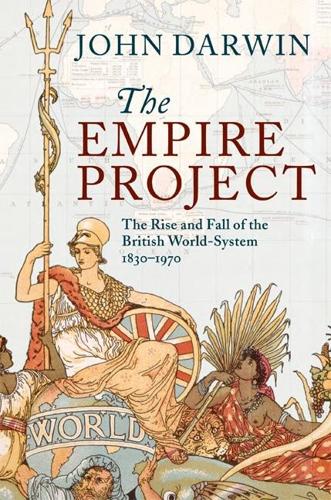
After Tamerlane: The Global History of Empire Since 1405
by
John Darwin
Published 5 Feb 2008
It was little wonder that a rash of speculative enterprise broke out and special-interest lobbies appeared: to raise cash, make publicity, and press their governments for help. In the new world economy, there were fortunes to be made. But the second scenario was less reassuring. Accompanying the sense of an accessible world, no longer protected by the moat of distance, was the pervasive fear that it was ‘filling up’ fast. In 1893 the young American historian Frederick Jackson Turner famously declared that America’s open frontier had been closed, and he was quickly followed by similar warnings in Australia and New Zealand.3 With no ‘empty lands’ in the temperate world to absorb their energies, the Europeans would compete for control of the tropics and the lands and commerce of the ‘dying nations’.4 Here, where local order was weak, a forceful foreign presence would be all.
…
In 1907 the United States Navy’s ‘Great White Fleet’ (a reference to its paintwork) made a much publicized cruise all round the Pacific.33 In these various ways, America was asserting its status as a major world power, on terms of equality with the largest European states. As a colonial power (after 1898) with extraterritorial privileges in China, its interests and outlook seemed remarkably similar to Europe’s. America, declared the influential historian Frederick Jackson Turner, was ‘an imperial republic with dependencies and protectorates… a new world power’.34 The Mexican revolution that broke out in 1910 pushed Washington further towards an imperial mentality. To force the removal of the dictator General Huerta, Mexico’s chief port was occupied for eight months in 1914.35 But the similarities and parallels should not be exaggerated.
…
Perhaps 150Europeans lived in Iran in the mid nineteenth century; still only 800 in 1890. Ibid., p. 207. CHAPTER 6: THE LIMITS OF EMPIRE 1. See H. J. Mackinder, ‘The Geographical Pivot of History’, Geographical Journal 23, 4 (1904), pp. 421–37. 2. The Times, 15 Sept. 1875, quoted in N. Pelcovits, Old China Hands and the Foreign Office (New York, 1948), p. 101. 3. Frederick Jackson Turner, ‘The Significance of the Frontier in American History’ (1893), reprinted in his The Frontier in American History (New York, 1920). 4. For a characteristic statement, B. Kidd, The Control of the Tropics (London, 1898). 5. Naito Konan’s article ‘Shosekai’ (‘Small World’) was published in 1888.
Drinking in America: Our Secret History
by
Susan Cheever
Published 12 Oct 2015
The Territorial Enterprise was the paper where Sam Clemens first used his pseudonym—Mark Twain—and later he wrote about Virginia City in the autobiographical Roughing It. As much as silver and gold, the treasure that seemed to thrive in the American West was mythmaking. “The most important effect of the frontier has been in the promotion of democracy,” writes Frederick Jackson Turner in his The Frontier in American History. “The frontier is productive of individualism. Complex society is precipitated by the wilderness into a kind of primitive organization based on the family. The tendency is anti-social. It produces antipathy to control…The tax-gatherer is viewed as a representative of oppression.”177 The frontier character—defiant, solitary, and prone to binge drinking, storytelling, and gambling—was solid gold when it came to larger-than-life characters and almost-impossible feats of strength, goodness, or villainy.
…
The books ranged from Nathaniel Philbrick’s brilliant and engaging histories of the Mayflower and Bunker Hill to his excellent biography of George Armstrong Custer, from David McCullough’s majestic biography of John Adams to Olivia Laing’s charming A Trip to Echo Springs and even to a less-than-persuasive book showing that the Kennedy assassination was linked to New Orleans monkey viruses via Clay Shaw. I reveled in biographies of General U. S. Grant and General Robert E. Lee, especially those by Michael Korda, who wrote about both great and fascinating warriors. I scoured histories of the frontier—from Frederick Jackson Turner’s The Frontier in American History to Ted Morgan’s wonderful Shovel of Stars—and of Prohibition and American writers, and I searched for links to drinking and stories at the intersection of drinking and history. I studied colonial eating habits and read the Warren Commission Report sections that describe drinking by the Secret Service Agents in the Kennedy detail the night before the assassination—facts to which I was alerted by Philip Shenon’s extraordinary book A Cruel and Shocking Act.
The Seventh Sense: Power, Fortune, and Survival in the Age of Networks
by
Joshua Cooper Ramo
Published 16 May 2016
So he traveled by train and died at a station on the way, like an absurd figure in a Gogol novel, enacting the tragedy of trying to use the modern to get to the past. At more or less exactly the same time, however, the American rail system was working its own transformation, but with almost no ambivalence. America was using the modern to get to the future—as fast as possible. This was a decisive difference in temperament. “The American frontier,” Frederick Jackson Turner wrote in his famous 1893 essay about borders and American life, “is sharply distinguished from the European frontier—a fortified boundary line running through dense populations.” American rails and roads (and trade) encountered no substantial fortifications. They ran nearly unchecked into the wilderness.
…
Black, review of The Connection Machine, by W. Daniel Hillis, AI Magazine 7, no. 3 (1986): 169. You can solve: Adam Beberg, “Distributed Systems: Computation with a Million Friends” (lecture, Stanford University Computer Systems Colloquium, April 30, 2008), at https://www.youtube.com/watch?v=7zafB2GkMBk. “The American frontier”: Frederick Jackson Turner, “The Significance of the Frontier in American History,” The Annual Report of the American Historical Association (1894): 119–227. There’s a phrase: Janelle identified what he called space-time convergence; later the geographer David Harvey renamed it space-time compression, which is the term more commonly used today.
The Tyranny of Merit: What’s Become of the Common Good?
by
Michael J. Sandel
Published 9 Sep 2020
He set out his vision in “Education for a Classless Society,” an address he delivered at the University of California and published in The Atlantic in 1940. Conant wanted to reclaim for American society the principle of equality of opportunity, now threatened by “the development of a hereditary aristocracy of wealth.” He cited Frederick Jackson Turner, the Harvard historian who had argued that the closing of the frontier cut off the traditional avenue of American opportunity—the ability to move west, to cultivate land, and to rise through effort and ingenuity unshackled by class-bound hierarchy. “The most distinctive fact” of the early period of American democracy, Turner had written, “was the freedom of the individual to rise under conditions of social mobility.” 7 Turner, writing at the end of the nineteenth century, was perhaps the first to use the term “social mobility.” 8 Conant called this concept “the heart of my argument” and used it to define his ideal of a classless society.
…
James Bryant Conant, “Education for a Classless Society: The Jeffersonian Tradition,” The Atlantic , May 1940, theatlantic.com/past/docs/issues/95sep/ets/edcla.htm . Conant’s quote from Turner on social mobility is from “Contributions of the West to American Democracy,” The Atlantic , January 1903, reprinted in Frederick Jackson Turner, The Frontier in American History (New York: Henry Holt and Co., 1921), p. 266. 8. On Turner being the first to use the term “social mobility,” see Christopher Lasch, The Revolt of the Elites and the Betrayal of Democracy (New York: W. W. Norton, 1995), p. 73. See also Lemann, The Big Test , p. 48.
Decline of the English Murder
by
George Orwell
Published 24 Jul 2009
Seneca On the Shortness of Life Marcus Aurelius Meditations St Augustine Confessions of a Sinner Thomas à Kempis The Inner Life Niccolò Machiavelli The Prince Michel de Montaigne On Friendship Jonathan Swift A Tale of a Tub Jean-Jacques Rousseau The Social Contract Edward Gibbon The Christians and the Fall of Rome Thomas Paine Common Sense Mary Wollstonecraft A Vindication of the Rights of Woman William Hazlitt On the Pleasure of Hating Karl Marx & Friedrich Engels The Communist Manifesto Arthur Schopenhauer On the Suffering of the World John Ruskin On Art and Life Charles Darwin On Natural Selection Friedrich Nietzsche Why I am So Wise Virginia Woolf A Room of One’s Own Sigmund Freud Civilization and Its Discontents George Orwell Why I Write Confucius The First Ten Books Sun-tzu The Art of War Plato The Symposium Lucretius Sensation and Sex Cicero An Attack on an Enemy of Freedom The Revelation of St John the Divine and The Book of Job Marco Polo Travels in the Land of Kubilai Khan Christine de Pizan The City of Ladies Baldesar Castiglione How to Achieve True Greatness Francis Bacon Of Empire Thomas Hobbes Of Man Sir Thomas Browne Urne-Burial Voltaire Miracles and Idolatry David Hume On Suicide Carl von Clausewitz On the Nature of War Søren Kierkegaard Fear and Trembling Henry David Thoreau Where I Lived, and What I Lived For Thorstein Veblen Conspicuous Consumption Albert Camus The Myth of Sisyphus Hannah Arendt Eichmann and the Holocaust Plutarch In Consolation to his Wife Robert Burton Some Anatomies of Melancholy Blaise Pascal Human Happiness Adam Smith The Invisible Hand Edmund Burke The Evils of Revolution Ralph Waldo Emerson Nature Søren Kierkegaard The Sickness unto Death John Ruskin The Lamp of Memory Friedrich Nietzsche Man Alone with Himself Leo Tolstoy A Confession William Morris Useful Work v. Useless Toil Frederick Jackson Turner The Significance of the Frontier in American History Marcel Proust Days of Reading Leon Trotsky An Appeal to the Toiling, Oppressed and Exhausted Peoples of Europe Sigmund Freud The Future of an Illusion Walter Benjamin The Work of Art in the Age of Mechanical Reproduction George Orwell Books v.
Head, Hand, Heart: Why Intelligence Is Over-Rewarded, Manual Workers Matter, and Caregivers Deserve More Respect
by
David Goodhart
Published 7 Sep 2020
Much of the above list would also apply to the United States, minus the empire but with the added task of fashioning a new society from scratch. But some Americans worried that their country’s democratic and classless character had curdled into something much less attractive at the start of the twentieth century. Frederick Jackson Turner, the historian of the American West, argued that what had made the United States a country of opportunity was the availability of land on the western frontier. With the frontier no more and cities filling up with collectivist-minded immigrants, this dream was over, he argued; moreover, America had also produced a distinct Great Gatsby–style upper class.17 Nicholas Lemann shows in The Big Test how this analysis motivated the men behind the Educational Testing Service and the introduction of the biggest IQ-style tests in the Western world, the Scholastic Aptitude Test (SAT), designed to create a new meritocratic leadership for American society as it became the most powerful country in the world.
…
Labaree, A Perfect Mess: The Unlikely Ascendancy of American Higher Education (Chicago: University of Chicago Press, 2017), 25. 14 Nicholas Lemann, The Big Test: The Secret History of the American Meritocracy (New York: Farrar, Straus and Giroux, 1999), 347. 15 Michael Sanderson, “Education and the Economy.” 16 Ibid. 17 Frederick Jackson Turner, The Significance of the Frontier in American History (American Historical Association, 1893). 18 Charles Murray on Coming Apart, Uncommon Knowledge, interview with Peter Robinson (Hoover Institution), YouTube, April 10, 2012, https://www.youtube.com/watch?v=6q3zy4NRzz4. Chapter Three: Cognitive Ability and the Meritocracy Puzzle 1 Polly Mackenzie, “The Myth of Meritocracy,” UnHerd, April 17, 2019, https://unherd.com/2019/04/the-myth-of-meritocracy/. 2 Linda S.
Dawn of Detroit
by
Tiya Miles
Published 13 Sep 2017
And in his forthcoming second study of indigenous peoples in the Great Lakes, Michael Witgen is endeavoring to formulate a capacious and exacting theoretical frame that historicizes the racialization of Indians in the age of U.S. expansion and interprets what he calls the “political economy of plunder” that links black and Native trajectories.16 In addition to charting complex cultural and political relations between European colonies and indigenous communities, historians of Native America have wrestled with connotations of the term “frontier,” rightly contesting the customary meaning of the word derived from historian Frederick Jackson Turner’s 1894 thesis of westward expansion.17 In Turner’s work and in American culture more generally, the word “frontier” has long suggested a line of difference between advancing white “civilization” and Native American “savagery,” where cross-cultural confrontation ultimately gives way to the perfection of the American character and expansion of the colonial enterprise captured by the idea of “manifest destiny.”
…
Christian Crouch, “The Black City: African and Indian Exchange in Pontiac’s Detroit,” revised version of Christian Crouch, “The Black City: Detroit and the Northeast Borderlands through African Eyes in the Era of ‘Pontiac’s War,’” The War Called Pontiac’s Conference, April 5, 2013, Philadelphia, PA, 20–21. Michael Witgen, book manuscript in progress, “Native Sons: Indigenous Land, Black Lives, and the Political Economy of Plunder in North America.” 17. Frederick Jackson Turner, The Significance of the Frontier in American History (Madison: State Historical Society of Wisconsin, 1894). 18. Ira Berlin, Generations of Captivity: A History of African American Slaves (Cambridge, MA: Harvard University Press, 2003), 153, 154, 182, 188, 192, 198. 19. Lea VanderVelde, Redemption Songs: Suing for Freedom before Dred Scott (New York: Oxford University Press, 2014), 16. 20.
Our Kids: The American Dream in Crisis
by
Robert D. Putnam
Published 10 Mar 2015
The absence of a preexisting feudal social structure—an important exception must be made for the antebellum slave-owning aristocracy—helped create and sustain an egalitarian political structure, marked especially by the rise of populist Jacksonian democracy of the 1830s. The vastness of the American frontier, with its virtually free land—free at least to the new settlers—made the ideal of upward mobility seem attainable. As Frederick Jackson Turner, the renowned historian of the frontier, put it, “The West was another name for opportunity.”23 Recurring spurts of evangelical religious fervor in America’s Great Awakenings (like the abolitionist Second Great Awakening of the 1830s and the “Social Gospel” of the Progressive Era) provided morally freighted reinforcement for extension of the foundational national pledge that God had created each of us equal.
…
See McCall, The Undeserving Rich. 22. Ben S. Bernanke, “The Level and Distribution of Economic Well-Being,” remarks before the Greater Omaha Chamber of Commerce, Omaha, NE (February 6, 2007), accessed August 29, 2014, http://www.federalreserve.gov/newsevents/speech/bernanke20070206a.htm. 23. Frederick Jackson Turner, The Frontier in American History (Tucson: University of Arizona Press, 1986; orig. pub., 1920), 212. 24. David M. Potter, People of Plenty: Economic Abundance and the American Character (Chicago: University of Chicago Press, 1969; orig. pub., 1954), 91–94. 25. That pattern corresponds to the distinctive pattern of American public spending compared to Europe, for we spend more on education and less on welfare state redistribution.
On the Move: Mobility in the Modern Western World
by
Timothy Cresswell
Published 21 May 2006
Jasper, Restless Nation: Starting Over in America (Chicago: University of Chicago Press, 2000); John Kouwenhoven, The Beer-Can by the Highway (Baltimore, MD: Johns Hopkins University Press, 1961); Alexis de Tocqueville, Democracy in America (Chicago, IL: University of Chicago Press, 2000); Frederick Jackson Turner, The Frontier in American History (New York: Holt, Rinehart and Winston, 1947). Crandall v. State of Nevada, 73 U.S. 35 (1867). Crandall v. State of Nevada, 6 Wall. 35, 49. Kent v. Dulles, 357 U.S. 116 (1958), 125–26. Ibid., 126. Justice Douglas citing Zechariah Chafee, Three Human Rights in the Constitution of 1787 (Lawrence: University of Kansas Press, 1956), 197.
…
Young, Justice and the Politics of Difference. Ibid., 156. Ibid., 157. Ibid., 158. Daniel Boorstin, The Americans: The National Experience (London: Weidenfeld and Nicholson, 1966); James M. Jasper, Restless Nation: Starting Over in America (Chicago, IL: University of Chicago Press, 2000); Frederick Jackson Turner, The Frontier in American History (New York: Holt, Rinehart and Winston, 1947); Wilbur Zelinsky, The Cultural Geography of the United States (Englewood Cliffs, NJ: Prentice Hall, 1973). Alan M. Kraut, Silent Travelers: Germs, Genes, and the “Immigrant Menace” (Baltimore, MD: Johns Hopkins University Press, 1995); David Ward, Poverty, Ethnicity and the American City, 1840–1925 (Cambridge: Cambridge University Press, 1989).
A City on Mars: Can We Settle Space, Should We Settle Space, and Have We Really Thought This Through?
by
Kelly Weinersmith
and
Zach Weinersmith
Published 6 Nov 2023
Progress in Physical Geography 39 (2015): 137–67. https://doi.org/10.1177/0309133314567585. Crawford, James R. The Creation of States in International Law. Oxford: Oxford University Press, 2011. Cristoforetti, Samantha. Diary of an Apprentice Astronaut. London: Allen Lane, 2020. Cronon, William. “Revisiting the Vanishing Frontier: The Legacy of Frederick Jackson Turner.” Western Historical Quarterly 18 (1987): 157–76. https://doi.org/10.2307/969581. Crossman, Frank, ed. MARS COLONIES: Plans for Settling the Red Planet. Lakewood, CO: Polaris Books, 2019. Cucinotta, Francis A. “Space Radiation Risks for Astronauts on Multiple International Space Station Missions.”
…
“Sleeping Under the Ocean: Despite Total Isolation, Nuclear Submariners Maintain Their Sleep and Wake Patterns Throughout Their Under Sea Mission.” PLOS ONE 10 (2015): e0126721. https://doi.org/10.1371/journal.pone.0126721. Turkina, Olessya. Soviet Space Dogs. Translated by Inna Cannon and Lisa Wasserman. London FUEL Design & Publishing, 2014. Turner, Frederick Jackson, and John Mack Faragher. Rereading Frederick Jackson Turner: The Significance of the Frontier in American History and Other Essays. New York: Henry Holt & Co, 1994. Turrini, Paolo. “The Sky’s Not the Limit: Legal Bonds and Boundaries in Claiming Sovereignty over Celestial Bodies.” In Borders, Legal Spaces and Territories in Contemporary International Law: Within and Beyond, edited by Tommaso Natoli and Alice Riccardi, 173–209.
Why Nothing Works: Who Killed Progress--And How to Bring It Back
by
Marc J Dunkelman
Published 17 Feb 2025
Howard, “From Progressivism to Paralysis,” 384. 58. Despite the failures of community action programs, successive progressive efforts embraced the same underlying bottom-up approach. Lemann, “The Myth of Community Development.” 59. As Frederick Jackson Turner would argue in his Frontier Thesis, the nation’s self-perception had hinged on a sense that the North American continent was an endless expanse. Frederick Jackson Turner, “The Significance of the Frontier in American History,” a paper read at the meeting of the American Historical Association in Chicago, July 12, 1893, https://nationalhumanitiescenter.org/pds/gilded/empire/text1/turner.pdf. 60.
Behind the Berlin Wall: East Germany and the Frontiers of Power
by
Patrick Major
Published 5 Nov 2009
By bringing ordinary people more firmly back to centre stage, without becoming sentimental or vindictive, and investigating the impact of high politics at the grass roots, we may better understand the human dimensions of the Wall.⁴² Moreover, what even many theoretical accounts implicitly overlook is that, for over a third of its existence, from 1945–61, East Germany remained unwalled. Only from 1961–89 was it the more familiar closed society. One of my aims is to draw attention to this early phase and compare GDR rule before and after the Wall.⁴³ This was, of course, not the first instance of a historically significant open border. Frederick Jackson Turner, in his renowned 1893 address, argued that American individualism and ‘antipathy to control’ were consecrated on the wild west frontier. Federal government on the eastern ³⁸ Thomas Lindenberger, ‘Diktatur der Grenzen’, in id. (ed.), Herrschaft und Eigen-Sinn, 32. ³⁹ Thomas Lindenberger, ‘Alltagsgeschichte und ihr möglicher Beitrag zu einer Gesellschaftsgeschichte der DDR’, in Bessel and Jessen (eds), Grenzen, 298–325. ⁴⁰ Cor Wagenaar et al. , Ideals in Concrete: Exploring Eastern and Central Europe (Rotterdam: NAi publishers, 2004). ⁴¹ Marion in ‘Buch der Erinnerungen’ at Berlin-Wilmersdorf Rathaus, Aug. 2001. ⁴² Timothy Garton Ash rightly took to task Cold War politicians’ lip service to ‘the people’ ( die Menschen), although his own methodological preferences for researching and interviewing elite figures were hardly likely to remedy this.
…
Equally plausibly, the open frontier before 1961 may have acted as a safety valve for popular discontent and a brake on authoritarianism. This is an important ambiguity and one to which I shall return, although there is no clear answer to this paradox. Freedom of movement has, nevertheless, generally been seen to increase the room for manoeuvre of those left behind and to encourage reform. Conversely, ⁴⁴ Frederick Jackson Turner, ‘The Significance of the Frontier in American History’, in id., The Frontier in American History (New York: Henry Holt, 1920), 1–38. ⁴⁵ Albert O. Hirschman, Exit, Voice and Loyalty: Responses to Decline in Firms, Organizations and States (Cambridge, MA: Harvard University Press, 1970). ⁴⁶ Ibid., 16. ⁴⁷ Ibid., 43. 10 Behind the Berlin Wall total monopolies with no exit become prisoners of their clients, who have no alternative but voice, forcing the powers-that-be to consider change.
The Forgotten Man
by
Amity Shlaes
Published 25 Jun 2007
But yet another was an aristocratic young politician who lived south of the Tugwells, in Hyde Park, New York: Franklin Roosevelt, a cousin of the president. At Harvard as a young man, Franklin Roosevelt had taken History 10-B with a visiting professor who was an expert on the American frontier, Frederick Jackson Turner. Turner was developing a thesis that stuck with Roosevelt all his life: as the American frontier closed, the United States was entering into a period where the old rules did not hold. As an undergraduate Roosevelt had also studied with a monetary expert, Oliver M. W. Sprague, and at least thought about the money problem and the farms.
…
“Depressions could, and did, come and go; but they could not alter the fundamental fact that most of the people lived partly by selling their labor and partly by extracting their livelihood from the soil, so that starvation and dislocation were practically impossible.” But now, building on the ideas of his old professor Frederick Jackson Turner, Roosevelt reminded his listeners of the importance of the fact that “our last frontier” had long since been reached. It was time for the “princes of property,” the wealthy, to share their resources. Growth would not provide for the poor; only redistribution could. The new situation had made the trusts all the more dangerous.
Capitalism in America: A History
by
Adrian Wooldridge
and
Alan Greenspan
Published 15 Oct 2018
European countries were so crowded together that they had little choice but to go to war for territory or to expand abroad. The quintessentially American advice was “Go west, young man.” America had so much space on the frontier that it recruited millions of Europeans with the promise not just of life and liberty but also of free land. In 1893, Frederick Jackson Turner, a young historian at the University of Wisconsin, announced a radical new thesis at the annual meeting of the American Historical Association in Chicago: the frontier had finally closed. The end of the frontier struck most Americans, not least Turner, as a change for the worst. The frontier had given America its egalitarian stamp: people who chafed under the yoke of Boston Brahmins or New York nabobs could simply move west.
…
Arjo Klamer once called America a “caravan” society as opposed to the “citadel” society of Europe: Americans were always on the move in pursuit of new opportunities while Europeans built citadels to protect what they already had.1 In the second half of the nineteenth century, almost two-thirds of Americans over the age of thirty made cross-country moves compared with only a quarter of Britons who moved across their Lilliputian island.2 “Few of us are natives of the country,” Edward Bates, later Lincoln’s attorney general, wrote in 1849, “we are all adventurers, coming from a distance, to seek a fortune or make a name.”3 Though Frederick Jackson Turner worried that America’s pioneer spirit had ended with the closing of the frontier in 1893, the country’s enthusiasm for mobility continued unabated. The United States has rightly regarded itself as a land of entrepreneurs, where it is easier than elsewhere to found companies and then, if you are lucky and determined, to turn those companies into giants.
Forever Free
by
Joe Haldeman
Published 14 Oct 2000
Where we found rough-and-ready frontier shops that served latte and cappuccino. It was possible that out of ten billion souls scattered through this corner of the Galaxy, only Marygay and I had even a tenuous connection to the American frontier. Charlie and Diana and Max were born in a place that still called itself America, but it had not been a place that Frederick Jackson Turner would have recognized, its only "frontier" light-years and centuries away, men and women fighting an incomprehensible enemy for no reason. Bill came in and we both put on aprons and gloves and went out to the dock. We worked in relative silence, monosyllables, for the first two trotlines, Bill beheading them with such fervor that twice he got the cleaver stuck in the wood.
Amusing Ourselves to Death: Public Discourse in the Age of Show Business
by
Neil Postman
and
Jeff Riggenbach Ph.
Published 1 Apr 2013
To them, mature citizenship was not conceivable without sophisticated literacy, which is why the voting age in most states was set at twenty-one, and why Jefferson saw in universal education America’s best hope. And that is also why, as Allan Nevins and Henry Steele Commager have pointed out, the voting restrictions against those who owned no property were frequently overlooked, but not one’s. inability to read. It may be true, as Frederick Jackson Turner wrote, that the spirit that fired the American mind was the fact of an ever-expanding frontier. But it is also true, as Paul Anderson has written, that “it is no mere figure of speech to say that farm boys followed the plow with book in hand, be it Shakespeare, Emerson, or Thoreau.” 23 For it was not only a frontier mentality that led Kansas to be the first state to permit women to vote in school elections, or Wyoming the first state to grant complete equality in the franchise.
Why Liberalism Failed
by
Patrick J. Deneen
Published 9 Jan 2018
Dewey, for example, in his short book Individualism, Old and New, praises the “old” liberalism for its success in “liquefying static property” of the type that was prevalent in feudal times, and for eliminating the local bases of social life as the economic and political system became visibly more national and “interdependent.” He dismisses the “romantic” individualism that had animated the American belief in self-reliance (here echoing Frederick Jackson Turner’s observations that the age of the American frontier had come to a close), instead calling for recognition that it was empirically true that Americans were now part of a “social whole” from which no individual could be understood to exist in separation.12 The “old individualism” had successfully undermined any vestiges of aristocratic society or Jeffersonian agrarianism, but the nation had not yet made the leap into a new “organic” reconciliation of individual and society.
The Aristocracy of Talent: How Meritocracy Made the Modern World
by
Adrian Wooldridge
Published 2 Jun 2021
THE RISE OF THE REST Many of these challenges to the meritocratic idea are familiar today: the consolidation of vast fortunes at the top of society; the growing distance between the professional classes and the masses; and the corruption of politics through money and ethnic voting. Yet Gilded Age America not only preserved its faith in the great trilogy of equality, opportunity and mobility. It pioneered a wide-ranging set of reforms that updated these ideals for new times. Frederick Jackson Turner concluded his classic essay on the closing of the American frontier, which argued that the country’s great westward expansion had reached its limits, by warning that it would be ‘a rash prophet who would assert that the expansive character of American life has now entirely ceased’. The same could be said of these new impediments to the meritocratic spirit.
…
L. 217 Titmuss, Richard 281 Tobin, James 226 Tocqueville, Alexis de 11, 19, 179, 191 Democracy in America 193 Tolstoy, Leo, War and Peace 50 Townsend Harris School 198 trade union movement and knowledge workers 341 and selective education 288–9 Transparency International 368 Tredegar’s Workmen’s Institute library 172, 173 Trevelyan family 152 Trevelyan, Sir Charles 155 Trevelyan, Sir George 160 Trevor-Roper, Hugh 235 Tri-Lateral Commission 320 tribal societies, kinship groups 48 Trinity College, Dublin, women graduates 268 Trollope, Anthony 149, 392 The Duke’s Children 151 The Prime Minister (1875) 31 The Three Clerks 157, 160–61 Trotsky, Leon 228 Truman, Harry S. 239 Trump, Donald 3, 316, 374 anti-intellectual appeal 332 election of 329, 330, 384 and nationalism 344–5 nepotism 48, 318, 319, 374 and press 334–5 support for 22, 342, 346 Trump, Ivanka 316, 319, 374 Turgot, Anne Robert Jacques 124 Turkey, imperial court 40 Turner, Frederick Jackson Turner 196 Turow, Scott 12 typewriters 271 tyranny, Plato on 64 UNCTAD 321 Unitarians 152 United Nations, declaration of human rights 26 United States 175–202 anti-federalism 188 and anti-meritocratic movement 283–92 Army General Classification Test (AGCT) 239 ‘captains of learning’ 223–7 civil disobedience (1960s) 301 civil rights 239 Civil Rights Bill (1964) 274 constitutions 177–8 and contempt for masses 342 Declaration of Independence 178–9, 238, 262, 301 East Coast elite (WASP) 194, 224, 232–3, 240 economy 186–7, 190–91, 193–4, 368–9 and educational egalitarianism 300–305 educational elites 4, 7, 194–5, 241–2 Educational Policies Commission 239–40 elite dynasties 318–19 enthusiasm for IQ tests 214–15 Equal Rights Amendment (ERA) 273 and equality of opportunity 19 Founding Fathers 178–9, 383 hierarchies in 202, 232–3 inequality in 225, 313, 325–6, 346–7 and Iraq War 336–7 Jews in 93, 202 and legacy of Plato 70 meritocracy in universities 2, 9–10 meritocratic administration 201–2 National Defense Education Act 274 National Merit Scholarship Corporation 240 political corruption 188, 190, 195–6, 200–202 political parties 188, 202, 331–2 post-war 238–42, 273 racial inequality 283, 302–5, 346–7 robber barons 17, 193, 196–7 Sarbanes–Oxley reforms (2002) 338 SAT (Scholastic Aptitude Test) (US) 6, 224–5, 239 and second chances in education 284, 382–3 and self-invention 175–6 self-made men 189, 191 self-reliance 176–7 and slavery 179, 192–3 and social mobility 323–4 Southern states Jim Crow laws 193 Supreme Court 16, 300, 303, 383 vocational education 393, 394 women in post-war years 273 women’s colleges 268 see also Black Americans universities and academic research 249–51 admissions policies 2, 316–18 black studies 298 children of academics 317–18 China 363 competition for places 308 corrupt admissions 315–16 expansion of 248 gender studies 298 German 140 limits on Jewish students in America 226, 233 and open competition 158–9 polytechnic colleges as 394 and professional management training 197 proposal for scholarships tied to public service 379 Protestant 112 Prussia 127 removal of religious restrictions 158, 159–60 restrictions on poor students 32–3, 317 and school examinations 161 and sponsored mobility 102–3 see also Cambridge; Ivy League universities; Oxford University Grants Committee 236 US Army, use of IQ testing 213–14, 215 Utilitarianism 146, 152 Vallance, Patrick 345 Van Buren, Martin 188, 189 Van Reenen, John 368 Vance, J.
The Upswing: How America Came Together a Century Ago and How We Can Do It Again
by
Robert D. Putnam
Published 12 Oct 2020
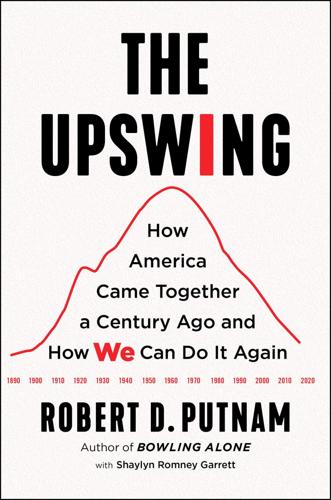
With Lincoln’s assassination, however, followed by the end of Reconstruction in 1877 and the full onset of the Industrial Revolution, his egalitarian emphasis on shared values gave way in both parties to the inegalitarian individualism of the Gilded Age. At the 1893 World’s Fair celebrating industrial change, the historian Frederick Jackson Turner reflected on whether American individualism, which had been fostered by the frontier then just closing, would be undermined by the emerging urban, industrial society.9 Recent research has confirmed that frontier life was indeed associated with a culture of bootstrap self-reliance and hostility to economic redistribution, an imprint still visible a century later.10 In this way, the frontier had encouraged American individualism generally, just as Turner had speculated, and its closing might portend a turn away from it.
…
See also his presidential address to the American Historical Association, 1910, in which he contrasted the individualism of the frontier years with the emerging need for a new democratic sensibility he identified with the progressive reformers: American Historical Review 16, no. 2 (1910): 217–33, https://www.historians.org/about-aha-and-membership/aha-history-and-archives/presidential-addresses/frederick-jackson-turner. 10 Samuel Bazzi, Martin Fiszbein, and Mesay Gebresilasse, “Frontier Culture: The Roots and Persistence of ‘Rugged Individualism’ in the United States,” Working Paper 23997 (National Bureau of Economic Research), November 2017, 23997, doi:10.3386/w23997. 11 Spencer was allegedly “the single most famous European intellectual in the closing decades of the nineteenth century,” according to “Herbert Spencer,” in Wikipedia, October 26, 2019, https://en.wikipedia.org/w/index.php?
Stories Are Weapons: Psychological Warfare and the American Mind
by
Annalee Newitz
Published 3 Jun 2024
Far from being a “true prophet of U.S. expansion,” O’Sullivan was just a two-bit hack who quickly lost his newspaper job and went on to work as a propagandist for the Confederacy before becoming a spiritualist who claimed he could speak with the dead.50 Though O’Sullivan died in obscurity, the phrase “manifest destiny” was taken up by public figures; it was used by politicians advocating for the annexation of Oregon51 and by the poet Walt Whitman, singing the praises of his expanding nation.52 More importantly, it was ensconced in history books for decades, affecting the perceptions of generations of young Americans. This latter feat was thanks largely to a Harvard historian named Frederick Jackson Turner, whose “frontier thesis” is what popularized the idea of manifest destiny. The young professor presented his frontier thesis in a famous speech during the 1893 Columbian Exposition in Chicago. There he told the assembled crowd that westward expansion defined the American character. This was a departure from the assertions of thinkers in previous generations, including Alexis de Tocqueville, who thought of New England as the center of gravity in the United States.
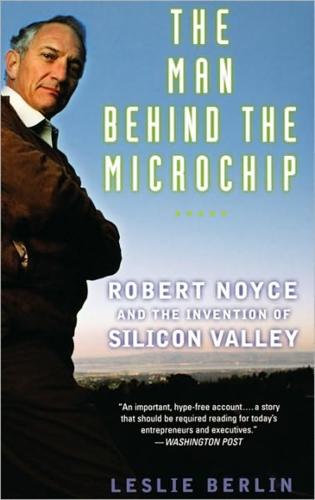
The Man Behind the Microchip: Robert Noyce and the Invention of Silicon Valley
by
Leslie Berlin
Published 9 Jun 2005
Top twelve American firms: Electronic Market Data Book: 1981 Edition (Electronic Industries Association: 1981), 92. Intel tenth anniversary celebration: “Intel Celebrates,” San Jose Mercury News, 23 Aug. 1978. Birthplace of freedom: Such ideas can be traced to the writings of historian Frederick Jackson Turner. The “free lands” of the West, Turner wrote, served as a “gate of escape” and reinvigorated the country by promoting “individualism, economic equality, freedom to rise, [and] democracy.” Frederick Jackson Turner, “Contributions of the West to American Democracy,” Atlantic Monthly, 91, Jan. 1903, 91. Broad and fertile plain: Noyce, “Competition and Cooperation—A Prescription for the Eighties,” Research Management, March 1982, 14, IA.
Appetite for America: Fred Harvey and the Business of Civilizing the Wild West--One Meal at a Time
by
Stephen Fried
Published 23 Mar 2010
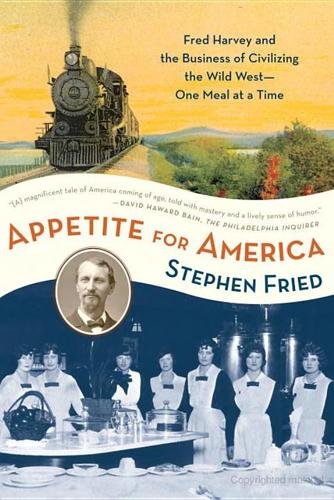
The devastation was evenly distributed between the cities and the countryside. As Americans wondered why this was happening to their country, a relatively obscure academic paper was published in the Proceedings of the State Historical Society of Wisconsin. Prepared for the World Columbian Exhibition by historian Frederick Jackson Turner, the paper examined the role of the frontier in U.S. history. Turner boldly suggested that frontier spirit—and the drive farther and farther west for free land—was what defined America and Americans. And he dared to wonder aloud what would become of the United States now that there was no more frontier, nowhere else to expand.
…
Besides jump-starting the economy, it further united the United States. The experience of facing a common enemy—even a fairly weak one—was profound. It fostered a patriotism that was genuinely national and felt inextricably linked to and inspired by that “frontier spirit” of the Old West. It was a renewed version of the idealistic spark that historian Frederick Jackson Turner—whose work was still obscure, but was known to Roosevelt—wondered if the country might have lost forever. The war also seemed to trigger the first of many cycles of Americans looking within—within the country, within themselves—to recapture that spirit of the frontier, that authentic “real America,” as a way of counterbalancing the forces of modernity and urbanization.
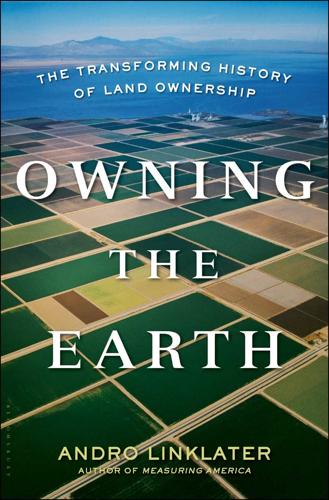
Owning the Earth: The Transforming History of Land Ownership
by
Andro Linklater
Published 12 Nov 2013
Just as the American way of converting the prairies into property would leave an indelible imprint on United States society, so the Russian method of imposing their ownership of the steppes profoundly affected the outlook and structure of the Romanov Empire. And at almost the same time in the 1890s, as Frederick Jackson Turner was selecting the frontier experience of the United States in its westward expansion as “the crucible [where] the immigrants were Americanized,” his Russian contemporary, Vasily Klyuchevsky, was insisting that the colonization of Asia was “the fundamental factor” in Russian history. At first the open country beyond the trees was simply called “the field” or polye, but quite soon people started using the word steppe, which dictionaries defined as an area that was grassy, treeless, and, despite the presence of several million nomadic Cossacks, Bashkirs, and Kalmyks, empty.
…
Central to the argument that he put forward in Progress and Poverty, published in 1879, was the assumption that the way the earth was owned provided the key to correcting what had gone wrong both socially and economically. “The ownership of land,” he wrote, “is the great fundamental fact which ultimately determines the social, the political and consequently the intellectual and moral condition of a people.” Long before Frederick Jackson Turner’s 1893 essay, Henry George identified the frontier as the critical agency in creating the old egalitarian America. Using the same arguments, and indeed the very phrases Turner would employ fourteen years later, he pointed to the impact of its limitless resources. “This great public domain is the key fact that has formed our national character and colored our thought,” he wrote.
The Smartphone Society
by
Nicole Aschoff
Moonshots and Teddy Bears Despite its deep roots in the military and ongoing partnership with the American intelligence establishment, Silicon Valley has long projected a wild and free image—a land of tech hippie-cowboy hackers embodying the rugged individualism of “the West” mythologized by Frederick Jackson Turner: “that coarseness and strength combined with acuteness and inquisitiveness; that restless, nervous energy . . . that dominant individualism, . . . that buoyancy and exuberance which comes from freedom.”7 Ellen Ullman, with the clarifying gaze afforded by a brilliant mind and the experience of being one of the few female software engineers in the Valley in the 1990s, recalls meeting someone who seemed to be the embodiment of Turner’s archetype: a “rebel cryptographer” sporting long hair and baggy jeans named Brian: “In appearing to be a genius on a skateboard,” Ullman recalls, “he couldn’t be playing his part better.”8 Brian cut quite a different figure from the slick haircuts running the show on Wall Street.
The Complacent Class: The Self-Defeating Quest for the American Dream
by
Tyler Cowen
Published 27 Feb 2017
In the beginning, the move isn’t supposed to be easy, but it’s a sign of hope, faith in the future, and a belief that a new start can lead to something grander and more glorious. Americans traditionally have thought of themselves as the great movers, and indeed that was true in the nineteenth century and even through most of the twentieth. In history, Frederick Jackson Turner’s 1893 Significance of the Frontier in American History described the American West as an outlet for our national energies. The classic American novel—Mark Twain’s Huckleberry Finn—is about a restless journey, a move, and an escape from a previous life, for both Huck and Jim. Herman Melville’s Moby-Dick was an epic novel of adventure, global travel, and a risky quest to confront God by hunting a vicious white whale.
The Decadent Society: How We Became the Victims of Our Own Success
by
Ross Douthat
Published 25 Feb 2020
In the case of the modern West, the first world civilization, it meant all of them: God and gold and glory, settler societies and far-flung imperial rule, races to the poles and to the peaks, and the sprawl of roads and railways and steamship lines and airline routes and communication networks that bound the world’s peripheries into a universal web. “Behind institutions, behind constitutional forms and modifications, lie the vital forces that call these organs into life and shape them to meet changing conditions.” The American historian Frederick Jackson Turner wrote those words in 1893, opining on how the idea and reality of the Western frontier shaped American history. There is a sense in which Turner’s frontier thesis can be usefully applied to the entire modern project, whose institutions and forms and bedrock assumptions—the sense of historical mission, the expectation of perpetual progress—have been ordered around the permanence of exploration, expansion, and discovery.
The Autonomous Revolution: Reclaiming the Future We’ve Sold to Machines
by
William Davidow
and
Michael Malone
Published 18 Feb 2020
“Go West, young man,” Horace Greeley wrote after the Civil War, and many, especially recent immigrants, listened. Abraham Lincoln’s Homestead Act of 1862 allowed citizens, including freed slaves, to purchase 160 acres for $200 in the West. The deal was so good that 1.6 million settlers took advantage of it.2 But by 1893, the historian Frederick Jackson Turner declared the American frontier closed. By 1930, farming accounted for just 10 percent of GDP, while manufacturing and services each accounted for about 40 percent of GDP.3 The structural transformations of the Industrial Revolution included vast demographic changes. Life expectancies leaped twenty years in the United States; many more people now could expect to live into their seventies and eighties.4 Urban populations grew and income inequality soared.
The Last Ride of the Pony Express: My 2,000-Mile Horseback Journey Into the Old West
by
Will Grant
Published 14 Oct 2023
The miles between horizons produce a psyche that, like sagebrush, doesn’t happen in the East. The psyche that the western frontier of the United States produced in the nineteenth century is significant because it affected the national psyche. One of the first people to recognize this was the historian Frederick Jackson Turner. In 1893, Turner published an essay titled “The Significance of the Frontier in American History,” in which he argues that the idea of a frontier was fundamental to the American character. Turner’s essay reflects a dated perspective, and it’s been widely criticized for its failure to address the expansion of the U.S. as the conquest of existing societies.
Servant Economy: Where America's Elite Is Sending the Middle Class
by
Jeff Faux
Published 16 May 2012
In the United States, you could keep going in the hope that you would finally find a place where you fit in. All working people could not escape their woes by moving west, and many failed as homesteaders. But the western frontier blossomed in the public’s mind as well as on the visible horizon. The late-nineteenth-century historian Frederick Jackson Turner famously maintained that the settling of the western frontier defined the American character: self-sufficient, practical, independent, and democratic. Later scholars have challenged his views as overly romantic and culturally myopic, but the settlement of the West remains an iconic episode in our collective consciousness.
Utopias: A Brief History From Ancient Writings to Virtual Communities
by
Howard P. Segal
Published 20 May 2012
Although Rydell reduces those late-nineteenth- and earlytwentieth-century American fairs to a single theme that surely did not encompass all the varied experiences of every attendee at any fair, ranging from scholarly presentations to entertainment to shopping, he does illuminate part (but only part) of the varying messages conveyed by many organizers.44 American history textbooks routinely observe that historian Frederick Jackson Turner’s famous address about the alleged closing of the American frontier was delivered at the 1893 Chicago fair. Early fairs in both America and Europe were highly respected as settings for powerful intellectual discourse, where scholarly papers on cutting-edge topics were given before eminent authorities in various fields.
Falter: Has the Human Game Begun to Play Itself Out?
by
Bill McKibben
Published 15 Apr 2019
They brought “dreadful misfortune” to the native inhabitants of those places, but by enlarging the game board, those new colonies raised “the mercantile system to a degree of splendour and glory which it could never otherwise have attained to.”3 Eventually, of course, North Americans managed to fill up much of the new continent, but that didn’t stop our expansion. By the 1890s, when Frederick Jackson Turner was declaring the frontier closed, another new continent was opening up, this one underground. Humans everywhere were quickly learning to burn fossil fuels, and so once again our range was expanding. Part of that expansion was literal: instead of being confined to the few villages where a horse or your feet could carry you, everyone was able to move about, a liberation from geography that changed everything, right down to whom you might marry.
Living in a Material World: The Commodity Connection
by
Kevin Morrison
Published 15 Jul 2008
They’re looking in Mongolia, Kazakhstan, Congo, Zambia, Peru, Brazil and Mexico, and there is also a renewed copper rush in the United States and in Australia. For much of the developing world the legacy of mining has been an unhappy one: polluted rivers, scarred lands and no sharing of the wealth extracted from the mines with the local population – far from the ‘frontier thesis’ that Frederick Jackson Turner proclaimed of the West: ‘Not the constitution, but free land and an abundance of natural resources open to a fit people, made the democratic type of society in America . . . These free lands promoted individualism, economic equality, freedom to rise, democracy.’ Africa has once again become the target for foreigners looking to extract wealth from its lands.
The Meritocracy Myth
by
Stephen J. McNamee
Published 17 Jul 2013
The “pioneer spirit” of striking out on one’s own and staking a claim was captured in American author Horace Greeley’s clarion call to “Go West, young man.” The absence of formal government on the frontier, including effective law enforcement, also undoubtedly contributed to feelings of independence and self-reliance. Historian Frederick Jackson Turner, in his classic book The Frontier in American History (1947), argued that the frontier was central to the development of American individualism. Turner further linked the rugged individualism of the pioneer with the ideals of democracy: “Quite as deeply fixed in the pioneer’s mind as the ideal of individuals was the ideal of democracy.
Transaction Man: The Rise of the Deal and the Decline of the American Dream
by
Nicholas Lemann
Published 9 Sep 2019
In 1903 Liang Qichao, a pioneering Chinese journalist and intellectual, visited New York and reported to his countrymen about the trusts: “In essence, this monster, whose power far exceeds that of Alexander the Great or Napoleon, is the one and only sovereign of the twentieth-century world.” Berle’s generation was heavily influenced by the historian Frederick Jackson Turner’s ominous declaration in 1890 that the opportunity-providing American frontier had closed and so the essential nature of the society had to be remade (Berle was a student, and then a research assistant, of Turner’s at Harvard). How to do that, especially in light of the sudden and unexpected dominance of big business, was the great career-defining question for reform-minded Progressives.
Border and Rule: Global Migration, Capitalism, and the Rise of Racist Nationalism
by
Harsha Walia
Published 9 Feb 2021
For instance, labor migration policy was first introduced in the Philippines under the US-backed dictatorship of Ferdinand Marcos, and the country is now one of the largest labor-exporting countries in the world. Ten percent of the population work overseas, and migrant domestic workers constitute a whopping 70 percent of all migrant workers leaving the country.60 US imperialism has influenced this exodus. Soon after Frederick Jackson Turner declared the archipelago an American frontier, the Philippines became a US colony, which it remained from 1898 until 1946. Approximately 1.4 million people were killed during the Philippine-American war, where waterboarding and scorched-earth tactics were first battle-tested by the US.61 Under colonial rule, workers from the Philippines were recruited by the Hawaiian Sugar Planters’ Association to work the plantations and serve US imperial interests there.
Democracy Incorporated
by
Sheldon S. Wolin
Published 7 Apr 2008
The change becomes comprehensible once it is realized that “frontier” signified not a distinct boundary or limit but the expression of a dynamic seeking an outlet for potential power frustrated by the lack of available land or opportunity. It then remained to claim that democracy was peculiarly the product of the frontier experience. For the historian Frederick Jackson Turner (1861–1932), the frontier, the conquest of new space, had been the crucible of democracy.36 The Western frontier experience, he declared, had been a main force in developing democratic virtues of independence, freedom, and individualism. It had supplied “what has been distinctive and valuable in America’s contributions to the history of the human spirit.”
Case for Mars
by
Robert Zubrin
Published 27 Jun 2011
Yet, despite all their wondrous powers, if we are the people who make it possible, then those billions of advanced beings living on worlds orbiting multitudes of civilized stars will look back at our time, and they will wonder at us. EPILOGUE: THE SIGNIFICANCE OF THE MARTIAN FRONTIER A bit more than one hundred years ago, a young professor of history from the then-relatively obscure Unive rsity of Wisconsin got up to speak at the annual conference of the American Historical Association. Frederick Jackson Turner’s talk was scheduled as the last one in the evening session. A long series of obscure papers preceded his address, yet the majority of the conference participants remained to hear him. Perhaps a rumor had gotten afoot that something important was about to be said. If so, it was correct; for in one bold sweep Turner presented a brilliant insight into the basis of American society and the American character.
The Case for Space: How the Revolution in Spaceflight Opens Up a Future of Limitless Possibility
by
Robert Zubrin
Published 30 Apr 2019
For four centuries they heard its call, listened to its promises, and bet their lives and fortunes on its outcome. It calls no more. —Walter Prescott Webb, The Great Frontier, 1951 A bit more than 125 years ago, a young professor of history from the then-relatively-obscure University of Wisconsin got up to speak at the annual conference of the American Historical Association. Frederick Jackson Turner's talk was scheduled as the last one in the evening session. A long series of obscure papers preceded Turner's address, yet the majority of the conference participants stayed to hear him. Perhaps a rumor had gotten afoot that something important was about to be said. If so, it was correct, for in one bold sweep, Turner held forth with a brilliant insight.
More Everything Forever: AI Overlords, Space Empires, and Silicon Valley's Crusade to Control the Fate of Humanity
by
Adam Becker
Published 14 Jun 2025
Yet Andreessen not only quotes Marinetti in the manifesto but also lists him among the “Patron Saints of Techo-Optimism.” Nor is Marinetti the only fascist on Andreessen’s list. He also includes Nick Land, a neoreactionary philosopher widely read among the alt-right followers of Curtis Yarvin. (The effective accelerationists also quote Land in their inaugural post.)101 Andreessen put Frederick Jackson Turner on the list too. Turner was a late-nineteenth- and early twentieth-century American historian who articulated and advocated for the “frontier thesis,” the idea that the frontier was essential to the vitality of American culture. This colonialist rhetoric is echoed in Andreessen’s manifesto, in Hall’s talk of the solar system as a necessary challenge for our civilization, and in O’Neill’s visions of the high frontier.
Mapping Mars: Science, Imagination and the Birth of a World
by
Oliver Morton
Published 15 Feb 2003
He saw space travel as a way of achieving his goal. And his goal was Mars. Zubrin is as passionate about Mars as a place as anyone on Earth. The nature of that passion is neither sentimental nor scientific. It is ideological. Zubrin believes fervently in the frontier theory of history first enunciated by Frederick Jackson Turner in an 1893 talk called “The Significance of the Frontier in American History.” Turner held that the uniquely impressive aspects of America’s national character—a love of the new, a braveness in the face of the future, a willingness to adapt and grow—derived from the existence of a frontier to the west.
Crisis and Leviathan: Critical Episodes in the Growth of American Government
by
Robert Higgs
and
Arthur A. Ekirch, Jr.
Published 15 Jan 1987
Robinson Jeffers, "Cassandra," 1948 (with apologies for my rearrangement of lines and capitalization). 39. Knight, Freedom and Reform, p. 236; Karl, UneasyState,pp. 39-40,106-107, 114, 172,216. CHAPTER FIVE 1. Godkin as quoted in Samuel Rezneck, "Unemployment, Unrest, and Relief in the United States during the Depression of 1893-97," Journal of Political Economy 61 (August 1953): 339; Frederick Jackson Turner, "The Problem of the West," Atlantic Monthly 78 (September 1896): 296. John Tipple describes the Populists as "a political faction made up chiefly of farmers but having significant support from industrial workers, social reformers, and intellectuals." The Capitalist Revolution: A History of American Social Thought, 1890-1919 (New York: Pegasus, 1970), p. 21.
A Voyage Long and Strange: On the Trail of Vikings, Conquistadors, Lost Colonists, and Other Adventurers in Early America
by
Tony Horwitz
Published 1 Jan 2008
Yet this remarkable man—African, Arab, European slave, American healer, interlocutor between three continents and cultures—is barely remembered today, except at a small park named for him, in a barrio at the edge of Tucson. CHAPTER 6 THE SOUTHWEST TO THE SEVEN CITIES OF STONE God knows that I wish I had better news to write Your Lordship, but I must give you the truth. —Francisco Vásquez de Coronado, to the viceroy of New Spain, 1540 IN 1893, DURING the Columbian quadricentennial, Frederick Jackson Turner delivered a paper entitled “The Significance of the Frontier in American History.” Turner argued that America’s steady push west had forged the country’s character. “Stand at Cumberland Gap and watch the procession of civilization,” he declared of the pioneer pass through the Appalachians.
America Right or Wrong: An Anatomy of American Nationalism
by
Anatol Lieven
Published 3 May 2010
And just as the roots of France's sense of transnational mission can be seen to originate long before the Revolution, so the roots of this antithetical tendency can be traced back to provincial resistance not only against the Revolution, but against previous attempts at royal centralization, standardization, conscription and taxation. Here too is a parallel with the world of the "antithesis" in the United States. The strong distrust of "government" characteristic of so many Americans has been generally attributed, following the great American historian Frederick Jackson Turner (1861-1932), to the individualist tradition of the American Frontier; and this is, of course, correct. However, this distrust also embodies elements of the old European peasant fear of state authority, which after all had generally appeared to peasants in old Europe—as in much of the "developing world" to this day—in the form of corrupt tax collectors, savage policemen, brutal conscripting sergeants and looting, raping armies (even those of one's own state), all of them speaking in alien languages or dialects.
Fantasyland: How America Went Haywire: A 500-Year History
by
Kurt Andersen
Published 4 Sep 2017
The gatekeepers of respectability and guardians of reality had given the fantasyland their imprimatur. They gathered at the fair in 1893 for a Congress of Mathematics and Astronomy, a Parliament of Religions—and the annual convention of the American Historical Association, where a thirty-one-year-old professor from Wisconsin named Frederick Jackson Turner delivered an hour-long talk a week after the Fourth of July called “The Significance of the Frontier in American History.” During the “four centuries from the discovery,” he said, Americans had invented and reinvented themselves on successive frontiers, in proximity to wild nature. “A steady movement away from the influence of Europe” had defined our new national character “on American lines,” making of us “a new product that is American.”
Fantasyland
by
Kurt Andersen
Published 5 Sep 2017
The gatekeepers of respectability and guardians of reality had given the fantasyland their imprimatur. They gathered at the fair in 1893 for a Congress of Mathematics and Astronomy, a Parliament of Religions—and the annual convention of the American Historical Association, where a thirty-one-year-old professor from Wisconsin named Frederick Jackson Turner delivered an hour-long talk a week after the Fourth of July called “The Significance of the Frontier in American History.” During the “four centuries from the discovery,” he said, Americans had invented and reinvented themselves on successive frontiers, in proximity to wild nature. “A steady movement away from the influence of Europe” had defined our new national character “on American lines,” making of us “a new product that is American.”
The Survival of the City: Human Flourishing in an Age of Isolation
by
Edward Glaeser
and
David Cutler
Published 14 Sep 2021
Since each city’s urban growth machine had to compete with every other city’s growth machine, they had strong incentives to provide inexpensive homes for outsiders. For several centuries, America’s cities provided a metropolitan frontier that was far more important than the wilder frontier in the West. In 1893, Frederick Jackson Turner claimed “up to our own day American history has been in a large degree the history of the colonization of the Great West,” and that “the existence of an area of free land, its continuous recession, and the advance of American settlement westward, explain American development.” For decades, historians would debate Turner’s essay on “The Significance of the Frontier in American History,” but the fact is that in 1890, the ten states and territories that composed that frontier contained about the same population as the island of Manhattan.
The Making of Global Capitalism
by
Leo Panitch
and
Sam Gindin
Published 8 Oct 2012
Moreover, the institutions created to organize and run the sale of agricultural produce (the commodity “exchanges”), with the state playing a crucial role in setting the legal framework for this, would eventually give birth to today’s financial derivatives markets.16 The links between US industry and finance were increasingly mediated by the stock market and the investment banks that handled the corporations’ sale of their own stocks and bonds. The huge strength and expansive dynamism of the US economy was momentarily obscured by an economic crisis that began in 1893, leading to severe unemployment and falling agricultural prices, prompting intense worker militancy and farmer populism, and seeming to confirm Frederick Jackson Turner’s thesis, articulated in the same year, on the dark consequences of “the closing of the American frontier.” Corporate leaders and business economists argued vociferously that the domestic market was no longer able to sustain the enormous productive capacity of the corporations or provide sufficient outlets for the capital they had accumulated.
The Transhumanist Reader
by
Max More
and
Natasha Vita-More
Published 4 Mar 2013
Ultimately, such a retreat might deaden the human spirit of exploration, taming and diminishing us. This seems particularly clear to the American psyche, influenced as it has been by the frontier. Many writers have described this exploratory exuberance. Early in the last century, the influential historian Frederick Jackson Turner (1920: 1–38) put it this way: For a moment, at the frontier, the bonds of custom are broken and unrestraint is triumphant … Each frontier did indeed furnish a new field of opportunity, a gate of escape from the bondage of the past; and freshness, and confidence, and scorn of older society, impatience of its restraints and its ideas, and indifference to its lessons, have accompanied the frontier.
The Age of Turbulence: Adventures in a New World (Hardback) - Common
by
Alan Greenspan
Published 14 Jun 2007
Nonetheless, assisted by the wave of deregulation since the mid-1970s, today's U.S. economy remains the most competitive large economy in the world, and American culture still exhibits much of the risk taking and taste for adventure of the country's earlier years. More than a century after Frederick Jackson Turner declared in 1893 that the frontier was closed, Americans reveled in stories of the exploits of the free-spirited cowboys who, following the Civil War, manned the cattle drives up the Chisholm Trail from Texas to the rail depots of Kansas. The cultural changes in America are noticeable, to be sure, but rather narrow in the context of more than two millennia of recorded human history characterized by tectonic changes in institutions.
The Bonfire of the Vanities
by
Tom Wolfe
Published 4 Mar 2008
“—a hundred million July-nineties at the buck—” “—naked short—” “Jesus Christ, what’s going on?” “I don’t fucking believe this!” “Holy fucking shit!” shouted the Yale men and the Harvard men and the Stanford men. “Ho-lee fuc-king shit.” How these sons of the great universities, these legatees of Jefferson, Emerson, Thoreau, William James, Frederick Jackson Turner, William Lyons Phelps, Samuel Flagg Bemis, and the other three-name giants of American scholarship—how these inheritors of the lux and the veritas now flocked to Wall Street and to the bond trading room of Pierce & Pierce! How the stories circulated on every campus! If you weren’t making $250,000 a year within five years, then you were either grossly stupid or grossly lazy.
The Rise and Fall of American Growth: The U.S. Standard of Living Since the Civil War (The Princeton Economic History of the Western World)
by
Robert J. Gordon
Published 12 Jan 2016
Half a square mile came out at 320 acres, similar to the farm sizes that Bryce observed. But historical statistics place the median size of the American farm as less than half that size—153 acres in 1870, 147 acres in 1900, and 157 acres in 1930, still substantial from Bryce’s European perspective.69 In light of Frederick Jackson Turner’s much-discussed 1893 hypothesis of the closing of the frontier, it is somewhat surprising to note, as shown in table 4–2, that substantially more than two-thirds of American farm dwellings in existence in 1940 were built after 1900. Many of the newly constructed farmhouses were replacements for the sod huts and log cabins that immigrant farmers initially built to shelter their families from winter in the northern and western plains.
The Empire Project: The Rise and Fall of the British World-System, 1830–1970
by
John Darwin
Published 23 Sep 2009
‘We have not a friend in Europe’, wrote a cabinet minister as Britain plunged into war in South Africa, ‘and…the main cause of the dislike is…that we are like an octopus with gigantic feelers stretching out over the habitable world, constantly interrupting and preventing foreign nations from doing that which we in the past have done ourselves.’2 The new geopolitics Even in the 1870s, the alarm had been sounded about the speed with which the world was ‘filling up’. ‘The world is growing so small that every patch of territory begins to be looked upon as a stray farm is by a County magnate’, wrote the editor of The Times in 1874, in language he thought ministers might understand.3 By the 1890s, the idea was becoming a commonplace. Frederick Jackson Turner (in an American context), and five widely influential writers, Charles Pearson (1893), Benjamin Kidd (1894), Alfred Mahan (1900), James Bryce (1902) and Halford Mackinder (1904) all regarded the closing of the settlement frontier and the demarcation of the world's land surface as the beginning of a new epoch.4 Coupled with the growth of almost instantaneous communications, what the Canadian imperialist George Parkin called ‘a new nervous system’ of the cable and telegraph,5 they had brought about a phase of unprecedented delicacy in great power diplomacy.
Ashes to Ashes: America's Hundred-Year Cigarette War, the Public Health, and the Unabashed Triumph of Philip Morris
by
Richard Kluger
Published 1 Jan 1996
And he was classless, purposely neither a boss nor a hand, though his white hat, confident gait, and effortless handling of his mount tagged him as a leader and no grubby bunkhouse malingerer. He was also an apolitical man of peace who was never armed and had no enemies, a knight errant patrolling his craggy Eden and embodying what Frederick Jackson Turner had termed, in writing of the frontiersman, “that dominant individualism … that buoyancy and exuberance which comes with freedom.” And what sort of cigarette would such a fellow smoke—as smoke he surely would with all that time and space on his hands? “For me, always, the cowboy contains the expression of flavor,” commented David Dangoor, an articulate latter-day head of Philip Morris’s marketing.
The Codebreakers: The Comprehensive History of Secret Communication From Ancient Times to the Internet
by
David Kahn
Published 1 Feb 1963
The same undogmatic approach was demonstrated in the submission of the books for cryptanalytic tests, and in the testing of 50,000 telegraphic combinations to empirically select those resulting in the fewest errors as codegroups for the Staff Code. In short, the Code Compiling Section was willing to learn, and it did learn a great deal that notably improved American codes. To an astonishing degree, it encapsulated “that practical, inventive turn of mind, quick to find expedients,” that historian Frederick Jackson Turner found the frontier had shaped as an American trait. Perhaps this is best epitomized—with the important addition of some American humor—by the codegroup to report that the code had been lost. The early codes did not even have one. The Hudson Code displayed in large type on its cover, “Memorize this Group: ‘2222—Code Lost.’ ” Then the codegroup for Code Lost was changed to DAM.