Building Habitats on the Moon: Engineering Approaches to Lunar Settlements
by Haym Benaroya · 12 Jan 2018 · 571pp · 124,448 words
Moon, of course, but the strategic vision requires us very quickly to be able to use local lunar resources to cover most of our needs. In-situ resource utilization will allow us to use lunar materials to build structures, manufacture very large solar panels for energy, and extract valuable elements from the lunar regolith
…
. This additional source of funds may need to be supplemented in some way.Table 2.1Partial list of dual-use technologies: Communications and Information Systems; In-Situ Resources Utilization; Surface Mobility – Suits Dual-Use Technologies: Communications/Information Systems Terrestrial Applications Technology Space/lunar/Mars applications Communications High-definition TV broadcast Business video conferencing Ka
…
of ‘race’. It will be for control of resources. Unfortunately, in the last 50 years neither NASA nor the DoD has embraced the concept of in-situ resource utilization ( ISRU ) with the singular exception of electrical energy from sunlight. The private sector has an appreciation of the necessity of ISRU for the next phase
…
leader in ISRU technology, and is an expert in requirements, architecture s and transportation systems for space missions, with particular emphasis on the impact of in-situ resource utilization and water resources. Rapp has surveyed the wide field of global climate change and its relationship to energy consumption and is familiar with the entire
Case for Mars
by Robert Zubrin · 27 Jun 2011 · 437pp · 126,860 words
American Astronautical Society, Univelt, San Diego, CA, 1984. 27. J. Williams, S. Coons, and A. Bruckner, “Design of a Water Vapor Adsorption Reactor for Martian In situ Resource Utilization,” Journal of the British Interplanetary Society, August 1995. 28. G. O’Neill, The High Frontier, William Morrow, New York, 1977. 29. J Lewis and R
Space 2.0
by Rod Pyle · 2 Jan 2019 · 352pp · 87,930 words
as cosmic rays. This is radiation from beyond the solar system that has a negative impact on both human bodies and electronics in space. ISRU: In-Situ Resource Utilization, the use of resources found in space to support operations there. Refers primarily to atmospheric gases, water ice, and metals found on the moon, asteroids
Open Space: From Earth to Eternity--the Global Race to Explore and Conquer the Cosmos
by David Ariosto · 24 Mar 2026 · 433pp · 116,344 words
rover had been able to cleave oxygen molecules for potential use in both breathable air and rocket propellant. The machine, known as MOXIE (Mars Oxygen In-Situ Resource Utilization Experiment), devised at the Massachusetts Institute of Technology, was able to generate oxygen sixteen times. “We are going to have to learn to be less
Interplanetary Robots
by Rod Pyle
about what resources might be found there. Planetary scientists and mission planners have talked about harvesting resources from the moon for decades—a process called In-Situ Resource Utilization, or ISRU. Analysis of the Apollo moon rocks showed that there are metals in them—aluminum, titanium, and more—as well as a surprising amount
Rocket Dreams: Musk, Bezos and the Trillion-Dollar Space Race
by Christian Davenport · 6 Sep 2025 · 441pp · 127,950 words
dirt, to build habitats and solar cells, and to extract water and separate out its hydrogen and oxygen. In space talk, this was known as in-situ resource utilization, or ISRU. If SpaceX had dominated the rocket race, Blue would focus on ISRU. In the middle of 2021, Blue Origin went on a hiring
Mission to Mars: My Vision for Space Exploration
by Buzz Aldrin and Leonard David · 1 Apr 2013 · 183pp · 51,514 words
Mars system, and return. Mars surface system capability is another challenge, whether lighter rover systems able to speed across the planet or equipment that demonstrates in situ resource utilization (ISRU). ISRU demos can shake out equipment to support human surface exploration and settlement—projects for extraction and long-term storage of oxygen and/or
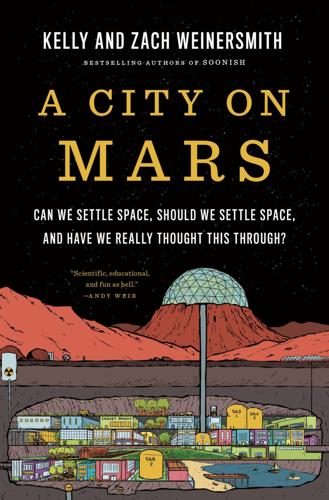
A City on Mars: Can We Settle Space, Should We Settle Space, and Have We Really Thought This Through?
by Kelly Weinersmith and Zach Weinersmith · 6 Nov 2023 · 490pp · 132,502 words
Journal of Asgardia, 2019. https://room.eu.com/article/asgardias-calendar-and-its-role-in-space-industrialisation-strategy. Moses, Robert, and Dennis M. Bushnell. “Frontier In-Situ Resource Utilization for Enabling Sustained Human Presence on Mars.” NASA, Langley Research Center, Hampton, VA, April 1, 2016. https://ntrs.nasa.gov/search.jsp?R=20160005963. Mountfield
4th Rock From the Sun: The Story of Mars
by Nicky Jenner · 5 Apr 2017 · 294pp · 87,986 words
pressurised and pumped full of breathable air, and adding a rocky layer of natural radiation protection. This is all part of a strategy known as ‘in-situ resource utilisation’ (ISRU), which is a fancy name for ‘using the stuff we find on Mars in an effective way so we don’t have to bring

Fire and Ice: The Volcanoes of the Solar System
by Natalie Starkey · 29 Sep 2021 · 309pp · 97,320 words
, making it easier for us to explore well beyond the Moon. This may all sound like science fiction, but scientists working in the field of In Situ Resource Utilization (ISRU) have been investigating at how to extract water from Moon rocks for several years and it is proving to be a viable technique. We
Mars Rover Curiosity: An Inside Account From Curiosity's Chief Engineer
by Rob Manning and William L. Simon · 20 Oct 2014 · 237pp · 76,486 words
How We'll Live on Mars (TED Books)
by Stephen Petranek · 6 Jul 2015 · 70pp · 22,172 words