James Surowiecki

back to index

description: American journalist

133 results

pages: 266 words: 87,411

The Slow Fix: Solve Problems, Work Smarter, and Live Better in a World Addicted to Speed
by Carl Honore
Published 29 Jan 2013

Nearly half of financial services firms do not rescue floundering projects: From a 2011 report by the Economist Intelligence Unit entitled “Proactive response – How mature financial services firms deal with troubled projects.” Climbing corporate ladder by concealing bad news: James Surowiecki, The Wisdom of Crowds (New York: Anchor, 2004), p. 205. Four of every five products perish in first year: James Surowiecki, The Wisdom of Crowds (New York: Anchor, 2004), p. 218. Domino’s television commercials: Full details of the campaign available at http://www.pizzaturnaround.com/. Fedex apologizes: Blog post and video apology at http://blog.fedex.designcdt.com/absolutely-positively-unacceptable Soothing effect of apology: M.C.

His contemporary, Henry David Thoreau, would also have sniffed at the idea of enlisting hoi polloi to help write a constitution: “The mass never comes up to the standard of the best member, but on the contrary degrades itself to a level with the lowest.” Yet that elegant blast of conventional wisdom happens to be completely untrue. Sure, crowds can be crass and barbaric. The riots that erupted near my home in London in the summer of 2011 are grim proof of that. But there is another side to the story. In The Wisdom of Crowds James Surowiecki makes a compelling case for enlisting the masses to help solve problems. The book is stuffed with examples of crowds outperforming the experts, from guessing the weight of an ox at a country fair to pinpointing the resting place of a vessel lost at sea. When NASA asked the public to find and classify craters on the surface of Mars, the public, with just a little training, delivered collective judgements that experts deemed “virtually indistinguishable” from those of a “geologist with years of experience in identifying Mars craters.”

Isaac Kohane quote: Jonah Lehrer, “Groupthink: The Brainstorming Myth,” New Yorker, 30 January 2012. Chapter 9 – Crowdsource: The Wisdom of the Masses Wutbürger as German word of the year: Full list available from German Language Society at http://www.gfds.de/aktionen/wort-des-jahres/ Guessing the weight of an ox: James Surowiecki, The Wisdom of Crowds (New York: Random, 2005), pp. xii-xiii. Pinpointing vessel lost at sea: Surowiecki, The Wisdom of Crowds, pp. xx-xxi. Public identifies Mars craters: Surowiecki, The Wisdom of Crowds, p. 276. Diversity Trumps Ability Theorem: Based on my interview with Scott Page. John Harrison: For the whole story check out Dava Sobel, Longitude: The True Story of a Lone Genius Who Solved the Greatest Scientific Problem of His Time (London: Fourth Estate, 1998).

pages: 326 words: 106,053

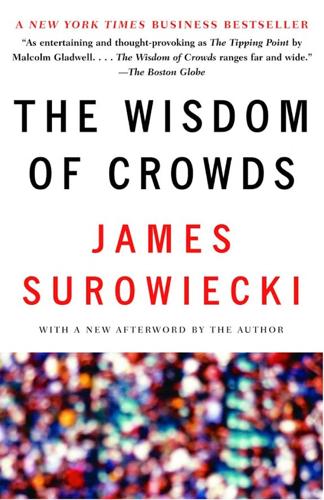
The Wisdom of Crowds
by James Surowiecki
Published 1 Jan 2004

Library of Congress Cataloging-in-Publication Data Surowiecki, James, 1967– The wisdom of crowds : why the many are smarter than the few and how collective wisdom shapes business, economies, societies, and nations / James Surowiecki. p. cm. Includes bibliographical references. 1. Consensus (Social sciences) 2. Common good. I. Title. JC328.2.S87 2003 303.3'8—dc22 2003070095 eISBN 0-307-27505-1 Copyright © 2004 by James Surowiecki All Rights Reserved www.anchorbooks.com v1.0 THE WISDOM OF CROWDS WHY THE MANY ARE SMARTER THAN THE FEW AND HOW COLLECTIVE WISDOM SHAPES BUSINESS, ECONOMIES, SOCIETIES, AND NATIONS JAMES SUROWIECKI DOUBLEDAY New York London Toronto Sydney Auckland
THE WISDOM OF CROWDS WHY THE MANY ARE SMARTER THAN THE FEW AND HOW COLLECTIVE WISDOM SHAPES BUSINESS, ECONOMIES, SOCIETIES, AND NATIONS JAMES SUROWIECKI DOUBLEDAY New York London Toronto Sydney Auckland CONTENTS Cover Page Title Page Dedication Introduction PART I 1. The Wisdom of Crowds 2. The Difference Difference Makes: Waggle Dances, the Bay of Pigs, and the Value of Diversity 3. Monkey See, Monkey Do: Imitation, Information Cascades, and Independence 4. Putting the Pieces Together: The CIA, Linux, and the Art of Decentralization 5. Shall We Dance?: Coordination in a Complex World 6.

Robert Shiller, “Conversation, Information, and Herd Behavior,” American Economic Review 85 (1995): 181–85. While Shiller is skeptical of the ubiquity of cascades, in this paper he nonetheless emphasizes the importance of social influence, as a way of explaining herding behavior. A longer account of William Sellers’s campaign to standardize the screw can be found in James Surowiecki, “Turn of the Century,” Wired 10.01 (January 2002), http://www.wired.com/wired/archive/10.01/standards_pr.html. A definitive account of the “1,000 percent myth” can be found in Andrew Odlyzko, “Internet Traffic Growth: Sources and Implications,” Optical Transmission Systems and Equipment for WDM Networking II, edited by B.

pages: 256 words: 60,620

Think Twice: Harnessing the Power of Counterintuition
by Michael J. Mauboussin
Published 6 Nov 2012

The stakes are especially high for consumer electronics firms because they generate so much of their revenue during the gift-giving season and the value of their inventory depreciates rapidly. The pressure is really on the internal experts at consumer-electronics giant Best Buy, one of a multitude of retailers that rely on specialists. So you can imagine the reaction when James Surowiecki, author of the best-selling book The Wisdom of Crowds, strolled into Best Buy’s headquarters and delivered a startling message: a relatively uninformed crowd could predict better than the firm’s best seers.1 Surowiecki’s message resonated with Jeff Severts, an executive then running Best Buy’s gift-card business.

(New York: John Wiley & Sons, 2006), 37–39. 36. Antonio Damasio, The Feeling of What Happens: Body and Emotion in the Making of Consciousness (New York: Harcourt Brace & Company, 1999), 42. Chapter 3—The Expert Squeeze: Why Netflix Knows More Than Clerks Do About Your Favorite Films 1. James Surowiecki, The Wisdom of Crowds: Why the Many Are Smarter Than the Few and How Collective Wisdom Shapes Business, Economies, Societies and Nations (New York: Doubleday and Company, 2004). 2. Gary Hamel with Bill Breen, The Future of Management (Boston: Harvard Business School Press, 2007), 229–239; Renée Dye, “The Promise of Prediction Markets: A Roundtable,” The McKinsey Quarterly, no. 2 (April 2008): 83–93; and Steve Lohr, “Betting to Improve the Odds,” New York Times, April 9, 2008. 3.

Smith and Gary Ferguson, Decade of the Wolf: Returning the Wild to Yellowstone (Guilford, CT: The Lyons Press, 2005). 14. Chase, Playing God in Yellowstone, 44. 15. Robert K. Merton, “The Unanticipated Consequences of Purposive Social Action,” American Sociological Review 1, no. 6 (1936): 894–904. 16. James Surowiecki, “Did Lehman Brothers’ Failure Matter?” The New Yorker.com, March 9, 2009; and Steve Stecklow and Diya Gullapalli, “A Money-Fund Manager’s Fateful Shift,” Wall Street Journal, December 8, 2008. 17. Michael E. Kerr and Murray Bowen, Family Evaluation: The Role of the Family as an Emotional Unit that Governs Individual Behavior and Development (New York: W.W.

pages: 250 words: 88,762

The Logic of Life: The Rational Economics of an Irrational World
by Tim Harford
Published 1 Jan 2008

That is not because the auction produces some odd psychological quirk. It’s because while the survey of the crowd will produce the average view of the value of coins, the auction will not. Instead, the auction automatically selects the highest bid, the crazier the better. The survey uncovers what New Yorker columnist James Surowiecki calls “the wisdom of crowds.” The auction, by contrast, finds the biggest sucker. Rational players, knowing this, would dramatically scale back their bids. They would reason like this: “I think the value of the coins in the jar is twenty dollars. So maybe I should bid eighteen dollars to leave some room for profit.

For example, when I learned how to write a decent book proposal and where to send it, all Stephen McGroarty got in repayment from me was a pint or two of Guinness, and possibly the vague sense that I owed him a favor. Another example: After I knew my book was to be published, I started to make a habit of attending book talks to pick up some tips for the forthcoming promotional tour. It cost me nothing at all to receive a lesson in how to give a book talk from James Surowiecki, author of The Wisdom of Crowds, at my local Barnes & Noble. It’s hard to imagine how he might try to charge soon-to-be authors to hear his book talks while letting mere potential buyers of his own tome through the doors for nothing. Neither service is as easy to package and market as a hot dog.

A classic example is traffic: When nobody has to pay to drive on the roads, the roads are too congested; people drive more than they would if they were charged for the cost of delays they were causing to others. But just as important, perhaps much more important, are “positive externalities”—nobody has to pay for book talk lessons from James Surowiecki, so he gives out fewer lessons than he would if he were fairly rewarded. This particular positive externality is called, for an obvious enough reason, a “knowledge spillover.” Knowledge spillovers sound wonderful, but as we learned on Hackney Downs in chapter 5, they are only wonderful if they happen.

pages: 400 words: 94,847

Reinventing Discovery: The New Era of Networked Science
by Michael Nielsen
Published 2 Oct 2011

Furthermore, we don’t yet have a good understanding of how the human brain works, so the metaphor is in any case of limited use at best. If we’re going to understand how to amplify collective intelligence, we need to look beyond the metaphor of the collective brain. Many books and magazine articles have been written about collective intelligence. Perhaps the best-known example of this work is James Surowiecki’s 2004 book The Wisdom of Crowds, which explains how large groups of people can sometimes perform surprisingly well at problem solving. Surowiecki opens his book with a striking story about the scientist Francis Galton. In 1906, Galton was attending an English country fair, and among the fair’s attractions was a weight-judging contest, where people competed to guess the weight of an ox.

The projects we’ve discussed have overcome these and similar problems: some have succeeded with flying colors (the Polymath Project), while others just barely succeeded (World Team deliberations sometimes teetered on the edge of breakdown because of lack of civility). Similar problems also afflict offline groups, and much has been written about the problems and how to overcome them—including books such as James Surowiecki’s The Wisdom of Crowds, Cass Sunstein’s Infotopia, and many other books about business and organizational behavior. While these practical problems are important, they can often be solved with good process. But no matter how good the process, there remains a fundamental dividing line: whether a shared praxis is available.

Yochai Benkler’s insightful “Coase’s Penguin, or, Linux and The Nature of the Firm” [12] and The Wealth of Networks [13] have strongly influenced much thinking about open source, especially in the academic community. Finally, I recommend Ned Gulley and Karim Lakhani’s fascinating account [87] of the Mathworks programming competition. Limits to collective intelligence: Informative summaries are Cass Sunstein’s Infotopia [212] and James Surowiecki’s The Wisdom of Crowds [214]. Classic texts include Charles Mackay’s Extraordinary Popular Delusions and the Madness of Crowds, first published in 1841, and since reprinted many times [130], and Irving Lester Janis’s Groupthink [99]. Of course, a considerable fraction of our written culture deals, directly or indirectly, with the challenges of group problem solving.

pages: 411 words: 80,925

What's Mine Is Yours: How Collaborative Consumption Is Changing the Way We Live
by Rachel Botsman and Roo Rogers
Published 2 Jan 2010

When you sign up, you become part of a hub that gives you access to the knowledge of millions of other users. The notion that the collective intelligence of thousands, even millions, of people can produce the results and knowledge that smaller groups and individuals can’t has been much discussed, probably best in James Surowiecki’s book The Wisdom of Crowds. But what’s new is applying collective intelligence to make product service systems more attractive than individual ownership. The in-depth knowledge accumulated through repeated consumer interactions presents a significant opportunity for businesses to form deeper relationships with customers and manage inventory more efficiently.

They wanted to share chores such as grocery shopping, but how would they know who wanted what and when? Meeting to decide these things would defeat the purpose of making life easier. And they didn’t want to create any kind of committee or nominate a leader to organize the effort, as that would be resorting back to the kind of centralized authority they were trying to avoid. As James Surowiecki writes in The Wisdom of Crowds, “How can people voluntarily—that is, without anyone telling them what to do—make their actions fit together in an efficient and orderly way?”24 With this need in mind, Stephanie launched the online version of the venture, WeCommune.com, in early 2009. A simple yet innovative platform, it makes it easier for people to come together and share resources in ways that fit into modern lifestyles.

From Rachel Botsman For me, this is a book about the possibilities and powerful reconnections that can help reshape our future for the better. I am indebted to the brilliant thought leaders whose ideas have inspired me to think in this way. These include Yochai Benkler, Robin Chase, Jeff Howe, Kevin Kelly, Lawrence Lessig, Bill McKibben, Elinor Ostrom, Robert Putnam, Jeremy Rifkin, Clay Shirky, and James Surowiecki. Personal thanks to Gillian Blake for transforming the way I write, and to Ben Loehnen for masterfully shepherding this project. This book would not have been remotely possible without my fantastic coauthor and wonderful friend, Roo Rogers. I am deeply grateful to him for his belief in me and for continually pushing to make this the best book possible in so many different ways.

pages: 348 words: 83,490

More Than You Know: Finding Financial Wisdom in Unconventional Places (Updated and Expanded)
by Michael J. Mauboussin
Published 1 Jan 2006

—Freidrich Hayek, “The Use of Knowledge in Society” Even when traders are not necessarily experts, their collective judgment is often remarkably accurate because markets are efficient at uncovering and aggregating diverse pieces of information. And it doesn’t seem to matter much what markets are being used to predict. —James Surowiecki, “Damn the Slam PAM Plan!” The Accuracy of Crowds Most investors do not associate group behavior with sparkling outcomes. An Amazon book review crows that Charles MacKay’s classic Extraordinary Popular Delusions and the Madness of Crowds “shows that the madness and confusion of crowds knows no limits, and has no temporal bounds.”

Meehl, “Clinical Versus Actuarial Judgment,” in Heuristics and Biases: The Psychology of Intuitive Judgment, ed. Thomas Gilovich, Dale Griffin, and Daniel Kahneman (Cambridge: Cambridge University Press, 2002), 716-29. 6 Gawande, Complications, 44. 7 Katie Haffner, “In an Ancient Game, Computing’s Future,” The New York Times, August 1, 2002. 8 James Surowiecki, The Wisdom of Crowds: Why the Many Are Smarter Than the Few and How Collective Wisdom Shapes Business, Economies, Societies and Nations (New York: Doubleday, 2004). 9 Joe Nocera, “On Oil Supply, Opinions Aren’t Scarce,” The New York Times, September 10, 2005. 10 Philip E. Tetlock, Expert Political Judgment: How Good Is It?

Also see Edmund Burke and Graham Kendall, “Applying Ant Algorithms and the No Fit Polygon to the Nesting Problem,” University of Nottingham Working Paper, 1999, http://www.asap.cs.nott.ac.uk/publications/pdf/gk_ai99.pdf. 5 See Iowa Electronic Markets Web site, http://www.biz.uiowa.edu/iem. 6 James Surowiecki, “Decisions, Decisions,” The New Yorker, March 28, 2003, available from http://www.newyorker.com/archive/2003/03/24/030324ta_talk_surowiecki. 7 See Hollywood Stock Exchange Web site, http://www.hsx.com. 8 See Betfair Web site, http://www.betfair.com. 9 Alfred Rappaport and Michael J. Mauboussin, Expectations Investing (Boston: Harvard Business School Press, 2001), 132-34. 10 Howard Rheingold, Smart Mobs: The Next Social Revolution (New York: Perseus, 2002). 11 Ken Brown, “Stocks March to the Beat of War, Weak Economy,” Wall Street Journal, March 31, 2003. 30.

pages: 317 words: 100,414

Superforecasting: The Art and Science of Prediction
by Philip Tetlock and Dan Gardner
Published 14 Sep 2015

Dragonfly Eye In 1906 the legendary British scientist Sir Francis Galton went to a country fair and watched as hundreds of people individually guessed the weight that a live ox would be after it was “slaughtered and dressed.” Their average guess—their collective judgment—was 1,197 pounds, one pound short of the correct answer, 1,198 pounds. It was the earliest demonstration of a phenomenon popularized by—and now named for—James Surowiecki’s bestseller The Wisdom of Crowds. Aggregating the judgment of many consistently beats the accuracy of the average member of the group, and is often as startlingly accurate as Galton’s weight-guessers. The collective judgment isn’t always more accurate than any individual guess, however. In fact, in any group there are likely to be individuals who beat the group.

But it was a process that led to a negotiated peace, not nuclear war.4 How the Kennedy White House changed its decision-making culture for the better is a must-read for students of management and public policy because it captures the dual-edged nature of working in groups. Teams can cause terrible mistakes. They can also sharpen judgment and accomplish together what cannot be done alone. Managers tend to focus on the negative or the positive but they need to see both. As mentioned earlier, the term “wisdom of crowds” comes from James Surowiecki’s 2004 bestseller of the same name, but Surowiecki’s title was itself a play on the title of a classic 1841 book, Extraordinary Popular Delusions and the Madness of Crowds, which chronicled a litany of collective folly. Groups can be wise, or mad, or both. What makes the difference isn’t just who is in the group, Kennedy’s circle of advisers demonstrated.

Those that deliver are expanded, those that fail are shuttered. In line with Bill Gates’s insistence on having clear goals and measures, the Gates Foundation, one of the world’s largest, is renowned for the rigor of its evaluations. Sports provide striking examples of the growth and power of evidence-based thinking. As James Surowiecki noted in the New Yorker, both athletes and teams have improved dramatically over the last thirty or forty years. In part, that’s because the stakes are bigger. But it also happened because what they are doing has increasingly become evidence based. “When John Madden coached the Oakland Raiders, he would force players to practice at midday in August in full pads,” Surowiecki noted.

pages: 247 words: 63,208

The Open Organization: Igniting Passion and Performance
by Jim Whitehurst
Published 1 Jun 2015

We’ve seen examples, such as Wikipedia or the Linux operating system (which played a key role in Red Hat’s start), where communities of people spontaneously self-organize around a problem or activity. Work is distributed in a network-like fashion and people are held accountable, all without a formal hierarchy. A growing number of organizations have learned to successfully tap the “wisdom of the crowd” (as documented by James Surowiecki in his book of the same name) in order to drive innovation and gain a competitive advantage through collaboration. The power of these networks has been well documented and explored in books like Wikinomics and Macrowikinomics by Don Tapscott and Anthony D. Williams; Clay Shirky’s Here Comes Everybody; Crowdsourcing by Jeff Howe; and the numerous books and articles by open innovation evangelist Henry Chesbrough.

More than fifty years of research suggest that irrational thinking occurs when people try to reach decisions in groups, and this can lead to a polarization of opinions and a highly biased assessment of a situation.”3 One term we often hear is groupthink, coined by William H. Whyte, author of The Organization Man, in a 1952 issue of Fortune. The idea is that when a group of people work together, they tend to want to reach some kind of harmony and to minimize conflict, which so often leads to terrible and even tragic results. James Surowiecki tackles this subject in his now famous book, The Wisdom of Crowds, in which he discusses the research done by the Yale University psychologist Irving Janis to understand how groupthink was responsible for the poor decision making leading up to events like the attack on Pearl Harbor and the Bay of Pigs invasion.

Drucker, “Managing Oneself,” Harvard Business Review, January 2005, http://hbr.org/2005/01/managing-oneself/ar/1. 2. Jonah Lehrer, “Groupthink: The Brainstorming Myth,” The New Yorker, January 30, 2012. 3. Richard Wiseman, 59 Seconds: Think a Little, Change a Lot (New York: Random House, 2010), 213–214. 4. James Surowiecki, The Wisdom of Crowds (New York: Anchor, 2005), 36. 5. Hill et al., Collective Genius, 121. 6. Ed Catmull and Amy Wallace, Creativity, Inc. (New York: Random House, 2014), Kindle version, location 1374. 7. Hill et al., Collective Genius, 139. 8. Ibid., 24. 9. Linux Kernel Mailing List, https://lkml.org/lkml/2013/2/21/225. 10.

pages: 121 words: 31,813

The Art of Execution: How the World's Best Investors Get It Wrong and Still Make Millions
by Lee Freeman-Shor
Published 8 Sep 2015

The reality is, many stocks go up hundreds or thousands of per cent, but few investors stay invested for the duration of the ride. Most sell once they have made a small profit and forsake supernormal returns as a result. “What makes a system successful is its ability to recognise losers and kill them quickly.”21 – James Surowiecki Here are some examples of the Assassins’ stop-loss rule in action: CASE STUDY: Genmab Genmab is a Danish biotechnology company based in Copenhagen that specialises in creating human antibody treatments for people suffering from cancer. At the time of writing, its Ofatumumab product that it is developing with GlaxoSmithKline is in phase three; should it successfully pass this final hurdle it could be a breakthrough for people suffering from leukaemia, non-Hodgkins’ lymphoma and rheumatoid arthritis.

Referring to his first mission where the objective was to construct a docking module on the Russian space station Mir. 18 In Market Wizards, by Jack D. Schwager (1990). 19 In The New Market Wizards, by Jack D. Schwager (1994). 20 So Far, So Good, by Roy R. Neuberger (1997). 21 The Wisdom of Crowds, by James Surowiecki (2005) 22 Predictably Irrational, by Dan Ariely (2009). “[T]o be a great investor you should have a clear maximum time for the idea to play out.” 23 The Dhandho Investor, by Mohnish Pabrai (2007). 24 ‘Gambling with the House Money and Trying to Break Even: The Effects of Prior Outcomes on Risky Choice’, Management Science, Richard H.

pages: 123 words: 32,382

Grouped: How Small Groups of Friends Are the Key to Influence on the Social Web
by Paul Adams
Published 1 Nov 2011

As we increase our reliance on our social networks to make decisions, we won’t turn to strangers, nor will we turn to recognized experts. Instead we will turn to the same people we have been genetically trained to turn to for help—the people we’re emotionally closest to. Groups can make better decisions than individuals Under the right conditions, groups are often better than individuals at making decisions. James Surowiecki defined four criteria necessary for a group decision to be accurate14: • People’s judgments need to be independent, and not influenced by the other group members. • People should have a diverse range of opinions, even if they are just multiple interpretations of the facts. • People should be able to draw on local or specialized knowledge

This example is from Dan Ariely’s book Predictably Irrational: The Hidden Forces That Shape Our Decisions (Harper Perennial, 2008). 11. See the Wikipedia article on Social Norms for more information. 12. See the 2010 poster presentation “N170 responses to faces predict implicit ingroup favoritism” by Kyle Ratner and David Amodio. 13. See the work of Herbert Simon and the Wikipedia article on Bounded Rationality. 14. See James Surowiecki’s book The Wisdom of Crowds (Anchor, 2005). 15. See the 2010 research paper “Optimally interacting minds” by Bahrami and others. 16. Data from the NCCN private community of cancer patients as described in Groundswell, a book by Charlene Li and Josh Bernoff (Harvard Business Press, 2008). 17.

pages: 502 words: 107,657

Predictive Analytics: The Power to Predict Who Will Click, Buy, Lie, or Die
by Eric Siegel
Published 19 Feb 2013

Netflix Prize leaderboard: Netflix Prize leaderboard results, September 21, 2009. www.netflixprize.com/leaderboard. Winning the Netflix Prize by a matter of 20 minutes: Steve Lohr, “A $1 Million Research Bargain for Netflix, and Maybe a Model for Others,” New York Times, September 1, 2009. www.nytimes.com/2009/09/22/technology/internet/22netflix.html. Quote from James Surowiecki: James Surowiecki, The Wisdom of Crowds (Anchor, reprint ed., 2005). A wise crowd guesses the dollars at Predictive Analytics World: Dean Abbott, “Another Wisdom of Crowds Prediction Win at eMetrics/Predictive Analytics World,” Data Mining and Predictive Analytics blog, April 26, 2012. http://abbottanalytics.blogspot.com/2012/04/another-wisdom-of-crowds-prediction-win.html.

At the very end of a multiple-year competition, BellKor’s Pragmatic Chaos had uploaded its winning entry just 20 minutes before The Ensemble. The winning team received the cash and the other team received nothing. Netflix CEO Reed Hastings reflected, “That 20 minutes was worth a million dollars.” Collective Intelligence With most things, the average is mediocrity. With decision making, it’s often excellence. — James Surowiecki, The Wisdom of Crowds Even competitions much simpler than a data mining contest can tap the wisdom held by a crowd. The magic of collective intelligence was lightheartedly demonstrated in 2012 at the Predictive Analytics World (PAW) conference. Charged with drawing attention to his analytics company on the event’s exposition floor, Gary Panchoo held a money-guessing contest.

By coming together as a group, our limited capacities as individuals are overcome. Moreover, we no longer need to take on the challenging task of identifying the best person for the job. It doesn’t matter which person is smartest. A diverse mix best does the trick. The collective intelligence of a crowd emerges on many occasions, as explored thoroughly by James Surowiecki in his book The Wisdom of Crowds. Examples include: Prediction markets, wherein a group of people together estimate the prospects for a horse race, political event, or economic occurrence by way of placing bets (unfortunately, this adept forecasting method cannot usually scale to the domain of PA, in which thousands or millions of predictions are generated by a predictive model).

pages: 501 words: 114,888

The Future Is Faster Than You Think: How Converging Technologies Are Transforming Business, Industries, and Our Lives
by Peter H. Diamandis and Steven Kotler
Published 28 Jan 2020

Economic Risks: The Threat of Technological Unemployment 47 percent of all US jobs: L. Nedelkoska, “Automation, Skills Use and Training,” OECD Social, Employment and Migration Working Papers, no. 202 (OECD Publishing, Paris, 2018). See: https://doi.org/10.1787/2e2f4eea-en. as journalist and author James Surowiecki: James Surowiecki, “Robots Will Not Take Your Job,” Wired. August, 2017. See: https://www.wired.com/2017/08/robots-will-not-take-your-job/. In 1790, 90 percent: See a more complete history here: https://classroom.synonym.com/during-early-1800s-americans-earned-living-what-12580.html. The agrarian economy morphed: For more information, see the US Bureau of Labor Statistics, “Employment by Major Industry Sector,” here: https://www.bls.gov/emp/tables/employment-by-major-industry-sector.htm.

One Oxford University study found 47 percent of all US jobs are threatened over the next few decades, and that number could be as high as 85 percent in the rest of the world. Yet the facts tell a different story. Consider the job market, which is one of the first places to look for signs of this coming robopocalypse. Except, as journalist and author James Surowiecki wrote in a 2017 article for Wired: Unemployment is below 5 percent, and employers in many states are complaining about labor shortages, not labor surpluses. And while millions of Americans dropped out of the labor force in the wake of the Great Recession, they’re now coming back—and getting jobs.

See also: “Population, Total,” World Bank, https://data.worldbank.org/indicator/SP.POP.TOTL. 8.2 billion in 2025: Daniel Goodkind, “The World Population at 7 Billion,” U.S. Census Bureau, October 31, 2011. See: https://www.census.gov/newsroom/blogs/random-samplings/2011/10/the-world-population-at-7-billion.html. AI and the Retail Experience Nokia was the world leader in cell phones, but when smartphones showed up, they ended up out of business: James Surowiecki, “Where Nokia Went Wrong,” New Yorker, September 3, 2013. See: https://www.newyorker.com/business/currency/where-nokia-went-wrong. See also: Haydn Shaughnessy, “Apple’s Rise and Nokia’s Fall Highlight Platform Strategy Essentials,” Forbes, March 8, 2013, https://www.forbes.com/sites/haydnshaughnessy/2013/03/08/apples-rise-and-nokias-fall-highlight-platform-strategy-essentials/#575a41346e9a.

pages: 369 words: 80,355

Too Big to Know: Rethinking Knowledge Now That the Facts Aren't the Facts, Experts Are Everywhere, and the Smartest Person in the Room Is the Room
by David Weinberger
Published 14 Jul 2011

Before too long, it had lynched black men and torched the Colored Orphan Asylum on Fifth Avenue.10 So, it’s interesting that in the past few years we’ve grabbed onto the terms “crowd” and “mob” and applied them as positive characterizations of Internet sociality. Howard Rheingold’s Smart Mobs in 2003 applied the term to people connected through instantaneous digital communication,11 and James Surowiecki’s The Wisdom of Crowds12 in 2004 pointed to ways that unassociated groups of people can come up with more accurate answers than can individuals. Both books—each excellent—had titles that played upon our negative feelings about groups of people who are sharing space. “You see,” both books in effect said, “there’s a new positive potential in bringing big groups of strangers together.”

Let’s look at five of the most basic properties of the Internet, starting with the simplest and moving to the more complex. Each of these is giving rise to its own types of networked expertise. 1. The Internet connects lots of people The first and most obvious fact about the Internet is that it’s the biggest crowd anyone has ever seen. Just as James Surowiecki says, there is a type of expertise that can come from people who are in the same place without being any further organized. The Wisdom of Crowds opens with what is now the canonical example. At a county fair in the eighteenth century it was noticed that if you wanted to know how much a particular ox weighs, the average of the total guesses of fair-goers was likely to be closer than the estimate of any particular expert.

Harris, In the Shadow of Slavery: African Americans in New York City, 1626–1863 (University of Chicago Press: Chicago, 2004). An excerpt of the chapter titled “The New York City Draft Riots of 1863” can be found at http://www.press.uchicago.edu/Misc/Chicago/317749.html. 11 Howard Rheingold, Smart Mobs: The Next Social Revolution (Basic Books, 2003). 12 James Surowiecki, The Wisdom of Crowds (Random House, 2004). 13 Jeff Howe, “The Rise of Crowdsourcing,” Wired 14, no. 6 (June 2006), http://www.wired.com/wired/archive/14.06/crowds.html. See also Howe’s Crowdsourcing (Crown Business, 2008). 14 “Darpa Network Challenge: We Have a Winner,” https://network-challenge.darpa.mil/Default.aspx. 15 “How It Works” (MIT), 2009, http://balloon.mit.edu/mit/payoff/. 16 Darren Murph, “MIT-Based Team Wins DARPA’s Red Balloon Challenge, Demonstrates Power of Social Networks (and Cold Hard Cash),” December 6, 2009, http://www.engadget.com/2009/12/06/mit-based-team-wins-darpas-red-balloon-challenge-demonstrates/. 17 See Jonathan Zittrain’s “Minds for Sale” video at http://www.youtube.com/watch?

pages: 475 words: 134,707

The Hype Machine: How Social Media Disrupts Our Elections, Our Economy, and Our Health--And How We Must Adapt
by Sinan Aral
Published 14 Sep 2020

Though the average effect of digital ads on vote choices may be small or even nonexistent, if the right subgroups are targeted and influenced in the right geographies—in the right states or voting districts—the potential to move elections remains real. Paradoxically, the best way for a group to be smart is for each person in it to think and act as independently as possible. —JAMES SUROWIECKI Interdependence is and ought to be as much the ideal of man as self-sufficiency. Man is a social being. —MOHANDAS GANDHI In his influential book The Wisdom of Crowds, James Surowiecki described the power of collective judgment to solve many of humanity’s most challenging problems, from prediction, to innovation, to governance, to strategic decision making, to more mundane matters like how to build a winning football or baseball team.

Social influence, on the other hand, injects positive correlations into individual guesses because we mimic others’ opinions, perhaps because we think they know something we don’t or feel pressure to conform to the group. This creates a herding effect, which drags the crowd toward one guess or another, eliminating its ability to cancel out errors. Online rating bias and Google Flu Trends are potent examples of this pathology. To his credit, James Surowiecki, the author of The Wisdom of Crowds, acknowledged that humans are “social beings.” “We want to learn from each other and learning is a social process,” he wrote. “The neighborhoods where we live, the schools we attend, and the corporations where we work shape the way we think and feel.” But despite acknowledging social influence as a fact of life, he maintained his thesis that wisdom, generally, requires independence.

those with closer ties had more influence than mere acquaintances: Robert M. Bond et al., “A 61-Million-Person Experiment in Social Influence and Political Mobilization,” Nature 489, no. 7415 (2012): 295. Chapter 10: The Wisdom and Madness of Crowds power of collective judgment to solve: James Surowiecki, The Wisdom of Crowds (New York: Anchor, 2005). The theory was originally proposed: Francis Galton, “Vox Populi,” Nature 75, no. 7 (1907): 450–51. Ninety-two percent of consumers report reading reviews: “Through the Eyes of the Consumer,” Consumer Shopping Habits Survey, Channel Advisor, 2010, http://docplayer.net/​18410379-Channeladvisor-white-paper-through-the-eyes-of-the-consumer-2010-consumer-shopping-habits-survey.html; “Study Shows 97% of People Buy from Local Businesses They Discover on Yelp,” Nielsen Survey Commissioned by Yelp, October 11, 2019, https://blog.yelp.com/​2019/​10/​study-shows-97-of-people-buy-from-local-businesses-they-discover-on-yelp.

pages: 190 words: 53,409

Success and Luck: Good Fortune and the Myth of Meritocracy
by Robert H. Frank
Published 31 Mar 2016

According to Gawker’s coverage of the event, “Rod Stewart was paid $1 million to perform for the assembled guests; Patti LaBelle sang ‘Happy Birthday.’ And the room was designed to replicate Schwarzman’s $40 million co-op at 740 Park Avenue.”18 But Schwarzman believes the government is taking far too much of “his” money. James Surowiecki, an economics writer for the New Yorker, offered these thoughts on the Blackstone executive: The past few years have been very good to Stephen Schwarzman…. His industry, which relies on borrowed money, has benefitted from low interest rates, and the stock-market boom has given his firm great opportunities to cash out investments.

Fincham, “A Grateful Heart Is a Nonviolent Heart: Cross-Sectional, Experience Sampling, Longitudinal, and Experimental Evidence,” Social Psychological and Personality Science 3.2 (March 2012): 232–40. 18. Cityfile, “Steve Schwarzman’s $3 Mil. Birthday Bash: Any Regrets?” Gawker, October, 30, 2008, http://gawker.com/502741/steve-schwarzmans-3-mil-birthday-bash-any-regrets. 19. James Surowiecki, “Moaning Moguls,” New Yorker, July 7, 2014, http://www.newyorker.com/talk/financial/2014/07/07/140707ta_talk_surowiecki. 20. Slate, http://www.slate.com/articles/business/it_seems_to_me/1997/05/herb_steins_unfamiliar_quotations.single.html. 21. Scott Clemens and Robert Barnes, “Support for Same-Sex Marriage at an All-Time High,” Washington Post, April 23, 2015, https://www.washingtonpost.com/politics/courts_law/poll-gay-marriage-support-at-record-high/2015/04/22/f6548332-e92a-11e4-aae1-d642717d8afa_story.html. 22.

pages: 459 words: 103,153

Adapt: Why Success Always Starts With Failure
by Tim Harford
Published 1 Jun 2011

Available at: http://timharford.com/2009/11/how-a-celebrity-chef-turned-into-a-social-scientist/; and Michele Belot and Jonathan James, ‘Healthy School Meals and Educational Achievements’, Nuffield College Working Paper. Available at: http://cess-wb.nuff.ox.ac.uk/downloads/schoolmeals.pdf 30 There is some evidence that the more ambitious: see James Surowiecki, The Wisdom of Crowds (London: Abacus, 2005), pp. 253–4. Surowiecki refers to two studies that reach this commonsense conclusion, but I have not been able to discover a precise citation. 30 Even when leaders and managers: Mancur Olson, Power and Prosperity (New York: Basic Books, 2000), pp. 138–9. 31 I spent the summer of 2005 studying poker: Tim Harford, ‘The Poker Machine’, Financial Times, 6 May 2006.

Mezias, ‘Financial Meltdown as Normal Accident: The Case of the American Savings and Loan Industry’, Accounting Organizations & Society, 18: 181–92 (1994); James Reason, Managing the Risks of Organizational Accidents (Ashgate Publishing Limited, 1997); Charles Perrow, Normal Accidents, second edition (Princeton: Princeton University Press, 1999); Andrew Lo, ‘The Three P’s of Total Risk Management’, Financial Analysts Journal, 55 (1999), 13–26; Richard Bookstaber, A Dream of Our Own Design (New Jersey: Wiley & Sons, 2007) and James Surowiecki, ‘Bonds Unbound’, The New Yorker (11 February 2008). 185 ‘I used to speak to bankers about risk’: author interview with James Reason, February 2009. 185 Argued that in a certain kind of system: Charles Perrow, Normal Accidents (Princeton: Princeton University Press, 1999; first edition published by Basic Books, 1984). 186 ‘Exceeds the complexity of any nuclear plant’: author interview with Charles Perrow, 25 February 2010. 187 The two end supports would often settle: A.M.

The evidence on the Peltzman effect is mixed, so for an alternative view see Alma Cohen & Liran Einav, ‘The effects of mandatory seat belt laws on driving behavior and traffic fatalities’, Discussion Paper No. 341, Harvard Law School, November 2001, http://www.law.harvard.edu/programs/olin_center/papers/pdf/341.pdf 189 And as its rating is downgraded: James Surowiecki, ‘Bonds unbound’, The New Yorker, 11 February 2008; and Aline van Duyn, ‘Banks and bond insurers ponder CDS costs’, Financial Times, 24 June 2008, http://www.ft.com/lepo/0/f6e40e9a-4142-11dd-9661-0000779fd2ac,dwp_uuid=b6abe56e-d0c2-11dc-953a-0000779fd2ac,s01=1.html 191 It started when engineers trying to clear: Perrow, Normal Accidents, chapter 1; and Trevor Kletz, An Engineer’s View of Human Error (Rugby, Warwickshire: Institution of Chemical Engineers, 2001; first edition published 1985). 192 It was impossible even for highly trained operators: Richard Bookstaber, A Demon of Our Own Design (New Jersey: Wiley & Sons, 2007), pp. 149–50. 192 With better indicators of what was happening: Perrow, Normal Accidents, chapter 1; and John G.

pages: 344 words: 104,077

Superminds: The Surprising Power of People and Computers Thinking Together
by Thomas W. Malone
Published 14 May 2018

Together this group’s brute-force searching solved the problem far faster than almost anyone expected. I can’t imagine that this method would have been possible without the fast, cheap communication enabled by modern information technologies. THE WISDOM-OF-CROWDS EFFECT In his book The Wisdom of Crowds, James Surowiecki popularized another reason why large groups can be smarter than small ones.9 He tells the story of the English statistician Sir Francis Galton, who, at a county fair in England in 1906, analyzed the results of a contest to guess the weight of an ox. It turned out that the average of all the guesses (1,197 pounds) was a remarkably accurate estimate of the actual weight (1,198 pounds).

Galen Pickard, Wei Pan, Iyad Rahwan, Manuel Cebrian, Riley Crane, Anmol Madan, and Alex Pentland, “Time-Critical Social Mobilization,” Science 334, no. 6,055 (2011): 509–12. 8. Alex Rutherford, Manuel Cebrian, Sohan Dsouza, Esteban Moro, Alex Pentland, and Iyad Rahwan, “Limits of Social Mobilization,” Proceedings of the National Academy of Sciences 110, no. 16 (2013): 6,281–86. 9. James Surowiecki, The Wisdom of Crowds (New York: Doubleday, 2004). 10. Andrew J. King and Guy Cowlishaw, “When to Use Social Information: The Advantage of Large Group Size in Individual Decision Making,” Biology Letters 3, no. 2 (2007): 137–39, http://rsbl.royalsocietypublishing.org/content/3/2/137?ijkey=f4eb55e0f4b8eda962eb8f930301e30d9eeda600&keytype2=tf_ipsecsha, doi:0.1098/rsbl.2007.0017; Albert Kao and Iain D.

Paul Osterman, Who Will Care for Us? (New York: Russell Sage Foundation, 2017); Eduardo Porter, “Home Health Care: Shouldn’t It Be Work Worth Doing?” New York Times, August 29, 2017, https://www.nytimes.com/2017/08/29/business/economy/home-health-care-work.html. 11. Autor, “Why Are There Still So Many Jobs?”; James Surowiecki, “The Great Tech Panic: Robots Won’t Take All Our Jobs,” Wired, September 2017, https://www.wired.com/2017/08/robots-will-not-take-your-job/; James Manyika, Susan Lund, Michael Chui, Jacques Bughin, Jonathan Woetzel, Parul Batra, Ryan Ko, Saurabh Sanghvi, Jobs Lost, Jobs Gained: Workforce Transitions in a Time of Automation (n.p.: McKinsey Global Institute, 2017), https://www.mckinsey.com/global-themes/future-of-organizations-and-work/what-the-future-of-work-will-mean-for-jobs-skills-and-wages; Kevin Maney, “Need a Job?

pages: 402 words: 110,972

Nerds on Wall Street: Math, Machines and Wired Markets
by David J. Leinweber
Published 31 Dec 2008

When every other customer complains about meeting a man with a stomach pump, you’re better off packing your own lunch. Markets themselves are a form of collective intelligence (CI), and since transactions occur, they clearly arrive at prices seen as fair by buyers and sellers alike for everything from stocks to Pez dispensers (the first eBay merchandise). A recent book by James Surowiecki, The Wisdom of Crowds: Why the Many Are Smarter Than the Few and How Collective Wisdom Shapes Business, Economies, Societies and Nations (Random House, 2004) has nearly 300 pages of examples of group wisdom. One such example is the television quiz show Who Wants to Be a Millionaire. Contestants are asked a series of increasingly difficult 227 228 Nerds on Wall Str eet questions, worth increasingly large payoffs if answered correctly.

We appreciate your patronage and wish you the best of luck in your personal investing.7 If I sound a tad cynical about this kind of site, it is because the grizzled old side of me that has seen the relentless search for profits on greater 232 Nerds on Wall Str eet Wall Street has pounded down the “peace, love, and understanding— three days of fun and music” side. I’m sure there were well-intentioned people offering sincere advice that they honestly believed in, but they were overwhelmed by shape-shifting anonymous hucksters with as many identities as they wanted. Maybe this concept can be saved by James Surowiecki’s notion about having the right sized group, with rules for good conduct. This seemed to be embodied in the Marketocracy approach. Marketocracy (www.marketocracy.com) is a social investing site that has spawned a professionally managed mutual fund, the Marketocracy Masters 100, based on the ideas on the site, allowing them (it is hoped) to sort out those with skill from those with luck and those with ill intentions.

The funniest line in that skit, a long disconnected utterance that failed to parse as English, was taken verbatim from the actual interview. 3. Treynor is widely regarded as having been a shoo-in to have shared the 1990 Nobel Prize in economics had he only published a paper that was sitting in his desk drawer. 4. Still in print after 150 years (New York: Three Rivers Press, 1995). 5. James Surowiecki, The Wisdom of Crowds:Why the Many Are Smarter Than the Few and How Collective Wisdom Shapes Business, Economies, Societies and Nations (New York: Random House, 2004), xix. 6. Used in other chapters, this is a fabulous site founded to allow the historians of the Internet era to have something to use.
pages: 249 words: 66,383

House of Debt: How They (And You) Caused the Great Recession, and How We Can Prevent It From Happening Again
by Atif Mian and Amir Sufi
Published 11 May 2014

But even if one believes other channels were more important, the pattern in figure 3.2 dampens alternative hypotheses. Whatever one wants to blame for the severe recession, it must be consistent with the strong geographic pattern in the spending data. What’s Debt Got to Do with It? In November 2011, James Surowiecki wrote an article titled “The Deleveraging Myth” in his influential New Yorker column, in which he claimed that debt was not the main reason household spending had collapsed during the Great Recession. Instead, he argued that the decline in house prices alone, even in the absence of debt, easily explained weakness in consumer spending.

The facts in this section are based on two research studies: Atif Mian, Kamalesh Rao, and Amir Sufi, “Household Balance Sheets, Consumption, and the Economic Slump,” Quarterly Journal of Economics, forthcoming; and Atif Mian and Amir Sufi, “Household Leverage and the Recession of 2007–2009,” IMF Economic Review 58 (2010): 74–117. 4. James Surowiecki, “The Deleveraging Myth,” New Yorker, November 14, 2011. He also wrote in his column that “borrowing furiously against home equity to fuel a spending spree wasn’t sustainable, and we shouldn’t be looking to get the economy back to that state.” We wholeheartedly agree with this view—see chapters 6 through 8. 5.

pages: 224 words: 64,156

You Are Not a Gadget
by Jaron Lanier
Published 12 Jan 2010

The only hope for social networking sites from a business point of view is for a magic formula to appear in which some method of violating privacy and dignity becomes acceptable. The Beacon episode proved that this cannot happen too quickly, so the question now is whether the empire of Facebook users can be lulled into accepting it gradually. The Truth About Crowds The term “wisdom of crowds” is the title of a book by James Surowiecki and is often introduced with the story of an ox in a marketplace. In the story, a bunch of people all guess the animal’s weight, and the average of the guesses turns out to be generally more reliable than any one person’s estimate. A common idea about why this works is that the mistakes various people make cancel one another out; an additional, more important idea is that there’s at least a little bit of correctness in the logic and assumptions underlying many of the guesses, so they center around the right answer.

America in Dreamland Meanwhile, the United States has chosen a different path entirely. While there is a lot of talk about networks and emergence from the top American capitalists and technologists, in truth most of them are hoping to thrive by controlling the network that everyone else is forced to pass through. Everyone wants to be a lord of a computing cloud. For instance, James Surowiecki in The Wisdom of Crowds extols an example in which an online crowd helped find gold in a gold mine even though the crowd didn’t own the gold mine. There are many forms of this style of yearning. The United States still has top universities and corporate labs, so we’d like the world to continue to accept intellectual property laws that send money our way based on our ideas, even when those ideas are acted on by others.

pages: 444 words: 124,631

Buy Now, Pay Later: The Extraordinary Story of Afterpay
by Jonathan Shapiro and James Eyers
Published 2 Aug 2021

In the United States, lay-by existed under another name: ‘layaway’. In the age of credit cards, the concept made little sense, given retailers charged an administration fee. The shopper might be better off paying the interest charged on the credit card, or saving up the money themselves before purchasing the goods. But as The New Yorker columnist James Surowiecki explained, layaway was not a form of payment but a ‘commitment device’. It was ‘a way to get yourself to do something that you want to do but know you’ll have a hard time doing if left purely to your own devices’—and this explained why it was back in vogue in 2012. ‘What the revival of layaway makes clear is that, while many shoppers are prone to spend what they don’t have on what they shouldn’t buy, they can also be sophisticated about their weakness, and savvy about finding ways to control it,’ wrote Surowiecki.6 When the birth of the internet gave rise to ecommerce, retailers were soon trying to come up with ways to digitise lay-by.

Anderson (curator), ‘Buy now, pay later: A history of personal credit’, Harvard Business School Historical Collections, <www.library.hbs.edu/hc/credit/credit4b.html>. 4 Beverley Kingston, Basket, Bag and Trolley: A History of Shopping in Australia, Melbourne: Oxford University Press, 1994. 5 Beverley Kingston, Basket, Bag and Trolley. 6 James Surowiecki, ‘Delayed Gratification’, The New Yorker, 25 December 2011. 7 Cara Waters, ‘Afterpay “brain bubble” came from jeweller Ice Online’. Chapter 4 1 XTCL was shorthand for ex-Touch Corp Limited, the remnants of the original Touchcorp. Chapter 5 1 ‘Crutching’ refers to the removal of wool from around the tail and between the rear legs of a sheep for hygiene purposes. 2 Damon Kitney, ‘Broker says small best in hard times’, The Australian, 13 March 2012. 3 Kitney, ‘Broker says small best in hard times’. 4 Jessica Gardner, ‘Inside the booming baby business’, The Australian Financial Review, 6 September 2014. 5 ‘Tips from a (newly engaged) jeweller on choosing the perfect engagement ring’, Easy Weddings, <www.easyweddings.com.au/articles/tips-newly-engaged-jeweller-choosing-perfect-engagement-ring/>.

, CNN Money, 1 February 2002 Chapter 2 Anthony Hughes, Geoff Wilson & Matthew Kidman, Masters of the Market: Secrets of Australia’s Leading Sharemarket Investors, Milton: John Wiley & Sons, 2005 Trevor Sykes, ‘Sir Ron runs a tight ship at GPG’, The Australian Financial Review, 2 October 2000 David Walker, ‘At front line of Telstra battle’, The Age, 19 November 1997 David Walker, ‘$35 billion man’, The Age, 22 November 1997 Nick Tabakoff, ‘Chris Tyler’s secret past’, The Australian Financial Review, 20 April 2000 Jennifer Hewett, ‘The Ron and Gary show, 20 years on’, The Age, 9 November 2002 Yvonne van Dongen, ‘Ron Brierley: The old warrior’, The New Zealand Herald, 3 June 2011 ‘Tony Ryan: wizard of the skies’, Royal Irish Academy, 15 July 2016, <www.ria.ie/news/tony-ryan-wizard-skies> Eli Greenblat, ‘No rest for this merry band of raiders’, The Australian Financial Review, 3 January 2006 Tony Boyd, ‘Exit Sir Ron, scourge of lazy boards’, The Australian Financial Review, 12 February 2011 Yvonne van Dongen, ‘Once a Warrior’, The Australian Financial Review Magazine, 27 May 2011 George Liondis, ‘GPG has Clearview on offer’, The Australian Financial Review, 13 July 2012 Chapter 3 Lauren Sams, ‘In Vogue’, The Australian Financial Review Magazine, 26 March 2021 Cara Waters, ‘Afterpay “brain bubble” came from jeweller Ice Online’, The Sydney Morning Herald, 3 November 2019 Caitlin E. Anderson (curator), ‘Buy now, pay later: A history of personal credit’, Harvard Business School Historical Collections, <www.library.hbs.edu/hc/credit/credit4b.html> Beverley Kingston, Basket, Bag and Trolley: A History of Shopping in Australia, Melbourne: Oxford University Press, 1994 James Surowiecki, ‘Delayed gratification’, The New Yorker, 25 December 2011 Live Differently Productions, ‘Afterpay commercial—Try before you pay—Master’, <https://vimeo.com/136589621> Chapter 4 Court documents filed in the Supreme Court of Victoria, Cleevecorp Pty Cleeve Group v Wendy Sze Teng Ng, S CI 2018 00897.

Blindside: How to Anticipate Forcing Events and Wild Cards in Global Politics
by Francis Fukuyama
Published 27 Aug 2007

A portfolio theory of collecting information, however, emphasizes using a multiplicity of data sources—both public and private. But the integration of all that disparate information ultimately relies upon the intuitive judgments of the human mind. 2990-7 ch09 schwarz 100 7/23/07 12:12 PM Page 100 peter schwartz and doug randall In an interview with us, James Surowiecki, New Yorker business columnist and author of The Wisdom of Crowds, noted three open-source ways to find relevant data and opinions outside of one’s most familiar frame of reference: discover unfamiliar terrain on the Internet; take high-quality but undervalued academic work and transport it to a different environment where it can be of high value; and read outside your field of expertise to find potentially useful metaphors and conceptual insights.2 When multiple sources are used and interpreted together, we have found that it is easier to separate the signal from the noise.

Hamburg, and Joshua Lederberg, eds., Microbial Threats to Health: Emergence, Detection, and Response (Washington: National Academies Press, 2003), p. 8. Chapter Nine 1. George Kennan, “The Sources of Soviet Conduct,” Foreign Affairs (July 1947); the article was published under the pseudonym “X.” 2. James Surowiecki, The Wisdom of Crowds (New York: Random House, 2004). 3. Robert William Fogel, The Fourth Awakening and the Future of Egalitarianism (University of Chicago Press, 2000). For examples of Bellah’s writings, see Beyond Belief: Essays on Religion in a Post-Traditional World, 2nd ed. (University of California Press, 1991); The Broken Covenant, 2nd ed.

pages: 265 words: 74,941

The Great Reset: How the Post-Crash Economy Will Change the Way We Live and Work
by Richard Florida
Published 22 Apr 2010

It’s not at all clear that we’re headed completely in the other direction, either. We’re not likely to enter a new age of thrift and frugality. The evidence for that “seems more like the product of wishful thinking (there’s a palpable longing among pundits for Americans to become more frugal) than anything else,” writes James Surowiecki in the New Yorker.24 He notes that after falling off a cliff when the stock market tanked, consumer spending rebounded by spring 2009, just nine months after the initial crash. But we are likely to see a continued evolution in what we consume—we’ll need to, in order to spur lasting recovery.

Tybur, and Bram Van den Bergh, “Going Green to Be Seen: Status, Reputation, and Conspicuous Conservation,” University of Minnesota, Carlson School of Management, retrieved from www.carlsonschool.umn.edu/assets/140554.pdf. 23. Robert Frank, “At Estates of the Fabulously Rich, Gilded Age Is Going, Going, Gone,” Wall Street Journal, May 19, 2009. 24. James Surowiecki, “Inconspicuous Consumption,” New Yorker, October 12, 2009. Chapter 18: The Great Resettle 1. Jean Gottmann, Megalopolis: The Urbanized Northeastern Seaboard of the United States (New York: Twentieth Century Fund, 1961). For a more detailed discussion of how we define and identify megaregions, see Richard Florida, Tim Gulden, and Charlotta Mellander, “The Rise of the Mega-Region,” Cambridge Journal of Regions, Economy and Society 1, no. 3, (2008), 459–476, and Richard Florida, Who’s Your City?

Infotopia: How Many Minds Produce Knowledge
by Cass R. Sunstein
Published 23 Aug 2006

What will be the effect of a hurricane? Is a flu pandemic going to strike Europe? Will an endangered species recover? A great deal of evidence suggests that under certain conditions, a promising way to answer such questions is this: Ask a large number of people and take the average answer. As emphasized by James Surowiecki in his engaging and illuminating The Wisdom of Crowds, large groups can, in a sense, be wiser than experts.1 When the relevant conditions are met, the average answer, which we might describe as the group’s “statistical answer,” is often accurate, where accuracy is measured by reference to objectively demonstrable facts.

Friedrich Hayek, Law, Legislation, and Liberty, vol. 1: Rules and Order (Chicago: University of Chicago Press, 1973), 13. 21. See Russell Hardin, “The Crippled Epistemology of Extremism,” in Political Rationality and Extremism, ed. Albert Breton et al. (Cambridge, UK: Cambridge University Press, 2002), 3, 16. Chapter 1 / 1. See James Surowiecki, The Wisdom of Crowds: Why the Many Are Smarter Than the Few and How Collective Wisdom Shapes Business, Economies, Societies, and Nations (New York: Doubleday, 2004). 2. John Zajc, “This Week in SABR” (Society for American Baseball Research, Cleveland, Ohio), Oct. 9, 2004 (Results of playoff prediction survey), available at http://www.sabr.org/ sabr.cfm?

pages: 280 words: 76,638

Rebel Ideas: The Power of Diverse Thinking
by Matthew Syed
Published 9 Sep 2019

The errors, on the other hand, emerge from different sources, and point in different directions. Some estimates are too high, others are too low, tending to cancel each other out. As Tetlock puts it: ‘With valid information piling up and errors nullifying themselves, the net result is an astonishingly accurate estimate.’ James Surowiecki, who has written a fine book on group decision-making, puts it this way: ‘Each person’s guess, you might say, has two components: information and error. Subtract the error, and you’re left with the information.’5 Of course, if the individuals in the group don’t know much then combining their judgements won’t achieve much.

Various other concerns have been raised by scholars and broadly acknowledged by the CIA. 2: Rebels Versus Clones 1 See http://aris.ss.uci.edu/~lin/52.pdf 2 Anthony King and Ivor Crewe, The Blunders of Our Governments (Oneworld, 2013). 3 Anthony King and Ivor Crewe, The Blunders of Our Governments. 4 https://www.linkedin.com/pulse/forget-culture-fit-your-team-needs-add-shane-snow 5 James Surowiecki, The Wisdom of the Crowds: Why the Many Are Smarter Than the Few (Abacus, 2005). 6 https://www.researchgate.net/publication/232513627_The_Differential_Contributions_of_Majority_and_Minority_Influence 7 Scott E. Page, The Diversity Bonus: How Great Teams Pay off in the Knowledge Economy (Princeton University Press, 2017). 8 Scott E.

pages: 246 words: 74,404

Do Nothing: How to Break Away From Overworking, Overdoing, and Underliving
by Celeste Headlee
Published 10 Mar 2020

Again and again, we’ve seen that better decisions are made by polling all employees of an organization than by relying on the judgment of a CEO or one executive team. “However well-informed and sophisticated an expert is, his advice and predictions should be pooled with those of others to get the most out of him,” James Surowiecki says in his book The Wisdom of Crowds. “The more power you give a single individual in the face of complexity and uncertainty, the more likely it is that bad decisions will get made.” Most businesses are not set up to gather the opinions of all employees, though, so how might this look in practice?

few people wave: Nicholas Epley, Mindwise (New York: Knopf, 2014), 70. “The strength of the pack is the wolf”: Rudyard Kipling, “The Law for the Wolves,” in A Victorian Anthology, 1837–1895, ed. Edmund Clarence Stedman (Boston: Houghton Mifflin, 1895). “However well-informed and sophisticated”: James Surowiecki, The Wisdom of Crowds: Why the Many Are Smarter Than the Few and How Collective Wisdom Shapes Business, Economies, Societies, and Nations (New York: Anchor Books, 2004), 220. “Charity is really self-interest masquerading”: Anthony de Mello, Awareness (New York: Image Books, 1992). families who donated their deceased loved one’s organs: Helen Levine Batten and Jeffrey M.

Virtual Competition
by Ariel Ezrachi and Maurice E. Stucke
Published 30 Nov 2016

Boomerang Commerce, What’s Worse than An 800-Pound Gorilla Undercutting Your Prices?, http://www.boomerangcommerce.com/resources/whats -worse-than-an-800-pound-gorilla-undercutting-your-prices/. Rohit Joshi, “How Does Uber’s Dispatch Algorithm Work?” Quora (December 13, 2014), http://www.quora.com/How-does-Ubers-dispatch -algorithm-work; James Surowiecki, “In Praise of Efficient Price Gouging,” MIT Technology Review, August 19, 2014, http://www.technologyreview.com /review/529961/in-praise-of-efficient-price-gouging/; Eric Posner, “Why Uber Will—and Should—Be Regulated,” Slate (January 5, 2015), http://www .slate.com/articles/news _ and _politics/view_from _chicago/2015/01/uber _ surge _pricing _federal _regulation _over_taxis _ and _car_ride _ services .html.

Advertising Week XII, “Journey of Data-Driven Marketing,” Advertising Week, September 28–October 2, 2015, http://www.advertisingweek.com /replay/#date =2015- 09-30~video-id=227~venue =2; Suzanne Vranica, “Ad Blocking Is the Latest Hot Topic, Media Executives,” Wall Street Journal, September 27, 2015), http://www.wsj.com/articles/ad-blocking-is-a-hot-topic -for-marketing-media-executives-1443259981. 2. James Surowiecki, “In Praise of Efficient Price Gouging,” MIT Technology Review (August 19, 2014), http://www.technologyreview.com/review/529961 /in-praise-of-efficient-price-gouging/. 3. J. Turow, L. Feldman, and K. Meltzer, K. “Open to Exploitation: America’s Shoppers Online and Offline,” Report from the Annenberg Public Policy Center of the University of Pennsylvania (June 6, 2005), http://repository .upenn.edu/asc _papers/35; Jennifer Valentino-Devries, Jeremy Singer-Vine, and Ashkan Soltani, “Websites Vary Prices, Deals Based on Users’ Information,” Wall Street Journal, December 24, 2012, http://www.wsj.com /articles /SB10001424127887323777204578189391813881534.

(Princeton, NJ: Princeton University Press, December 28, 2003): 148, 152 (many consumers “dislike price increases more than they like the windfall gain from price cuts and will cut back purchases more when prices rise compared with the extra amount they buy when prices fall”); Daniel Kahneman, “Maps of Bounded Rationality: Psychology for Behavioral Economics,” American Economic Review 93 (December 2003): 1449, 1458. 55. James Surowiecki, “In Praise of Efficient Gouging,” MIT Technology Review (August 19, 2004), http://www.technologyreview.com/review/529961/in -praise-of-efficient-price-gouging/. 56. Frank Pasquale, The Black Box Society: The Secret Algorithms that Control Money and Information (Cambridge, MA: Harvard University Press, 2015). 57.

pages: 314 words: 94,600

Business Metadata: Capturing Enterprise Knowledge
by William H. Inmon , Bonnie K. O'Neil and Lowell Fryman
Published 15 Feb 2008

It seems, however, that the socialization of knowledge is much broader than mini-collectives. 6.5 Socialization of Knowledge 6.5.1.1 97 Knowledge Socialization and the Wisdom of Crowds Don Tapscott, in Wikinomics, uses the term collective intelligence, which he defines as “the aggregate knowledge that emerges from the decentralized choices and judgments of groups of independent participants” (Tapscott, 2006, p. 41). Tapscott also discusses James Surowiecki’s provocative book, The Wisdom of Crowds, in which Surowiecki proposes that a crowd or a group is usually more accurate than an expert alone. The subtitle of his book is Why the Many Are Smarter than the Few and How Collective Wisdom Shapes Business, Economies, Societies and Nations. Four conditions must be met for a crowd’s collective intelligence to produce more accurate outcomes than a small group of experts: ✦ Diversity of opinion ✦ Independence of members from one another ✦ Decentralization ✦ A good method for aggregating opinions Tapscott believes that mass collaboration to create collective intelligence in nearly every endeavor of life, ranging from science to business, will be the “next big thing,” revolutionizing life and business as we know it. 6.5.1.2 Why Do We Need Experts?

Finally, the end of the chapter shared some new Web 2.0 enabling technologies and showed how these products help to capture business metadata directly from businesspeople, with no programmer involvement. 6.12 References ✦ Allen, David. Getting Things Done. New York: Penguin Group, 2001. ✦ Amazon.com. Review of The Wisdom of Crowds. http://www.amazon.com/ Wisdom-Crowds-James-Surowiecki/dp/0385721706/sr=1-1/qid=1162589559/ ref=pd_bbs_sr_1/103-0890407-7574238?ie=UTF8&s=books 120 Chapter 6 Business Metadata Capture ✦ Dixon, Nancy M. Common Knowledge. Cambridge, MA: Harvard Business School Press, March 2000. ✦ McGuinness, Deborah. “Making Web Applications Trustable.” Semantic Technology Conference, March 2006. ✦ McQuade, James.

pages: 313 words: 84,312

We-Think: Mass Innovation, Not Mass Production
by Charles Leadbeater
Published 9 Dec 2010

Several books heavily influenced my thinking, including Ilkka Tuomi’s Networks of Innovation, Steven Weber’s The Success of Open Source, Yochai Benkler’s The Wealth of Networks, Henry Chesbrough’s Open Innovation, Steve Johnson’s Emergence, Carliss Baldwin and Kim Clark’s Design Rules, Eric von Hippel’s Democratizing Innovation, C. K. Prahalad and Venkat Ramaswamy’s The Future of Competition, Scott Page’s The Difference, James Surowiecki’s The Wisdom of Crowds and Chris Anderson’s The Long Tail. The other books, papers and articles I have drawn on are listed in the bibliography. Should you think that is incomplete, you can go to the wiki version of the book and add in your own references and links. Many of the ideas were developed through projects I worked on with other people or by speaking at seminars and workshops.

Available from http://www.upgrade-cepis.org/ issues/2005/3/up6-3Amor.pdf 10 Steven Weber, The Success of Open Source (Cambridge, MA/London: Harvard University Press, 2004) 11 Thomas Kuhn, The Structure of Scientific Revolutions (University of Chicago Press, 1962), p. 10 12 Richard K. Lester and Michael Piore, Innovation: The Mission Dimension (Cambridge, MA/London: Harvard University Press, 2004) 13 Andrew Hargadon, How Breakthroughs Happen (Boston, MA: HBS Press, 2003) 14 James Surowiecki, The Wisdom of Crowds (Little, Brown, 2004) 15 Scott E. Page, The Difference: How the Power of Diversity Creates Better Groups, Firms, Schools, and Societies (Princeton University Press, 2007) 16 Bart Nooteboom, Learning and Innovation in Organizations and Economies (Oxford University Press, 2000) 17 Steven Weber, The Success of Open Source (Cambridge, MA/London: Harvard University Press, 2004) 18 Articles by Lakhani, Ghosh and Lerner in Joseph Feller, Brian Fitzgerald, Scott A.

pages: 283 words: 85,824

The People's Platform: Taking Back Power and Culture in the Digital Age
by Astra Taylor
Published 4 Mar 2014

Baumol and Bowen’s analysis focused specifically on live performance, but their basic insight is applicable to any practice that demands human ingenuity and effort that cannot be made more efficient or eliminated through technological innovation. (Explaining Baumol and Bowen’s dilemma in the New Yorker, James Surowiecki notes that there are, in effect, two economies in existence, one that is becoming more productive while the other isn’t. In the first camp, we have the economy of computer manufacturing, carmakers, and Walmart bargains; in the second, the economy of undergraduate colleges, hair salons, auto repair, and the arts.

Christopher Steiner, Automate This: How Algorithms Came to Rule Our World (New York: Portfolio, 2012), 88. 7. I owe this observation to an exchange with Richard Nash, who went on to make the point eloquently here: Richard Nash, “What Is the Business of Literature?,” Virginia Quarterly Review, vol. 89, no. 2 (Spring 2013): 14–27. 8. James Surowiecki, “What Ails Us,” New Yorker, July 7, 2003. 9. William Baumol and William Bowen, Performing Arts: The Economic Dilemma (Cambridge, Mass.: MIT Press, 1967), 407. 10. Populism has always been a double-edged sword, sometimes devolving into anti-intellectualism, witch-hunts, and worse. For two fascinating takes on this history see Richard Hofstadter’s classic Anti-Intellectualism in American Life (New York: Vintage, 1966) and Catherine Liu’s American Idyll: Academic Antielitism as Cultural Critique (Iowa: University of Iowa Press, 2011). 11.

pages: 361 words: 81,068

The Internet Is Not the Answer
by Andrew Keen
Published 5 Jan 2015

Three years later, the billion-dollar app has become “a second plotline” for its 150 million users with Meanwhile on Instagram being the preface for a whole generation of Internet users. “Software,” as Marc Andreessen likes to boast, “is eating the world.”44 Everybody wins. One hundred and fifty million people can’t be wrong? Right? Wrong. “There’s a catch though,” as James Surowiecki warns in a 2013 New Yorker piece titled “Gross Domestic Freebie,” about the Instagram economy. And it’s a very big catch indeed. “Digitalization doesn’t require a lot of workers: you can come up with an idea, write a piece of software and distribute it to hundreds of millions of people with ease,” Surowiecki explains.

,” TechCrunch, June 15, 2011, techcrunch.com/2011/06/15/keen-on-eli-pariser-have-progressives-lost-faith-in-the-internet-tctv. 42 Claire Carter, “Global Village of Technology a Myth as Study Shows Most Online Communication Limited to 100-Mile Radius,” BBC, December 18, 2013; Claire Cain Miller, “How Social Media Silences Debate,” New York Times, August 26, 2014. 43 Josh Constine, “The Data Factory—How Your Free Labor Lets Tech Giants Grow the Wealth Gap.” 44 Derek Thompson, “Google’s CEO: ‘The Laws Are Written by Lobbyists,’” Atlantic, October 1, 2010. 45 James Surowiecki, “Gross Domestic Freebie,” New Yorker, November 25, 2013. 46 Monica Anderson, “At Newspapers, Photographers Feel the Brunt of Job Cuts,” Pew Research Center, November 11, 2013. 47 Robert Reich, “Robert Reich: WhatsApp Is Everything Wrong with the U.S. Economy,” Slate, February 22, 2014. 48 Alyson Shontell, “Meet the 20 Employees Behind Snapchat,” Business Insider, November 15, 2013, businessinsider.com/snapchat-early-and-first-employees-2013-11?

pages: 486 words: 148,485

Being Wrong: Adventures in the Margin of Error
by Kathryn Schulz
Published 7 Jun 2010

Abbott, ed. (Longmans, Green and Co., 1886), lxxii–lxxiii. Thomas Gilovich. Thomas Gilovich, How We Know What Isn’t So: The Fallibility of Human Reason in Everyday Life (The Free Press, 1991), 112. Cass Sunstein. Cass Sunstein, Why Societies Need Dissent (Harvard University Press, 2005), v. James Surowiecki. James Surowiecki, The Wisdom of Crowds (Anchor Books, 2005), 43. John Locke and David Hume. This rejection of secondhand information as insufficient grounds for knowledge is part of the same epistemological tradition articulated by, among others, Descartes (who cautioned against believing anything based on scanty evidence) and William Clifford (James’s foil in “The Will To Believe”).
The Cornell psychologist and behavioral economist Thomas Gilovich has observed that, “Other things being equal, the greater the number of people who believe something, the more likely it is to be true.” And the legal scholar Cass Sunstein has pointed out that, “Conformity of this kind is not stupid or senseless,” since “the decisions of other people convey information about what really should be done.” The financial writer James Surowiecki calls this notion “social proof”—the idea that “if lots of people are doing something or believe something, there must be a good reason why.”* The other side of the Fifty Million Frenchmen coin is the one your mother loves: if all your friends were jumping off the roof, would you jump, too?

pages: 332 words: 91,780

Starstruck: The Business of Celebrity
by Currid
Published 9 Nov 2010

Prior to the scandal, Woods’s lifetime endorsement deals were approximated at $6 billion. Since the revelations surrounding his personal life, Woods’s management company, IMG, has lost $4.6 million in fees. It is estimated that Woods has lost between $23 million and $30 million since the scandal broke.87 “The problem isn’t a question of morals, exactly,” James Surowiecki writes. “It’s that a huge gap has opened up between Woods’s advertising persona and his public image.”88 Celebrity, a seemingly intangible quality, translates into real money and lots of it. And while it’s not economically irrational that stars get paid more than nonstars, what’s fascinating is that stars get paid that much more.

Tripp, Jensen, and Carlson, “The Effects of Multiple Product Endorsements by Celebrities.” 86. John Cassidy, “Rational Irrationality: Tiger’s Mental Error,” New Yorker, December 17, 2009. 87. Darren Rovell, “Tiger’s Lost Endorsements Cost IMG $4.6 Million Last Year,” CNBC.com, June 18, 2010. 88. James Surowiecki, “Branded a Cheat,” New Yorker, December 29, 2009. 8. The Democratic Celebrity 1. Darnton, “London Journal: For 20%, He Sells Scandal, Keeping Britain Agog.” 2. Lyall, “Sex! Sleaze! Filth!” 3. Darnton, “London Journal.” 4. Ibid. 5. Frith, The Celeb Diaries. 6. Lyall, “British Reality TV Star Ready to Die for the Cameras.” 7.

pages: 342 words: 94,762

Wait: The Art and Science of Delay
by Frank Partnoy
Published 15 Jan 2012

Anderson and Block concluded that, “if Akerlof is correct in asserting that this kind of behavior is common, this fact had radical, and troubling implications for economics” (204). 26. Akerlof didn’t send the box until he could send it along with a friend’s shipment to the United States. James Surowiecki, who writes “The Financial Page” at The New Yorker, has suggested that, “given the vagaries of intercontinental mail, it is possible that Akerlof made it back to the States before Stiglitz’s shirts did.” James Surowiecki, “Later: What Does Procrastination Tell Us About Ourselves?” The New Yorker, October 11, 2010. 27. Paying the same amount in the future, without any interest, is like getting a zero-interest loan.

pages: 313 words: 95,077

Here Comes Everybody: The Power of Organizing Without Organizations
by Clay Shirky
Published 28 Feb 2008

This is one of the things social tools don’t change about group life—small groups are more effective at creating and sustaining both agreement and shared awareness. The core characteristics of large groups are the inverse. People have to be less tightly connected, on average, to one another. As a result, such groups are better able to produce what James Surowiecki has called “the wisdom of crowds.” In his book of that name he identified the ways distributed groups whose members aren’t connected can often generate better answers, by pooling their knowledge or intuition without having to come to an agreement. We have many ways of achieving this kind of aggregation, from market pricing mechanisms to voting to the prediction markets Surowiecki champions, but these methods all have two common characteristics: they work better in large groups, and they don’t require direct communication as the norm among members.

Martin Enserink has a broader review of the Chinese performance in “SARS in China: China’s Missed Chance” Science 301 (5631), July 18, 2003, and at www.sciencemag.org/cgi/content/full/301/5631/294). CHAPTER 11: PROMISE, TOOL, BARGAIN Page 267: The Wisdom of Crowds: Why the Many Are Smarter Than the Few and How Collective Wisdom Shapes Business, Economies, Societies and Nations, James Surowiecki (Doubleday, 2004) Page 276: equality matching The idea of equality matching (and the other listed forms of social participation) come from Alan Page Fiske’s Structures of Social Life: The Four Elementary Forms of Human Relations: Communal Sharing, Authority Ranking, Equality Matching, Market Pricing, Free Press (1991).

pages: 324 words: 93,175

The Upside of Irrationality: The Unexpected Benefits of Defying Logic at Work and at Home
by Dan Ariely
Published 31 May 2010

Acronyms are not particularly harmful, but problems arise when companies become victims of their own mythologies and adopt a narrow internal focus. Sony, for example, had a long track record of highly successful inventions—the transistor radio, the Walkman, the Trinitron tube. After a long string of successes, the company drank its own Kool-Aid; “if something wasn’t invented at Sony, they wanted nothing to do with it,” wrote James Surowiecki in The New Yorker. Sony’s CEO, Sir Howard Stringer, himself admitted that Sony engineers suffered from a damaging Not-Invented-Here bias. Even as rivals were introducing next-generation products that flew off shelves, such as the iPod and Xbox, the people at Sony did not believe that those outside ideas were as good as theirs.

Laura Shapiro, Something from the Oven: Reinventing Dinner in 1950s America (New York: Viking, 2004). 4. www.foodnetwork.com/recipes/sandra-lee/sensuous-chocolate-truffles-recipe/index.html. 5. Mark Twain, Europe and Elsewhere (New York: Harper & Brothers Publishers, 1923). 6. http://tierneylab.blogs.nytimes.com. 7. Richard Munson, From Edison to Enron: The Business of Power and What It Means for the Future of Electricity (Westport, Conn.: Praeger Publishers, 2005), 23. 8. James Surowiecki, “All Together Now,” The New Yorker, April 11, 2005. 9. www.openleft.com/showDiary.do?diaryId=8374, September 21, 2008. 10. The complete presentation is available at www.danariely.com/files/hotel.html. 11. Albert Wu, I-Chan Huang, Samantha Stokes, and Peter Pronovost, “Disclosing Medical Errors to Patients: It’s Not What You Say, It’s What They Hear,” Journal of General Internal Medicine 24, no. 9 (2009): 1012–1017. 12.

pages: 322 words: 87,181

Straight Talk on Trade: Ideas for a Sane World Economy
by Dani Rodrik
Published 8 Oct 2017

They understood the need for taxes to pay for important public goods such as the interstate highway and safety nets for the poor and elderly. Business elites were not any less politically powerful back then. But they used their influence to advance an agenda that was broadly in the national interest. By contrast, today’s super-rich are “moaning moguls,” to use James Surowiecki’s evocative term.27 Exhibit A for Surowiecki is Stephen Schwarzman, the chairman and CEO of the private equity firm the Blackstone Group, whose wealth exceeds $10 billion. Schwarzman acts as if “he’s beset by a meddlesome, tax-happy government and a whiny, envious populace.” He has suggested that “it might be good to raise income taxes on the poor so they had ‘skin in the game,’ and that proposals to repeal the carried-interest tax loophole—from which he personally benefits—were akin to the German invasion of Poland.”

Experiments in Low-Income Democracies,” Annual Review of Economics, vol. 3, September 2011: 215–237. 24. Johnson and Kwak, 13 Bankers. 25. Calomiris and Haber, Fragile by Design. 26. Mark S. Mizruchi, The Fracturing of the American Corporate Elite, Harvard University Press, Cambridge, MA, 2013. 27. James Surowiecki, “Moaning Moguls,” The New Yorker, July 7, 2014, http://www.newyorker.com/magazine/2014/07/07/moaning-moguls. 28. For a good discussion of how economic ideas can shape politics, see Edward López and Wayne Leighton, Madmen, Intellectuals, and Academic Scribblers: The Economic Engine of Political Change, Stanford University Press, Stanford, CA, 2012.

The Myth of Artificial Intelligence: Why Computers Can't Think the Way We Do
by Erik J. Larson
Published 5 Apr 2021

In retrospect, Lanier’s worry in his 2010 You Are Not a Gadget was prescient, but all too late: “A new generation has come of age with a reduced expectation of what a person can be, and of who each person might become.”6 Perhaps the hive mind idea itself seems a little quaint today, if only for the equally depressing reason that major ideas about human potential have receded. In 2005 Google was still a marvel, a wonderful example of human innovation. Today, our ubiquitous search engine giant is like the keychain in our pocket. We have ceased to even notice it. Less than a decade after James Surowiecki’s 2005 hit The Wisdom of Crowds, the idea that people on Twitter or other social networks display collective wisdom—or wisdom at all—seemed laughable.7 It is telling that mythology about AI has not also been ridiculed, and seems ever more on the rise. Chapter 16 AI MYTHOLOGY INVADES NEUROSCIENCE “Hive mind” remains in the lexicon, even if it isn’t invoked with such seriousness anymore.

Yochai Benkler, The Wealth of Networks: How Social Production Transforms Markets and Freedom (New Haven, CT: Yale University Press, 2007). 4. Ibid., Epigraph. 5. Clay Shirky, Here Comes Everybody: The Power of Organizing Without Organizations (New York: Penguin Books, 2009). 6. Lanier, You Are Not a Gadget, 1. 7. James Surowiecki, The Wisdom of Crowds (New York: Anchor, 2005). Chapter 16: AI Mythology Invades Neuroscience 1. Sean Hill, “Simulating the Brain,” in Gary Marcus and Jeremy Freeman, eds., The Future of the Brain: Essays by the World’s Leading Neuroscientists (Princeton, NJ: Princeton University Press, 2015), 123–124. 2.

pages: 323 words: 95,939

Present Shock: When Everything Happens Now
by Douglas Rushkoff
Published 21 Mar 2013

The process is still poorly understood by social science, with its search for external causes of behavior, but is essential to bridging the largest chasm in intellectual life: that between individual psychology and collective culture.”13 As above, so below. The effort to make things on different levels conform to the same rules had become explicit. Economics writer and The Wisdom of Crowds author James Surowiecki explained to libertarian Reason magazine that Hayek’s notion of catallaxy—amplified by Santa Fe’s computers—could well become a universal approach to understanding humans: “In the 20th Century, this insight helped change the way people thought about markets. In the next century, it should change the way people think about organizations, networks, and the social order more generally.”14 And so scientists, economists, cultural theorists, and even military strategists15 end up adopting fractalnoia as the new approach to describing and predicting the behavior of both individual actors and the greater systems in which they live.

Archibald MacLeish, “Bubble of Blue Air,” New York Times, December 25, 1968, p. 1. 12. Lenora Foerstal and Angela Gilliam, Confronting Margaret Mead: Scholarship, Empire, and the South Pacific (Philadelphia: Temple University Press, 1992), 126–27. 13. Steven Pinker, quoted in Nick Gillespie, “Hayek’s Legacy,” Reason, January 2005. 14. James Surowiecki, quoted in Gillespie, ibid. 15. See Manuel De Landa, War in the Age of Intelligent Machines (Cambridge, MA: MIT Press, 1992). 16. Jeff Sommer, “A Market Forecast That Says ‘Take Cover,’” New York Times, July 3, 2010. 17. Philip E. Tetlock, Expert Political Judgment: How Good Is It?

pages: 332 words: 100,245

Mine!: How the Hidden Rules of Ownership Control Our Lives
by Michael A. Heller and James Salzman
Published 2 Mar 2021

If it’s too easy to create ownership tollbooths, then we pay a price on the other end, when people want to assemble those rights into some useful new resource—like a documentary film. It took the filmmakers until 2006—along with a million dollars in donations—to clear the rights to (or replace) elements in the film and finally rerelease Eyes on the Prize, which you can now watch online for free. James Surowiecki, writing in The New Yorker, is right when he charges, “The open fields of culture are increasingly fenced in with concertina wire.” The Eyes film is just one example. To give another, gridlock radically changed the sound of hip-hop. Consider the classic 1988 album by Public Enemy, It Takes a Nation of Millions to Hold Us Back.

Thomas Merrill and Henry Smith have sought to rehabilitate it, in articles such as “What Happened to Property in Law and Economics,” Yale Law Journal 111 (2001): 357–98. Eyes Off the Prize: This account is drawn substantially from Michael Heller, The Gridlock Economy: How Too Much Ownership Wrecks Markets, Stops Innovation, and Costs Lives (New York: Basic Books, 2008), 9–11. “The open fields”: James Surowiecki, “Righting Copywrongs,” The New Yorker, January 14, 2002. “Caught, now in court”: Public Enemy, “Caught, Can We Get a Witness?,” It Takes a Nation of Millions to Hold Us Back, Def Jam, Columbia Records, June 28, 1988. “Public Enemy’s music was affected”: Kembrew McLeod, “How Copyright Law Changed Hip Hop: An Interview with Public Enemy’s Chuck D and Hank Shocklee,” Stay Free!

pages: 354 words: 105,322

The Road to Ruin: The Global Elites' Secret Plan for the Next Financial Crisis
by James Rickards
Published 15 Nov 2016

A certain type of foreign exchange market participant, the young London City banker who makes markets for his firm and clients, considered betting odds a distillation of the “wisdom of crowds” and priced sterling to reflect that ostensible wisdom. The wisdom of crowds concept was popularized in a 2004 book by that title written by James Surowiecki. The book included an overview of published behavioral research on the subject. The classic example involved guessing the number of jellybeans in a large jar. In a typical experiment, an average of mere guesses by a large number of everyday observers proved more accurate than the estimate of a single expert who might try to calculate the jar’s volume divided by the estimated volume of one jellybean with allowance for the irregular space between beans.

One prominent foreign exchange market participant: Peter Spence, “Swiss Franc Surges After Scrapping Euro Ceiling,” The Telegraph, January 15, 2015, accessed August 9, 2016, www.telegraph.co.uk/finance/currency/11347218/Swiss-franc-surges-after-scrapping-euro-peg.html. The wisdom of crowds concept: See James Surowiecki, The Wisdom of Crowds: Why the Many Are Smarter Than the Few and How Collective Wisdom Shapes Business, Economics, Societies, and Nations (New York: Anchor Books, 2005). This move was followed by an IMF study: “Staff Note for the G20: The Role of the SDR—Initial Considerations,” International Monetary Fund, July 15, 2016, accessed August 9, 2016, www.imf.org/external/np/pp/eng/2016/072416.pdf.

pages: 352 words: 104,411

Rush Hour: How 500 Million Commuters Survive the Daily Journey to Work
by Iain Gately
Published 6 Nov 2014

The idea that the creative types who ruled the web should be required to gather at set hours in offices was unthinkable. It was the equivalent of calling in all the cowboys in late nineteenth-century Texas and telling them to give up their Colt 45s and spurs and sit together in a schoolroom. According to James Surowiecki of The New Yorker, Yahoo wasn’t just ‘tweaking an H.R. policy’ but also ‘trampling on the future’. The memo announcing the recall, from Chief Development Officer Jackie Reses to Yahoos everywhere, avoided the subject of liberty to work solo wherever they wished and focused instead on the pleasures of cooperation.

_headcount_data. 293 For IBM headcount statistics, see: http://www.ieeeusa.org/calendar/conferences/stem/ 2012/presentations/HIRA.pdf. 293 For ‘presumably because it does not want unemployed Americans’, see: http://blogs.timesofindia.indiatimes.com/Tech-a-tete/entry/if-cognizant-is-indian-so-are-ibm-and-accenture. 294 For ‘we believe there are significant tangible and intangible benefits’, see: http://allthingsd.com/ 20130225/survey-says-despite-yahoo-ban-most-tech-companies-support-work-from-home-for-employees/? utm_source=dlvr.it&utm_medium=twitter. 294 For ‘The surprising question we get’, see: http://www.smh.com.au/it-pro/business-it/do-as-we-say-not-as-we-do-googlers-dont-telecommute-20130218-2eo8w.html. 297 ‘trampling on the future’, James Surowiecki, ‘Face Time’, The New Yorker, 18 March 2003. 297 ‘There’s a ton of abuse at Yahoo’, Nate C. Hindman, Huffington Post, 26 February 2013: http://www.huffingtonpost.com/2013/02/26/marissa-mayer-memo-yahoo-home_n_2764725.html. 298 ‘a remote-access future possible’, see Surowiecki, ‘Face Time’. 298 ‘helmed by its own chef’, Tanya Steel, ‘Inside Google’s Kitchens’, Gourmet Live, 3 July 2012: http://www.gourmet.com/ food/gourmetlive/2012/ 030712/inside-googles-kitchens?

pages: 96 words: 36,083

The Economic Consequences of Mr Trump: What the Trade War Means for the World
by Philip Coggan
Published 1 Jul 2025

That rate was then halved (Mr Trump described this as ‘being kind’) to get the US’s new tariff rate; so 25 per cent in the fictional case of Ruritania. There was an exception to this rule, however. Even if the US had a trade surplus with another nation, that country still faced a tariff of 10 per cent. James Surowiecki, the journalist who wrote the 2004 book The Wisdom of Crowds, seems to have been the first to spot this simplistic calculation method. However, when the White House released the details, the formula looked a lot more sophisticated because it incorporated some Greek letters. These additional terms were the elasticity of import demand with respect to import prices, and the elasticity of import prices with respect to tariffs.2 It is perfectly reasonable to include these terms in a trade calculation as you would expect both demand and prices to adjust when tariffs are imposed.

pages: 265 words: 15,515

Nomad Citizenship: Free-Market Communism and the Slow-Motion General Strike
by Eugene W. Holland
Published 1 Jan 2009

On the basis of extensive historical studies, Fernand Braudel has pro­ posed an Important distinction between markets and antimarkets that can serve as one point of departure.38 Along similar lines, but on the basis of M arx’s theoretical investigations, Deleuze and Guattari distinguished be­ tween the positive, economic component of markets and their negative, power component.39 More specifically, James Surowiecki, in his recent work The Wisdom of Crowds, lays out the conditions under which largescale interactive systems such as markets can produce surprising results in the domains of coordination and cooperation as well as cognition.40 The prerequisites for the wisdom of crowds to emerge, as he shows, include diversity and independence of knowledge or opinion, decentralization of decisions, and some mechanism to aggregate multiple decisions to pro­ duce a result—prerequisites that truly free free markets often realize.

The result of the aggrega­ tion mechanism of the market would then be more than mere efficiency: it would be an aggregated version of the Common Good. Like the free, open-source software movement, Wikipedia, or the NASA clickworkers discussed in the previous chapter, a nomad market intentionally oriented to the Common Good in this way would harness what James Surowiecki has called the wisdom of crowds.47 The resultant definition of the Com­ mon Good would, of course, always be an approximation, never perfec­ tion itself. And it would not constitute the kind of explicitly agreed-on ultimate end that, for von Hayek, signals the death of liberal society. N o­ mad market agents would be free to pursue their particular ends, as long as this pursuit is coupled with pursuit of their particular versions of the Common Good, with the market producing a continually aggregated and reaggregated approximation of a collective version of the Common Good.

pages: 464 words: 117,495

The New Trading for a Living: Psychology, Discipline, Trading Tools and Systems, Risk Control, Trade Management
by Alexander Elder
Published 28 Sep 2014

A Positive Group You don't have to be a hermit—steering clear of the crowd's impulsivity doesn't mean you have to trade in total solitude. While some of us prefer doing it that way, intelligent and productive groups can exist. Their key feature has to be independent decision making. This concept is clearly explained in a book, The Wisdom of Crowds, by a financial journalist James Surowiecki. He acknowledges that members of most groups constantly influence one another, creating waves of shared feelings and actions. A smart group is different: all members make independent decisions without knowing what others are doing. Instead of impacting each other and creating emotional waves, members of an intelligent group benefit from combining their knowledge and expertise.

Williams, Larry Winner Take All (William R. Gallacher) Winning. See also Success bending the rules after desire for difficulty of and emotional trading essential components for and self-control vs. controlling markets by taking charge of your life and volume of trading Wisdom of crowds Wisdom of Crowds, The (James Surowiecki) Wishful thinking with classical charting giving trades “more room” as and stops Worldwide crowds Writing options Y Yahoo Finance Z Zero-sum game: forex market as trading as WILEY END USER LICENSE AGREEMENT Go to www.wiley.com/go/eula to access Wiley’s ebook EULA.

pages: 397 words: 110,130

Smarter Than You Think: How Technology Is Changing Our Minds for the Better
by Clive Thompson
Published 11 Sep 2013

She’s not sure precisely how many fans were involved overall—hundreds, she guesses—but the group was diverse enough that it tapped into a broad range of skills. “There were some very tech-savvy people on the chat, so when we started asking for something really hard they could say, ‘Okay, that’s technologically feasible and that’s not.’” This breadth of participation is key to what author James Surowiecki dubbed “the wisdom of crowds.” Crowd wisdom as a scientific phenomenon was first explored in 1906 when the British scientist Francis Galton visited a county fair and observed a contest to guess the weight of an ox. About eight hundred fair attendees put in guesses. Galton expected that compared to the guess of an expert judge of oxen, the crowd of attendees would be far off the mark.

pagewanted=all&_r=0. “If you wanted to read a 3000 word fic”: Maciej Cegłowski, “The Fans Are All Right,” Pinboard Blog, accessed March 24, 2013, blog.pinboard.in/2011/10/the_fans_are_all_right/. “These people,” he wrote later, “do not waste time”: Ibid. “the crowd’s judgment was essentially perfect”: James Surowiecki, The Wisdom of Crowds: Why the Many Are Smarter Than the Few and How Collective Wisdom Shapes Business, Economies, Societies, and Nations (New York: Doubleday, 2004), xiii. the spectacular collapse of the Los Angeles Times’s “wikitorial”: Dan Glaister, “LA Times ‘wikitorial’ gives editors red faces,” The Guardian, June 21, 2005, accessed March 25, 2013, www.guardian.co.uk/technology/2005/jun/22/media.pressandpublishing.

pages: 772 words: 203,182

What Went Wrong: How the 1% Hijacked the American Middle Class . . . And What Other Countries Got Right
by George R. Tyler
Published 15 Jul 2013

Gordon, “The Demise of Okun’s Law and of Procyclical Fluctuations in Conventional and Unconventional Measures of Productivity,” Northwestern University and the National Bureau of Economic Research, 2010. Also see James Surowiecki, “Mind the Gap,” The Financial Page, The New Yorker, July 9, 2012. 13 Adam Smith, The Wealth of Nations, book IV, chapter vii, 372–73. 14 Claire Gatinois, “The Bosses’ Lament,” Le Monde, May 28, 2012. 15 Alfred Marshall, Principles of Economics (London: Macmillan, 1895), book 3, chapter 5. 16 As recounted by Justin Baer, Francesco Guerrera, and Richard Milne, “A Need to Reconnect,” Financial Times, March 13, 2009. 17 James Surowiecki, “Sputnikonomics,” The Financial Page, The New Yorker, Feb. 14–21, 2011. 18 Edmund Phelps, “Uncertainty Bedevils the Best System,” Financial Times, April 14, 2009. 19 Sheila C.

A modern-day restatement of Marshall is provided by Jeffrey Sonnenfeld, Dean of Yale’s School of Management, who criticizes Reaganomics: “Immediate shareholder value maximization, by itself, was always too short-term in nature. It created a fleeting illusion of value creation by emphasizing immediate goals over long-term strategies.”16 Managerial capitalism has reduced investment time horizons dramatically. The visionary CEOs of old, Robert Wood Johnson or even Henry Ford, are no longer role models. James Surowiecki of the New Yorker magazine conceptualized what happened this way: During Johnson’s day in the golden age, American management “faced less short-term pressure from shareholders; they could invest heavily in work that didn’t yield an immediate return. Those days are gone, and American companies now do less basic research.”17 The opportunity to score outsized compensation by spiking quarterly earnings discourages long-term investment in favor of mergers, share buybacks, and other “short-termisms,” explains Phelps.18 Reaganomics has mutated the traditional executive-suite ethos taught in academia, bringing to the fore managers who are experts at the short term because it wildly overcompensates for stock price manipulation.

pages: 404 words: 124,705

The Village Effect: How Face-To-Face Contact Can Make Us Healthier, Happier, and Smarter
by Susan Pinker
Published 30 Sep 2013

Instead of offering little to no training, basement-level wages, constantly changing schedules, minimal benefits, and no opportunities to move up (as experienced by nearly 20 percent of the American workforce), they “eliminated waste in everything but staffing, and let employees make some decisions,” she wrote.48 Their stores are better places to work, obviously, but they also generate more profit per square foot than their barebones competitors. Citing a study showing that every extra dollar a five-hundred-store retailer spent on payroll netted it between $4 and $28 in new sales, James Surowiecki, author of The Wisdom of Crowds, points out that the opposite is also true: cutting back on human resources can harm a business. Of course, if you have a lousy product selection, a bigger payroll won’t help much. But there’s a strong case to be made that corporate America’s fetish for cost-cutting has gone too far.… When Bob Nardelli took over Home Depot, in 2000, he reduced the number of salespeople on the floor and turned many full-time jobs into part-time ones.

Kahneman, Thinking Fast and Slow. 46. Tony Hsieh, Delivering Happiness: A Path to Profits, Passion and Purpose (New York: Grand Central, 2010). 47. Alexandra Jacobs, “Happy Feet,” New Yorker, September 14, 2009. 48. Zeynep Ton, “Why ‘Good Jobs’ Are Good for Retailers,” Harvard Business Review 90, no. 1/2 (2012). 49. James Surowiecki, “The More the Merrier,” New Yorker, March 26, 2012. 50. Charles Duhigg, “What Does Your Credit-Card Company Know about You?” New York Times Magazine, May 17, 2009. 51. Alex Pentland, “To Signal Is Human: Real-Time Data Mining Unmasks the Power of Imitation, Kith and Charisma in Our Face-to-Face Social Networks,” American Scientist 98 (2010). 52.

pages: 515 words: 132,295

Makers and Takers: The Rise of Finance and the Fall of American Business
by Rana Foroohar
Published 16 May 2016

Quentin Hardy, “At Kodak, Clinging to a Future Beyond Film,” New York Times, March 20, 2015. 22. “Remember When Companies Actually Created Products?” Wall Street Journal, September 18, 1997, cited in Davis, Managed by the Markets, 86. 23. Jack Welch, Jack: Straight from the Gut, with John A. Byrne (New York: Warner Books, 2003). 24. James Surowiecki, “Back to Basics,” New Yorker, May 4, 2015. 25. Matt Murray, “Why Jack Welch’s Brand of Leadership Matters,” Wall Street Journal, September 5, 2001; Thomas J. Lueck, “Why Jack Welch Is Changing GE,” New York Times, May 5, 1985. 26. “A Hard Act to Follow,” Economist, June 28, 2014. 27. Jonathan Laing, “Jack’s Magic,” Barron’s, December 26, 2005. 28.

In 2013, the Urban Institute published a short entertaining video that broke down the group that paid no federal income taxes (that year, they made up 43 percent of Americans), showing that only 1 percent could be suspected of free-riding. See Urban Institute, “Debunking Myths About Who Pays No Federal Income Tax,” video, August 29, 2013, https://www.youtube.com/watch?v=nM7orhQIzKM. 37. Author interview with Buffett for this book. 38. James Surowiecki, “The Debt Economy,” New Yorker, November 23, 2009. 39. Asker, Farre-Mensa, and Ljungqvist, “Comparing the Investment Behavior of Public and Private Firms.” 40. Smithers, The Road to Recovery, 15; “The Profits Prophet,” Economist, October 5, 2013. 41. Author interview with Smithers for this book. 42.

Evil Genes: Why Rome Fell, Hitler Rose, Enron Failed, and My Sister Stole My Mother's Boyfriend
by Barbara Oakley Phd
Published 20 Oct 2008

Family upbringing, religion, political persuasion, educational background, work experience—all help create the different framing lenses people use.6 Practiced expertise with a musical instrument, for example, can change the structure of the musician's primary motor cortex; London's experienced taxi drivers develop enlarged back ends of their hippocampi as a result of the intricate mental map of the city that they develop and store.7 James Surowiecki's The Wisdom of Crowds drives home his counterintuitive thesis that multiple viewpoints from individuals with a wide range of backgrounds, rather than the restricted viewpoints of experts or specialists, are crucial in reaching informed decisions on complex topics. Such successful problem solving almost certainly reflects the value of using a wide variety of framing lenses.

It is that ability to listen and, at least on occasion, to change one's views in response (perhaps echoes of the ability or inability to resolve conflicting information that Posner's group was studying), that appears to be the key difference between inflexible tyrants such as Hitler and Mao, and vastly more effective, although still tough, leaders such as Turkey's founder Kemal Ataturk; Britain's Winston Churchill, and, in other fields, business executive Jack Welch, basketball coach extraordinaire “Red” Auerbach, and Manhattan project director J. Robert Oppenheimer (a probable polio survivor).62 After all, as James Surowiecki has shown in The Wisdom of Crowds, although groups don't always converge on the right answers, they can frequently get pretty close. One smart but inflexible person will always be wrong part of the time—and sometimes about crucially important decisions. But a critical thinker who accepts the best of surrounding input, instead of tuning out what he or she doesn't want to hear, can obviously do far better than any one inflexible thinker acting alone.

pages: 467 words: 154,960

Trend Following: How Great Traders Make Millions in Up or Down Markets
by Michael W. Covel
Published 19 Mar 2007

Rob Neyer, Examining the Art of Evaluating: Q&A with Michael Lewis. ESPN.com, May 13, 2003. 12. Michael Lewis, Moneyball: The Art of Winning an Unfair Game. New York: W.W. Norton and Company, 2003. 13. James Surowiecki, The Buffett of Baseball. The New Yorker (September 23, 2002). 14. Rob Neyer, Red Sox Hire James in Advisory Capacity. ESPN.com, November 7, 2002. 413 Endnotes 15. Bill James, Red Sox Hire. Baseball Abstract. USA Today, November 15, 2002. 16. James Surowiecki, The Buffett of Baseball. The New Yorker (September 23, 2002). 17. Ben McGrath, The Professor of Baseball. The New Yorker (July 14, 2003), 38. 18. John W. Henry, quoted in The New York Times, September 26, 2002. 19.

pages: 629 words: 142,393

The Future of the Internet: And How to Stop It
by Jonathan Zittrain
Published 27 May 2009

Michael Snow, Article Creation Restricted to Logged-in Editors (Dec. 5, 2005), http://en.wikipedia.org/wiki/Wikipedia:Wikipedia_Signpost/2005-12-05/Page_creationrestrictions. 51. See supra note 19. 52. Wikipedia, Congressional Staffer Edits to Wikipedia, http://en.wikipedia.org/wiki/Con gressional_staffer_edits_to_Wikipedia (as of June 1, 2007, 09:00 GMT). 53. Time on Wikipedia Was Wasted, LOWELL SUN, Jan. 28, 2006. 54. See generally JAMES SUROWIECKI, THE WISDOM OF CROWDS (2004). 55. Centiare, Directory: MyWikiBiz, http://www.centiare.eom/Directory:MyWikiBiz (as of June 1, 2007, 09:05 GMT). 56. Id. 57. Wikipedia, User Talk:MyWikiBiz, http://en.wikipedia.Org/wild/User_talk:MyWikiBiz/Archive_1 (as of June 1, 2007, 09:05 GMT). 58. E-mail from Jimmy Wales, founder, Wikipedia, to WikiEN-1 mailing list, about My WikiBiz (Aug. 9, 2006, 02:58 PM), http://www.nabble.com/MyWikiBiz-tf2080660.html 59.

See John Borland, See Who’s Editing Wikipedia, Wired.com, Aug. 15, 2007, http://www.wired.com/politics/onlinerights/news/2007/08/wiki_tracker (explaining the mechanics of Wikiscanner); Posting of Kevin Poulsen to meat level, Vote on the Most Shameful Wikipedia Spin Jobs, Wired.com, http://blog.wired.com/27bstroke6/wikiwatch/ (Aug. 13, 2007, 23:03 GMT) (curating a user-contributed library of particularly notable instances of organizational censorship on Wikipedia). 4. See generally James Surowiecki, THE WISDOM OF CROWDS (2004). For a discussion of communitarian views of democratic citizenship and participatory meaning-making, see, for example, Michael Walzer, Response, in PLURALISM, JUSTICE, AND EQUALITY 282 (David Miller & Michael Walzer eds., 1993). 5. Communitarians have championed citizens’ role in shaping their communities.

pages: 498 words: 145,708

Consumed: How Markets Corrupt Children, Infantilize Adults, and Swallow Citizens Whole
by Benjamin R. Barber
Published 1 Jan 2007

Rather, it generates an ethos of schizophrenia that helps condition the attitudes and behavior it requires for its own survival. It fosters “me” thinking on the model of the narcissistic child and discourages “we” thinking of the kind deliberative grown-up citizens recognize as wisdom and that constitutes what James Surowiecki (business columnist for The New Yorker) has called “the wisdom of crowds”—a wisdom that rests on “diversity and independence” that allow “disagreement and contest.”22 Consumerism thus builds psychic monkey traps into its free-range marketplace. If the attitudes and behaviors that result turn out to undermine other important cultural values, which however are extraneous to capitalism’s concerns—however deeply relevant they may be to moral and spiritual frameworks and to the shaping of an ideal public culture—too bad.

Postwar Harvard political theorist Louis Hartz dismissed the Tocquevillian obsession with the tyranny of the majority by noting that the much maligned American majority “has been an amiable shepherd dog kept forever on a lion’s leash” (Louis Hartz, The Liberal Tradition in America: An Interpretation of American Political Thought Since the Revolution [New York: Harcourt, Brace, & Company, 1955], p. 129). 21. Lizabeth Cohen, A Consumers’ Republic: The Politics of Mass Consumption in Postwar America (New York: Alfred A. Knopf, 2003). 22. James Surowiecki, The Wisdom of Crowds: Why the Many Are Smarter Than the Few and How Collective Wisdom Shapes Business, Economies, Societies, and Nations (New York: Doubleday, 2004), p. xix. 23. Sigmund Freud, Civilization and Its Discontents (edited and translated by J. Strachey; New York: W. W. Norton, 1961), pp. 55, 59.

pages: 520 words: 153,517

The Color of Money: Black Banks and the Racial Wealth Gap
by Mehrsa Baradaran
Published 14 Sep 2017

William Julies Wilson, The Truly Disadvantaged: The Inner City, the Underclass, and Public Policy (Chicago: University of Chicago Press, 2012), 126. 24. Dalton Conley, Being Black, Living in the Red: Race, Wealth, and Social Policy in America (Berkeley: University of California Press 2010), 115. 25. James Surowiecki, “The Widening Racial Wealth Divide," New Yorker, October 10, 2016. 26. “Barack Obama, “‘83’s Keynote Speech at the 2004 Democratic National Convention, July 27, 2004, Boston," Columbia College Today, January 2005, http: / /www .college.columbia.edu/cct_archive/jan05/cover_speech.php. 27. Melvin Oliver and Thomas Shapiro have explained that the disparity in basic wealth explains more than any other racial disparity because “the command over resources that wealth entails is more encompassing than is income or education, and closer in meaning and theoretical significance to our traditional notions of economic well-being and access to life chances."

Hrung, “The Permanent Income Hypothesis and Black /White Savings Differentials,” Department of Economics, University of California at Berkeley, 1997. 44. U.S. Census Bureau, “Quarterly Residential Vacancies and Homeownership, Fourth Quarter 2016,” http://www.census.gov/housing/hvs/files/currenthvs press.pdf. 45. James Surowiecki, “The Widening Racial Wealth Divide,” New Yorker, October 10, 2016; Michael J. Graetz, “The Truth about Tax Reform,” Faculty Scholarship Series 1625 (1988), http://digitalcommons.law.yale.edu/fss_papers/1625; Amos Kiewe and Davis W. Houck, A Shining City on a Hill: Ronald Reagan’s Economic Rhetoric, 1951-1989 (New York: Praeger, 1991). 46.

pages: 898 words: 266,274

The Irrational Bundle
by Dan Ariely
Published 3 Apr 2013

—Jerome Groopman, New York Times bestselling author of How Doctors Think “Dan Ariely is a genius at understanding human behavior: no economist does a better job of uncovering and explaining the hidden reasons for the weird ways we act, in the marketplace and out. Predictably Irrational will reshape the way you see the world, and yourself, for good.” —James Surowiecki, author of The Wisdom of Crowds “Predictably Irrational is a charmer—filled with clever experiments, engaging ideas, and delightful anecdotes. Dan Ariely is a wise and amusing guide to the foibles, errors, and bloopers of everyday decision-making.” —Daniel Gilbert, Professor of Psychology, Harvard University, and author of Stumbling on Happiness “Predictably Irrational is going to be the most influential, talked-about book in years.

Acronyms are not particularly harmful, but problems arise when companies become victims of their own mythologies and adopt a narrow internal focus. Sony, for example, had a long track record of highly successful inventions—the transistor radio, the Walkman, the Trinitron tube. After a long string of successes, the company drank its own Kool-Aid; “if something wasn’t invented at Sony, they wanted nothing to do with it,” wrote James Surowiecki in The New Yorker. Sony’s CEO, Sir Howard Stringer, himself admitted that Sony engineers suffered from a damaging Not-Invented-Here bias. Even as rivals were introducing next-generation products that flew off shelves, such as the iPod and Xbox, the people at Sony did not believe that those outside ideas were as good as theirs.

Laura Shapiro, Something from the Oven: Reinventing Dinner in 1950s America (New York: Viking, 2004). 4. www.foodnetwork.com/recipes/sandra-lee/sensuous-chocolate-truffles-recipe/index.html. 5. Mark Twain, Europe and Elsewhere (New York: Harper & Brothers Publishers, 1923). 6. http://tierneylab.blogs.nytimes.com. 7. Richard Munson, From Edison to Enron: The Business of Power and What It Means for the Future of Electricity (Westport, Conn.: Praeger Publishers, 2005), 23. 8. James Surowiecki, “All Together Now,” The New Yorker, April 11, 2005. 9. www.openleft.com/showDiary.do?diaryId=8374, September 21, 2008. 10. The complete presentation is available at www.danariely.com/files/hotel.html. 11. Albert Wu, I-Chan Huang, Samantha Stokes, and Peter Pronovost, “Disclosing Medical Errors to Patients: It’s Not What You Say, It’s What They Hear,” Journal of General Internal Medicine 24, no. 9 (2009): 1012–1017. 12.

pages: 230 words: 61,702

The Internet of Us: Knowing More and Understanding Less in the Age of Big Data
by Michael P. Lynch
Published 21 Mar 2016

To name the most obvious: the more rankings, the more reliable we tend to take the average score to be (1,000 rankings with an average of 4 stars is far more impressive than three rankings of 4.5 stars). Of course, we also know that the fact that many people like something doesn’t mean we’ll like it too. The fact that we so often trust such rankings—at least, in the right conditions—points out that we already tend to abide by the main lesson of James Surowiecki’s 2004 landmark book The Wisdom of Crowds. Surowiecki’s point was that in certain conditions, the aggregated answers of large groups could be wiser—could display more knowledge—than an individual, even an individual expert. Suroweicki’s most famous example comes from the work of Francis Galton, a British scientist.

pages: 202 words: 62,199

Essentialism: The Disciplined Pursuit of Less
by Greg McKeown
Published 14 Apr 2014

I originally wrote this in a blog post for Harvard Business Review called “The Disciplined Pursuit of Less,” August 8, 2012, http://blogs.hbr.org/2012/08/the-disciplined-pursuit-of-less/. 8. Hal R. Arkes and Peter Aykon, “The Sunk Cost and Concorde Effects: Are Humans Less Rational Than Lower Animals?” Psychological Bulletin 125, no. 5 (1999): 591–600, http://americandreamcoalition-org.adcblog.org/transit/sunkcosteffect.pdf. 9. James Surowiecki, “That Sunk-Cost Feeling,” The New Yorker, January 21, 2013, www.newyorker.com/talk/financial/2013/01/21/130121ta_talk_surowiecki. 10. Daniel Shapero, “Great Managers Prune as Well as Plant,” LinkedIn, December 13, 2012, www.linkedin.com/today/post/article/20121213073143-314058-great-managers-prune-as-well-as-plant. 13.

pages: 566 words: 163,322

The Rise and Fall of Nations: Forces of Change in the Post-Crisis World
by Ruchir Sharma
Published 5 Jun 2016

This is a classic case of Goodhart’s Law, which says that once a measure becomes a target, it ceases to be useful, partly because so many people have an incentive to doctor numbers to meet it.6 One useful and timely data source is the prices in global financial markets, which in normal times will accurately capture the world’s best collective guess about the likely prospects of an economy. What author James Surowiecki has called “the wisdom of crowds” has substance, and the market embodies it, second by second, subject to emotional contagions but not wild revisions.7 A sharp decline in the price of copper has almost always been an ominous sign for the global economy, earning the base metal the moniker “Dr.

EPWP1401, February 2014. 4 Ghada Fayad and Roberto Perrelli, “Growth Surprises and Synchronized Slowdowns in Emerging Markets: An Empirical Investigation,” International Monetary Fund, 2014. 5 Lant Pritchett and Lawrence Summers, “Asiaphoria Meets Regression to the Mean,” National Bureau of Economic Research, Working Paper no. 20573, October 2014. 6 “Goodhart’s Law,” BusinessDictionary.com. 7 James Surowiecki, The Wisdom of Crowds: Why the Many Are Smarter Than the Few and How Collective Wisdom Shapes Business, Economies, Societies, and Nations (New York: Doubleday, 2004). 8 Ned Davis, Ned’s Insights, November 14, 2014. 9 “Picking Apart the Productivity Paradox,” Goldman Sachs Research, October 5, 2015.

pages: 253 words: 65,834

Mastering the VC Game: A Venture Capital Insider Reveals How to Get From Start-Up to IPO on Your Terms
by Jeffrey Bussgang
Published 31 Mar 2010

The typical start-up that is a good fit for VC money may not generate any revenue for two to four years, if ever. And the typical entrepreneur who is a good fit for VC money wants and needs the very active participation of the capital provider in the oversight of the business. THE PLAYERS A VC firm tends to be organized (often unwittingly) around the thesis of James Surowiecki’s book The Wisdom of Crowds—that is, no one person can be as smart as a group of informed, independent-minded people. And the way to make the best investment decisions is to construct a democratic process rather than a hierarchical one. Thus, VC firms typically gather a group of experienced investment professionals with diverse backgrounds and perspectives and do not allow any one individual’s power or status to sway the discussion.

pages: 231 words: 70,274

What Money Can't Buy: The Moral Limits of Markets
by Michael Sandel
Published 26 Apr 2012

See also Kenneth Arrow et al., “The Promise of Prediction Markets,” Science 320 (May 16, 2008): 877–78; Justin Wolfers and Eric Zitzewitz, “Prediction Markets,” Journal of Economic Perspectives 18 (Spring 2004): 107–26; Reuven Brenner, “A Safe Bet,” Wall Street Journal, August 3, 2003. 50. On the limitations of prediction markets, see Joseph E. Stiglitz, “Terrorism: There’s No Futures in It,” Los Angeles Times, July 31, 2003. For a defense of them, see Adam Meirowitz and Joshua A. Tucker, “Learning from Terrorism Markets,” Perspectives on Politics 2 (June 2004), and James Surowiecki, “Damn the Slam PAM Plan!” Slate, July 30, 2003, www.slate.com/articles/news_and_politics/hey_wait_a_minute/2003/07/damn_the_slam_pam_plan.html. For an overview, see Wolfers and Zitzewitz, “Prediction Markets.” 51. Quote from Robin D. Hanson, an economist at George Mason University, in David Glenn, “Defending the ‘Terrorism Futures’ Market,” Chronicle of Higher Education, August 15, 2003. 52.

pages: 654 words: 191,864

Thinking, Fast and Slow
by Daniel Kahneman
Published 24 Oct 2011

The uncomfortable inconsistency that was revealed when I switched to the new procedure was real: it reflected both the inadequacy of any single question as a measure of what the student knew and the unreliability of my own grading. The procedure I adopted to tame the halo effect conforms to a general principle: decorrelate error! To understand how this principle works, imagine that a large number of observers are shown glass jars containing pennies and are challenged to estimate the number of pennies in each jar. As James Surowiecki explained in his best-selling The Wisdom of Crowds, this is the kind of task in which individuals do very poorly, but pools of individual judgments do remarkably well. Some individuals greatly overestimate the true number, others underestimate it, but when many judgments are averaged, the average tends to be quite accurate.

Malone, “Unbelieving the Unbelievable: Some Problems in the Rejection of False Information,” Journal of Personality and Social Psychology 59 (1990): 601–13. descriptions of two people: Solomon E. Asch, “Forming {#823. Impressions of Personality,” Journal of Abnormal and Social Psychology 41 (1946): 258–90. all six adjectives: Ibid. Wisdom of Crowds: James Surowiecki, The Wisdom of Crowds (New York: Anchor Books, 2005). one-sided evidence: Lyle A. Brenner, Derek J. Koehler, and Amos Tversky, “On the Evaluation of One-Sided Evidence,” Journal of Behavioral Decision Making 9 (1996): 59–70. 8: How Judgments Happen biological roots: Alexander Todorov, Sean G.

pages: 733 words: 179,391

Adaptive Markets: Financial Evolution at the Speed of Thought
by Andrew W. Lo
Published 3 Apr 2017

We should buy and hold a passive, well-diversified portfolio of stocks and bonds, they said, preferably through a no-load index mutual fund or an exchange-traded fund, requiring as little thought as possible. The market has already taken everything into account. The market always takes everything into account. This idealistic view of the market still sticks in the craw of professional money managers, but the basic idea is more than forty years old. The long-time business journalist James Surowiecki has dubbed it the “wisdom of crowds” in his delightful book of the same name, turning Charles Mackay’s famous phrase, the “madness of crowds,” on its head.4 Decades of academic research have argued, and argued convincingly, that trying to beat the market is a fool’s errand. Any pattern or regularity in asset prices in the market would immediately be taken advantage of by investors looking to make a profit, leaving behind only random fluctuations in their wake.

Somehow the stock market in 1986 was able to aggregate all information about the Challenger accident within minutes, come up with the correct conclusion, and apply it to the assets of the company that must have immediately appeared most likely to be affected. Moreover, the market was able to accomplish this without its buyers and sellers having any special technical expertise about aerospace disasters. A catastrophic explosion might suggest a failure in the fuel tanks, made by Morton Thiokol, which turned out to be the case. James Surowiecki, the business columnist for The New Yorker, called this an example of the wisdom of crowds.8 If the Efficient Markets Hypothesis is true—and the Challenger example certainly implies it is—the wisdom of crowds has enormously far-reaching consequences. A RANDOM WALK THROUGH HISTORY Markets are mysterious things to the layperson, and this is nothing new.

pages: 302 words: 74,878

A Curious Mind: The Secret to a Bigger Life
by Brian Grazer and Charles Fishman
Published 6 Apr 2014

Rick Smolan: cocreator of the Day in the Life book series, former photographer for National Geographic, Time and Life magazines Frank Snepp: journalist, former CIA agent and analyst during the Vietnam War Scott Snyder: comic book and short-story writer Scott Andrew Snyder and Tracy Forman-Snyder: design and art direction, Arkitip Johnny Spain: one of the “San Quentin Six,” who attempted to escape from San Quentin State Prison in 1971 Gerry Spence: famed trial lawyer, never lost a criminal case as a prosecutor or a defense attorney Art Spiegelman: cartoonist, illustrator, author of Maus, winner of the Pulitzer Prize Eliot Spitzer: governor of New York, 2007–2008, former attorney general of New York Peter Stan: analyst and economic theorist at RAND Corporation Gwen Stefani: musician, fashion designer Howard Stern: radio and TV personality Cyndi Stivers: journalist, former editor in chief of Time Out New York Biz Stone: cofounder of Twitter Neil Strauss: author of The Game: Penetrating the Secret Society of Pickup Artists Yancey Strickler: cofounder and CEO of Kickstarter James Surowiecki: journalist, business and financial columnist for the New Yorker Eric Sussman: senior lecturer at UCLA School of Management, president of Amber Capital t.A.T.u.: Russian music duo André Leon Talley: contributor and former editor at large for Vogue Amy Tan: author of The Joy Luck Club Gerald Tarlow: clinical psychologist and therapist Ron Teeguarden: herbalist, explores Asian healing techniques Edward Teller: theoretical physicist, father of the hydrogen bomb Ed Templeton: professional skateboarder, founder of skateboard company Toy Machine Margaret Thatcher: prime minister of the United Kingdom, 1979–1990 Lynn Tilton: investor, businesswoman, founder and CEO of Patriarch Partners Justin Timberlake: musician, actor Jeffrey Toobin: journalist, author, lawyer, staff writer for the New Yorker, senior legal analyst for CNN Abdullah Toukan: CEO of Strategic Analysis and Global Risk Assessment (SAGRA) Center, Jordan Robert Trivers: evolutionary biologist, professor at Rutgers University Richard Turco: atmospheric scientist, professor emeritus at UCLA, MacArthur Fellowship recipient Ted Turner: media mogul, founder of CNN Richard Tyler: fashion designer Tim Uyeki: epidemiologist at U.S.

pages: 293 words: 78,439

Dual Transformation: How to Reposition Today's Business While Creating the Future
by Scott D. Anthony and Mark W. Johnson
Published 27 Mar 2017

Blockbuster passes on buying Netflix for $50 million: Celena Chong, “Blockbuster's CEO once passed up a chance to buy Netflix for only $50 million,” Business Insider, July 17, 2015, http://www.businessinsider.com/blockbuster-ceo-passed-up-chance-to-buy-netflix-for-50-million-2015-7. See also James Surowiecki, “Content and its Discontents,” New Yorker, October 20, 2014. 2015 Netflix DVD subscriber numbers: Emily Steel, “Netflix Refines Its DVD Business, Even as Streaming Unit Booms,” New York Times, July 26, 2015. Concept of job to be done: Clayton M. Christensen, Taddy Hall, Karen Dillon, and David S.

pages: 301 words: 78,638

Atomic Habits: An Easy & Proven Way to Build Good Habits & Break Bad Ones
by James Clear
Published 15 Oct 2018

a garden hose that is bent in the middle: This analogy is a modified version of an idea Josh Waitzkin mentioned in his interview with Tim Ferriss. “The Tim Ferriss Show, Episode 2: Josh Waitzkin,” May 2, 2014, audio, https://soundcloud.com/tim-ferriss/the-tim-ferriss-show-episode-2-josh-waitzkin. “it took American workers three times as long to assemble their sets”: James Surowiecki, “Better All the Time,” New Yorker, November 10, 2014, https://www.newyorker.com/magazine/2014/11/10/better-time. addition by subtraction: Addition by subtraction is an example of a larger principle known as inversion, which I have written about previously at https://jamesclear.com/inversion.

pages: 296 words: 78,631

Hello World: Being Human in the Age of Algorithms
by Hannah Fry
Published 17 Sep 2018

A slight caveat here: there probably is some selection bias in this statistic. ‘Ask the audience’ was typically used in the early rounds of the game, when the questions were a lot easier. None the less, the idea of the collective opinions of a group being more accurate than those of any individual is a well-documented phenomenon. For more on this, see James Surowiecki, The Wisdom of Crowds: Why the Many Are Smarter than the Few (New York: Doubleday, 2004), p. 4. 22. Netflix Technology Blog, https://medium.com/netflix-techblog/netflix-recommendations-beyond-the-5-stars-part-2-d9b96aa399f5. 23. Shih-ho Cheng, ‘Unboxing the random forest classifier: the threshold distributions’, Airbnb Engineering and Data Science, https://medium.com/airbnb-engineering/unboxing-the-random-forest-classifier-the-threshold-distributions-22ea2bb58ea6. 24.

pages: 261 words: 79,883

Start With Why: How Great Leaders Inspire Everyone to Take Action
by Simon Sinek
Published 29 Oct 2009

by Spencer Johnson, M.D., The Monk and the Riddle by Randy Komisar, The Five Dysfunctions of a Team by Patrick Lencioni, Freakanomics by Steven D. Levitt and Stephen J. Dubner, FISH! By Stephen Lundin, Harry Paul, John Christensen and Ken Blanchard, The Naked Brain by Richard Restack, Authentic Happiness by Martin Seligman, The Wisdom of Crowds by James Surowiecki, The Black Swan by Nicholas Taleb, American Mania by Peter Whybrow, M.D., and the single most important book everyone should read, the book that teaches us that we cannot control the circumstances around us, all we can control is our attitude—Man’s Search for Meaning by Viktor Frankel. I want to especially thank all those people who have joined this cause and actively work to inspire those around you.

pages: 309 words: 86,909

The Spirit Level: Why Greater Equality Makes Societies Stronger
by Richard Wilkinson and Kate Pickett
Published 1 Jan 2009

In economic terms, CEOs have become less like top bureaucrats and more like Hollywood celebrities or star athletes, who take a share of the house. Hollywood’s most popular celebrities now pull in around 15 percent of whatever the studios take in at the box office, and athletes are also getting a growing portion of sales. As the New Yorker’s James Surowiecki has reminded us, Mickey Mantle earned $60,000 in 1957. Carlos Beltran made $15 million in 2005. Even adjusting for inflation, Beltran got 40 times as much as Mantle. Clark Gable earned $100,000 a picture in the 1940s, which translates into roughly $800,000 today. Tom Hanks, by contrast, makes closer to $20 million per film.

pages: 398 words: 86,023

The Wikipedia Revolution: How a Bunch of Nobodies Created the World's Greatest Encyclopedia
by Andrew Lih
Published 5 Jul 2010

Credentials and central control, once considered the most important parameters for generating quality content, now yield to new terms: crowdsourcing, peer production, and open source intelligence. What was once only done top-down is now being viewed bottom-up. Books and essays have addressed the impact of projects freely driven by communities of scattered individuals: The Cathedral and the Bazaar by Eric S. Raymond, The Wisdom of Crowds by James Surowiecki, The Wealth of Networks by Yochai Benkler, The Long Tail by Chris Anderson, Infotopia by Cass R. Sun-stein, and Everything Is Miscellaneous by David Weinberger. This book, however, goes in with a deeper focus on Wikipedia, explaining how it evolved to become the phenomenon it is today, and showing the fascinating community behind the articles and the unique online culture the site has fostered.

pages: 337 words: 86,320

Everybody Lies: Big Data, New Data, and What the Internet Can Tell Us About Who We Really Are
by Seth Stephens-Davidowitz
Published 8 May 2017

So learning he was my doppelganger hasn’t really changed my life. But it’s still pretty cool to know the person most similar to you in the world, especially if it’s someone you admire. And when I finish this book and stop being a hermit, maybe Matthews and I can hang out and discuss the writings of James Surowiecki. The Ortiz doppelganger search was neat for baseball fans. And my doppelganger search was entertaining, at least to me. But what else can these searches reveal? For one thing, doppelganger searches have been used by many of the biggest internet companies to dramatically improve their offerings and user experience.

pages: 266 words: 86,324

The Drunkard's Walk: How Randomness Rules Our Lives
by Leonard Mlodinow
Published 12 May 2008

Craig Brown, “Administrative Succession and Organizational Performance: The Succession Effect,” Administrative Science Quarterly 27, no. 1 (March 1982): 1–16; on baseball, Oscar Grusky, “Managerial Succession and Organizational Effectiveness,” American Journal of Sociology 69, no. 1 (July 1963): 21–31, and William A. Gamson and Norman A. Scotch, “Scapegoating in Baseball,” American Journal of Sociology 70, no. 1 (July 1964): 69–72; on soccer, Ruud H. Koning, “An Econometric Evaluation of the Effect of Firing a Coach on Team Performance,” Applied Economics 35, no. 5 (March 2003): 555–64. 3. James Surowiecki, The Wisdom of Crowds (New York: Doubleday, 2004), pp. 218–19. 4. Armen Alchian, “Uncertainty, Evolution, and Economic Theory,” Journal of Political Economy 58, no. 3 (June 1950): 213. Chapter 1: Peering through the Eyepiece of Randomness 1. Kerstin Preuschoff, Peter Bossaerts, and Steven R.

pages: 261 words: 86,905

How to Speak Money: What the Money People Say--And What It Really Means
by John Lanchester
Published 5 Oct 2014

Market Markets are frequently spoken of as if they have thoughts and feelings and intentions, and this puzzles outsiders: I’ve often been asked what on earth it means when commentators say, “The market thinks that . . .” The answer is that markets aggregate a whole range of widely divergent views and end up in effect expressing a single aggregate opinion. This process is discussed fascinatingly and at length in James Surowiecki’s brilliant book The Wisdom of Crowds. It’s often an aid to clarity to regard the market as an individual, expressing an individual view: “The market hates sterling today,” for instance, even though many of the people taking part in that market in fact think the exact opposite. It is crucial to remember that this individual, dubbed Mr.

pages: 304 words: 82,395

Big Data: A Revolution That Will Transform How We Live, Work, and Think
by Viktor Mayer-Schonberger and Kenneth Cukier
Published 5 Mar 2013

The difficulty of wireless data readings comes from Cukier, “Data, Data, Everywhere.” The system is obviously not infallible: a fire at the BP Cherry Point refinery in February 2012 was blamed on a corroded pipe. [>] Billion Prices Project—From interview with co-founders with Cukier, October 2012. Also, James Surowiecki, “A Billion Prices Now,” The New Yorker, May 30, 2011; data and details can be found on the project’s website (http://bpp.mit.edu/); Annie Lowrey, “Economists’ Programs Are Beating U.S. at Tracking Inflation,” Washington Post, December 25, 2010 (http://www.washingtonpost.com/wp-dyn/content/article/2010/12/25/AR2010122502600.html). [>] On PriceStats as a check on national statistics—“Official Statistics: Don’t Lie to Me, Argentina,” The Economist, February 25, 2012 (http://www.economist.com/node/21548242).

pages: 1,535 words: 337,071

Networks, Crowds, and Markets: Reasoning About a Highly Connected World
by David Easley and Jon Kleinberg
Published 15 Nov 2010

More generally, perhaps the main lesson to be learned from studying cascades is to be careful in drawing conclusions about the best course of action from the behavior of a crowd. As we have just seen, the crowd can be wrong even if everyone is rational and everyone takes the same action. This forms an interesting contrast with an argument made by popular general-audience books such as James Surowiecki’s The Wisdom of Crowds [377], that the aggregate behavior of many people with limited information can sometimes produce very accurate results. In his opening example, Surowiecki notes that if many people are guessing independently, then the average of their guesses is often a surprisingly good estimate of whatever they are guessing about (perhaps the number of jelly beans in a jar, or the weight of a bull at a fair).

For our horse-race market (with the logarithmic utility function) this market probability is the weighted average of the investors’ beliefs, with each investor’s weight determined by his share of the wealth.3 The Relationship to the “Wisdom of Crowds.” What does this analysis say about the intuition popularized by recent books such as James Surowiecki’s The Wisdom of Crowds [377]? The basic argument there, drawing on a long history of intuition about markets, is that the aggregate behavior of many people, each with limited information, can produce very accurate beliefs. Our results on state prices illustrate some of the technical basis for this intuition.

The large-scale structure of semantic networks: Statistical analyses and a model of semantic growth. Cognitive Science, 29(1):41–78, 2005. [376] David Strang and Sarah Soule. Diffusion in organizations and social movements: From hybrid corn to poison pills. Annual Review of Sociology, 24:265–290, 1998. 826 BIBLIOGRAPHY [377] James Surowiecki. The Wisdom of Crowds: Why the Many Are Smarter Than the Few and How Collective Wisdom Shapes Business, Economies, Societies and Nations. Little, Brown, 2004. [378] Alexander Tabarrok and Lee Spector. Would the Borda Count have avoid the Civil War? Journal of Theoretical Politics, 11(2):261–288, 1999

pages: 299 words: 91,839

What Would Google Do?
by Jeff Jarvis
Published 15 Feb 2009

This reliance on data as the proxy for the will of the people is so ingrained in Google’s culture that it even supersedes organizational politics. “We rely so much on the data and we do so much measurement that you don’t have to worry that your idea will get picked because you’re the favorite,” Mayer said. “Data is apolitical.” Google has faith in data because it has faith in us. When you take to heart the moral of James Surowiecki’s 2004 book, The Wisdom of Crowds, you must realize that your crowd—your users, customers, voters, students, audience, neighbors—is wise. The next questions should be: How do you capture and act on that wisdom? How do you listen? How do you enable them to share their wisdom with each other and with you?

pages: 375 words: 88,306

The Sharing Economy: The End of Employment and the Rise of Crowd-Based Capitalism
by Arun Sundararajan
Published 12 May 2016

Some of the others that were especially notable and/or frequent were with Bhavish Aggarwal, Alisha Ali, Douglas Atkin, Michel Avital, Emily Badger, Mara Balestrini, Yochai Benkler, Rachel Botsman, danah boyd, Nathan Blecharczyk, Jennifer Bradley, Erik Brynjolfsson, Valentina Carbone, Emily Castor, David Chiu, Marc-David Chokrun, Sonal Choksi, Peter Coles, Chip Conley, Ariane Conrad, Arnab Das, Cristian Fleming (and his team at the Public Society), Richard Florida, Natalie Foster, Justin Fox, Liz Gannes, Lisa Gansky, Marina Gorbis, Neal Gorenflo, Alison Griswold, Vijay Gurbaxani, Tanner Hackett, Aassia Haroon Haq, Scott Heiferman, Jeremy Heimans, Sara Horowitz, Sam Hodges, Milicent Johnson, Noah Karesh, Stephane Kasriel, Sarah Kessler, David Kirkpatrick, Marjo Koivisto, Karim Lakhani, Kevin Laws, Michael Luca, Benita Matofska, Andrew McAfee, Ryan McKillen, Lesa Mitchell, Amy Nelson, Jeff Nickerson, Melissa O’Young, Janelle Orsi, Jeremy Osborn, Jeremiah Owyang (to whom I owe a special debt of gratitude for his remarkably selfless sharing of ideas and data), Wrede Petersmeyer, Ai-Jen Poo, Andrew Rasiej, Simone Ross, Anita Roth, Chelsea Rustrum, Carolyn Said, Marcela Sapone, Marie Schneegans, Trebor Scholz, Swati Sharma, Clay Shirky, Dane Stangler, Alex Stephany, James Surowiecki, Jason Tanz, Marie Ternes, Henry Timms, Viv Wang, Cheng Wei, Adam Werbach, Jamie Wong, Caroline Woolard, and numerous members of the OuiShare collective (including Flore Berlingen, Julie Braka, Albert Cañigueral, Simone Cicero, Javier Creus, Arthur De Grave, Elena Denaro, Diana Fillipova, Marguerite Grandjean, Asmaa Guedira, Ana Manzanedo, Bernie Mitchell, Edwin Mootoosamy, Ruhi Shamim, Maeva Tordo and especially Francesca Pick).

pages: 327 words: 91,351

Traders at Work: How the World's Most Successful Traders Make Their Living in the Markets
by Tim Bourquin and Nicholas Mango
Published 26 Dec 2012

But many of the wealthy traders I talked with realized early on in their trading careers that the markets are driven by human greed, fear, and panic—the same emotions that drive rioters to overturn cars and break store windows. There are several excellent trading books that aren’t actually about trading at all but nevertheless will give you insight into what drives human behavior in a variety of situations. One my favorites is The Wisdom of Crowds, by James Surowiecki (Doubleday, 2004). Another is The Art of Strategy, by Avinash Dixit and Barry Nalebuff (W. W. Norton & Company, 2008). And finally, a third book I recommend is Markets, Mobs, and Mayhem, by Robert Menschel (Wiley, 2002). Books that address the basic premises of human nature will give you a new perspective on how supply and demand in any market move prices—and price is king.

pages: 282 words: 88,320

Brick by Brick: How LEGO Rewrote the Rules of Innovation and Conquered the Global Toy Industry
by David Robertson and Bill Breen
Published 24 Jun 2013

“They knew stuff that we didn’t.” So began the LEGO Group’s disciplined bid to amplify one of the past decade’s most talked-about business innovations—tapping the “wisdom of the crowd” to create breakthrough products. Keep in mind that LEGO launched its experiment with crowdsourcing in 2004, a full year before James Surowiecki came out with his groundbreaking book The Wisdom of Crowds, in which he posited that because groups of people are “often smarter than the smartest people in them,” a crowd’s “collective intelligence” will produce better outcomes than a small group of experts. Since the publication of that and other books on customer cocreation, initiatives ranging from LINUX to Wikipedia to more than 240,000 open-source software development projects (according to SourceForge.net) have amply demonstrated that crowdsourcing opens an organization up to a broad swath of insights and ideas that it could never muster by itself.

pages: 422 words: 89,770

Death of the Liberal Class
by Chris Hedges
Published 14 May 2010

“There are some things crowds can do, such as count the jelly beans in the jar or guess the weight of the ox,” Lanier said:I acknowledge this phenomenon is real. But I propose that the line between when crowds can think effectively as a crowd and when they can’t is a little different. If you read [James] Surowiecki’s The Wisdom of Crowds, he, as well as other theorists, say that if you want a crowd to be wise, the key is to reduce the communication flow between the members so they do not influence each other, so they are truly independent and have separate sample points. It brings up an interesting paradox.

pages: 326 words: 91,559

Everything for Everyone: The Radical Tradition That Is Shaping the Next Economy
by Nathan Schneider
Published 10 Sep 2018

Kathi Weeks, The Problem with Work: Feminism, Marxism, Antiwork Politics, and Postwork Imaginaries (Duke University Press, 2011); Andy Stern and Lee Kravitz, Raising the Floor: How a Universal Basic Income Can Renew Our Economy and Rebuild the American Dream (PublicAffairs, 2016). 20. “Black Cooperatives and the Fight for Economic Democracy,” session at the Left Forum at the John Jay College of Criminal Justice (May 31, 2015); see also Marina Gorbis’s calls for “universal basic assets” rather than merely income. 21. On technological unemployment, see a summary in James Surowiecki, “Robopocalypse Not,” Wired (September 2017); on employment and inequality, see (among many other studies) Michael Förster and Horacio Levy, United States: Tackling High Inequalities, Creating Opportunities for All (OECD, 2014); on workplace surveillance, see Esther Kaplan, “The Spy Who Fired Me,” Harper’s (March 2015); on human computerization, see Brett M.

pages: 374 words: 94,508

Infonomics: How to Monetize, Manage, and Measure Information as an Asset for Competitive Advantage
by Douglas B. Laney
Published 4 Sep 2017

Others like Gartner’s Andrew White, Alan Duncan, Alan Dayley, and Brian Lowans, along with practitioners including John Ladley, James Price, Tony Fisher, Thomas Redman, Kelle O’Neal, Danette McGilvray, Theresa Kushner, Maria Villar, and Rob Hillard, have been pushing the envelope on how to manage information more like an asset. But even as Urs Birchler, Monka Bütler, James Surowiecki, and Hal Varian have offered advanced thinking on information’s role in economic phenomena, to my knowledge there’s a void in exploring and practicably applying the array of standard economic principles and models to information itself. University of Illinois professor Nolan Miller cautions about the term “economics of information” or “information economics”, noting they are monikers for an established field concerning information’s role in human behavior, especially decision making.1 “Infonomics” on the other hand is about how information behaves as an economic asset itself—the topic of this book, and I believe, a greenfield subdiscipline for economists and a future core competency for CDOs, other information professionals, and enterprise architects.

pages: 383 words: 92,837

Incognito: The Secret Lives of the Brain
by David Eagleman
Published 29 May 2011

Shiller, “Infectious exuberance,” Atlantic Monthly, July/August 2008. 20 Freud, “The future of an illusion,” in The Standard Edition. 21 Illinois Daily Republican, Belvidere, IL, January 2, 1920. 22 Arlie R. Slabaugh, Christmas Tokens and Medals (Chicago: printed by Author, 1966), ANA Library Catalogue No. RM85.C5S5. 23 James Surowiecki, “Bitter money and christmas clubs,” Forbes.com, February 14, 2006. 24 Eagleman, “America on deadline.” 25 Thomas C. Schelling, Choice and Consequence (Cambridge, MA Harvard University Press, 1984); Ryan Spellecy, “Reviving Ulysses contracts,” Kennedy Institute of Ethics Journal 13, no. 4 (2003): 373–92; Namita Puran, “Ulysses contracts: Bound to treatment or free to choose?”

pages: 345 words: 92,063

Power, for All: How It Really Works and Why It's Everyone's Business
by Julie Battilana and Tiziana Casciaro
Published 30 Aug 2021

Subsequent models also see personal and moral development as progressing in stages of increasing mental complexity, most prominently the developmental psychology of Robert Kegan (see Robert Kegan, The Evolving Self: Problem and Process in Human Development [Cambridge, MA: Harvard University Press, 1982]). 85 Lars Skov Henriksen, Kristin Strømsnes, and Lars Svedberg, eds., Civic Engagement in Scandinavia: Volunteering, Informal Help and Giving in Denmark, Norway and Sweden (Cham, Switzerland: Springer, 2018). 86 Elizabeth Anderson, “The Epistemology of Democracy,” Episteme 3, no. 1–2 (2006): 8–22. 87 James Surowiecki, The Wisdom of Crowds (New York: Anchor Books, 2005); Hélène Landemore, Democratic Reason: Politics, Collective Intelligence, and the Rule of the Many (Princeton, NJ: Princeton University Press, 2017). 88 Jean-Jacques Rousseau, Du contrat social ou Principes du droit politique (Paris: P. Pourrat Frères, 1839), 93.

How to Stand Up to a Dictator
by Maria Ressa
Published 19 Oct 2022

,” South China Morning Post, April 28, 2020, https://www.scmp.com/week-asia/politics/article/3081939/coronavirus-covid-19-task-force-dutertes-rolex-12-plan-marcos. 7.Korina Sanchez, Henry Omaga-Diaz, and Ces Oreña-Drilon were the founding anchors of Bandila. 8.We co-opted two key ideas: crowdsourcing from James Surowiecki, who wrote the book The Wisdom of Crowds, and the tipping point from the book The Tipping Point, written more than a decade earlier by Malcolm Gladwell. 9.“Ako ang Simula,” YouTube, October 20, 2009, https://www.youtube.com/watch?v=Kbm1HfW9HYs. 10.Joseph Campbell was right about the power of myth, and we thought about universal truths that would resonate for the Philippines. 11.Video call to action available here: bravenewworldressa, “Boto Mo, iPatrol Mo Maria Ressa Stand Up and Say AKO ANG SIMULA!

pages: 797 words: 227,399

Wired for War: The Robotics Revolution and Conflict in the 21st Century
by P. W. Singer
Published 1 Jan 2010

Adams, “The Real Military Revolution,” Parameters 30, no. 3 (2000). 231 “boids,” artificial birds Craig W. Reynolds, “An Evolved, Vision-Based Model of Obstacle Avoidance Behavior,” in Proceedings, ed. C. Langton (Redwood City, CA: Addison-Wesley, 1994). 231 follow three simple rules Adams, “The Real Military Revolution.” 232 “the wisdom of crowds” James Surowiecki, The Wisdom of Crowds: Why the Many Are Smarter than the Few and How Collective Wisdom Shapes Business, Economies, Societies, and Nations, 1st ed. (New York: Doubleday, 2004). 232 “We don’t want to copy” Tobey Grumet, “Robots Clean House,” Popular Mechanics 180, no. 11 (2003): 30. 232 “an unassailable wireless ‘Internet in the sky’” Lakshmi Sandhana, “The Drone Armies Are Coming,” Wired News, August 30, 2002, http://www.wired.com/science/discoveries/news/2002/08/54728. 232 “They should just go ahead” Scientist, interview, Peter W.

Singer, “Research Visit to iRobot Corporation,” 2006. 250 “when they only want to buy one” Stayne Hoff, interview, Peter W. Singer, December 5, 2007. 250 “If the U.S. doesn’t wake up” Tina Hesman, “Stephen Thaler’s Computer Creativity Machine Simulates the Human Brain,” St. Louis Post-Dispatch, January 24, 2004. 251 new ideas still have trouble Credit goes to James Surowiecki for this insight. 251 QWERTY is the way Jared M. Diamond, Guns, Germs, and Steel: The Fates of Human Societies, 1st ed. (New York: W. W. Norton & Co., 1997), 248. 251 “In no profession” Stephen Peter Rosen, Winning the Next War: Innovation and the Modern Military (Ithaca, NY: Cornell University Press, 1991), 2. 252 good enough for their heroes J.

pages: 327 words: 103,336

Everything Is Obvious: *Once You Know the Answer
by Duncan J. Watts
Published 28 Mar 2011

But in the case of prediction markets, the prices are explicitly interpreted as making a prediction about the outcome in question—for example, the probability of an Obama victory on the eve of Election Day was predicted by the Iowa Electronic Markets to be 92 percent. In generating predictions like this one, prediction markets exploit a phenomenon that New Yorker writer James Surowiecki dubbed the “wisdom of crowds”—the notion that although individual people tend to make highly error-prone predictions, when lots of these estimates are averaged together, the errors have a tendency to cancel out; hence the market is in some sense “smarter” than its constitutents. Many such markets also require participants to bet real money, thus people who know something about a particular topic are more likely to participate than people who don’t.

Future Files: A Brief History of the Next 50 Years
by Richard Watson
Published 1 Jan 2008

But while Kurzweil sees computers doubling in speed and power and programmers working feverishly to this end, Kapor believes that human beings differ so totally from machines that the test will never be passed, not least because we are housed in bodies that feel pleasure and pain and accumulate experience and knowledge, much of which is tacit rather than expressed. Other experts such as neurophysiologist Bill Calvin suggest that the human brain is so “buggy” that computers will never be able to emulate it. Ultimately, though, this might not be the point; as some have suggested — such as James Surowiecki in his book The Wisdom of Crowds — the internet is already fostering an unanticipated form of AI, a highly efficient marketplace for ideas and information known as collective intelligence or the “hive mind”. In other words, if we connected up all the computers on the planet and asked the resultant network or grid a question like “Is there a God?”

pages: 410 words: 101,260

Originals: How Non-Conformists Move the World
by Adam Grant
Published 2 Feb 2016

“There are so few originals”: Personal interview with Mellody Hobson, May 12, 2015, and Hobson USC commencement speech, May 19, 2015, http://time.com/3889937/mellody-hobson-graduation-speech-usc/. The word entrepreneur: Richard Cantillon, An Essay on Economic Theory (Auburn, AL: Ludwig von Mises Institute, 1755/2010); see also James Surowiecki, “Epic Fails of the Startup World,” New Yorker, May 19, 2014, www.newyorker.com/magazine/2014/05/19/epic-fails-of-the-startup-world. Entrepreneurs who kept their day jobs: Joseph Raffiee and Jie Feng, “Should I Quit My Day Job? A Hybrid Path to Entrepreneurship,” Academy of Management Journal 57 (2014): 936–63.

pages: 370 words: 94,968

The Most Human Human: What Talking With Computers Teaches Us About What It Means to Be Alive
by Brian Christian
Published 1 Mar 2011

A glance at the jacket blurbs is enough to produce a resounding no, revealing the light in which we are meant to read these deviations from economic theory. “How we can prevent being fooled,” says Jerome Groopman, Recanati Professor of Medicine at Harvard Medical School. “The weird ways we act,” says business writer James Surowiecki. “Foibles, errors, and bloopers,” says Harvard psychologist Daniel Gilbert. “Foolish, and sometimes disastrous, mistakes,” says Nobel laureate in economics George Akerlof. “Managing your emotions … so challenging for all of us … can help you avoid common mistakes,” says financial icon Charles Schwab.12 Now, some of what passes for “irrationality” in traditional “rational” economics is simply bad science, cautions Daniel Kahneman, Nobel laureate from Princeton.

pages: 370 words: 99,312

Can Democracy Work?: A Short History of a Radical Idea, From Ancient Athens to Our World
by James Miller
Published 17 Sep 2018

“Take away from these … wills the pluses and minuses”: Rousseau, Social Contract, bk. 2, chap. 3, in Œuvres complètes, 3:371. According to Condorcet’s mathematical argument: See Hélène Landemore, Democratic Reason: Politics, Intelligence, and the Rule of the Many (Princeton: Princeton University Press, 2013), 70–75. “the wisdom of crowds”: James Surowiecki, The Wisdom of Crowds (New York: Doubleday, 2004). “I saw people pass by, arm in arm”: Louis-Sébestien Mercier, Paris pendant la Révolution (1789–1798), ou, Le Nouveau Paris (Paris, 1862), bk. 3, chap. 82. “To form a constitution for a territory”: An Authentic Copy of the New Plan of the French Constitution, as Presented to the National Convention, by the Committee of Constitution, to Which Is Prefixed the Speech of M.

pages: 324 words: 96,491

Messing With the Enemy: Surviving in a Social Media World of Hackers, Terrorists, Russians, and Fake News
by Clint Watts
Published 28 May 2018

During breaks, academic presenters often conducted a hasty Google search and revealed to these analog counterterrorists that their precious secret intelligence sat on the World Wide Web for everyone to see. The advantages the U.S. intelligence community had once enjoyed were slipping away in the open-source world. A few years before, in 2004, American journalist James Surowiecki had published a book called The Wisdom of Crowds, which described how the internet provided a vehicle for crowds to make smarter decisions than even the smartest person in the crowd, working alone, could make. Collective intelligence mined from the internet through crowdsourcing proved effective in three types of decisions: coordination challenges, where groups work together to determine an optimal solution, such as the best way to get to work or travel overseas; cognition calculations, where people involved in a market compete to provide the right answer, such as guessing the winner of an election; and cooperation networks, where a central system collects information and the crowd then controls behavior and enforces compliance—think Wikipedia as an example.

pages: 330 words: 99,044

Reimagining Capitalism in a World on Fire
by Rebecca Henderson
Published 27 Apr 2020

Now He Wants to Reinvent Capitalism,” New York Times, Aug. 29, 2019, www.nytimes.com/2019/08/29/business/paul-polman-unilever-corner-office.html. 2. The material that follows draws from Rebecca M. Henderson, Russell Eisenstat, and Matthew Preble, HBS Case no. 318-048, February 2018. 3. Knowledge@Wharton, “Aetna CEO Mark Bertolini on Leadership, Yoga, and Fair Wages.” 4. James Surowiecki, “A Fair Day’s Wage,” New Yorker, February 2, 2015, www.newyorker.com/magazine/2015/02/09/fair-days-wage. 5. Lisa Rapaport, “U.S. Health Spending Twice Other Countries’ with Worse Results,” Reuters, Mar. 13, 2018, www.reuters.com/article/us-health-spending/u-s-health-spending-twice-other-countries-with-worse-results-idUSKCN1GP2YN. 6.

The Unusual Billionaires
by Saurabh Mukherjea
Published 16 Aug 2016

Throughout the late 1990s, HDFC Bank’s ROA (return on assets, an indicator of a bank’s profitability which is calculated by dividing net profit by total assets) was 100 bps higher than that of its peers. Phase 2: 2000–08 Building the Retail Bank ‘The fundamental problem with banks is what it’s always been: they’re in the business of banking, and banking, whether plain vanilla or incredibly sophisticated is inherently risky.’—James Surowiecki, author of The Wisdom of Crowds (2004). HDFC Bank was acutely aware of the opportunities that lay in retail banking: taking savings deposits from customers and in turn providing them loans like car loans, credit cards, etc. Whilst the bank had started talking about the opportunity in 1997, the focus of the bank was still on building its corporate franchise and there was no separate retail group within the bank.

pages: 430 words: 109,064

13 Bankers: The Wall Street Takeover and the Next Financial Meltdown
by Simon Johnson and James Kwak
Published 29 Mar 2010

Blogs enabled commentators to offer almost immediate reactions to breaking news stories or policy announcements, and policymakers began paying attention to bloggers as an important audience. There are hundreds of worthwhile blogs that cover economics and economic policy. These are some of the ones that we read, with apologies to those that we are sure to have overlooked. The Balance Sheet (James Surowiecki): http://www.newyorker.com/online/blogs/jamessurowiecki/ Beat the Press (Dean Baker): http://www.prospect.org/csnc/blogs/beat_the_press Calculated Risk: http://calculatedriskblog.com The Conscience of a Liberal (Paul Krugman): http://krugman.blogs.nytimes.com/ J. Bradford DeLong’s Grasping Reality with Opposable Thumbs: http://delong.typepad.com/ Econbrowser (Menzie Chinn and James Hamilton): http://www.econbrowser.com/ Econlog (Arnold Kling, Bryan Caplan, and David Henderson): http://econlog.econlib.org/ Economists’ Forum (Martin Wolf and guests): http://blogs.ft.com/economistsforum/ Economist’s View (Mark Thoma): http://economistsview.typepad.com/ Economix (New York Times reporters and guest economists): http://economix.blogs.nytimes.com/ Executive Suite (Joe Nocera): http://executivesuite.blogs.nytimes.com/ Free Exchange (The Economist): http://www.economist.com/blogs/freeexchange/ Interfluidity (Steve Randy Waldman): http://www.interfluidity.com/ Ezra Klein: http://voices.washingtonpost.com/ezra-klein/ Making Sense (Paul Solman): http://www.pbs.org/newshour/economy/makingsense/ Greg Mankiw: http://gregmankiw.blogspot.com/ Marginal Revolution (Tyler Cowen and Alex Tabarrok): http://www.marginalrevolution.com/ Naked Capitalism (Yves Smith and others): http://www.nakedcapitalism.com/ Planet Money: http://www.npr.org/blogs/money/ Real Time Economics (Wall Street Journal): http://blogs.wsj.com/economics/ Rortybomb (Mike Konczal): http://rortybomb.wordpress.com/ Felix Salmon: http://blogs.reuters.com/felix-salmon/ Acknowledgments This book is the product of a friendship that began twenty years ago and a collaboration that began at the peak of the financial crisis in 2008.

pages: 489 words: 106,008

Risk: A User's Guide
by Stanley McChrystal and Anna Butrico
Published 4 Oct 2021

prevent the piracy: Knopper, Appetite for Self-Destruction, chap. 5; “Napster: Culture of Free.” record labels had two choices: “Napster: Culture of Free.” Taylor Swift famously criticized: Knopper, Appetite for Self-Destruction, chap. 7. time on the road touring: “Napster: Culture of Free.” Nokia Corporation, a multinational: James Surowiecki, “Where Nokia Went Wrong,” The New Yorker, September 3, 2013, https://newyorker.com/business/currency/where-nokia-went-wrong; “Our History,” Nokia, accessed September 23, 2013, https://nokia.com/about-us/our-history/. paper mill in 1865: “Our History,” Nokia. top manufacturer of mobile phones: BBC, “The Rise and Fall of Nokia,” YouTube, uploaded by Educate Learning, August 31, 2018, https://youtube.com/watch?

pages: 419 words: 109,241

A World Without Work: Technology, Automation, and How We Should Respond
by Daniel Susskind
Published 14 Jan 2020

These numbers and those that follow are from James Bessen, “Toil and Technology,” IMF Financial and Development 51, no. 1 (2015). For the “20 percent,” see chart 1—from approximately 500,000 tellers in the late 1980s, to approximately 600,000 in the late 2000s. 48.  Lots of other economists have explored this problem. See Autor, “Why Are There Still So Many Jobs?”; and Bessen, “Toil and Technology,” for instance. James Surowiecki, “Robots Won’t Take All Our Jobs,” Wired, 12 September 2017, is another. 2. THE AGE OF LABOR   1.  See, for instance, Daron Acemoglu, “Technical Change, Inequality, and the Labor Market,” Journal of Economic Literature 40, no. 1 (2002): 7–72.   2.  David Autor, Lawrence Katz, and Alan Krueger, “Computing Inequality: Have Computers Changed the Labor Market?”

pages: 363 words: 109,834

The Crux
by Richard Rumelt
Published 27 Apr 2022

THE CHALLENGE OF ORGANIZATION DYSFUNCTION 1. Maryann Keller, Rude Awakening: The Rise, Fall, and Struggle for Recovery of General Motors (New York: HarperPerennial, 1990), 107. 2. Anton R. Valukas, “Report to Board of Directors of General Motors Company Regarding Ignition Switch Recalls,” Jenner & Block, May 29, 2014, 252, 253. 3. James Surowiecki, “Where Nokia Went Wrong,” New Yorker. September 3, 2013, www.newyorker.com/business/currency/where-nokia-went-wrong. 4. Yves Doz and Keeley Wilson, Ringtone: Exploring the Rise and Fall of Nokia in Mobile Phones (Oxford: Oxford University Press, 2017). 5. Juha-Antti Lamberg et al., “The Curse of Agility: Nokia Corporation and the Loss of Market Dominance, 2003–2013,” Industry Studies Conference, 2016. 6.

pages: 385 words: 103,818

Bad Company
by Megan Greenwell
Published 18 Apr 2025

It’s Still Here,” Mother Jones, May 2022, https://www.motherjones.com/politics/2022/05/carried-interest-loophole-biden-trump-private-equity-tax-break/. Victor Fleischer: Victor Fleischer, “Two and Twenty Revisited: Taxing Carried Interest as Ordinary Income Through Executive Action Instead of Legislation,” September 16, 2015, http://dx.doi.org/10.2139/ssrn.2661623. As the New Yorker: James Surowiecki, “Private Inequity,” New Yorker, January 22, 2012, https://www.newyorker.com/magazine/2012/01/30/private-inequity. That November, a group: Andrew Ross Sorkin, “HCA Buyout Highlights Era of Going Private,” New York Times, July 25, 2006, https://www.nytimes.com/2006/07/25/business/25buyout.html.

pages: 377 words: 115,122

Quiet: The Power of Introverts in a World That Can't Stop Talking
by Susan Cain
Published 24 Jan 2012

We also see talkers as leaders: Simon Taggar et al., “Leadership Emergence in Autonomous Work Teams: Antecedents and Outcomes,” Personnel Psychology 52, no. 4 (Winter 1999): 899–926. (“The person that speaks most is likely to be perceived as the leader.”) 16. The more a person talks, the more other group members: James Surowiecki, The Wisdom of Crowds (New York: Doubleday Anchor, 2005), 187. 17. It also helps to speak fast: Howard Giles and Richard L. Street Jr., “Communicator Characteristics and Behavior,” in M. L. Knapp and G. R. Miller, eds., Handbook of Interpersonal Communication, 2nd ed. (Thousand Oaks, CA: Sage, 1994), 103–61. 18. college students were asked to solve math problems: Cameron Anderson and Gavin Kilduff, “Why Do Dominant Personalities Attain Influence in Face-to-Face Groups?

pages: 349 words: 114,038

Culture & Empire: Digital Revolution
by Pieter Hintjens
Published 11 Mar 2013

The Wisdom of Crowds Niccolo Machiavelli observed, in "Discourses on the First Decade of Titus Livius" that: "As for prudence and stability of purpose, I affirm that a people is more prudent, more stable, and of better judgment than a prince. Nor is it without reason that the voice of the people has been likened to the voice of God; for we see that wide-spread beliefs fulfill themselves, and bring about marvelous results." In his book "The Wisdom of Crowds," James Surowiecki wrote, "under the right circumstances, groups are remarkably intelligent, and are often smarter than the smartest people in them." He noted that a collective intelligence usually produces better outcomes than a small group of experts, even if members of the crowd do not know all the facts or choose, individually, to act irrationally.

pages: 381 words: 112,674

eBoys
by Randall E. Stross
Published 30 Oct 2008

Investors shrugged off the naysayers. By November 9, the stock had exceeded Kiggen’s price target, closing at 103. Passing that milestone only whetted investors’ appetite, and the next day it was at 131, almost double the price level that had provoked Barron’s to outrage only the week before. Others piled on. Slate writer James Surowiecki pointed out that eBay’s price-to-sales ratio was 500 to 1, compared with Microsoft’s 20 to 1, and asked rhetorically, “Speculative froth, anyone?” He was comparatively polite. In an attempt to be heard, other critics cranked up the volume. Christopher Byron, a columnist writing for msnbc.com, said eBay showed him the rules had changed so fundamentally that the game had ceased to have any meaning that he could understand: For someone who has covered the day-to-day events of Wall Street for 30 years now, there is, I must confess, something at once awful yet fascinating at bearing witness to a Goldman Sachs–underwritten stock that comes to market at $18 and within six weeks is selling for $126.

Super Thinking: The Big Book of Mental Models
by Gabriel Weinberg and Lauren McCann
Published 17 Jun 2019

Crowdsourcing can help you get a sense of what a wide array of people think about a topic, which can inform your future decision making, updating your prior beliefs (see Bayesian statistics in Chapter 5). It can also help you uncover unknown unknowns and unknown knowns as you get feedback from people with previous experiences you might not have had. In James Surowiecki’s book The Wisdom of Crowds, he examines situations where input from crowds can be particularly effective. It opens with a story about how the crowd at a county fair in 1906, attended by statistician Francis Galton, correctly guessed the weight of an ox. Almost eight hundred people participated, each individually guessing, and the average weight guessed was 1,197 pounds—exactly the weight of the ox, to the pound!

pages: 422 words: 112,638

Empty Vessel: The Story of the Global Economy in One Barge
by Ian Kumekawa
Published 6 May 2025

Christer Ericsson, Utan omsvep: Mitt berikande liv med Consafe (Stockholm: Timbro, 1987), chapter 4. BACK TO NOTE REFERENCE 1 Marc Levinson, The Box: How the Shipping Container Made the World Smaller and the World Economy Bigger (Princeton: Princeton University Press, 2006). BACK TO NOTE REFERENCE 2 James Surowiecki, “Turn of the Century,” Wired, January 1, 2002. BACK TO NOTE REFERENCE 3 “How to Get 20 Million Tons of Grain Out of Ukraine,” The Indicator from Planet Money, NPR, June 1, 2022. BACK TO NOTE REFERENCE 4 See “Planet Money Makes a T-Shirt: The World Behind a Simple Shirt, in Five Chapters,” Planet Money, NPR, 2013.

pages: 460 words: 122,556

The End of Wall Street
by Roger Lowenstein
Published 15 Jan 2010

Should Consider Breaking Up Large Banks,” Bloomberg, October 15, 2009. 12 In his reconfirmation hearing, on December 3, 2009, Bernanke told the Senate Banking Committee, “I did not anticipate a crisis of this magnitude.” 13 From September 30, 2007, to September 30, 2009, leverage at Citigroup declined from 18.6 to 13.5; at Goldman from 26.8 to 13.6, and at Morgan Stanley from 33.9 to 14.8. 14 James Surowiecki, “The Financial Page: Why Banks Stay Big,” New Yorker, November 2, 2009. The banks are Bank of America, Citigroup, JPMorgan Chase, and Wells Fargo. 15 Matt Apuzzo and Daniel Wagner, “Geithner Makes Time to Talk to Wall Street Bankers,” Associated Press. The story, published October 8, 2009, in the Boston Globe, reported eighty such contacts in Geithner’s first seven months. 16 “The Keynes books are Peter Clarke’s Keynes: The Rise, Fall, and Return of the Twentieth Century’s Most Influential Economist (New York: Bloomsbury, 2009); Robert Skidelsky’s Keynes: The Return of the Master (New York: PublicAffairs, 2009); and Paul Davidson’s The Keynes Solution: The Path to Global Economic Prosperity (New York: Palgrave Macmillan, 2009). 17 G20 deficits: “A Fine Balance,” special report, Economist, October 3, 2009.

pages: 471 words: 124,585

The Ascent of Money: A Financial History of the World
by Niall Ferguson
Published 13 Nov 2007

Mauboussin, More Than You Know: Finding Financial Wisdom in Unconventional Places (New York / Chichester, 2006). 12 Mark Buchanan, The Social Atom: Why the Rich Get Richer, Cheaters Get Caught, and Your Neighbor Usually Looks Like You (New York, 2007), p. 54. 13 For an introduction, see Andrei Shleifer, Inefficient Markets: An Introduction to Behavioral Finance (Oxford, 2000). For some practical applications see Richard H. Thaler and Cass R. Sunstein, Nudge: Improving Decisions About Health, Wealth, and Happiness (New Haven, 2008). 14 See Peter Bernstein, Capital Ideas Evolving (New York, 2007). 15 See for example James Surowiecki, The Wisdom of Crowds (New York, 2005); Ian Ayres, Supercrunchers: How Anything Can Be Predicted (London, 2007). 16 Daniel Gross, ‘The Forecast for Forecasters is Dismal’, New York Times, 4 March 2007. 17 The classic work, first published in 1841, is Charles MacKay, Extraordinary Popular Delusions and the Madness of Crowds (New York, 2003 [1841]). 18 Yudkowsky, ‘Cognitive Biases’, pp. 110f. 19 For an introduction to Lo’s work, see Bernstein, Capital Ideas Evolving , ch. 4.

pages: 464 words: 121,983

Disaster Capitalism: Making a Killing Out of Catastrophe
by Antony Loewenstein
Published 1 Sep 2015

Nation, November 5, 2012. 18Andrew Martin, “Hurricane Sandy and the Disaster-Preparedness Economy,” New York Times, November 10, 2012. “Disaster economics,” writes a New Yorker columnist, “should ensure that the state prepares for disasters before they happen, rather than just dealing with them after they have hit.” James Surowiecki, “Disaster Economics,” New Yorker, December 3, 2012. 19Mariah Blake, “How Hillary Clinton’s State Department Sold Fracking to the World,” Guardian, September 11, 2014. 20Naomi Klein, “Climate Change Is the Fight of Our Lives—Yet We Can Hardly Bear to Look at It,” Guardian, April 23, 2014. 21Bill McKibben, “Global Warming’s Terrifying New Math,” Rolling Stone, August 2, 2012. 22George Monbiot, “Forbidden Planet,” Guardian, December 3, 2012. 23McKenzie Funk, Windfall: The Booming Business of Global Warming (London: Penguin, 2014), p. 10. 24James Risen, “The Post-9/11 Homeland Security Industrial Complex Profiteers and Endless War,” Truthout, November 16, 2014, at truth-out.org. 25Rick Wallace, “Ex-Ambassador Frustrated by Post-Tsunami Silence,” Australian, March 10–11, 2012. 26Klein, Shock Doctrine, pp. 391–4. 27Mark Anderson, “Aid to Africa: Donations from West Mask ‘60bn looting’ of Continent,” Guardian, July 15, 2014. 28Felicity Lawrence, “Alarm as Corporate Giants Target Developing Countries,” Guardian, November 23, 2011. 29Hannah Beech and Oyu Tolgoi, “Hesitant Steppes,” Time, August 20, 2012. 30Thanassis Cambanis, “Could Aid to Syrians be Prolonging the War?”

pages: 478 words: 126,416

Other People's Money: Masters of the Universe or Servants of the People?
by John Kay
Published 2 Sep 2015

PART II: THE FUNCTIONS OF FINANCE 5 Capital allocation Physical assets Housing Property and infrastructure Large companies Financing small and medium-size enterprises 6 The deposit channel Household wealth The payment system The activities of the deposit channel 7 The investment channel Stewardship A bias to action The role of the asset manager PART III: POLICY 8 Regulation The origins of financial regulation The Basel agreements Securities regulation The regulation industry What went wrong 9 Economic policy Maestro Financial markets and economic policy Pensions and inter-generational equity Consumer protection The British dilemma 10 Reform Principles of reform Robust systems and complex structures Other people’s money The reform of structure Personal responsibility 11 The future of finance Epilogue; The emperor’s guard’s new clothes Acknowledgements Notes Bibliography Index PROLOGUE The parable of the ox1 In 1906 the great statistician Francis Galton observed a competition to guess the weight of an ox at a country fair. Eight hundred people entered. Galton, being the kind of man he was, ran statistical tests on the numbers. He discovered that the average guess was extremely close to the weight of the ox. This story was told by James Surowiecki, in his entertaining book The Wisdom of Crowds.2 Not many people know the events that followed. A few years later, the scales seemed to become less and less reliable. Repairs would be expensive, but the fair organiser had a brilliant idea. Since attendees were so good at guessing the weight of an ox, it was unnecessary to repair the scales.

pages: 497 words: 123,778

The People vs. Democracy: Why Our Freedom Is in Danger and How to Save It
by Yascha Mounk
Published 15 Feb 2018

North American Free Trade Agreement, NAFTA, 2014, https://www.nafta-sec-alena.org/Home/Texts-of-the-Agreement/North-American-Free-Trade-Agreement?mvid=2. 77. See Cory Adkins and David Singh Grewal, “Democracy and Legitimacy in Investor-State Relations,” Yale Law Journal Forum 65 (2016); as well as James Surowiecki, “Trade-Agreement Troubles,” New Yorker, June 22, 2015, http://www.newyorker.com/magazine/2015/06/22/trade-agreement-troubles. 78. See Kenneth A. Armstrong and Simon Bulmer, The Governance of the Single European Market (Manchester: Manchester University Press, 1998); Gerda Falkner, Complying with Europe: EU Harmonisation and Soft Law in the Member States (Cambridge: Cambridge University Press, 2005); and Frans Vanistendael, “The ECJ at the Crossroads: Balancing Tax Sovereignty against the Imperatives of the Single Market,” European Taxation 46, no. 9 (2006): 413–420. 79.

pages: 503 words: 131,064

Liars and Outliers: How Security Holds Society Together
by Bruce Schneier
Published 14 Feb 2012

Beaman, Bonnel Kentz, Edward Diener, and Soren Svanum (1979), “Self-Awareness and Transgression in Children: Two Field Studies,” Journal of Personality & Social Psychology, 37:1835–46. There's a great word Oliver Conway (22 Jun 2004), “Congo Word ‘Most Untranslatable,'” BBC News. Quakers would cooperate Adrian Cadbury (2003), “Beliefs and Business: The Experience of Quaker Companies,” The Foundation of Lady Katherine Leveson. James Surowiecki (2004), The Wisdom of Crowds, Anchor. Steven Davison (2011), “The Double-Culture Period: Factors in Quaker Success,” unpublished manuscript. Maghribi traders Avner Greif (2008), “Contract Enforcement and Institutions among the Maghribi Traders: Refuting Edwards and Ogilvie,” SIEPR Discussion Paper 08–018, Stanford Institute for Economic Policy Research.

pages: 515 words: 126,820

Blockchain Revolution: How the Technology Behind Bitcoin Is Changing Money, Business, and the World
by Don Tapscott and Alex Tapscott
Published 9 May 2016

Interview with Erik Voorhees, June 16, 2015. 78. www.sec.gov/about/laws/sa33.pdf. 79. http://www.wired.com/2015/12/sec-approves-plan-to-issue-company-stock-via-the-bitcoin-blockchain/. 80. http://investors.overstock.com/mobile.view?c=131091&v=203&d=1&id=2073583. 81. https://bitcoinmagazine.com/21007/nasdaq-selects-bitcoin-startup-chain-run-pilot-private-market-arm/. 82. James Surowiecki, The Wisdom of Crowds: Why the Many Are Smarter Than the Few and How Collective Wisdom Shapes Business, Economies, Societies and Nations (New York: Doubleday, 2014). 83. www.augur.net. 84. From e-mail exchange with the Augur team: Jack Peterson, Core Developer; Joey Krug, Core Developer; Peronet Despeignes, SpecialOps. 85.

pages: 742 words: 137,937

The Future of the Professions: How Technology Will Transform the Work of Human Experts
by Richard Susskind and Daniel Susskind
Published 24 Aug 2015

Glasgow Herald, 18 Nov.1985, p. 15. 17 <http://www.ey.com> (accessed 23 March 2015). 18 Atul Gawande, The Checklist Manifesto (2010), 34. 19 Gawande, The Checklist Manifesto, 36. 20 See Yochai Benkler, The Wealth of Networks—How Social Production Transforms Markets and Freedom (2006). 21 <http://www.tripadvisor.co.uk>. 22 See Eric Topol, The Patient Will See You Now (2015), on driverless cars and doctorless patients. 23 Penelope Eckert, ‘Communities of Practice’, in The Encyclopedia of Language and Linguistics, ed. Keith Brown (2006). 24 James Surowiecki, The Wisdom of Crowds (2004). 25 See e.g. David Maister, Managing the Professional Service Firm (1993). 26 See e.g. the Sarbanes–Oxley Act of 2002 in the USA (n. 15 above). 27 Directive 2014/56/EU of the European Parliament and of the Council of 16 April 2014 amending Directive 2006/43/EC on statutory audits of annual accounts and consolidated accounts. 28 With original emphasis, from Herbert L.

pages: 461 words: 128,421

The Myth of the Rational Market: A History of Risk, Reward, and Delusion on Wall Street
by Justin Fox
Published 29 May 2009

It’s not just whether one can beat the market, but whether one can rely on the prices prevailing on financial markets to be right. A popular concept in recent years has been the “wisdom of crowds”—the notion that groups can often make better-informed decisions than individuals. It’s a valid enough idea, and the title of an excellent book by James Surowiecki, but the wording is misleading. Crowds—and markets—possess many useful traits. Wisdom is not one of them. It is as Henri Poincaré wrote a century ago: When men are brought together, they no longer decide by chance and independently of each other, but react upon one another. Many causes come into action, they trouble the men and draw them this way and that, but there is one thing they cannot destroy, the habits they have of Panurge’s sheep.

Stocks for the Long Run, 4th Edition: The Definitive Guide to Financial Market Returns & Long Term Investment Strategies
by Jeremy J. Siegel
Published 18 Dec 2007

There are many times when the “crowd” is right,9 but often following the crowd can lead you astray. 7 Morton Deutsch and Harold B. Gerard, “A Study of Normative and Informational Social Influences upon Individual Judgment,” Journal of Abnormal and Social Psychology, vol. 51 (1955), pp. 629–636. 8 Charles Mackay, Memoirs of Extraordinary Popular Delusions and the Madness of Crowd, London: Bentley, 1841. 9 See James Surowiecki, The Wisdom of Crowds, New York: Anchor Books, 2005. CHAPTER 19 Behavioral Finance and the Psychology of Investing 325 Dave, have you ever been in a new town and found yourself choosing between two restaurants? One perfectly rational way of deciding, if they are close in distance, is to see which restaurant is busier since there’s a good chance that at least some of those patrons have tried both restaurants and have chosen to eat at the better one.

pages: 511 words: 132,682

Competition Overdose: How Free Market Mythology Transformed Us From Citizen Kings to Market Servants
by Maurice E. Stucke and Ariel Ezrachi
Published 14 May 2020

Ct. 2473, 2489 [2014]), 9. 161.Matt Day, “Amazon Is Working on a Device That Can Read Human Emotions,” Bloomberg, May 23, 2019, https://www.bloomberg.com/news/articles/2019-05-23/amazon-is-working-on-a-wearable-device-that-reads-human-emotions. 162.Danny Yadron, “Google Assistant Takes on Amazon and Apple to Be the Ultimate Digital Butler,” Guardian (Manchester), May 18, 2016, https://www.theguardian.com/technology/2016/may/18/google-home-assistant-amazon-echo-apple-siri. 163.Jay Greene, “Microsoft, Other Tech Giants Race to Develop Machine Intelligence,” Wall Street Journal, June 14, 2016, http://www.wsj.com/articles/tech-giants-race-to-develop-machine-intelligence-1465941959. 164.James Surowiecki, “A Big Tobacco Moment for the Sugar Industry,” New Yorker, September 15, 2016, https://www.newyorker.com/business/currency/a-big-tobacco-moment-for-the-sugar-industry. The authors thank one of the students from the Georgetown Tech Law and Policy Colloquium for this observation. 165.David Reinsel, John Gantz, and John Rydning, “The Digitization of the World: From Edge to Core,” IDC White Paper no.

pages: 517 words: 139,477

Stocks for the Long Run 5/E: the Definitive Guide to Financial Market Returns & Long-Term Investment Strategies
by Jeremy Siegel
Published 7 Jan 2014

Morton Deutsch and Harold B. Gerard, “A Study of Normative and Informational Social Influences upon Individual Judgment,” Journal of Abnormal and Social Psychology, vol. 51 (1955), pp. 629-636. 8. Charles Mackay, Memoirs of Extraordinary Popular Delusions and the Madness of Crowds, London: Bentley, 1841. 9. See James Surowiecki, The Wisdom of Crowds, New York: Anchor Books, 2005. 10. Robert Shiller, “Conversation, Information, and Herd Behavior,” American Economic Review, vol. 85, no. 2 (1995), pp. 181-185; S. D. Bikhchandani, David Hirshleifer, and Ivo Welch, “A Theory of Fashion, Social Custom and Cultural Change,” Journal of Political Economy, vol. 81 (1992), pp. 637-654; and Abhijit V.

Adam Smith: Father of Economics
by Jesse Norman
Published 30 Jun 2018

In other words, market failure is endemic, and can never be the sole justification for policy interventions; and there can be no escape through economic theory from the need for political economy. I am very grateful to Tim Besley for this point; see especially his ‘The New Political Economy’, Economic Journal, 117.524, 2007. See also Roman Frydman and Michael D. Goldberg, Imperfect Knowledge Economics, Princeton University Press 2007 Wisdom of crowds: cf. James Surowiecki, The Wisdom of Crowds, Doubleday Books 2004 Veblen goods: see Thorstein Veblen, The Theory of the Leisure Class: An Economic Study in the Evolution of Institutions, Macmillan 1899. In his essay on the imitative arts (in EPS) Smith memorably analyses the phenomenon of topiary in Veblenian terms: ‘It was some years ago the fashion to ornament a garden with yew and holly trees, clipped into the artificial shapes of pyramids, and columns, and vases, and obelisks.

pages: 509 words: 147,998

The Geeks Shall Inherit the Earth: Popularity, Quirk Theory, and Why Outsiders Thrive After High School
by Alexandra Robbins
Published 31 Mar 2009

Yet many perceived popular students demand that group members stick to the same bland fare. In the school setting, the higher a group’s status, the more likely it is to require unanimity. “The more influence a group’s members exert on each other . . . the less likely it is that the group’s decisions will be wise ones,” journalist James Surowiecki wrote in The Wisdom of Crowds. “The more influence we exert on each other, the more likely it is that we will believe the same things and make the same mistakes.” The conformity that tends to characterize student social circles, then, negates many of the benefits of belonging to a group in the first place.

pages: 570 words: 158,139

Overbooked: The Exploding Business of Travel and Tourism
by Elizabeth Becker
Published 16 Apr 2013

the Hyatt hotel chain laid off: Katie Johnston Chase, “A Hard Ending for Housekeepers: Uncommon Outsourcing Eliminates 100 Hyatt Jobs,” Boston Globe, September 17, 2009. “We do know that over sixty percent”: Author interview with Wolfgang Weinz, June 3, 2011. “When you are self-employed like I am”: Author interview with Dorothy McGhee, March 6, 2012. she is a typical medical tourist: James Surowiecki, “Club Med,” New Yorker, April 16, 2012, for a description of who are medical tourists. There are 5 million patients worldwide: Patients Beyond Borders, http://www.patientsbeyondborders.com/medical-tourism-statistics-facts. What started with Americans crossing: Kate Pickert, “A Brief History of Medical Tourism,” Time, November 25, 2008.

pages: 519 words: 155,332

Tailspin: The People and Forces Behind America's Fifty-Year Fall--And Those Fighting to Reverse It
by Steven Brill
Published 28 May 2018

I especially relied on an excellent article by David Crow, “Valeant: The Harder They Fall,” Financial Times, March 28, 2016. https://www.ft.com/​content/​dbc52fa8-f0d6-11e5-9f20-c3a047354386?mhq5j=e5. Ackman told stock analysts: A transcript of a presentation that Ackman gave to investors was filed with the SEC. Text: https://www.sec.gov/​Archives/​edgar/​data/​850693/​000119312514155081/​d714446d425.htm. Valeant’s stock was up 4,000 percent: James Surowiecki, “The Roll-Up Racket,” The New Yorker, April 4, 2016, https://www.newyorker.com/​magazine/​2016/​04/​04/​inside-the-valeant-scandal. stock and stock options: Bethany McLean, “The Valeant Meltdown and Wall Street’s Major Drug Problem,” Vanity Fair, Summer 2016, https://www.vanityfair.com/​news/​2016/​06/​the-valeant-meltdown-and-wall-streets-major-drug-problem.

pages: 579 words: 160,351

Breaking News: The Remaking of Journalism and Why It Matters Now
by Alan Rusbridger
Published 14 Oct 2018

‘Goodbye to the Age of Newspapers (Hello to a New Era of Corruption)’, New Republic, 4 March 2009; Paul Starr 3. Quoted in ‘Newspapers Last Bastion Against Political Corruption’; Oliver Burkeman, Guardian, 27 March 2009 4. A reasoned case for the power of ‘open information’ had been advanced in 2004 by the author James Surowiecki in his book The Wisdom of Crowds; see Bibliography. 5. An inquest found he had been unlawfully killed. The policeman who struck him was found not guilty after the jury deliberated for four days. He was dismissed from the police for ‘gross misconduct’ towards Tomlinson, and for using ‘excessive and unlawful force’. 6.

pages: 512 words: 165,704

Traffic: Why We Drive the Way We Do (And What It Says About Us)
by Tom Vanderbilt
Published 28 Jul 2008

Stephen Most at the University of Delaware and Daniel Simons at the University of Illinois read parts of the manuscript and offered useful commentary, as did Matthew Kitchen of the Puget Sound Regional Council. Benjamin Coifman at Ohio State University helped me through the complexities of traffic flow. Ian Walker at the University of Bath is a brilliant scholar and all-around mensch. Iain Couzin at Oxford and Princeton led me through the world of ant traffic. James Surowiecki and Matt Weiland read drafts and offered honest feedback. Peter Hall graciously chipped in with research help. Ben Hamilton-Baillie, impassioned “shared space” advocate and wizard of the slide show, led me on an eye-opening tour through Germany and the Netherlands, where he generously introduced me to Joost Váhl, one of the seminal forces in traffic calming and engineering with a human face, and Hans Monderman, whose words and spirit pervade this book.

pages: 855 words: 178,507

The Information: A History, a Theory, a Flood
by James Gleick
Published 1 Mar 2011

In 2007 this database revealed something that had eluded distinguished critics and listeners: that more than one hundred recordings released by the late English pianist Joyce Hatto—music by Chopin, Beethoven, Mozart, Liszt, and others—were actually stolen performances by other pianists. MIT established a Center for Collective Intelligence, devoted to finding group wisdom and “harnessing” it. It remains difficult to know when and how much to trust the wisdom of crowds—the title of a 2004 book by James Surowiecki, to be distinguished from the madness of crowds as chronicled in 1841 by Charles Mackay, who declared that people “go mad in herds, while they recover their senses slowly, and one by one.”♦ Crowds turn all too quickly into mobs, with their time-honored manifestations: manias, bubbles, lynch mobs, flash mobs, crusades, mass hysteria, herd mentality, goose-stepping, conformity, groupthink—all potentially magnified by network effects and studied under the rubric of information cascades.

pages: 533

Future Politics: Living Together in a World Transformed by Tech
by Jamie Susskind
Published 3 Sep 2018

Josiah Ober, Democracy and Knowledge: Innovation and Learning in Classical Athens (Princeton: Princeton University Press, 2008). 55. See Landemore, Democratic Reason; Philip E. Tetlock, Expert Political Judgment: How Good Is It? How Can We Know? (Princeton: Princeton University Press, 2006). 56. Baruch Spinoza, Tractatus Theologico-Politicus (1670), cited in Landemore, Democratic Reason, 67. 57. James Surowiecki, The Wisdom of Crowds: Why the Many are Smarter than the Few (London: Abacus, 2005). 58. Landemore, Democratic Reason, 157. 59. Jürgen Habermas, cited in Landemore, Democratic Reason, xvii; see also Landemore, Democratic Reason, 97. 60. Tocqueville, Democracy in America, 70. 61. Rousseau, Social Contract, 64. 62.

pages: 1,239 words: 163,625

The Joys of Compounding: The Passionate Pursuit of Lifelong Learning, Revised and Updated
by Gautam Baid
Published 1 Jun 2020

Investors should not face significant impediments to trading; otherwise, estimates of value will not be expressed, aggregated, and incorporated into the stock price; and individuals must have incentives to give estimates that they believe are true. When these conditions are met, the crowd produces an accurate answer and it will be next to impossible for the individual to beat the collective. When I read James Surowiecki’s book The Wisdom of Crowds, I finally learned to recognize the significance and deeper meaning of trading volumes. When in doubt about a stock after a sudden sharp move on either side, look at the volumes. The collective wisdom of the market will guide you in the right direction most of the time.

pages: 662 words: 180,546

Never Let a Serious Crisis Go to Waste: How Neoliberalism Survived the Financial Meltdown
by Philip Mirowski
Published 24 Jun 2013

First and foremost, neoliberalism masquerades as a radically populist philosophy, one that begins with a set of philosophical theses about knowledge and its relationship to society. It seems at first to be a radical leveling philosophy, denigrating expertise and elite pretentions to hard-won knowledge, instead praising the “wisdom of crowds.” The Malcolm Gladwells, Jimmy Waleses, and James Surowieckis of the world are its pied pipers. This movement appeals to the vanity of every self-absorbed narcissist, who would be glad to ridicule intellectuals as “professional secondhand dealers in ideas.”154 But of course it sports a predisposition to disparage intellectuals, since “knowledge and ignorance are relative concepts.”

pages: 829 words: 186,976

The Signal and the Noise: Why So Many Predictions Fail-But Some Don't
by Nate Silver
Published 31 Aug 2012

For 1980, they are taken from data on the market capitalization within the New York Stock Exchange (“Annual reported volume, turnover rate, reported trades [mils. of shares],” http://www.nyxdata.com/nysedata/asp/factbook/viewer_edition.asp?mode=table&key=2206&category=4) and multiplied by the ratio of all U.S. stock holdings to NYSE market capitalization as of 1988, per World Bank data. All figures are adjusted to 2007 dollars. 74. James Surowiecki, The Wisdom of Crowds (New York: Random House, 2004). 75. Silver, “Intrade Betting Is Suspicious.” 76. Marko Kolanovic, Davide Silvestrini, Tony SK Lee, and Michiro Naito, “Rise of Cross-Asset Correlations,” Global Equity Derivatives and Delta One Strategy, J.P. Morgan, May 16, 2011. http://www.cboe.com/Institutional/JPMCrossAssetCorrelations.pdf. 77.

pages: 654 words: 204,260

A Short History of Nearly Everything
by Bill Bryson
Published 5 May 2003

Only one type of antibiotic, vancomycin, remained effective against it, but in 1997 a hospital in Tokyo reported the appearance of a strain that could resist even that. Within months it had spread to six other Japanese hospitals. All over, the microbes are beginning to win the war again: in U.S. hospitals alone, some fourteen thousand people a year die from infections they pick up there. As James Surowiecki has noted, given a choice between developing antibiotics that people will take every day for two weeks or antidepressants that people will take every day forever, drug companies not surprisingly opt for the latter. Although a few antibiotics have been toughened up a bit, the pharmaceutical industry hasn't given us an entirely new antibiotic since the 1970s.

pages: 716 words: 192,143

The Enlightened Capitalists
by James O'Toole
Published 29 Dec 2018

New Yorker, January 4, 2010. 15.John Mackey, “What Conscious Capitalism Really Is,” California Management Review 53, no. 3 (Spring 2011): 86–87. 16.Mackey, 90. 17.James O’Toole and David Vogel, “Two and a Half Cheers for Conscious Capitalism,” California Management Review 53, no. 3 (Spring 2011): 60–76. 18.Gary Hirshberg, “How to Make Money and Save the World,” address given at “Conceptualizing Conscious Capitalism” conference, Bentley College, Waltham, MA, May 24, 2010. 19.Rajendra Sisodia, “Conscious Capitalism: A Better Way to Win,” California Management Review 53, no. 3 (Spring 2011): 105. 20.O’Toole and Vogel, “Two and a Half Cheers,” 73. 21.Alice Troy-Donovan, “The Homeless and the Upper House,” Financial Times, House and Home section, 13–14, January 12, 2018. 22.Eduardo Porter, “Motivating Corporations to Do Good,” New York Times, July 16, 2014. 23.James Surowiecki, “Companies with Benefits,” New Yorker, August 4, 2014, 23. 24.Ryan Honeyman, The B Corp Handbook (San Francisco: Berrett-Koehler, 2014), 174. 25.Andrew Ward, “Green Bonds Boom Brings Growing Pains,” Financial Times, 2017. 26.Paul Sullivan, “How to Invest with a Conscience (and Still Make Money),” New York Times, March 17, 2018; Ron Lieber, “Why It’s So Hard to Invest with a Social Conscience,” New York Times, March 3, 2018. 27.Andrew Ross Sorkin, “A Feel-Good Index Now Has a Fund,” New York Times, June 12, 2018, B2. 28.

pages: 669 words: 210,153

Tools of Titans: The Tactics, Routines, and Habits of Billionaires, Icons, and World-Class Performers
by Timothy Ferriss
Published 6 Dec 2016

Frankl), The Fourth Turning; Generations (William Strauss), Slow Sex (Nicole Daedone), Mindset (Carol Dweck) Rodriguez, Robert: Start with Why: How Great Leaders Inspire Everyone to Take Action (Simon Sinek) Rogen, Seth: Watchmen (Alan Moore), Preacher (Garth Ennis), The Hitchhiker’s Guide to the Galaxy (Douglas Adams), The Art of Dramatic Writing (Lajos Egri), The Conquest of Happiness (Bertrand Russell) Rose, Kevin: The Miracle of Mindfulness: An Introduction to the Practice of Meditation (Thich Nhat Hanh), The Wisdom of Crowds (James Surowiecki) Rowe, Mike: The Deep Blue Good-by; Pale Gray for Guilt, Bright Orange for the Shroud; The Lonely Silver Rain, Nightmare in Pink; A Tan and Sandy Silence; Cinnamon Skin (John D. MacDonald), At Home: A Short History of Private Life; The Lost Continent: Travels in Small-Town America (Bill Bryson), A Curious Discovery: An Entrepreneur’s Story (John Hendricks) Rubin, Rick: Tao Te Ching (Lao Tzu, translation by Stephen Mitchell), Wherever You Go, There You Are (Jon Kabat-Zinn) Sacca, Chris: Not Fade Away: A Short Life Well Lived (Laurence Shames and Peter Barton), The Essential Scratch & Sniff Guide to Becoming a Whiskey Know-It-All; The Essential Scratch & Sniff Guide to Becoming a Wine Expert (Richard Betts), How to Get Filthy Rich in Rising Asia: A Novel (Mohsin Hamid), I Seem to Be a Verb (R.

pages: 351 words: 102,379

Too big to fail: the inside story of how Wall Street and Washington fought to save the financial system from crisis--and themselves
by Andrew Ross Sorkin
Published 15 Oct 2009

FDIC was about to seize IndyMac: On Friday, July 11, 2008, the Office of Thrift Supervision closed IndyMac Bank, F.S.B, with total assets of $32.01 billion, transferring its operations to the FDIC. “OTS Closes IndyMac Bank and Transfers Operations to FDIC,” July 11, 2008. See http://www.fdic.gov/news/news/press/2008/pr08056.html. “We have a new kind of bank”: James Surowiecki, “Too Dumb to Fail,” New Yorker, March 31, 2008. “We’re giving serious consideration to becoming a bank holding company: Fuld’s plea to become a bank holding company was first reported by Julie MacIntosh and Francesco Guerrera, “Lehman Failed to Convince Fed Officials over Survival Strategy,” Financial Times, October 6, 2008; and subsequently reported by Julie Creswell and Ben White, “The Guys from ‘Government Sachs,’” New York Times, October 19, 2008.

pages: 848 words: 227,015

On the Edge: The Art of Risking Everything
by Nate Silver
Published 12 Aug 2024

Attorney’s Office, Southern District of New York, July 27, 2017, justice.gov/usao-sdny/pr/william-t-billy-walters-sentenced-manhattan-federal-court-43-million-insider-trading. GO TO NOTE REFERENCE IN TEXT ever since Mindlin: Thomsen, “The Gang That Beat Vegas.” GO TO NOTE REFERENCE IN TEXT wisdom of crowds: James Surowiecki, The Wisdom of Crowds (New York: Anchor Books, 2005). GO TO NOTE REFERENCE IN TEXT deluged the airwaves: Peter Kafka, “DraftKings and FanDuel Look Wobbly, and So Does $220 Million in TV Ads,” Vox, November 11, 2015, vox.com/2015/11/11/11620574/draftkings-and-fanduel-look-wobbly-and-so-do-220-million-in-tv-ads.

pages: 1,351 words: 404,177

Nixonland: The Rise of a President and the Fracturing of America
by Rick Perlstein
Published 1 Jan 2008

Johns, “A Voice from the Wilderness: Richard Nixon and the Vietnam War, 1964–1966,” Presidential Studies Quarterly 29(1999). A trip to Finland: Witcover, Resurrection of Richard Nixon, 111–12. His domestic politics now: “Over-Nominated, Under-Elected.” A PR flack named Bill Safire: Maurice Stans, The Terrors of Justice: The Untold Story of Watergate (Washington: Brassey’s, 1995), 127. Eugene Genovese affair: James Surowiecki, “Genovese’s March,” Lingua Franca, November/December 1996; Garment, Crazy Rhythm, 111–12; Witcover, Resurrection of Richard Nixon, 116–19; Nation, November 15, 1965. CHAPTER FOUR: RONALD REAGAN “Now and then the police cars”: “Watts: Is the Next Time Now?” WP, May 29, 1966. “I threw the firebomb”: “CBS Reports: Watts: Riots or Revolt?”