Jean Baudrillard

back to index

80 results

Hacking Capitalism
by Söderberg, Johan; Söderberg, Johan;

From then onwards, however, the informational mode of production renders historical materialism obsolete, by which it is also implied that Marxism and the very idea of a universal, emancipatory project has been invalidated. Manuel Castells echoes the French philosopher Jean Baudrillard’s charge against Marxism under the banner of simulacra. In The Mirror of Production, were Baudrillard definitely departed from his Marxist heritage, he announced that political economy had been overturned by semiotics. At a closer look, however, it becomes clear that simulacra is mobilised exactly for the purpose of simulating the dogmas of bourgeoisie political economy. Jean Baudrillard, The Mirror of Production (St Lois: Telos Press, 1975); hereafter cited in text. 20. One exception is the Soviet linguistic Valentin Volosinov.

“The signifier becomes its own referent and the use value of the sign disappears to the benefit of its commutation and exchange value alone.” (Baudrillard, 128). Jean Baudrillard has rightly been criticised for theorising use value exclusively from the viewpoint of capital and for not taking account of how class struggle intervenes in the process of defining needs. Nonetheless, both Douglas Kellner and Maryn Lee concede that the early works of Baudrillard is challenging and warrant a serious discussion. Douglas Kellner, Jean Baudrillard—From Marxism to Postmodernism and Beyond (Cambridge: Polity Press, 1989), and, Martyn Lee, Consumer Culture Reborn—The Cultural Politics of Consumption (London: Routledge 1993). 13.

The overwhelming majority of aesthetic innovations are made in the street, in communities, in language, by users. It is thus we can start to outline the dimensions of the social factory. Audiences and Users as Sources of Surplus Value In order to include users and audiences in the production process we need to re-examine the commonsense categorisation of production and consumption. Starting with Jean Baudrillard, post-modernists have relentlessly charged that Marxism is outdated because it fails to give due consideration to consumption as well as production. While post-modernists and mainstream economists recently became aware of the overlapping between the consumer and the producer role in the cultural economy, Karl Marx had a more complex picture to start with.

pages: 231 words: 85,135

Superbloom: How Technologies of Connection Tear Us Apart
by Nicholas Carr
Published 28 Jan 2025

Peter Conradi (New York: Penguin, 1999), 75. 5.Nathan Jurgenson, The Social Photo (London: Verso, 2019), 35. 6.Annelyse Gelman, Vexations (Chicago: University of Chicago Press, 2023). 7.Jean Baudrillard, Cool Memories, trans. Chris Turner (London: Verso, 1990), 22. 8.Jean Baudrillard, Symbolic Exchange and Death, trans. Iain Hamilton Grant (London: Sage, 1993), 2, 76. Italics are Baudrillard’s. 9.Jaak Panksepp, Affective Neuroscience (New York: Oxford University Press, 1998), 145. 10.Jean Baudrillard, The Ecstasy of Communication, trans. Bernard Schütze and Caroline Schütze (Los Angeles: Semiotext(e), 2012), 20. 11.Caroline Mimbs Nyce, “TikTok Is Opening a Parallel Dimension in Europe,” Atlantic, August 16, 2023. 12.Jean Baudrillard, The Vital Illusion (New York: Columbia University Press, 2000), 66. 13.Jane McGonigal, Reality Is Broken (New York: Penguin, 2011), 3. 14.Christopher Mims, “You Can’t Look Away from Work,” Wall Street Journal, February 10, 2024. 15.Antón Barba-Kay, A Web of Our Own Making (Cambridge: Cambridge University Press, 2023), 22–23. 16.John Dewey, The Public and Its Problems (New York: Henry Holt, 1927), 214.

As a machine for bending the will, it is a triumph of efficiency. In engineering what we pay attention to, it also engineers much else about us—how we talk, how we see other people, how we experience the world. Part Two The Tragedy Of Communication * * * Words move quicker than meaning. —jean baudrillard Chapter 4 Fast Talking, Fast Thinking Marching Backwards Something unexpected happened when engineers and mathematicians logged onto the Arpanet early in the 1970s. They started sending personal messages to each other. Although the system had been designed for sharing computer resources and exchanging software files, electronic mail became its killer app.

The self collapses into, and must compete with, everything else in the feed, from news stories to celebrity memes. Media programming used to be something we looked at and listened to, something presented to our senses from the outside. Now it takes shape within us, its production exerting a formative pressure on our being. Media today works “from the inside,” the French philosopher and semiotician Jean Baudrillard argued in The Perfect Crime, “precisely as a virus does with a normal cell.”22 We consume media, then media consumes us. We’re not just actors playing roles anymore. We’ve been required to take on the jobs of producer and impresario, hawker and emcee, for a show that never stops. Even when we’re not posting, we’re scouting locations and looking for material.

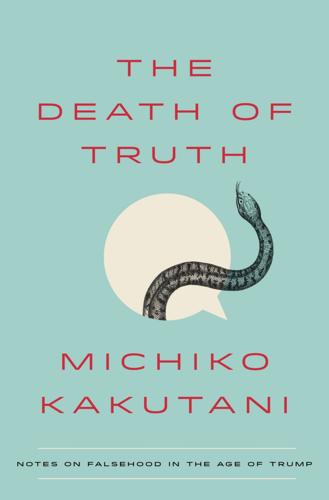
pages: 137 words: 38,925

The Death of Truth: Notes on Falsehood in the Age of Trump
by Michiko Kakutani
Published 17 Jul 2018

would even host a show: Laura Bradley, “Trump Bashes Schwarzenegger’s Celebrity Apprentice, Forgets He Still Produces It,” Vanity Fair, Jan. 6, 2017. “prince of humbugs”: Boorstin, Image, 209–11. Much the way images: Ibid., 241, 212. “desert of the real”: https://en.wikiquote.org/​wiki/​Jean_Baudrillard; Stanford Encyclopedia of Philosophy, s.v. “Jean Baudrillard”; Jean Baudrillard, Simulacra and Simulation (Ann Arbor: University of Michigan Press, 1994). “a secret society of astronomers”: Jorge Luis Borges, Ficciones (New York: Grove Press, 1962), loc. 21–22, 34, Kindle. “Reality gave ground”: Ibid., 33. “If there is something comforting”: Thomas Pynchon, Gravity’s Rainbow (New York: Viking Press, 1973), loc. 434, Kindle.

‘Cat-and-Mouse Game’ Generates Believable Fake Photos,” New York Times, Jan. 2, 2018; James Vincent, “New AI Research Makes It Easier to Create Fake Footage of Someone Speaking,” Verge, July 12, 2017; David Gershgorn, “AI Researchers Are Trying to Combat How AI Can Be Used to Lie and Deceive,” Quartz, Dec. 8, 2017; Stanford Encyclopedia of Philosophy, s.v. “Jean Baudrillard.” 8. “THE FIREHOSE OF FALSEHOOD”: PROPAGANDA AND FAKE NEWS “You can sway a thousand men”: Robert A. Heinlein, “If This Goes On—,” in Revolt in 2100 (New York: Spectrum, 2013), Kindle. the much lesser known Vladislav Surkov: Peter Pomerantsev, “Putin’s Rasputin,” London Review of Books, Oct. 20, 2011.

City: A Guidebook for the Urban Age
by P. D. Smith
Published 19 Jun 2012

Whereas cities such as New York or Chicago became major centres during the streetcar era, Los Angeles became a world city only after the car became a feature of everyday life. It is one of the first cities whose form was moulded by the automobile. From 1920 Los Angeles developed a new idea of public transport: ‘the public provides the road, and, to use it, you must bring the car.’39 As Jean Baudrillard has said, Los Angeles ‘is in love with its limitless horizontality, as New York may be with its verticality’.40 This sprawling, multi-centred city made up of low-density, single-family housing offers people a lifestyle that is only possible thanks to the car. Angelinos use the car for virtually everything: from commuting and visiting the mall or the cinema, to buying a hamburger.

By 2009, 746,635 runners had completed the London Marathon, and a record 35,694 people finished in 2007. It is the world’s largest single annual fund-raising event, generating a world-record breaking £46.7 million in 2008 and more than £500 million since it began. Not everyone is a fan, however. Jean Baudrillard has described the New York Marathon – the inspiration for London’s race – as ‘the end-of-the-world show’, a post-modern symbol ‘of the mania for an empty victory’. Like taggers and spray-can artists, marathon runners are saying: ‘I’m so-and-so and I exist!’48 Stadiums, like cultural institutions, have been used in recent years to revitalise post-industrial areas.

Metropolis was dominated by a skyscraper, a new Tower of Babel, the headquarters of the city’s ruler. Similarly, Scott’s future Los Angeles is overshadowed by the vast, seven hundred-storey pyramid of the Tyrell Corporation, its form reminiscent of that most famous ziggurat – the Tower of Babel. Jean Baudrillard, who visited the city not long after the film was released, noted that ‘there is nothing to match flying over Los Angeles by night’. But like the makers of Blade Runner, he, too, saw the dark side of this immense, sprawling metropolis: ‘only Hieronymus Bosch’s hell can match this inferno effect’.44 Inspired by the real Los Angeles, Ridley Scott’s future noir set new standards for depicting the cities of tomorrow.

words: 49,604

The Weightless World: Strategies for Managing the Digital Economy
by Diane Coyle
Published 29 Oct 1998

The value in what the financial markets do lies not just in financing tangible trade and direct investment flows, but increasingly in dematerialised functions such as hedging risk. Moreover, governments cannot reverse technological change Globalism and Globaloney 173 in the way they might be able to rebuild cross-border barriers. Much as he over-hypes it, Jean Baudrillard is intuitively right to think of the financial markets as having started to operate in a different sphere. War, depression and then war again broke down the old nineteenth-century imperial order. International trade collapsed. International investment came to comprise the American bankrolling of western Europe and to a far smaller extent the British subsidy of its colonies and commonwealth.

‘Each bundle of innovations has allowed a radical shift in the way that space is organised and therefore opened up radical new opportunities for the urban process.’8 I believe that the weightless economy, the product of the latest technological wave, will renew concentration in the great cities. This is an argument that The Weightless World 202 many people find counter-intuitive. At an abstract level, the philosopher Jean Baudrillard suggests that the modern economy is becoming steadily more and more divorced from the real world. In fact, there is a separate virtual economy, he suggests. ‘Our only reality is an unchecked orbital whirl of capital which, when it does crash, causes no substantial disequilibrium in real economies ...

These kinds of obstacles must be overcome. Governments will have to co-operate to police multinational banks, enforce contracts, co-ordinate rescues when a bank or country is in danger of going under, and even lend each other vast amounts of money in emergencies. In The Transparency of Evil, Jean Baudrillard portrays the global capital markets as an extreme phenomenon divorced from real economies. ‘Our only reality is an unchecked orbital whirl of capital, which, when it does crash, causes no substantial disequilibrium in real economies . . . The realm of mobile and speculative capital has achieved so great an autonomy that even its cataclysms leave no traces.’

pages: 717 words: 150,288

Cities Under Siege: The New Military Urbanism
by Stephen Graham
Published 30 Oct 2009

, 112. 114 Center for Land Use Interpretation, ‘Exhibition Review: Emergency State: First Responders and Emergency Training Architecture’, 2004, available at www.clui.org. 115 Richard Florida, The Rise of the Creative Class, New York: Basic Books, 2003. 116 ‘SimCity will be huge’, Suffolk News Herald, 10 May 2005. 117 Ibid. 118 Walter Benjamin, ‘The Work of Art in the Age of Mechanical Reproduction’, in Hannah Arendt Illuminations, ed., trans. Harry Zohn, New York: Schocken, 1968, 241. Thanks to Marcus Power for this reference. 119 Jean Baudrillard, The Gulf War Did Not Take Place, Bloomington, IN: Indiana University Press, 1991. 120 Jean Baudrillard, Simulacra and Simulation, Ann Arbor, MI: University of Michigan Press, 1994. 121 Abhinava Kumar, ‘America’s Army Game and the Production of War’, YCISS working paper 27, March 2004, 8. 122 James Der Derian, conference brief for Dis/Simulations of War and Peace Symposium, 6–7 June, 2004. 123 Kumar, ‘America’s Army Game and the Production of War’, 8. 124 Roger Stahl, ‘Have You Played the War on Terror?’

In their pre-invasion discussions about the threat of ‘urban warfare’ facing invading US forces in highly urbanized Iraq, for example, mainstream media such as Time Magazine repeatedly depicted stylized and intrinsically devious Orientalized streets in their colorful graphics.96 In these, every feature or element of the city seemed to be deceitful device that hid threats which needed to be addressed through the superior technological mastery of US military forces.97 The rhetoric of the War on Terror has become sufficiently diffuse that virtually any political opposition to the sovereign power of the US and its allies can be labelled as terrorist. ‘Without defined shape, or determinate roots’, writes Derek Gregory, the mantle of terrorism can now ‘be cast over any form of resistance to sovereign power’.98 Jean Baudrillard argues that ‘the system takes as objectively terrorist whatever is set against it’.99 Those frequently labelled as terrorists by national governments or sympathetic media since 9/11 include anti-war dissenters, striking dock workers, anti-globalization protestors, campaigners against the arms trade, computer hackers, artists, critical researchers, urban sociologists, advocates for ecological sustainability and freedom of speech, and pro-independence campaigners within US allies such as Indonesia – protagonists of a wide spectrum of opposition to transnational US dominance.

For a discussion of the Mumbai example, see Appadurai, Fear of Small Numbers, 87–114. 84 Said, Orientalism, 2003, vi. 85 Gregory, The Colonial Present. 86 Paul Gilroy, ‘Where Ignorant Armies Clash by Night’: Homogeneous Community and the Planetary Aspect’, International Journal of Cultural Studies 6, 2003, 263. 87 John Collins and Ross Glover, eds., Collateral Language: A user’s guide to America’s new war, New York: New York University Press, 2002. 88 Jasbir Puar and Amit Rai, ‘Monster, Terrorist, Fag: The War on Terrorism and the Production of Docile Patriots’, Social Text 20: 3, 2002, 117. 89 Mike Davis, ‘The Pentagon as Global Slumlord’, Tom Dispatch, February 2006. 90 Patai, The Arab Mind. 91 Derek Gregory, ‘The Angel of Iraq’, Society and Space 22: 3, 2004. 92 Qureshi and Sells, eds, The New Crusades, 2. 93 Cited in Jan Nederveen Pieterse, ‘Neoliberal Empire’, Theory, Culture & Society 21:3, 2004, 122. 94 Stephen Graham, ‘Lessons in Urbicide’, New Left Review 2:19, 2003, 2–3, 63–78. 95 Quoted on News24.com, 2004, see Stephen Graham, ‘Remember Fallujah: Demonizing Place, Constructing Atrocity’, Environment and Planning D: Society and Space, 23, 2005, 1–10. 96 Gregory, The Colonial Present, 222. 97 Ibid. 98 Gregory, The Colonial Present, 219. 99 Jean Baudrillard, ‘This Is the Fourth World War’, International Journal of Baudrillard Studies 1: 1, 2004. 100 Dawson, ‘Combat in Hell’, 177. 101 Gregory, ‘Geographies, Publics and Politics’, 9. CHAPTER THREE The New Military Urbanism Above all, [the United States’ new low-intensity war culture] is self-perpetuating and self-replicating; it normalizes and naturalizes a state of war.

pages: 415 words: 119,277

Naked City: The Death and Life of Authentic Urban Places
by Sharon Zukin
Published 1 Dec 2009

Time magazine named authenticity one of the ten most important ideas of 2007, partly because of the promotional campaign of two marketing gurus, James H. Gilmore and B. Joseph Pine II, whose work emphasizes this journey from things to experience, and partly because of the anxiety fueled by social theorists such as Walter Benjamin and Jean Baudrillard, who say that, through technology, imitation of novelty, and the normal hype of consumer culture, experience is increasingly seduced by appearances. Viewed through either of these lenses, a city is authentic if it can create the experience of origins. This is done by preserving historic buildings and districts, encouraging the development of small-scale boutiques and cafés, and branding neighborhoods in terms of distinctive cultural identities.2 Whether it’s real or not, then, authenticity becomes a tool of power.

“This will be increasingly important while areas of our economy are struggling from the turmoil on Wall Street.”15 These cultural strategies do bring one big benefit to elected officials: they suggest that all cities can be winners. Unlike old smokestacks and docks, they’re clean. Like shopping centers and Business Improvement Districts, they make people feel safe. They create a sense of belonging. The Gates, the Guggenheim, and the Cow Parade, as Jean Baudrillard once wrote about the “Beaubourg effect,” are a part of the “hypermarket of culture” that keeps people enthralled, “in a state of integrated mass.” As a result, public art installations, modern art museums, and festivals have become a pervasive part of cities’ toolkit to encourage entrepreneurial innovation and creativity, cleanse public spaces of visible signs of moral decay, and compete with other capitals of the symbolic economy of finance, media, and tourism.

Cover story, Time, March 24, 2008, pp. 52–54; James H. Gilmore and B. Joseph Pine II, Authenticity: What Consumers Really Want (Cambridge, MA: Harvard Business School Press, 2007); Walter Benjamin, The Arcades Project, trans. Howard Eiland and Kevin McLaughlin (Cambridge, MA: Harvard University Press, 1999); Jean Baudrillard, The Consumer Society (London: Sage, 1998). 3. John Hannigan, Fantasy City: Pleasure and Profit in the Postmodern Metropolis (London: Routledge, 1998). I first used “domestication by cappuccino” to describe the upgrading of Bryant Park in midtown Manhattan in The Cultures of Cities (Oxford: Blackwell, 1995). 4.

pages: 297 words: 83,651

The Twittering Machine
by Richard Seymour
Published 20 Aug 2019

iii A form of bait-and-switch trolling where users access a link pointing to seemingly interesting content, only to be confronted with the music video of Rick Astley’s 1980s hit, ‘Never Gonna Give You Up’. CHAPTER FIVE WE ARE ALL LIARS Everywhere socialization is measured by the exposure to media messages. Whoever is underexposed to the media is desocialized or virtually asocial Jean Baudrillard, Simulacra and Simulation A human being takes in far more information than he or she can put out. ‘Stupidity’ is a process or strategy by which a human . . . commits him- or herself to taking in no more information than she or he can put out Samuel Delany, Stars in My Pocket Like Grains of Sand Not to lie about the future is impossible and one can lie about it at will Naum Gabo, The Realistic Manifesto I.

Faked celebrity deaths, trolling, porn clickbait, advertisements, flurries of food and animal pictures, thirst traps, the endless ticker tape of messages, mean less than they perform. The increase of information corresponds to a decrease in meaning. Moreover, this production is taking place in a simulacrum much like that described by the theorist of postmodernity Jean Baudrillard.68 A simulacrum is not a representation of reality. It is reality, albeit reality generated from digital writing and simulated models. It is simulation woven into our lives, with effects every bit as real as stock-market values, or the belief in God. It is reality as a cybernetic production.

We are already living in the absolute, since we have already created eternal, omnipresent speed’, Filippo Tommaso Marinetti, The Futurist Manifesto, 1909. 66. By 2008, the average American consumed . . . Stephens, The Poetics of Information Overload, Kindle loc. 83. 67. When engineer Claude Shannon declared . . . Gleick, The Information: A History, A Theory, A Flood, pp. 251–9. 68. Moreover, this production is taking place in a . . . Jean Baudrillard, Simulacra and Simulation, University of Michigan Press: Ann Arbor, MI, 1994. 69. What seems like a device . . . Ian Hamilton, ‘Jaron Lanier Explains What Could Make VR “A Device Of Nightmares”’, Upload (www.uploadvr.com), 8 June 2018. 70. For example, the BBC alleges . . . Joel Gunter and Olga Robinson, ‘Sergei Skripal and the Russian disinformation game’, BBC News, 9 September 2018. 71.

pages: 191 words: 51,242

Unsustainable Inequalities: Social Justice and the Environment
by Lucas Chancel
Published 15 Jan 2020

Considering the United States today, the Israeli economist Ori Heffetz has shown that the greater one’s income, the larger the share of disposable income that is devoted to buying socially visible goods.39 The workings of this mechanism were penetratingly analyzed more than a century ago by the American economic sociologist Thorstein Veblen.40 In The Theory of the Leisure Class, Veblen argued that each social class seeks to imitate the consumption habits of the one above it in order to distance itself from the one beneath it. This idea of the invidious nature of consumption had been anticipated by Adam Smith’s notion of a human need for recognition; later it was to be echoed by the English economist Fred Hirsch’s concept of positional competition, and by the French sociologist and philosopher Jean Baudrillard’s concept of differentiation.41 Marketing specialists are very familiar with this effect. Apple, to name only one of a nearly endless number of examples, blithely makes use of it in advertising its iPhones: by purchasing the latest model, consumers buy more than a new and improved (according to the ads) bundle of applications—they buy themselves social status.

Ori Heffetz, “A Test of Conspicuous Consumption: Visibility and Income Elasticities,” Review of Economics and Statistics 93, no. 4 (2010): 1101–1117. 40. Thorstein Veblen, The Theory of the Leisure Class (1899; repr., New York: Penguin, 1994). 41. Adam Smith, The Theory of Moral Sentiments (1759; repr., London: Penguin, 2009); Fred Hirsch, The Social Limits to Growth, rev. ed. (London: Routledge, 1995); Jean Baudrillard, The Consumer Society: Myths and Structures (1970; repr., London: Sage, 1998). 42. Samuel Bowles and Yongjin Park, “Emulation, Inequality, and Work Hours: Was Thorsten Veblen Right?,” Economic Journal 115, no. 507 (2005): F397–F412. 43. Laurent, “Inequality as Pollution, Pollution as Inequality.” 44.

pages: 190 words: 56,531

Where We Are: The State of Britain Now
by Roger Scruton
Published 16 Nov 2017

The combat, for the latter, is not that of the proletariat against the bourgeoisie, but that of France against the culture of nowhere. The French attitude to globalization has also been ambivalent, and has undergone a radical overhaul in the last two years. The intellectuals of a previous generation were brought up on the leftist literature – from Guy Debord to Jean Baudrillard – that seems to welcome the commodification of the world with tongue in cheek.15 The Communist Manifesto’s ironical celebration of capitalism, as the agent by which ‘all that is solid melts into air’, became an ambiguous welcome extended by Debord to the society of the ‘spectacle’ and by Baudrillard to the culture of the ‘simulacrum’.

– the first line of the Czech national anthem. 10Information from BMG research on behalf of the Commission for National Renewal. 11On the inherent confrontation between Americanization and European culture see the evocative study by George Steiner, The Idea of Europe, London, 2004. 12See in general David Goodhart, The Road to Somewhere: The Populist Revolt and the Future of Politics, London, 2017, Chapter 4. 13See for example Finbarr Livesey, From Global to Local, London, 2017. 14See John R. Silber, Architecture of the Absurd: How ‘Genius’ Disfigured a Practical Art, London, 2007. 15See Guy Debord, La société du spectacle, Paris, 1967, Jean Baudrillard, Simulacres et simulation, Paris, 1981; G. Lipovetsky and J. Serroy, L’esthétisation du monde, Paris, 2006. 16See the new journal Limite, for example, which advocates an integral ecology, in which the human settlement is defended alongside the natural environment. 17See George A. Akerlof and Rachel E.

Smart Mobs: The Next Social Revolution
by Howard Rheingold
Published 24 Dec 2011

Haddon, “The Social Consequences of Mobile Telephony.” 36. Fortunati, “The Mobile Phone.” 37. Ibid., 17. 38. T. W. Adorno and M. Horkheimer, “The Culture Industry: Enlightenment as Mass Deception,” in The Dialectic of Enlightenment, trans. John Cumming (New York: Herder and Herder, 1972). 39. Jean Baudrillard, “Simulacra and Simulations,” in Jean Baudrillard, Selected Writings, ed. Mark Poster (Stanford: Stanford University Press, 1988), 166184. 40. Neil Postman, Amusing Ourselves to Death: Public Discourse in the Age of Show Business (New York: Viking, 1985). 41. Robert McChesney, Rich Media, Poor Democracy: Communication Politics in Dubious Times (Champaign: University of Illinois Press, 1999). 42.

In the 2000 edition of The Virtual Community, I discussed the “Frankfurt School” philosophers Adorno and Horkheimer who saw mass media as a weapon of psychological manipulation of the consumer by a culture industry that eats everything authentic, privatizes everything public, and feeds it back to people as pay-as-you-go fables.38 An even more extreme position was taken by Jean Baudrillard, whose descriptions of the “hyperreal” portray a world in which everyone is so mesmerized that they have forgotten that their environment is no longer real.39 Hyperreal media, Baudrillard proposed, are the ultimate refinement of capitalism, generating desire for consumption simply by manipulating the simulation of the moment.

pages: 378 words: 107,957

Cynical Theories: How Activist Scholarship Made Everything About Race, Gender, and Identity―and Why This Harms Everybody
by Helen Pluckrose and James A. Lindsay
Published 14 Jul 2020

They have also been criticized as “essentialist” for this reason. 5.A comprehensive account of every postmodern thinker and his or her sources of inspiration is beyond the scope of this book. 6.Jean François Lyotard, The Postmodern Condition: A Report on Knowledge (Manchester: Manchester UP, 1991). 7.Jean Baudrillard, Simulacra and Simulation, trans. Sheila Faria Glaser (Ann Arbor: University of Michigan Press, 1994). 8.Baudrillard takes this odd view to a macabre and nihilistic extreme, calling for drastic measures to return us to a more productive, pretechnological time. Jean Baudrillard, Symbolic Exchange and Death, trans. Iain Hamilton Gran (London: SAGE Publications, 2017). 9.Gilles Deleuze and Felix Guattari, Anti-Oedipus: Capitalism and Schizophrenia, trans.

The development of the scientific method in the nineteenth century was centered on skepticism and the need for increasingly rigorous testing and falsification. Beyond cynical “skepticism,” the postmodernists had concerns about the deaths of authenticity and meaning in modern society that also carried considerable weight, especially with French Theorists. These concerns were especially acutely expressed by Jean Baudrillard. For Baudrillard, whose nihilistic despair at the loss of the “real” drew heavily on the work of French psychoanalyst Jacques Lacan, all realities had become mere simulations (imitations of real-world phenomena and systems) and simulacra (“copies” of things without an original).7 Baudrillard described three levels of simulacra: associated with the premodern, modern, and postmodern.

pages: 350 words: 110,764

The Problem With Work: Feminism, Marxism, Antiwork Politics, and Postwork Imaginaries
by Kathi Weeks
Published 8 Sep 2011

But first, I want to concentrate on presenting the project’s major theoretical lineages and dominant conceptual frames, not to pre-view the analyses to come so much as to account for their inspiration and explain the kinds of claims and assumptions they presuppose. In terms of theoretical resources, although Max Weber, Jean Baudrillard, and Friedrich Nietzsche will each have a critical role to play at some point in the analysis, the project draws most heavily, albeit selectively, on the fields of feminist theory and Marxist theory, as this introductory discussion will illustrate. I should note, however, that it is not only political theory’s disregard for the politics of work that poses obstacles for this endeavor; as we will see, both feminism’s and Marxism’s productivist tendencies—their sometimes explicit, sometimes tacit pro-work suppositions and commitments—present problems as well.

Today when neoliberal and postneoliberal regimes demand that almost everyone work for wages (never mind that there is not enough work to go around), when postindustrial production employs workers’ minds and hearts as well as their hands, and when post-Taylorist labor processes increasingly require the self-management of subjectivity so that attitudes and affective orientations to work will themselves produce value, the dominant ethical discourse of work may be more indispensable than it has ever been, and the refusal of its prescriptions even more timely. The analysis thus attempts to account not only for the ethic’s longevity and power, but also its points of instability and vulnerability. Chapter 2 explores some theoretical tools with which we might exploit some of these openings. Drawing on Jean Baudrillard’s critique of productivism, the chapter explores the limitations of two familiar paradigms of Marxist theory, labeled here “socialist modernization” and “socialist humanism,” and then concentrates on an explication of autonomist Marxism’s theory and practice of the refusal of work. The critical review of the two earlier models presents an opportunity to confront the pro-work assumptions and values that remain stubbornly embedded within a number of theoretical frameworks, including some Marxist discourses, as well as instructive contrasts to the very different commitments animating the more recent example of autonomist Marxism.

To understand the refusal of work as a Marxist concept that nonetheless takes aim at a fairly broad swath of Marxist history, the chapter will begin with a brief genealogical account that will situate the refusal of work in relation to a history of conflict within Marxism over the nature, meaning, and value of work, a field of contestation for which the critique of productivism will serve as our point of entry. The critique of productivism in Marxism was put forth perhaps most succinctly and certainly most provocatively by Jean Baudrillard in The Mirror of Production. According to Baudrillard, “a specter haunts the revolutionary imagination: the phantom of production. Everywhere it sustains an unbridled romanticism of productivity” (1975, 17). As he sees it, historical materialism reproduces political economy’s fetishism of labor; the evidence of Marxism’s complicity can be found in a naturalized ontology of labor and a utopian vision of a future in which this essence is fully realized in the form of an unhindered productivity.

pages: 292 words: 106,826

Boom: Bubbles and the End of Stagnation
by Byrne Hobart and Tobias Huber
Published 29 Oct 2024

One of the drivers of economic growth in the last half-century has been the observation that the real world of atoms can be described in sequences of bits. But as technologies of bit manipulation improve, the artificial worlds they create are improving faster than the real one. The philosopher Jean Baudrillard referred to this category as technologies of the “hyper-real”: simulacra that lack a referent and become substitutes for reality. In other words, instead of building the future, we are becoming better at developing increasingly realistic simulations of it. The words “progress,” “innovation,” and “disruption” have become empty signifiers, ritualistically evoked in pitch decks and advertisements to suggest “world-changing” “novelty,” “creativity,” or “originality.”

Consequently, “creative destruction without destruction,” “capitalism without bankruptcy,” and “risk without consequences” essentially amount to Christianity without Hell. 51 And since Hell is not an attractive political pitch, the technocratic policies of perpetual risk suppression constantly create more systemic risk the harder they attempt to annihilate it. Naturally, eternal stagnation is preferred over economic collapse, which is not a political option. Stagnation, in other words, is a choice. The postmodern philosopher Jean Baudrillard was not primarily thinking about finance when he came up with the idea of hyper­reality, but the term is apt in this post-Bretton Woods universe, where hyper-financialization and central bank intervention have created the financial low-volatility complex. Baudrillard defines hyper­reality as “the generation by models of a real without origin or reality… a liquidation of all referentials.” 52 Hyperreality is a representation, a sign without an original referent.

I think that if we can help people, we need to help people… There is a thesis that the only way to restore the economy is by a necessary purging of previous excesses. In disagreeing, I am not saying there are not imbalances that need to be fixed… but subjecting the system to high unemployment and high rates of bankruptcy and foreclosure is a very inefficient way to get there.” Roger Lowenstein, “The Villain,” The Atlantic, April 2012. 52 Jean Baudrillard, Simulacra and Simulation (Ann Arbor: University of Michigan, 1994), 2. 53 Referring to the dichotomy between a real and a virtual economy, Baudrillard writes that “the sphere of virtual capital has become so autonomous, so orbitalized, that it can in some cases proliferate—or even devour itself—without leaving any trace… Between the two spheres [of the virtual and the real], there is no longer any communication… It is this break between the two, this loss of a referent on the part of the virtual economy, which enables it to produce prodigious effects, but it is also this which protects the real economy from the catastrophes which may occur in the other sphere.”

pages: 217 words: 63,287

The Participation Revolution: How to Ride the Waves of Change in a Terrifyingly Turbulent World
by Neil Gibb
Published 15 Feb 2018

This is the changing landscape of social economics. The consumer economy is based on generating value from products and content; the social economy, from participation and tools. 5. Generation why “We live in a world where there is more and more information, and less and less meaning” Jean Baudrillard, Simulacra and Simulation In early 2012, a teaser for a new HBO series, The Newsroom, showed up on YouTube. The clip contained the opening scene, in which the central character, a TV news anchor named Will McAvoy, played by 58-year-old actor Jeff Daniels, is on the panel of an American political talk show.

Mobilise a movement Principles • Enable participation Participation over content Tools over products • Make it a game – a deadly serious game Coopetitive Significant Networked 1. Weapons of mass participation “In dealing all the cards to itself, the system forced the Other to change the rules of the game. And the new rules are ferocious, because the game is ferocious” Jean Baudrillard In the introduction I briefly touched on the story of Donald Trump’s 2016 presidential campaign. I have to confess this made me a little nervous. No other Western leader this century has provoked so much reaction and division. Using his name has the same effect on some people that catnip and dog whistles have on cats and dogs.

pages: 405 words: 117,219

In Our Own Image: Savior or Destroyer? The History and Future of Artificial Intelligence
by George Zarkadakis
Published 7 Mar 2016

Politicians, oversensitive to voters’ mood swings and the mass media, which is grossly ignorant of science anyway, are too quick to put an end to anything that might appear a ‘waste of taxpayers’ money’. Thus, pressure to produce faster scientific results leads to the current, and rather worrying, phenomenon where scientific publications are sometimes published with fabricated results in order to look good. Nothing is real …6 A very prominent post-structuralist philosopher is Jean Baudrillard (1929–2007), who became more widely known thanks to the movie The Matrix. Baudrillard began his career as a teacher and a sociologist, but later took an interest in philosophy and cultural criticism, contributing one of the most interesting and hotly debated bodies of work in the field. His interests were wide and varied, and included mass media and postmodernity.

You do not have to be a cunning marketing executive, or indeed a politician, to adopt a vocabulary that undermines the true meaning of words. Impressions have a higher monetisation value than reflections. But even if you are a well-meaning communicator pursuing the higher goal of true elucidation, language is firmly set against you. We discussed how the French post-structuralist philosopher Jean Baudrillard cast doubt upon whether the First Gulf War actually ‘happened’, by challenging the language and other communication devices used to communicate the war through mass media. Likewise, when we talk about ‘Artificial Intelligence’, ‘consciousness’ and the ‘mind’, we often lose ourselves in the translation of metaphors.

The father of structural linguistics, Ferdinand de Saussure, has exerted major influence on structuralists. 4The list of post-structuralist philosophers includes philosopher and historian Michel Foucault, philosopher and social commentator Jacques Derrida, Marxist philosopher Louis Althusser, literary critic Roland Barthes, and philosopher Jean Baudrillard. 5Latour B., and Woolgar S. (1979), Laboratory Life: The Social Construction of Scientific Facts. Los Angeles: Sage Publications. 6Lyrics from the Beatles’ song ‘Strawberry Fields Forever’. 7Baudrillard J. (1991), La Guerre du Golfe n’a pas eu lieu. Paris: Galilée. 8I adopt the word ‘metaphor’ instead of Baudrillard’s ‘simulation’ to avoid confusion with the same word, as I will use it to describe computer simulations of life and the brain in later chapters.
pages: 287 words: 86,919

Protocol: how control exists after decentralization
by Alexander R. Galloway
Published 1 Apr 2004

He lauds the new electronic media for being “oriented towards action, not contemplation; towards the present, not [bourgeois] tradition.”9 The very immateriality of the media resists commodification and reification, suggests Enzensberger: “The media produce no objects that can be hoarded and auctioned,”10 and later: “The media also do away with the old category of works of art which can only be considered as separate objects . . . The media do not produce such objects. They create programs. Their production is in the nature of a process.”11 The discovery of processes where once there were objects—this is perhaps the most fundamental moment in a Marxist method. Jean Baudrillard’s “Requiem for the Media” was inspired by Enzensberger, but he rewrites Enzensberger’s battle cry “there is no Marxist theory of the media” as simply “there is no theory of the media,” Marxist or otherwise.12 This suggests that Baudrillard wants to push media theory out of the realm of pure Marxism (Enzensberger’s position) and into the realm of signification and communication.

He says as much: “One retains the general form of Marxist analysis . . . , but admits that the classical definition of productive forces is too restricted, so one expands the analysis in terms of productive forces to the whole murky field of signification and communication.”13 While ostensibly non-Marxist, it is worth noting here the work of Norbert Wiener and Vannevar Bush, two of the most important thinkers in the history of computers and electronic media. 9. Enzensberger, “Constituents,” p. 105. 10. Enzensberger, “Constituents,” p. 105. 11. Enzensberger, “Constituents,” p. 121. 12. Jean Baudrillard, “Requiem for the Media,” in Video Culture, ed. John Hanhardt (Layton, UT: Peregrine Smith Books, 1986), p. 124. 13. Baudrillard, “Requiem for the Media,” pp. 124–125. Chapter 2 58 Wiener’s theory of dynamic systems, known as cybernetics, acts as an alternative or even a precursor to network theory.

pages: 337 words: 87,236

Fallen Idols: Twelve Statues That Made History
by Alex von Tunzelmann
Published 7 Jul 2021

The Indian Express suggested that Prajapati made the Firdos Square statue among several other bronzes of Saddam, after meeting him once in 1997.7 The fact that two entirely different people have been claimed as the creator of this statue, though, is characteristic of the story. The boundary between what is real and what is fake would soon disappear altogether. The French philosopher Jean Baudrillard defined ‘hyperreality’ – a state in which you cannot tell the difference between reality and a simulation, or ‘simulacrum’, of reality. In 1991, at the time of the first Gulf War, he wrote three essays touching on this theme, later published together as The Gulf War Did Not Take Place. The assertion in the title seemed ridiculous to many, and the style of the essays was dense and theoretical.

./. 7James Meek, ‘The sculptor’, Guardian, 19 March 2004; Andrew Buncombe, ‘Mayawati Kumari: Untouchable and unstoppable’, Independent, 4 February 2008; Lalmani Verma and Chinki Sinha, ‘The men and women at work’, Indian Express, 5 July 2009; Swati Mathur, ‘Indian idols’, Times of India, 3 April 2010. 8Jean Baudrillard, The Gulf War Did Not Take Place, translated by Paul Patton (Bloomington, IN: Indiana University Press, 1995), pp. 53, 24, 64. See also Samuel Strehle, ‘A poetic anthropology of war: Jean Baudrillard and the 1991 Gulf War’, International Journal of Baudrillard Studies, vol. 11, no. 2, May 2014. 9Quoted in Nicholas Watt, ‘Baghdad is safe, the infidels are committing suicide’, Guardian, 8 April 2003. 10Colonel Chris Vernon, transcribed in ‘British Military Update’, CNN, 29 March 2003, available at http://transcripts.cnn.com/TRANSCRIPTS/0303/29/se.14.html. 11Peter Maass, ‘The Toppling: How the media inflated a minor moment in a long war’, New Yorker, 3 January 2011. 12Florian Göttke, Toppled, pp. 58–65. 13Peter Maass, ‘The Toppling’; ‘I toppled Saddam’s statue, now I want him back’, BBC News, 5 July 2016, https://www.bbc.co.uk/news/av/world-36712233; ‘Iraqi who toppled Saddam Hussein’s statue 15 years ago regrets his action’, NPR, 9 April 2018; ‘Saddam Hussein statue toppled in Baghdad, April 2003 – video’, Guardian, 9 March 2013, https://www.theguardian.com/world/video/2013/mar/09/saddam-hussein-statue-toppled-bagdhad-april-2003-video; Florian Göttke, Toppled, pp. 21–40. 14Patrick Baz, ‘A tale of two statues’, AFP Correspondent, 9 April 2018, https://correspondent.afp.com/tale-two-statues. 15Quoted in Peter Maass, ‘The Toppling’; Dhiaa Kareem, ‘“The Butcher of Baghdad”: US Press Hyper-personalization of the US-led Invasion of Iraq’, Annual Review of Education, Communication & Language Sciences, vol. 16, p. 124; Anton Antonowicz, ‘What was it like in Baghdad when Saddam Hussein’s statue was toppled?
pages: 244 words: 81,334

Picnic Comma Lightning: In Search of a New Reality
by Laurence Scott
Published 11 Jul 2018

And yet, with the widespread cultural rise of theatrical obscenity – the offstage perspective – the opposite appears to be true. It is the bloopers and ruptures of the performance that turn us on. Increasingly we encounter public life – on television and social media – as a curious, ironic mix of artifice and reality, as a fantasy that deliberately undoes itself. In the early 1980s, the philosopher Jean Baudrillard described the rise of mass-media technologies as a ‘pornography of information18 and communication, circuits and networks’, which over-expose social life, turning it transparent, making the private sphere obscene by wheeling it onto the public stage. ‘This white obscenity,’ Baudrillard wrote, ‘this crescendo of transparency reaches its summit with the collapse of the political scene.’

Storey and Arlene Allan: A Guide to Ancient Greek Drama (Oxford: Blackwell Publishing, 2005); ‘plays on the …’, David Wiles, Greek Theatre Performance (Cambridge: Cambridge University Press, 2000). 14 ‘says what he …’, see The New York Times/CBS Poll, 4th–8th December 2015; ‘never turn around …’, see ‘Watch Ben Carson endorse Donald Trump full news conference’, PBS NewsHour YouTube Channel, 11th March 2016. 15 ‘Anyone who knows …’, see ‘Donald Trump apologises for controversial video remarks’, Fox News YouTube Channel, 7th October 2016; ‘everyone can draw …’, see ‘Watch Live: The 2nd Presidential Debate’, CBS News YouTube Channel, 9th October 2016. 16 ‘If, for example …’, Herbert Marcuse, An Essay on Liberation (Boston, MA: Beacon, 1969). 17 ‘I had to …’, The Last Unicorn, dir. Jules Bass and Arthur Rankin, Jr, Rankin/Bass Productions, 1982. 18 ‘pornography of information …’, Jean Baudrillard, Revenge of the Crystal: Selected Writings on the Modern Object and its Destiny, 1968– 1983, ed. and trans. Paul Foss and Julian Pefanis (London: Pluto Press, 1999). Romance Languages 1 ‘play a central …’, George Lakoff and Mark Johnson, Metaphors We Live By (Chicago, IL: Chicago University Press, 1980); ‘Metaphor creates a …’, Wallace Stevens, ‘Adagia’, in Collected Poetry and Prose, ed.

pages: 322 words: 88,197

Wonderland: How Play Made the Modern World
by Steven Johnson
Published 15 Nov 2016

(In the United States alone, amusement parks generate more than $50 billion in economic activity each year.) But these fantasylands turned out to have philosophical implications as well. A rich tradition of continental philosophy emerged in the 1970s—most famously Umberto Eco’s Travels in Hyperreality and Jean Baudrillard’s Simulacra and Simulation—decrying the illusory artifice of modern culture, all the theme restaurants and megamalls and old downtowns converted into spectacles of consumption. “Disneyland is presented as imaginary in order to make us believe that the rest is real,” Baudrillard famously announced in Simulacra and Simulation, “whereas all of Los Angeles and the America that surrounds it are no longer real, but belong to the hyperreal order and to the order of simulation.”

“Let man visit Ourang-outang”: Ibid., Kindle locations 854–858. “An enormous task lay”: Eric Ames, Carl Hagenbeck’s Empire of Entertainments (Seattle: University of Washington Press, 2008), 163. At the summit of the “Northern Plateau”: Ibid., 180. “When you approach the Lions’ Ravine”: Ibid., 184. “Disneyland is presented”: Jean Baudrillard, Simulacra and Simulation (Ann Arbor, MI: University of Michigan Press, 1994), 12. Conclusion The model has several variants: R. A. Rescorla and A. R. Wagner, “A Theory of Pavlovian Conditioning: Variations in the Effectiveness of Reinforcement and Nonreinforcement,” in A. H. Black and W.

pages: 342 words: 90,734

Mysteries of the Mall: And Other Essays
by Witold Rybczynski
Published 7 Sep 2015

She maintains that she only writes about buildings she has personally visited but includes an extended discussion of the new Disney community of Celebration that appears to be based entirely on promotional brochures. Huxtable’s polemic leans heavily on the writing of European intellectuals such as Umberto Eco, André Corboz, and Jean Baudrillard. They provide a shaky support, consisting chiefly of academic jargon: “surrogate experience,” “artificial environments,” and “simulacra.” Such pseudoscientific terms are intended to lend credence to a thesis that is, at its core, unconvincing. It presumes that the public—except you, wise reader—cannot tell the difference between what is real and what is not, that we live in a sort of perpetual haze.

The Taste Pilots’ Grill, for example, is shoehorned into a jet-engine testing workshop, with Chuck Yeager’s Bell X-1 suspended over the entrance; elsewhere, the restrooms are in a pilots’ shack; and a ride called Soarin’ over California is housed in what appears to be an old hangar. Braverman insists that we go in. I generally avoid amusement park rides, but this one, thanks to a Disney-developed cinematic projection process called Omnimax, is truly breathtaking. Jean Baudrillard once visited Disney World and wrote archly about “simulacra” and “hyper-reality.” What would he make of this park? It is both about California and in California, it refers to the past yet is about today, it contains a portion of real vineyard and a real bakery next to a fake oceanfront and a simulated—but geologically accurate—mountain.

Artificial Whiteness
by Yarden Katz

In October 2019 Microsoft finally beat Amazon in a bid for the Pentagon’s ten-billion-dollar cloud infrastructure contract, meaning that for the next decade, Microsoft will build the U.S. military’s cloud-computing backbone.44 At the same time, Microsoft has continued to invest in infrastructure for surveilling Palestinians in the West Bank on behalf of the Israeli military.45 With strategic partnerships and clever branding, Microsoft manages to be on the front lines of both the battlefield and social justice. * * * Since the 2010s the discourse on AI has blended with discourses on social justice, which carceral-positive logic appropriates. But if there seemed to be a major difference between critical AI experts and unreconstructed entrepreneurs and CEOs, it was merely, to borrow from Jean Baudrillard, “a simulation of scandal for regenerative ends.”46 The regenerative end here is the expansion of computing systems and data collection—for governance by the numbers and enhancing the carceral eye—while installing more experts to maintain and justify such systems. How does AI manage to move seamlessly between the worlds of military planners, corporations, and now progressive-sounding projects on social justice while still serving essentially the same capitalist and imperial agenda of white supremacy?

,” NBC News, 2019. The Israeli company Microsoft has invested in is AnyVision, whose tagline is “Making AI Accessible to the World.” AnyVision has also partnered with Nvidia, among other companies, “to achieve high-speed, real-time face recognition from surveillance video streams.”   46.   Jean Baudrillard, Simulacra and Simulation, trans. Sheila Faria Glaser (Ann Arbor: University of Michigan Press, 1994), 16. 5. ARTIFICIAL WHITENESS     1.   Max Tegmark, Life 3.0: Being Human in the Age of Artificial Intelligence (New York: Knopf, 2017), 119.     2.   Toni Morrison, Playing in the Dark: Whiteness and the Literary Imagination, William E.

pages: 359 words: 105,248

Power Button: A History of Pleasure, Panic, and the Politics of Pushing
by Rachel Plotnick
Published 24 Sep 2018

Howard Eiland and Michael W. Jennings, vol. 4, 1938–1940 (Cambridge, MA: Harvard University Press), 328. 6. The Factory Management Series: Machinery and Equipment (Chicago: A. W. Shaw Company, 1915). 7. Karl Marx and Friedrich Engels, Manifesto of the Communist Party (London: Reeves, 1888). 8. Jean Baudrillard, The System of Objects (London: Verso, 2005); Michel de Certeau, Luce Giard, and Pierre Mayol, The Practice of Everyday Life: Living and Cooking, vol. 2 (Minneapolis: University of Minnesota Press, 1998); Vilém Flusser, Shape of Things: A Philosophy of Design (London: Reaktion Books, 1999). 9. 

For a history of changes to internal communication practices in businesses, see Joanne Yates, Control through Communication: The Rise of System in American Management (Baltimore: Johns Hopkins University Press, 1989). 12. “Electric Current-Selling Devices,” Electrical Record and Buyer’s Reference 5, no. 6 (1909): 262. 13. Jean Baudrillard, The System of Objects (London: Verso, 2005), 58–59. 14. Michel de Certeau, Luce Giard, and Pierre Mayol, The Practice of Everyday Life: Living and Cooking, vol. 2 (Minneapolis: University of Minnesota Press, 1998), 212. 15. de Certeau et al., The Practice of Everyday Life, 212. 16. Langdon Winner, Autonomous Technology: Technics-out-of-Control as a Theme in Political Thought (Cambridge, MA: MIT Press, 1977), 42. 17. 

pages: 341 words: 116,854

The Devil's Playground: A Century of Pleasure and Profit in Times Square
by James Traub
Published 1 Jan 2004

Taylor understood Times Square as the all-but-perfected form of a new world, a world whose essential commodity was information, and which was thus based on the insubstantial, the transitory, the instantly transmissible—information as a universal currency into which all the solid things of the world are translated. In the world of bits, distinctions between surface and depth, high and low, original and reproduction, fall away. This was the world described by the French sociologist Jean Baudrillard, who, in Simulacra and Simulations, declared the death of a stable world of correspondences, in which, say, the relationship of physical territory to map was understood as that of a real thing to its abstract representation. By contrast, in a world of simulations and infinite reproduction, Baudrillard writes, “The territory no longer precedes the map, nor survives it.

.: MIT Press, 2001); Rem Koolhaas, Delirious New York: A Retroactive Manifesto for New York (New York: Oxford University Press, 1978). CHAPTER TWENTY Marshall Berman, “Signs of the Times,” in Dissent, Fall 1997; Lynne B. Sagalyn, Times Square Roulette: Remaking the City Icon (Cambridge, Mass.: MIT Press, 2001). CHAPTER TWENTY-ONE Mark C. Taylor, Hiding (Chicago: University of Chicago Press, 1997); Jean Baudrillard, Simulacra and Simulations (Ann Arbor: University of Michigan Press, 1994). JAMES TRAUB has been writing about the politics, culture, characters, and institutions of New York City for twenty-five years. Currently a contributing writer for The New York Times Magazine, he has also served as a staff writer for The New Yorker and has written for the country’s leading publications in fields as diverse as foreign affairs, national politics, education, urban policy, sports, and food.

pages: 412 words: 116,685

The Metaverse: And How It Will Revolutionize Everything
by Matthew Ball
Published 18 Jul 2022

Yet there is no reason to assume that such an outcome is inevitable, or even likely, for the actual Metaverse. A perfect society tends not to make for much human drama, and human drama is the root of most fiction. As a point of contrast, we can consider the French philosopher and cultural theorist Jean Baudrillard, who coined the term “hyperreality” in 1981 and whose works are often linked to those of Gibson, and those Gibson influenced.‡ Baudrillard described hyperreality as a state in which reality and simulations were so seamlessly integrated that they were indistinguishable. Though many find this idea frightening, Baudrillard argued that what mattered was where individuals would derive more meaning and value—and speculated it would be in the simulated world.5 The idea of the Metaverse is also inseparable from the ideas of the Memex, but where Bush imagined an infinite series of documents linked together via words, Stephenson and others conceived infinitely interconnected worlds.

‡ When asked about Baudrillard in April 1991, Gibson said, “He’s a cool science-fiction writer” (Daniel Fischlin, Veronica Hollinger, Andrew Taylor, William Gibson, and Bruce Sterling, “‘The Charisma Leak’: A Conversation with William Gibson and Bruce Sterling,” Science Fiction Studies 19, no. 1 [March 1992], 13). The Wachowskis tried to involve Baudrillard in their film, but he declined and later described the film as a misread of his ideas (Aude Lancelin, “The Matrix Decoded: Le Nouvel Observateur Interview with Jean Baudrillard,” Le Nouvel Observateur 1, no. 2 [July 2004]). When Morpheus introduces the film’s protagonist to the “real world,” he tells Neo “As in Baudrillard’s vision, your whole life has been spent inside the map, not the territory.” (Lana Wachowski and Lilly Wachowski, The Matrix, directed by Lana Wachowski and Lilly Wachowski [1999; Burbank, CA: Warner Bros., 1999], DVD.)

pages: 311 words: 130,761

Framing Class: Media Representations of Wealth and Poverty in America
by Diana Elizabeth Kendall
Published 27 Jul 2005

By this I mean that the framing of news articles and television story lines does not necessarily realistically portray class and how it affects our daily lives. We should not assume that what we see in the media accurately reflects class and class-based inequalities. In fact, contemporary media messages about class have a limited basis in reality. At the extreme, French social theorist Jean Baudrillard argues that media images have replaced reality to an extent that we are unable to distinguish between a media image of reality and reality itself.15 Other scholars join him, arguing that for many people the media constitute “reality” as much as anything that actually happens in the real world.

Manoff and Michael Schudson, 197–229 (New York: Pantheon, 1987). 13. Gaye Tuchman, Making News: A Study in the Construction of Reality (New York: Free Press, 1978), 193. 14. Max Horkheimer and Theodor W. Adorno, Dialectic of Enlightenment, trans. John Cummings (New York: Continuum International, 2002 [1944]). 15. Jean Baudrillard, Simulations (New York: Semiotext[e], 1983). 16. Gitlin, The Whole World Is Watching, 1. 17. Peter L. Berger and Thomas Luckmann, The Social Construction of Reality: A Treatise in the Sociology of Knowledge (New York: Anchor/Doubleday, 1967), 189. 18. Berger and Luckmann, The Social Construction of Reality, 131. 19.

Howard Rheingold
by The Virtual Community Homesteading on the Electronic Frontier-Perseus Books (1993)
Published 26 Apr 2012

At the same time, the birth of advertising and the beginnings of the public-relations industry began to undermine the public sphere by inventing a kind of buyable and sellable phony discourse that displaced the genuine kind. The simulation (and therefore destruction) of authentic discourse, first in the United States, and then spreading to the rest of the world, is what Guy Debord would call the first quantum leap into the "society of the spectacle" and what Jean Baudrillard would recognize as a milestone in the world's slide into hyper-reality. Mass media's colonization of civil society turned into a quasipolitical campaign promoting technology itself when the imagemaking technology of television came along. ("Progress is our most important product," said General Electric spokesman Ronald Reagan, in the early years of television.)

There is no place left where people can discuss the realities which concern them, because they can never lastingly free themselves from the crushing presence of media discourse and of the various forces organized to relay it. . . . What is false creates taste, and reinforces itself by knowingly eliminating any possible reference to the authentic. And what is genuine is reconstructed as quickly as possible, to resemble the false. Another French social critic, Jean Baudrillard, has been writing since the 1960s about the increasingly synthetic nature of technological civilization and a culture that has been irrevocably tainted by the corruption of our symbolic systems. This analysis goes deeper than the effects of media on our minds; Baudrillard claims to track the degeneration of meaning itself.
pages: 512 words: 131,112

Retrofitting Suburbia, Updated Edition: Urban Design Solutions for Redesigning Suburbs
by Ellen Dunham-Jones and June Williamson
Published 23 Mar 2011

Census Bureau, Census 2000 Special Reports, Series CENSR-4, Demographic Trends in the 20th Century (Washington: U.S. Government Printing Office, 2002). 4 Brenda Case Scheer, “The Anatomy of Sprawl,” Places 14:2 (Fall 2001): 28–37. Chapter 1 1 Sociologist Jean Baudrillard’s theorization of simulacra proposes that the contemporary world is dominated by copies for which there are no originals, an observation that several authors have related to the architecture of suburbia. See in particular, Jean Baudrillard, America, trans. Chris Turner (London: Verso, 1988). 2 Examples from the popular press include the following: Karrie Jacobs, “The Manchurian Main Street,” Metropolis, June 2005, 110, 112, 114; Thaddeus Herrick, “Fake Suburban Towns Offer Urban Life Without the Grit,” Wall Street Journal online, June 1, 2006; John King, “Instant Urbanism, Citified Suburbs Becoming New Model for the Bay Area,” San Francisco Chronicle, April 8, 2007. 3 Although on a per acre basis cities look like big polluters and energy users compared to suburbs, the story is reversed in a per capita view.

pages: 184 words: 54,833

Why Orwell Matters
by Christopher Hitchens
Published 1 Jan 2002

On the Left, Louis Althusser’s attempt to recreate Communism by abstract thought was probably the last exhalation of the idea, terminating in his own insanity and by what I once rather heartlessly called his application for the Electric Chair of Philosophy at the École Abnormale. While among the more affectless and detached (‘post-modernism’ consisting in essence of the view that nothing would ever again happen for the first time), Jean Baudrillard won golden opinions for such propositions as the fictional nature of the Gulf War, a war which, he ‘ironically suggested, had not ‘really’ taken place. In confrontations between this cult of the arcane and the ‘virtual’ and its critics, the name of George Orwell kept insistently surfacing. A new stage in the argument was opened by Professor Alan Sokal, who in 1997 submitted a satirical article to the journal Social Text.

pages: 196 words: 54,339

Team Human
by Douglas Rushkoff
Published 22 Jan 2019

Dennis Des Chene, Spirits and Clocks: Machine and Organism in Descartes (Ithaca, NY: Cornell University Press, 2000). We sought to operate faster George Lakoff, Metaphors We Live By (Chicago: University of Chicago Press, 1980). Lewis Mumford, Myth of the Machine (Boston: Mariner, 1971). Neil Postman, Technopoly: The Surrender of Culture to Technology (New York: Vintage, 1993). Jean Baudrillard, Simulacra and Simulation (Ann Arbor: University of Michigan Press, 1994). It’s not just treating machines as living humans; it’s treating humans as machines John Seely Brown and Paul Duguid, The Social Life of Information (Cambridge, MA: Harvard Business Review Press, 2000). 38. Study after study has shown that human beings cannot multitask Clifford Nass, “Cognitive Control in Media Multitaskers,” Pro­ceedings of the National Academy of Sciences 106, no. 27 (September 15, 2009). 39.

pages: 467 words: 149,632

If Then: How Simulmatics Corporation Invented the Future
by Jill Lepore
Published 14 Sep 2020

In 1973, the avant-garde German filmmaker Rainer Werner Fassbinder adapted Simulacron-3 into World on a Wire, a terrifying futurist tour de force, a forerunner to the 1999 film The Matrix in which all of humanity lives in a simulation, locked, trapped, deluded, and dehumanized; Matrix’s main character, trying to set humanity free, hides stolen software inside a hollowed-out copy of Jean Baudrillard’s 1981 book, Simulacra and Simulation, a metatext about the meaningless “hell of simulation.”8 In fiction and film, Dr. Frankenstein yielded to Dr. Jekyll and, finally, to Dr. Strangelove, as mad science moved from biology to chemistry to physics. But Simulmatics’ fiction-and-film avatar—the mad scientist of computer science—is wildly outsized, the lengthening shadow of a very small man.

ELG, “Statement to Simulmatics Stockholders, September 20, 1966,” printed brochure, Pool Papers, Box 177, no folder. TBM, “The People-Machine,” Harper’s, June 1961. EB, The 480 (New York: McGraw-Hill, 1964). Daniel F. Galouye, Simulacron-3 (1964; repr., Rockville, MD: Phoenix Pick, 2011). Jean Baudrillard, Simulacra and Simulation (1981; Ann Arbor: University of Michigan Press, 1994), 18. Chapter 1: Madly for Adlai That wise man was Paul Baran of RAND. See his RAND obituary at https://www.rand.org/news/press/2011/03/28/index1.html. Abigail Casey, Registrar’s Office, Wabash College, e-mail to the author, July 23, 2018.

pages: 483 words: 144,957

At the Existentialist Café: Freedom, Being, and Apricot Cocktails With Jean-Paul Sartre, Simone De Beauvoir, Albert Camus, Martin Heidegger, Maurice Merleau-Ponty and Others
by Sarah Bakewell
Published 1 Mar 2016

In 1966 Michel Foucault predicted that ‘man’, being a relatively recent invention, might soon be ‘erased, like a face drawn in sand at the edge of the sea’ — an image that recalls Lévi-Strauss’ call for studies that would ‘dissolve man’. Later, at the turn of the twenty-first century, the postmodernist Jean Baudrillard dismissed Sartrean philosophy as a historical curiosity, like the classic 1950s films whose old-fashioned psychological dramas and clear characterisation ‘express marvellously well the — already banal — post-Romantic death throes of subjectivity’. No one needs this kind of ‘existential garb’ any more, Baudrillard wrote.

On Gray, see Woessner, Heidegger in America, 132–59. 64 Robbe-Grillet: Alain Robbe-Grillet, For a New Novel, tr. Richard Howard (NY: Grove, 1965), 64. 65 ‘Erased’: Michel Foucault, The Order of Things (London: Tavistock, 1970), 387. ‘Dissolve man’: Claude Levi-Strauss, The Savage Mind (London: Weidenfeld & Nicolson, 1966), 247. 66 ‘Express’ and ‘Who cares about freedom?’: Jean Baudrillard, Impossible Exchange, tr. C. Turner (London: Verso, 2001), 73. See Jack Reynolds and Ashley Woodward, ‘Existentialism and Poststructuralism: some unfashionable observations’, in Felicity Joseph, Jack Reynolds & Ashley Woodward (eds), The Continuum Companion to Existentialism (London: Continuum, 2011), 260–81. 67 Plays in Prague: ASAD, 358.

pages: 219 words: 61,334

Brit-Myth: Who Do the British Think They Are?
by Chris Rojek
Published 15 Feb 2008

However, in the matter of public proclamations on government policy the monarch is obliged to stay mute. Failure to observe this unwritten ordinance would precipitate a constitutional crisis. 39 ‘C O O L BRITANNIA’ AND THE NATION ‘A Very Strange Country’ The late French postmodernist writer Jean Baudrillard once declared that Britain is ‘a very strange country (cited in Mike Gane’s Baudrillard Live, p. 208). So it must seem to many British, as well as non-British citizens. For crucial matters of constitutional rule depend upon centuries of unwritten precedent rather than codified rules or democratic elections.

pages: 198 words: 63,612

Practical Anarchism: A Guide for Daily Life
by Scott. Branson
Published 14 Jun 2022

Even a film such as They Live— where the protagonist finds a pair of glasses that allow him to see the subliminal messages that control behavior through state and media in an apocalyptic USA—oversimplifies the process I am suggesting here, which is more like a kaleidoscope shift than a full-on replacement of one world with another. The Matrix allegory can be traced back to anarchist aligned theorization, from Jean Baudrillard’s simulacrum to Guy Debord’s society of the spectacle, which theorize that the current stage of capitalism replaces society with an image of itself: a highly mediated form of engagement that removes people from their environment and social bonds with others. Even a liberal political thinker, Hannah Arendt, theorized this as “image making,” in response to the US government and media representation of the war in Vietnam.

pages: 199 words: 62,204

The Passenger: Paris
by AA.VV.
Published 26 Jun 2021

It was only when I turned around to get a better look at the gentleman’s face that I realised it was Allen Ginsberg, and I smiled at this fortuitous encounter with one of my heroes. But I was very shy and didn’t dare go up and speak to him. * I must now turn to a text of around five thousand words (that is, roughly the same length as the article you are reading now), written in 1977 by Jean Baudrillard: ‘L’Effet Beaubourg’ (‘The Beaubourg Effect’). Once again, the Pompidou Centre can take pride in a rare thing, namely that a philosopher should dedicate a whole essay to it shortly after it opened. Baudrillard was more than critical. He attacked the architecture and the way the building operated for resembling a nuclear power station, an airport, a supermarket – in other words, places of flow management, whether of people, baggage, fluids, merchandise or energy.

pages: 1,015 words: 170,908

Empire
by Michael Hardt and Antonio Negri
Published 9 Mar 2000

This postmodernist critical sensibility is extremely important in this regard because it constitutes the proposition (or the symptom) ofa break with respect to the entire development ofmodern sovereignty. It is difficult to generalize about the numerous discourses that go under the banner ofpostmodernism, but most ofthem draw at least indirectly on Jean-Franc¸ois Lyotard’s critique ofmodernist master narratives, Jean Baudrillard’s affirmations of cultural simula- cra, or Jacques Derrida’s critique ofWestern metaphysics. In the most basic and reductive formulation, postmodernist theories are 140 P A S S A G E S O F S O V E R E I G N T Y defined by many oftheir proponents as sharing one single common denominator, a generalized attack on the Enlightenment.2 From this perspective the call to action is clear: Enlightenment is the problem and postmodernism is the solution.

Rahman, Islam and Modernity, p. 136. 18. Robert Reich, The Work of Nations (New York: Random House, 1992), pp. 8 and 3. 19. See Arjun Appadurai, ‘‘Disjuncture and Difference in the Global Cultural Economy,’’ in Modernity at Large (Minneapolis: University ofMinnesota Press, 1996), pp. 27–47. 20. See, for example, Jean Baudrillard, Selected Writings, ed. Mark Poster (Oxford: Blackwell, 1988); and Umberto Eco, Travels in Hyper-reality, trans. William Weaver (London: Picador, 1986), pp. 3–58. 21. Stephen Brown, Postmodern Marketing (London: Routledge, 1995), p. 157. Whereas marketing practice is postmodernist, Brown points out, market- ing theory remains stubbornly ‘‘modernist’’ (which here means positivis- tic).

pages: 246 words: 70,404

Come and Take It: The Gun Printer's Guide to Thinking Free
by Cody Wilson
Published 10 Oct 2016

CLICK HERE TO SIGN UP or visit us online to sign up at eBookNews.SimonandSchuster.com For my parents, Dennis and Cecelia and To the memory of my grandfather, Harold B. Wilson There is much more to be hoped for in an excess of information or of weapons than in the restriction of information or arms control. —Jean Baudrillard CONTENTS PROLOGUE WikiLeaks, Solid Imaging, and Open Source PART I Wiki Weapon PART II Ministry of Defense PART III The Gun Printer PART IV Terror PART V Danger PART VI Jarhead Angel PART VII John PART VIII Modern Politics PART IX Dropping the Liberator PART X Old Street PART XI Who Does What to Whom PART XII Wine-Dark PART XIII Undetectable PART XIV REDACTED EPILOGUE Nine Months of Night About Cody Wilson PROLOGUE WikiLeaks, Solid Imaging, and Open Source At high summer, we gathered in Little Rock at the Peabody.

pages: 306 words: 78,893

After the New Economy: The Binge . . . And the Hangover That Won't Go Away
by Doug Henwood
Published 9 May 2005

Material production, as well as services, become subordinate to the handling of information.... And this, from the first volume of his far-from-physically-weightless trilogy on the Info Age (Castells 1996): "Timeless time belongs to the space of flows...," which sounds like something out of Deepak Chopra. Or take the inevitable Jean Baudrillard (1993, pp. 10-11, 33), who was several years ahead of the accounting profs: Marx simply did not foresee that it would be possible for capital, in the face of the imminent threat to its existence, to transpoliticize itself, as it were: to launch itself into an orbit beyond the relations of production and political contradictions, to make itself autonomous in a free-floating, ecstatic and haphazard form, and thus to totalize the world in its own image.

pages: 254 words: 72,929

The Age of the Infovore: Succeeding in the Information Economy
by Tyler Cowen
Published 25 May 2010

The Keillor anecdote is taken from a web article on the psychology of collecting;seeboards.collectors-society.com/ubbthreads.php/ubb/showflat/Number/1449381/site_id/1#import, in turn drawn from Steve Winn, “Call them what you will—obsessive compulsive eccentrics, materialist philosophers or pack-rat artists—collectors’ ‘unruly passions’ make sense of our world,” San Francisco Chronicle, December 15, 2003. The Fauron quotation is from Jean Baudrillard, The System of Objects (London: Verso Books, 1996), 94. On George Veley, see Rolf Potts, “Mister Universe: What Makes Someone Want to Be the World’s Most Traveled Man?” New York Times Magazine, November 16, 2008, 84–87. The educational test questions are from Charles Murray’s Real Education: Four Simple Truths for Bringing America’s Schools Back to Reality (New York: Crown Forum, 2008), 36–37.

pages: 309 words: 78,361

Plenitude: The New Economics of True Wealth
by Juliet B. Schor
Published 12 May 2010

Whether for reasons of style, fit, color, design, or even just novelty, in a fashion-driven consumer world, items that still work in the everyday sense of the term are abandoned because they are seen as out-of-date, ugly, ratty, old, or just plain boring. Their social meaning, or what the literature calls symbolic value, is what counts. For decades, theorists of consumer society, most prominently Jean Baudrillard, have written about this symbolic economy. These postmodern accounts of consumer culture argue that what we now care about as we consume is not products themselves, but the signs and symbols they connect to. Image is paramount. The classic example is the branded athletic shoe, which costs only a few dollars to make, and is not physically distinct from many other shoes.

pages: 281 words: 78,317

But What if We're Wrong? Thinking About the Present as if It Were the Past
by Chuck Klosterman
Published 6 Jun 2016

It was also well received by critics, most of whom focused on one of two qualities—the technological (it mainstreamed the digital technique of three-dimensional “bullet time,” where the on-screen action would freeze while the camera continued to revolve around the participants) or the philosophical (it served as a trippy entry point for the notion that we already live in a simulated world, directly quoting philosopher Jean Baudrillard’s 1981 reality-rejecting book Simulacra and Simulation). If you talk about The Matrix right now, these are still the two things you likely discuss. But what will still be interesting about this film once the technology becomes ancient and the philosophy becomes standard? I suspect it might be this: The Matrix was written and directed by “the Wachowski siblings.”

pages: 338 words: 74,302

Only Americans Burn in Hell
by Jarett Kobek
Published 10 Apr 2019

It’s a multibillion-dollar multinational corporation owned by another multibillion-dollar multinational corporation called Bertelsmann, which spent much of World War Two producing Nazi propaganda and using Jewish slaves to work in its factories. My book was backed by Nazi money! And it still failed! So what happened? For decades, everyone who had any pretense to High Culture wasted fathomless hours talking about theorists like Michel Foucault and Jean Baudrillard. These people with pretenses to High Culture had advanced the idea that reading incomprehensible French books gave them special insight into the way the world works. Sometimes they expressed this pretense in unreadable texts called master’s theses and doctoral dissertations. One of Baudrillard’s ideas was very popular.

pages: 262 words: 79,469

On Paradise Drive: How We Live Now (And Always Have) in the Future Tense
by David Brooks
Published 2 Jun 2004

The French writer, you see, is on safari for puerile paradoxes. He wants to explore the meaning of vapidity, the exquisite sadness of glitter, and the penetrating tranquility of violence. He wants to head straight for the hyper-reality, for Vegas, for Orlando. The quintessential French love letter to the U.S. is Jean Baudrillard’s 1986 book, America. It is of course a brilliant book. That is to say, the subject of the book is Baudrillard’s brilliance. There are scenes of Baudrillard being brilliant in Utah, being brilliant in Los Angeles, being brilliant in New York. America has only a minor supporting role. “Americans believe in facts, but not in facticity,” he writes.
pages: 242 words: 76,315

Summer of Our Discontent: The Age of Certainty and the Demise of Discourse
by Thomas Chatterton Williams
Published 4 Aug 2025

* * * — What happened on January 6 at the Capitol was a proxy for a far more profound sickness we feel everywhere around us, regardless of our tribalized political alliances: there is something deeply wrong in our society, and there has been for some time now. The unique threat to American, and global,[*11] democracy that Trump and his movement represent cannot be excused or downplayed; it may very well mark a pivotal moment in the country’s decline. “History reproducing itself becomes farce,” Jean Baudrillard echoed Marx with a twist. “Farce reproducing itself becomes history.” After the ignominy of 2021, Trump’s return to power in 2025 represents that aphorism’s darkest fulfillment. The weeks that followed January 6—during which he finally faced bipartisan condemnation in the Senate, a slew of resignations in his administration, a second impeachment in the House, and banishment across social media—were, in retrospect, a passing moment of sobriety.

pages: 252 words: 80,636

Bureaucracy
by David Graeber
Published 3 Feb 2015

They thought that we’d actually be doing this kind of thing by now. Not just figuring out more sophisticated ways to simulate it.” That last word, “simulate,” is key. What technological progress we have seen since the seventies has largely been in information technologies—that is, technologies of simulation. They are technologies of what Jean Baudrillard and Umberto Eco used to call the “hyper-real”—the ability to make imitations more realistic than the original. The entire postmodern sensibility, the feeling that we had somehow broken into an unprecedented new historical period where we understood that there was nothing new; that grand historical narratives of progress and liberation were meaningless; that everything now was simulation, ironic repetition, fragmentation and pastiche: all this only makes sense in a technological environment where the only major breakthroughs were ones making it easier to create, transfer, and rearrange virtual projections of things that either already existed, or, we now came to realize, never really would.

pages: 324 words: 80,217

The Decadent Society: How We Became the Victims of Our Own Success
by Ross Douthat
Published 25 Feb 2020

But it may be that the nature of our decadence, our civilizational old age, makes that scenario unlikely, and that our problem is a different one: that our battles are sound and fury signifying relatively little; that even as it makes them more ferocious, the virtual realm also makes them more performative and empty; and that online rage is just a safety valve, a steam-venting technology for a society that is misgoverned, stagnant, and yet ultimately far more stable than it looks on Twitter. Recall that Barzun wrote that decadence could be a “very active time” and “peculiarly restless” despite its tendency toward fatigue and repetition. That combination—restlessness and even frenzied activity that ultimately just recycles and repeats—was also predicted by Jean Baudrillard, famous for his pre-Internet emphasis on simulated reality as the default experience of late modernity. The French theorist answered Fukuyama’s “end of history” argument by suggesting that a society facing the closing of its historical frontier would not, in fact, suffer the sleep of a museum docent, the “centuries of boredom” that Fukuyama feared, because of the great “postmodern invention of recycling”: We shall not be spared the worst—that is, History will not come to an end—since the leftovers, all the leftovers—the Church, communism, ethnic groups, conflicts, ideologies—are indefinitely recyclable.

pages: 308 words: 85,880

How to Fix the Future: Staying Human in the Digital Age
by Andrew Keen
Published 1 Mar 2018

Rather than xenophobia or a desire for historical vengeance, however, Ilves’s hostility to contemporary Russia is rooted in his profound distaste for a new category of government that Putin is pioneering. It’s a twenty-first-century type of dictatorship, he explains, that has grown out of what Ilves dubs the “post-truth” philosophy of French postmodernists like Jacques Derrida and Jean Baudrillard. Orchestrated by Vladislav Surkov—Putin’s personal advisor and, according to the Anglo-Russian writer Peter Pomerantsev, the “hidden author of Putinism”19—it’s a style of government intent on transforming politics into a tightly produced reality television show of innuendo, gossip, and menacing unreality.

pages: 338 words: 85,566

Restarting the Future: How to Fix the Intangible Economy
by Jonathan Haskel and Stian Westlake
Published 4 Apr 2022

Consider anthropologist David Graeber’s critique of “bullshit jobs”: “Through some strange alchemy, the number of salaried paper-pushers ultimately seems to expand” even while “the lay-offs and speed-ups invariably fall on that class of people who are actually making, moving, fixing, and maintaining things.”3 Graeber’s critique follows in the footsteps of postmodernists such as Jean Baudrillard, who argued that the modern world is dominated by “simulacra”: imitations and symbols that, like Disneyland, take on a new life of their own that is detached from the underlying reality.4 Likewise, the conservative commentator Ross Douthat has argued that one of the characteristics of modern decadence is the prevalence of imitation rather than originality in culture, media, and entertainment.

pages: 255 words: 80,203

Amateurs!: How We Built Internet Culture and Why It Matters
by Joanna Walsh
Published 22 Sep 2025

They partake in the same kind of complicated, social dis/belief that Slavoj Žižek labelled primitive: belief as doublethink social performance. It’s seldom that the consumer of kitsch doesn’t know that what they’re viewing is a representation, and that it is very far from the challenges of (even if they have never seen it) professional art. What it does is facilitate communication, communal experience. Jean Baudrillard, standing in Disneyland’s car park in 1981, should not have been surprised that customers took it for an experience of the real, but that they already understood that, in order to have a real experience there, they must willingly surrender to the fake. If amateurism bypasses risk, it may also produce a lack of failure: ‘One can fail to be a professional,’ Halter wrote, ‘but one cannot fail to be an amateur.’16 What are we to do with this lack of tension?

Noam Chomsky: A Life of Dissent
by Robert F. Barsky
Published 2 Feb 1997

One of the most useful references to postmodernism and its theorists as they are related to Chomsky is Christopher Norris. Norris's detailed criticism of the overall movementand in particular works by Baudrillard, de Man, Derrida, Lyotardis a careful and wellreasoned version of Chomsky's own rather dramatic assessment. Norris's critique of Jean Baudrillard's postmodernism, in particular, serves to contextualize Chomsky's stance. In his Uncritical Theory: Postmodernism, Intellectuals and the Gulf War (1992), Norris responds to Baudrillard's article "The Gulf War Has Not Taken Place" with a sustained polemic aimed at the excesses and errors of postmodernism.

pages: 333 words: 86,662

Zeitgeist
by Bruce Sterling
Published 1 Nov 2000

Derrida revealed that the Western intellectual tradition is riddled with logical aporias.” Viktor looked up. “Have you read Jacques Derrida, Mr. Starlitz? En français?” “Uh … I don’t exactly read those guys,” Starlitz confessed. “I had to pick it all up on the street.” Viktor grunted in disdain. “I do read Jean Baudrillard sometimes. Baudrillard’s a real comedian.” “I don’t like Baudrillard,” said Viktor, sitting up straighter. “He never made it clear how a political intervention can avoid being recuperated by the system. ‘Seduction,’ ‘fatal strategies,’ where does that get us?” He sighed. “We might as well go get drunk.”

pages: 354 words: 93,882

How to Be Idle
by Tom Hodgkinson
Published 1 Jan 2004

These are the places which today fulfil the fascist definition of the function of food, ' to give the worker' s body an injection of energy' . It ' s a miserable sight, the rows of lone toilers sitting in the windows of these outlets, munching joylessly, reading the paper or staring blankly on to the street outside. The French philosopher Jean Baudrillard, in America (1986) , comments on his sadness at the sight of another strange modern phenomenon -joggers - and then writes: ' The only comparable distress is that of a man eating alone in the heart of the city' In the UK and in the United States, idlers have witnessed with horror the rise of the Starbucks-style coffee shop, which is where many of us grab a lunchtime sandwich these days.

pages: 307 words: 88,085

SEDATED: How Modern Capitalism Created Our Mental Health Crisis
by James. Davies
Published 15 Nov 2021

Jack recognises that by flying first class today he is exploiting the very dynamic that meant he suffered as a young man. But he will continue to buy his first-class ticket, because for him it shores up a particular kind of desirable identity, sparing him the humiliation of what being at the back represents. In the language of the French social thinker Jean Baudrillard, his ticket does more than satisfy a desire for comfort. It additionally buys the sense of higher status that comes from believing you are part of a privileged social group. In fact, without knowing it, Jack is embroiled in a social dynamic about which sociologists have long written. He is consuming a sense of distinction from those he perceives as lower down the social scale, using his money to purchase the status that as a child his family so sorely lacked.

pages: 323 words: 95,939

Present Shock: When Everything Happens Now
by Douglas Rushkoff
Published 21 Mar 2013

Digital time ignores nearly every feature of kairos, but in doing so may offer us the opportunity to recognize kairos by its very absence. Clocks initially disconnected us from organic time by creating a metaphor to replace it. Digital time is one step further removed, replacing what it was we meant by “time” altogether. It’s a progression akin to what postmodern philosopher Jean Baudrillard called the “precession of the simulacra.” There is the real world, then there are the metaphors and maps we use to represent that world, and then there is yet another level of activity that can occur on those maps—utterly disconnected from the original. This happens because we have grown to treat the maps and symbols we have created as if they were the underlying reality.

pages: 319 words: 103,707

Against Everything: Essays
by Mark Greif
Published 5 Sep 2016

Before September 11, 2001, and the three years of continuous war that have followed it, a decade or more of thought on postmodern war declared that we were coming into the presence of a new formation in the history of the world. The human body would disappear from the scene of war, and it would become a kind of video game for those people who would do the new “postmodern” killing. Paul Virilio predicted the disintegration of the personality of the warrior. Jean Baudrillard spoke of wars that didn’t take place. Michael Ignatieff analyzed “virtual war.” Edward Luttwak argued for “post-heroic war.” Even in the Pentagon—most importantly there—the generals dreamt of a revolution in military affairs, and network-centric warfare, information warfare, and a possibility of killing without risking US life, to make the loop between sensing and killing an opponent increasingly autonomous and automatic.

pages: 1,233 words: 239,800

Public Places, Urban Spaces: The Dimensions of Urban Design
by Matthew Carmona , Tim Heath , Steve Tiesdell and Taner Oc
Published 15 Feb 2010

In Empire of Illusion: The End of Literacy and the Triumph of Spectacle Hedges (2009: 44, 51) argues that a public no longer able to ‘distinguish between truth and fiction’ must interpret ‘reality through illusion’, and laments how contemporary America has become ‘… a culture that has been denied, or has passively given up, the linguistic and intellectual tools to cope with complexity, to separate illusion from reality.’ He, thus, reflects Jean Baudrillard’s contention that we live in a Disney-esque world in which our understanding is shaped by media-driven signs, and that the tools of historical intelligibility – without which we can no longer tell what is real, if indeed anything is real. (iv) Authenticity Relph (1976: 113) recognised sense of place may be ‘authentic’ and ‘genuine’ or, equally, ‘inauthentic’, ‘contrived’ or ‘artificial’.

in Krieger, A & Saunders, WS (2009) (editors) Urban Design, University of Minnesota Press, Minneapolis & London, 113–130 Krieger, A (1995) Reinventing public space’, Architectural Record 183 (6), 76–77 Krier, L (2009) The Architecture of Community (edited by Thadani, D A & Hetzel, P J), Island Press, Washington DC Krier, L (1990) Urban components, in Papadakis, A & Watson, H (1990) (editors) New Classicism: Omnibus Edition, Academy Editions, London, 196–211 Krier, L (1987) ‘Tradition–Modernity–Modernism: Some necessary explanations, Architectural Design, 57(1/2), 38–43 Krier, L (1984) Houses, places, cities’, Architectural Design, 54(7/8), 43–49 Krier, L (1979) The cities within a city, Architectural Design, 49(1), 19–32 Krier, L (1978a) The reconstruction of the city’, in Deleroy, R L (1978) Rational Architecture, Archives d'Architecture Moderne, Brussels, 38–44 Krier, L (1978b) Urban transformations Architectural Design, 48(4), 219–266 Krier, R (1990) Typological elements of the concept of urban space, in Papadakis, A & Watson, H (1990) (editors) New Classicism: Omnibus Edition, Academy Editions, London, 212–219 Krier, R 1979; (first published in German in 1975) Urban Space, Academy Editions, London Kropf, K (2006) Against the perimeter block: A morphological critique’, Urban Design, Winter, 97, 12–13 Kropf, K S (1996) An alternative approach to zoning in France: Typology, historical character and development control, European Planning Studies, 4(6), 717–737 Kuh, D J L & Cooper, C (1992) Physical activity at 36 years: Patterns and childhood predictors in a longitudinal study, Journal of Epidemiology & Community Health, 46, 114–119 Kunstler, J H (2005) The Long Emergency: Surviving the End of Oil, Climate Change and Other Converging Catastrophes of the Twenty-First Century, Grove Press, New York Kunstler, J H (1996) Home from Nowhere: Remaking our Everyday World for the 21st Century, Simon & Schuster, New York Kunstler, JH (1993) The Geography of Nowhere: The Rise and Decline of America's Man-Made Landscape, Simon & Schuster, New York L LaFrage, A (2000) (editor) The Essential William H Whyte, Fordham University Press, New York Lagopoulos, AP (1993) Psotmodernism, geography and the social semiotics of space’, Environment & Planning D: Society & Space, 11, 255–278 Lai, R (1994) Can the process of architectural design review withstand constitutional scrutiny? in Case Scheer B & Preiser W (1994) (editors) Design Review, Challenging Urban Aesthetic Control, New York, Chapman & Hall Lai, R T (1988) Law in Urban Design and Planning, Van Nostrand Reinhold, New York Lane, R J (2000) Jean Baudrillard, Routledge, London Lang, J (2005) Urban Design – A Typology of Procedures and Products, Oxford, Architectural Press Lang, J (1996) Implementing urban design in America: Project types and methodological implications, Journal of Urban Design, 1(1), 7–22 Lang, J (1994) Urban Design: The American Experience, Van Nostrand Reinhold, New York Lang, J (1989) Psychology and Architecture’, Penn in Ink Newsletter of Graduate School of Fine Arts, University of Pennsylvania, Fall, 10–11 Lang, J (1987) Creating Architectural Theory: The Role of the Behavioural Sciences in Environmental Theory, Van Nostrand Reinhold, New York Lang, R E (2003a) Edgeless Cities: Exploring the Elusive Metropolis, Brookings Institution Press, Washington DC Lang, R (2003b) Are the Boomburbs Still Booming?

pages: 372 words: 107,587

The End of Growth: Adapting to Our New Economic Reality
by Richard Heinberg
Published 1 Jun 2011

Its conclusion: “Economic growth in the OECD cannot be reconciled with a 2, 3, or even 4°C characterization of dangerous climate change.”31 Herman Daly, one of the pioneers of ecological economics (he published Toward a Steady State Economy in 1973 and Beyond Growth in 1996, and co-authored a textbook titled Ecological Economics in 2004), differentiates between economic growth and uneconomic growth.32 For Daly, uneconomic growth consists of GDP gains that are accompanied by static or declining social benefits, as for example when a certain amount of short-term growth is achieved by undermining ecosystems whose services have a greater long-term value.33 In Europe, a “degrowth” movement has taken root, founded on the ideas of Mohandas Gandhi, Leopold Kohr, Jean Baudrillard, André Gorz, Edward Goldsmith, Ivan Illich, and Serge Latouche.34 The work of Romanian economist Nicholas Georgescu-Roegen (1906–1994) was especially pivotal in setting the movement on its path: his 1971 book titled The Entropy Law and the Economic Process pointed out that neoclassical economics fails to acknowledge the second law of thermodynamics by not accounting for the degradation of energy and matter.

pages: 460 words: 107,712

A Devil's Chaplain: Selected Writings
by Richard Dawkins
Published 1 Jan 2004

You don’t have to be a physicist to smell out the daffy absurdity of this kind of argument (the tone of it has become all too familiar), but it helps to have Sokal and Bricmont on hand to tell us the real reason why turbulent flow is a hard problem (the Navier-Stokes equations are difficult to solve). In similar manner, Sokal and Bricmont expose Bruno Latour’s confusion of relativity with relativism, Lyotard’s ‘postmodern science’, and the widespread and predictable misuses of Gödel’s Theorem, quantum theory and chaos theory. The renowned Jean Baudrillard is only one of many to find chaos theory a useful tool for bamboozling readers. Once again, Sokal and Bricmont help us by analysing the tricks being played. The following sentence, ‘though constructed from scientific terminology, is meaningless from a scientific point of view’: Perhaps history itself has to be regarded as a chaotic formation, in which acceleration puts an end to linearity and the turbulence created by acceleration deflects history definitively from its end, just as such turbulence distances effects from their causes.

pages: 391 words: 105,382

Utopia Is Creepy: And Other Provocations
by Nicholas Carr
Published 5 Sep 2016

:-) [less than 10 seconds ago] Seventeen killed in Baghdad suicide bombing [2 minutes ago] OMG I cant believe I just ate 14 Double Stuf Oreos [3 minutes ago] “Twitter is a representation of my stream of consciousness,” writes one Twitterer. What used to happen in the privacy of the mind is now tossed into the public’s bowl like so many Fritos. The broadcasting of the spectacle of the self has become a full-time job. Au revoir, Jean Baudrillard, your work here is done. Like so many other Web 2.0 services, Twitter wraps itself and its users in an infantile language. We’re not adults having conversations, or even people sending messages. We’re tweeters twittering tweets. We’re twitters tweetering twits. We’re twits tweeting twitters.

pages: 371 words: 107,141

You've Been Played: How Corporations, Governments, and Schools Use Games to Control Us All
by Adrian Hon
Published 14 Sep 2022

Andrea Phillips, our designer based in New York, got the ball rolling, only for our order to be rejected: M&M’s had looked up Ceretin online and it was clearly a trademark of a company called Cognivia. Cue Andrea patiently explaining ARGs to an M&M’s customer service representative. This confusion is emblematic of hyperreality, an idea coined by Jean Baudrillard.11 It’s what happens when a simulation of reality becomes blended with reality itself, where the simulation is sufficiently realistic that it becomes indistinguishable from reality, where it’s experienced as more real than the real. Hyperreality manifests in theme parks, TV shows, virtual reality, and lately, social networking apps.

pages: 301 words: 105,209

Searches: Selfhood in the Digital Age
by Vauhini Vara
Published 8 Apr 2025

There is a one-paragraph Jorge Luis Borges story called “On Exactitude in Science”—written as the United States and its allies were redrawing the map of the world after World War II—in which a map is created of an empire that has the exact size and proportions of the empire itself. In Simulacra and Simulation, published in 1981, Jean Baudrillard argues that in postmodern society the physical empire ceases to exist, replaced fully by the representational empire. Google’s parent corporation is called Alphabet partly because, according to Larry Page, “it means a collection of letters that represent language, one of humanity’s most important innovations.”

pages: 323 words: 108,377

On the Road to Kandahar: Travels Through Conflict in the Islamic World
by Jason Burke
Published 21 May 2025

And, remaining in the realm of the broad historical and conceptual contexts of radical Islam, Occidentalism, by Ian Buruma and Avishai Margalit (Penguin, 2005), draws on an astonishing range of references (from Japan in the 1930s to the pre-biblical Middle East) to explore the reaction to the arrival of ‘Western modernity’ around the world over the last two centuries. As this is a personal list of books I will include two books by European critical theorists, Jean Baudrillard’s The Spirit of Terrorism (Verso, 2002) and Slavoj Zizek’s Welcome to the Desert of the Real (Verso, 2002). Do not read them expecting a coherent analysis of radical Islam, Islam or in fact a coherent analysis of anything much, but do expect some amazing ideas. There are now of course many hundred works on ‘al-Qaeda’ and Osama bin Laden, including my own.

pages: 265 words: 15,515

Nomad Citizenship: Free-Market Communism and the Slow-Motion General Strike
by Eugene W. Holland
Published 1 Jan 2009

In addition to the w ork of Braudel and DeLanda (introduction, n. 38), see Wallerstein, “Bourgeois(ie) as Concept and Reality,” esp. 147-50, and Baran and Sweezy, Monopoly Capital. 123. Deleuze and G uattari, Λ Thousand Plateaus, 442. 124. Ibid., 4 2 7 -2 8 ,4 4 3 . 125. This is one respect in which Jean Baudrillard was right that use-value is a product of exchange-value rather than the other w ay around (see his Mirror of Production); the conclusions he draw s, however, are very different. 126. O n the pertinence of M a rx ’s labor theory of value to the distinction De­ leuze and G uattari will draw between striated and smooth capital, see A Thousand Plateaus, 391-92. 127.

pages: 414 words: 121,243

What's Left?: How Liberals Lost Their Way
by Nick Cohen
Published 15 Jul 2015

‘It is more accurate and more useful … to understand the various fundamentalism [sic] not as the re-creation of a pre-modern world, but rather as a powerful refusal of the contemporary historical passage in course.’ The religious right was against ‘the empire’ of liberal democracy and globalization (‘the contemporary historical passage’), so it had to be progressive. Jean Baudrillard, an overrated French theorist, was no different. To him the hegemonic empire was represented by American mass culture that had the terrifying power to make manufactured images more real than reality. It had brainwashed US citizens – although not, once again, French philosophers – into believing that lies were true and the truth was a lie.

pages: 436 words: 127,642

When Einstein Walked With Gödel: Excursions to the Edge of Thought
by Jim Holt
Published 14 May 2018

On the pro-truth side, one finds the pope emeritus Benedict XVI, who staunchly maintained that moral truths correspond to divine commands and railed against what he (oddly) calls the “dictatorship of relativism.” On the “anything goes” side, one finds the member of the George W. Bush administration who mocked the idea of objective evidence by declaring, “We’re an empire now, and when we act, we create our own reality.” Among philosophers, Continental post-structuralists like Jean Baudrillard and Jacques Derrida tend to be arrayed on the anti-truth side. One might expect their hardheaded counterparts in Britain and the United States—practitioners of what is called analytic philosophy—to be firmly in the pro-truth camp. And yet, as Simon Blackburn observes in his 2005 book, Truth: A Guide, the “brand-name” Anglophone philosophers of the past fifty years—Wittgenstein, W.

On the Move: Mobility in the Modern Western World
by Timothy Cresswell
Published 21 May 2006

RT52565_C011.indd 287 3/7/06 9:01:56 PM 288 • Notes 2. 3. 4. 5. 6. 7. 8. 9. 10. 11. 12. 13. 14. 15. 16. 17. 18. 19. 20. 21. 22. 23. 24. 25. 26. 27. 28. 29. 30. Ibid., 9969. Ibid., 10230. Ibid., 10231. Ibid., 10232. David Delaney, “Laws of Motion and Immobilization: Bodies, Figures and the Politics of Mobility” (paper presented at the Mobilities Conference, Gregynog, Newtown, Wales, 1999), 3. See, for instance, Jean Baudrillard, America (London: Verso, 1988); James M. Jasper, Restless Nation: Starting Over in America (Chicago: University of Chicago Press, 2000); John Kouwenhoven, The Beer-Can by the Highway (Baltimore, MD: Johns Hopkins University Press, 1961); Alexis de Tocqueville, Democracy in America (Chicago, IL: University of Chicago Press, 2000); Frederick Jackson Turner, The Frontier in American History (New York: Holt, Rinehart and Winston, 1947).

pages: 519 words: 136,708

Vertical: The City From Satellites to Bunkers
by Stephen Graham
Published 8 Nov 2016

As new building, materials and elevator technologies combined with the massive growth of the power and reach of corporations, insurance companies, airlines, retail operations, telecommunications companies, banks and conglomerates, rising skyscrapers embodied a period of intense ‘Manhattanism’ – the structuring of a few dominant central cities based on skylines made up of clusters of skyscrapers.9 ‘All Manhattan’s tall buildings had been content to confront each other in a competitive verticality’, French philosopher Jean Baudrillard wrote in 2002. ‘And the product of this was an architectural panorama reflecting the capitalist system itself – a pyramidal jungle, whose famous image [of Manhattan] stretched out before you as you arrived from the sea.’10 Just as the skyscraper skyline emerged as the dominant symbol of the US central city,11 so skyscrapers loomed large as images of modernity and futurity within fiction, cinema, comic books, art, architecture and urbanism.12 ‘The skyscraper is not only the building of the century’, the New York Times’s legendary architecture critic Ada Louise Huxtable wrote in 1984.

pages: 461 words: 139,924

The Habsburgs: To Rule the World
by Martyn Rady
Published 24 Aug 2020

As noted by Anton Schindling, Die Anfänge des Immerwährenden Reichstags zu Regensburg (Mainz, 1991), 224. CHAPTER 15: SPAIN’S INVISIBLE SOVEREIGNS AND THE DEATH OF THE BEWITCHED KING 1. Francisco de la Maza, ‘Iconografia de Pedro de Gante’, Artes de México, 150 (1972), 17–32 (28). 2. See here Jean Baudrillard, Simulacra and Simulation, trans. S. H. Glaser (Ann Arbor, MI, 1994), 5–7. 3. Minou Schraven, Festive Funerals in Early Modern Italy: The Art and Culture of Conspicuous Commemoration (Abingdon and New York, 2016), 53–83. 4. Cervantes de Salazar, Túmulo Imperial (Mexico City, 1560), fols 4v, 14r; Elizabeth Olton, ‘To Shepherd the Empire: The Catafalque of Charles V in Mexico City’, Hispanic Issues On Line, 7 (2010), 10–26. 5.

Convergence Culture: Where Old and New Media Collide
by Henry Jenkins
Published 31 Jul 2006

All kinds of elements: suicidal attacks by elite special forces, crashing helicopters, oodles of martial arts, a chaste yet passionate story of predestined love, bugeyed monsters of the absolute first water, fetish clothes, captivity and torture and daring rescue, plus really weird, cool submarines. . . . There's Christian exegesis, a Redeemer myth, a death and rebirth, a hero in selfdiscovery, The Odyssey, Jean Baudrillard (lots of Baudrillard, the best part of the film), science fiction ontological riffs of the Philip K. Dick school, Nebuchadnezzar, the Buddha, Taoism, martial-arts mysticism, oracular prophecy, spoon-bending telekinesis, Houdini stage-show magic, Joseph Campbell, and Godelian mathematical metaphysics. 12 A n d that's just i n the first film!

pages: 498 words: 145,708

Consumed: How Markets Corrupt Children, Infantilize Adults, and Swallow Citizens Whole
by Benjamin R. Barber
Published 1 Jan 2007

“The Mall of America combined shopping, entertainment, and a pleasant, unthreatening crowd experience,” he observes, so that “shopping had become leisure, even a vacation.”39 Even Los Angeles, the city of angels dreaming wicked dreams—written off by Adorno and Horkheimer (who wrote Dialectic of Enlightenment there during World War II) as an “anti-city” that was a dispiriting “crystal ball of capitalism’s future”—remains a city of “fleshpots and enchantments.”40 While it repelled many of the German cultural critics who spent their war years there, it seduced others like Herbert Marcuse, who found in southern California (to which he came in the 1960s from his post at Brandeis University in Boston) a hothouse of political subversion and cultural transgression. He half hoped he would find in West Coast soul music and jazz, or in the politics of subversives like Communist Angela Davis and the Black Panthers, a response to the homogenizing culture of One-Dimensional Man. Jean Baudrillard, stern critic of capitalist philistinism, was likewise said to have found “perverse exhilaration” in Hollywood’s Hieronymous Bosch inferno.41 Certainly Los Angeles knew how to mythologize itself as a celluloid carnival imitating a real-life circus which, if indeed it predicted capitalism’s future, suggested that the future encompassed a consumer counterculture “that would reject the values of the dominant society” and attune itself instead to “the most important signifiers of late modern youth…the various bikers, heavy metal, hip hop, grunge, punks, goths and ravers.”42 For according to Bakhtin scholars Laura Langman and Katie Cangemi, “While these groups differ from each other, they share certain crucial features, they embody and celebrate the carnivalization of everyday life.

pages: 1,213 words: 376,284

Empire of Things: How We Became a World of Consumers, From the Fifteenth Century to the Twenty-First
by Frank Trentmann
Published 1 Dec 2015

Pier Paolo Pasolini, the Italian poet and filmmaker, lamented that television and cars had flattened customs and classes into the same materialist monoculture; the ‘craving to consume’ had led to a ‘new fascism’, degrading the Italian popolo far more than in Mussolini’s day – rather downplaying the way in which leisure had been manipulated under Il Duce.160 In France, Jean Baudrillard offered a new critique of consumer society as a total system of signs, in which people lived under a kind of magical spell, no longer choosing goods for their practical utility but for the images and messages they conveyed. As these were infinite, the system generated a continuous longing for more: ‘affluence is . . . merely the accumulation of the signs of happiness.’161 In 1972, the Club of Rome – a group of scientists, businessmen and professionals – published its first report, warning that in a world of finite resources there were limits to growth.

Gudrun Cyprian, Sozialisation in Wohngemeinschaften: Eine empirische Untersuchung ihrer strukturellen Bedingungen (Stuttgart, 1978), 81–5; the research was conducted in 1974. 160. Pier Paolo Pasolini, Scritti corsari (Milan, 1975/2008), see esp. 9 Dec. 1973, 22–5; and 10 June 1974, 39–44, my translation. 161. Jean Baudrillard, Société de consommation (1970) (English: The Consumer Society: Myths and Structures (London, 1970/98), 27, emphasis in original, my translation. 162. Alexander Solzhenitsyn, Letter to Soviet Leaders (London, 1974), 21–4. 163. Kuisel, Seducing the French, 153. 164. Jean-François Revel, Without Marx or Jesus, trans.

pages: 522 words: 162,310

Fantasyland: How America Went Haywire: A 500-Year History
by Kurt Andersen
Published 4 Sep 2017

The work of a couple of French intellectuals, their gnomic murkiness part of the attraction to Americans, helped make relativism even more irresistible to intellectuals during the 1980s and ’90s. After Michel Foucault had become an intellectual superstar with his critique of the concept of insanity, his rival Jean Baudrillard became a celebrity among American intellectuals by going further, declaring that rationalism was a tool of the oppressors that was tapped out as a way of understanding the world, pointless and doomed. In other words, as he wrote in 1986, “the secret of theory”—this whole intellectual realm now called itself simply Theory—“is that truth does not exist.”

pages: 632 words: 166,729

Addiction by Design: Machine Gambling in Las Vegas
by Natasha Dow Schüll
Published 15 Jan 2012

This design strategy was carried over to the interior of Wynn’s next major property, the Bellagio, where groups of six exterior windows are made to appear as one. 35. Friedman 2000, 82, 69. 36. Ibid., 79, 84. An analyst of casino design similarly writes that Friedman’s typical “lack of open space may induce disorientation and impede a logical interpretation of the scene” (Finlay et al. 2006, 580). 37. Friedman 2000, 82, 284. As Jean Baudrillard notes, commodity displays can “mimic disorder to better seduce, but they are always arranged to trace out directive paths” (1988, 31). If this arrangement is not in place, Margaret Crawford writes in her study of malls, “the resulting disorientation leads to acute shopper paralysis” (1992, 17).

Fantasyland
by Kurt Andersen
Published 5 Sep 2017

The work of a couple of French intellectuals, their gnomic murkiness part of the attraction to Americans, helped make relativism even more irresistible to intellectuals during the 1980s and ’90s. After Michel Foucault had become an intellectual superstar with his critique of the concept of insanity, his rival Jean Baudrillard became a celebrity among American intellectuals by going further, declaring that rationalism was a tool of the oppressors that was tapped out as a way of understanding the world, pointless and doomed. In other words, as he wrote in 1986, “the secret of theory”—this whole intellectual realm now called itself simply Theory—“is that truth does not exist.”

Addiction by Design: Machine Gambling in Las Vegas
by Natasha Dow Schüll
Published 19 Aug 2012

This design strategy was carried over to the interior of Wynn’s next major property, the Bellagio, where groups of six exterior windows are made to appear as one. 35. Friedman 2000, 82, 69. 36. Ibid., 79, 84. An analyst of casino design similarly writes that Friedman’s typical “lack of open space may induce disorientation and impede a logical interpretation of the scene” (Finlay et al. 2006, 580). 37. Friedman 2000, 82, 284. As Jean Baudrillard notes, commodity displays can “mimic disorder to better seduce, but they are always arranged to trace out directive paths” (1988, 31). If this arrangement is not in place, Margaret Crawford writes in her study of malls, “the resulting disorientation leads to acute shopper paralysis” (1992, 17).

pages: 717 words: 196,908

The Idea of Decline in Western History
by Arthur Herman
Published 8 Jan 1997

However, his allegiance to Marxism was only skin-deep. Benjamin’s real hero was the French poet Charles Baudelaire; in fact, his theory of culture forms a bridge extending from the late Romantic rebellion of Baudelaire and the Decadents, to the similar impulses of German Expressionism and modernism, to “postmodern” critics such as Susan Sontag, Jean Baudrillard, and Gianni Vattimo. Julian Roberts, Walter Benjamin (London, 1982). * Cf. Erich Fromm’s disingenuous introduction to Orwell’s novel in the New American Library edition (New York, 1949): “It would be most unfortunate if the reader smugly interpreted 1984 as another description of Stalinist barbarism, and if he did not see he means us, too

pages: 700 words: 201,953

The Social Life of Money
by Nigel Dodd
Published 14 May 2014

Or consider Paul Auster’s moon people, whose money is poetry: “actual poems, written out on pieces of paper whose value is determined by the worth of the poem itself” (Auster 1989: 39). More recently, the expansion of the financial sector has generated some colorful and (usually) dystopian language metaphors. Jean Baudrillard wrote of an “economy of signs” flowing endlessly through a domain of circulation that he likened to the grotesquely bloated, vacuous belly of Alfred Jarry’s absurd king, Ubu Roi (Jarry 1977). Brian Rotman devised the term xenomoney to describe a form of money that promises only an identical copy of itself as redemption (Rotman 1993: 5),27 and Bill Maurer has compared derivatives to a form of theological divination whose underlying moral structures have been repressed (Maurer 2002).

pages: 843 words: 223,858

The Rise of the Network Society
by Manuel Castells
Published 31 Aug 1996

Every cultural expression, from the worst to the best, from the most elitist to the most popular, comes together in this digital universe that links up in a giant, non-historical hypertext, past, present, and future manifestations of the communicative mind. By so doing, they construct a new symbolic environment. They make virtuality our reality. The Culture of Real Virtuality Cultures are made up of communication processes. And all forms of communication, as Roland Barthes and Jean Baudrillard taught us many years ago, are based on the production and consumption of signs.145 Thus there is no separation between “reality” and symbolic representation. In all societies humankind has existed in and acted through a symbolic environment. Therefore, what is historically specific to the new communication system, organized around the electronic integration of all communication modes from the typographic to the multisensorial, is not its inducement of virtual reality but the construction of real virtuality.

pages: 879 words: 233,093

The Empathic Civilization: The Race to Global Consciousness in a World in Crisis
by Jeremy Rifkin
Published 31 Dec 2009

[O]ne ceases to believe in a self independent of the relationships in which he or she is embedded . . . thus placing relationships in the central position occupied by the individual self for the last several hundred years of Western history. 32 Most postmodern thinkers welcome the new sense of a relational self, suggesting that by breaking down the barriers of “mine versus thine,” we open up the possibility of a more tolerant, multicultural approach to socialization in the twenty-first century. Jean Baudrillard, for one, sees an unfolding globalized society in which “our private sphere has ceased to be the stage where the drama of the subject at odds with his objects . . . is played out.” We no longer exist as subjects at all, argues Baudrillard, but, rather, “as terminals of multiple networks.”33 Robert J.

pages: 1,327 words: 360,897

Demanding the Impossible: A History of Anarchism
by Peter Marshall
Published 2 Jan 1992

Although he denies free will and intentionality, he says the goal of ‘postmodern anarchism’ is to ‘reprogram and redesign ourselves’ – as if we were computers. This, he tells us, would involve killing ‘our inner fascist’.26 Call’s most significant contribution however is in his notion of the gift which he takes up from Jean Baudrillard: ‘the symbolic violence of the gift without return is the only violence which has any chance against the omnipresent semiotic codes of political economy’.27 As a cyberpunk enthusiast, he naturally celebrates the Internet as opening up a space where such non-capitalistic exchanges can take place.