
Enshittification: Why Everything Suddenly Got Worse and What to Do About It
by Cory Doctorow · 6 Oct 2025 · 313pp · 94,415 words
of academics, who made something of a game of it. For example, mathematicians like to calculate their “Erdős numbers,” a measure of their proximity to Paul Erdős, a legendary and fantastically prolific mathematician. Erdős was an itinerant, driven, brilliant weirdo who would show up on his colleagues’ doorsteps, install himself in their
Messy: The Power of Disorder to Transform Our Lives
by Tim Harford · 3 Oct 2016 · 349pp · 95,972 words
another direction.” Bowie, Eno, and Darwin: How Frustration and Distraction Help Us Solve Problems in Art, Science, and Life 2. Collaboration “My brain is open!” Paul Erdős and the Robbers Cave: Why Tidy Teams Have More Fun but Messy Teamwork Gets More Done 3. Workplaces “Nobody cares what you do in there
…
out of nothing.”42 He adds, “They’re very curious cards.” When I tell Brian Eno this, he laughs. 2 Collaboration “My brain is open!” Paul Erdős and the Robbers Cave: Why Tidy Teams Have More Fun but Messy Teamwork Gets More Done In 1999, as the Summer Olympics in Sydney approached
…
, and there is one man who personified the approach so completely that his name is now used to describe networks of collaboration. That name is Paul Erdős. Erdős was a brilliant mathematician. He was once sipping coffee in the mathematics common room at Texas A&M University when he noticed some intriguing
…
can tell you the same gossip. The more peripheral the contact, the more likely she is to tell you something you didn’t know.7 Paul Erdős was the quintessential weak tie. He made the connections that nobody else could. He never stayed long in any particular university department or in any
…
; it was like caring for an infant.9 And yet, everyone loved working with him. Years after his death, papers continued to be published listing Paul Erdős as a coauthor, as the seeds he planted continued to bear fruit. • • • Sociologists have a term for these different kinds of collaboration. When Hunt-Davis
…
another and the task ahead of them, cutting themselves off from the temptations of the outside world, they were building up their “bonding social capital.” Paul Erdős restlessly traversed that outside world with a plastic bag full of the latest mathematical offprints, bringing news from Beijing to Princeton to Manchester to Budapest
…
. Paul Hoffman, The Man Who Loved Only Numbers (London: Fourth Estate, 1999), p. 49. 5. Bruce Schechter, My Brain Is Open: The Mathematical Journeys of Paul Erdős (Oxford: Oxford University Press, 1998), p. 182. Also see the Erdős Number Project at Oakland University: http://wwwp.oakland.edu/enp/. The Erdős number graph
The Golden Ticket: P, NP, and the Search for the Impossible
by Lance Fortnow · 30 Mar 2013 · 236pp · 50,763 words
tiny uncredited role in Mystic River with Kevin Bacon. Mathematicians have a similar game for having co-written papers centering on the highly prolific combinatorialist Paul Erdős.* The researchers at the Institute first decided to check the six-degrees rule for friendships in Frenemy. To check whether Alice and George have a
…
in the next chapter. A Solution to the Icosian Game Figure 3-18. Icosian Solution. * I have written papers with three different co-authors of Paul Erdős, giving me an Erdős number of 2. With Erdős’s 1996 passing, my chances of reducing my Erdős number are slim. I have had no
The Simpsons and Their Mathematical Secrets
by Simon Singh · 29 Oct 2013 · 262pp · 65,959 words
a perfect measurement, but it can offer some interesting insights. The mathematical version of six degrees of separation is called six degrees of Paul Erdős, named after the mathematician Paul Erdős (1913–96). The goal is to find a connection between any given mathematician and Erdős, and mathematicians with closer connections are then ranked
…
often repeated a notion first posited by his colleague Alfréd Rényi: “A mathematician is a machine for turning coffee into theorems.” In six degrees of Paul Erdős, connections are made via co-authored articles, typically mathematical research papers. Anybody who has co-authored a paper directly with Erdős is said to have
…
Structures for Dynamic Graph Algorithms,” he co-authored papers with his supervisor Robert Tarjan. In turn, Tarjan has published with Maria Klawe, who collaborated with Paul Erdős. This gives Westbrook a very respectable Erdős number of just 3. However, this does not make him a clear winner among the writers on The
…
6, which is low enough to beat Firth, but too high to offer any hope of a serious challenge to Reznick’s record. What about Paul Erdős? Surprisingly, he has a Bacon number of 4, because he appeared in N Is a Number (1993), a documentary about his life, which also featured
…
California Institute for Telecommunications and Information Technology (Cal(IT)2). Incidentally, Graham was well known as having co-authored more than two dozen papers with Paul Erdős, and he was the foremost figure in popularizing the notion of Erdős numbers. One of Graham’s other claims to fame is Graham’s number
Six Degrees: The Science of a Connected Age
by Duncan J. Watts · 1 Feb 2003 · 379pp · 113,656 words
down in all the messy details. CHAPTER TWO The Origins of a “New” Science THE THEORY OF RANDOM GRAPHS ABOUT FORTY YEARS AGO, THE MATHEMATICIAN PAUL ERDOS took a particularly simple approach to the study of communication networks. Erdos was the kind of unusual figure who makes other oddballs look positively vanilla
Algorithms Unlocked
by Thomas H. Cormen · 15 Jan 2013
́e’s Kevin Bacon number is 3. Mathematicians have a similar concept in the Erdős number, which gives the shortest path from the great Paul Erdős to any other mathematician by a chain of coauthor relationships.1 What about graphs with negative-weight edges? How do they relate to the
The Music of the Primes
by Marcus Du Sautoy · 26 Apr 2004 · 434pp · 135,226 words
intertwined with Selberg’s. While Ramanujan’s story had been inspiring the young Selberg in Norway, its magic was also working on another young mind. Paul Erdos, a Hungarian, was to become one of the most intriguing mathematicians of the second half of the twentieth century. But Ramanujan would not be the

Daily Rituals: How Artists Work
by Mason Currey · 22 Apr 2013 · 264pp · 68,108 words
Ilich Tchaikovsky Mark Twain Alexander Graham Bell Vincent van Gogh N. C. Wyeth Georgia O’Keeffe Sergey Rachmaninoff Vladimir Nabokov Balthus Le Corbusier Buckminster Fuller Paul Erdos Andy Warhol Edward Abbey V. S. Pritchett Edmund Wilson John Updike Albert Einstein L. Frank Baum Knut Hamsun Willa Cather Ayn Rand George Orwell James
Why Stock Markets Crash: Critical Events in Complex Financial Systems
by Didier Sornette · 18 Nov 2002 · 442pp · 39,064 words
in the paper. The idea of networks of coauthorship is not new. Most practicing mathematicians are familiar with the definition of the Erdös number [178]. Paul Erdös (1913–1996), the widely traveled and incredibly prolific Hungarian mathematician, wrote at least 1,400 mathematical research papers in many different areas, many in collaboration
Shape: The Hidden Geometry of Information, Biology, Strategy, Democracy, and Everything Else
by Jordan Ellenberg · 14 May 2021 · 665pp · 159,350 words
half-page note in the American Mathematical Monthly, “And What Is Your Erdős Number?,” in 1969. Your Erdős number is your distance from the mathematician Paul Erdős, who’s considered central to the network thanks to his immense number of collaborators—511 at last count, but even though he died in 1996
…
moves. The hundreds of thousands of published mathematicians are all (with the exception of the applied Ukrainians and other isolates) only thirteen collaborations away from Paul Erdős. But math is a human activity, mathematicians are humans, and the network that captures our interest the most, if we’re to be honest, is
Machine Learning for Hackers
by Drew Conway and John Myles White · 10 Feb 2012 · 451pp · 103,606 words
Think Complexity
by Allen B. Downey · 23 Feb 2012 · 247pp · 43,430 words
The Scientist as Rebel
by Freeman Dyson · 1 Jan 2006 · 332pp · 109,213 words
A Mathematician Plays the Stock Market
by John Allen Paulos · 1 Jan 2003 · 295pp · 66,824 words
The Drunkard's Walk: How Randomness Rules Our Lives
by Leonard Mlodinow · 12 May 2008 · 266pp · 86,324 words
Why Machines Learn: The Elegant Math Behind Modern AI
by Anil Ananthaswamy · 15 Jul 2024 · 416pp · 118,522 words
Networks, Crowds, and Markets: Reasoning About a Highly Connected World
by David Easley and Jon Kleinberg · 15 Nov 2010 · 1,535pp · 337,071 words

Journey to the Edge of Reason: The Life of Kurt Gödel
by Stephen Budiansky · 10 May 2021 · 406pp · 108,266 words
What We Cannot Know: Explorations at the Edge of Knowledge
by Marcus Du Sautoy · 18 May 2016

I Am a Strange Loop
by Douglas R. Hofstadter · 21 Feb 2011 · 626pp · 181,434 words
Infinite Powers: How Calculus Reveals the Secrets of the Universe
by Steven Strogatz · 31 Mar 2019 · 407pp · 116,726 words
Rationality: What It Is, Why It Seems Scarce, Why It Matters
by Steven Pinker · 14 Oct 2021 · 533pp · 125,495 words

A Man for All Markets
by Edward O. Thorp · 15 Nov 2016 · 505pp · 142,118 words
The Man Who Knew Infinity: A Life of the Genius Ramanujan
by Robert Kanigel · 25 Apr 2016

When Einstein Walked With Gödel: Excursions to the Edge of Thought
by Jim Holt · 14 May 2018 · 436pp · 127,642 words
Turing's Vision: The Birth of Computer Science
by Chris Bernhardt · 12 May 2016 · 210pp · 62,771 words
Prime Obsession:: Bernhard Riemann and the Greatest Unsolved Problem in Mathematics
by John Derbyshire · 14 Apr 2003
The Art of Computer Programming
by Donald Ervin Knuth · 15 Jan 2001
The End of Nice: How to Be Human in a World Run by Robots (Kindle Single)
by Richard Newton · 11 Apr 2015 · 94pp · 26,453 words
The Art of Computer Programming: Sorting and Searching
by Donald Ervin Knuth · 15 Jan 1998
A Beautiful Mind
by Sylvia Nasar · 11 Jun 1998 · 998pp · 211,235 words
The Half-Life of Facts: Why Everything We Know Has an Expiration Date
by Samuel Arbesman · 31 Aug 2012 · 284pp · 79,265 words
Dawn of the New Everything: Encounters With Reality and Virtual Reality
by Jaron Lanier · 21 Nov 2017 · 480pp · 123,979 words
SQL Hacks
by Andrew Cumming and Gordon Russell · 28 Nov 2006 · 696pp · 111,976 words
Turing's Cathedral
by George Dyson · 6 Mar 2012
Everything Is Predictable: How Bayesian Statistics Explain Our World
by Tom Chivers · 6 May 2024 · 283pp · 102,484 words
Against Empathy: The Case for Rational Compassion
by Paul Bloom · 281pp · 79,464 words
Complexity: A Guided Tour
by Melanie Mitchell · 31 Mar 2009 · 524pp · 120,182 words
The Book of Why: The New Science of Cause and Effect
by Judea Pearl and Dana Mackenzie · 1 Mar 2018
Model Thinker: What You Need to Know to Make Data Work for You
by Scott E. Page · 27 Nov 2018 · 543pp · 153,550 words
In Our Own Image: Savior or Destroyer? The History and Future of Artificial Intelligence
by George Zarkadakis · 7 Mar 2016 · 405pp · 117,219 words
On Intelligence
by Jeff Hawkins and Sandra Blakeslee · 1 Jan 2004 · 246pp · 81,625 words
Alex's Adventures in Numberland
by Alex Bellos · 3 Apr 2011 · 437pp · 132,041 words
Thinking in Numbers
by Daniel Tammet · 15 Aug 2012 · 212pp · 68,754 words
Big Bang
by Simon Singh · 1 Jan 2004 · 492pp · 149,259 words
The Wealth and Poverty of Nations: Why Some Are So Rich and Some So Poor
by David S. Landes · 14 Sep 1999 · 1,060pp · 265,296 words
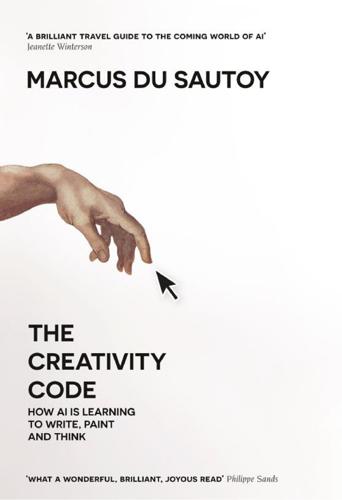
The Creativity Code: How AI Is Learning to Write, Paint and Think
by Marcus Du Sautoy · 7 Mar 2019 · 337pp · 103,522 words
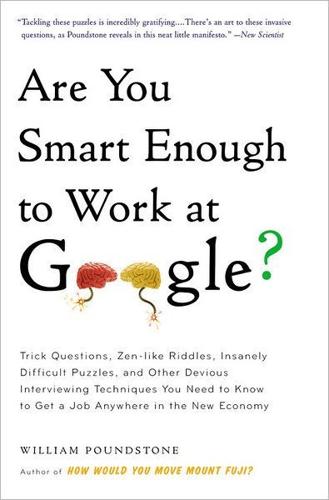
Are You Smart Enough to Work at Google?: Trick Questions, Zen-Like Riddles, Insanely Difficult Puzzles, and Other Devious Interviewing Techniques You ... Know to Get a Job Anywhere in the New Economy
by William Poundstone · 4 Jan 2012 · 260pp · 77,007 words
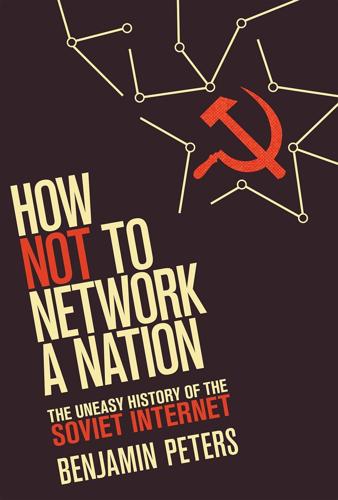
How Not to Network a Nation: The Uneasy History of the Soviet Internet (Information Policy)
by Benjamin Peters · 2 Jun 2016 · 518pp · 107,836 words