Rebecca Giblin
description: author and researcher, Monash University, Melbourne
6 results
Chokepoint Capitalism
by Rebecca Giblin and Cory Doctorow · 26 Sep 2022 · 396pp · 113,613 words
PRAISE FOR CHOKEPOINT CAPITALISM “Are you a writer, a musician, an artist? Is Big Tech eating your brain and sucking your financial blood? Rebecca Giblin and Cory Doctorow’s Chokepoint Capitalism tells us how the vampires crashed the party and provides protective garlic. Your brain must remain your own concern,
…
Don’t Look Up and founder of The Lever “Rather than simply lamenting the problem, or falling back on clich’s about starving artists, what Rebecca Giblin and Cory Doctorow do in Chokepoint Capitalism is make clear the overall pattern that drives exploitation of artists… . Every creator will find inspiration here.” —ANIL
…
about it… . An infuriating yet inspiring call to collective action.” —DOUGLAS RUSHKOFF, author of Throwing Rocks at the Google Bus and Survival of the Richest “Rebecca Giblin and Cory Doctorow lay out their case in plain and powerful prose, offering a grand tour of the blighted cultural landscape and how our arts
…
. Amazon UK, “Kindle: A Year in Review,” Day One (blog), Dec. 23, 2019, https://blog.aboutamazon.co.uk/innovation/kindle-a-year-in-review. 39. Rebecca Giblin, “What’s Happening to Authors’ Earnings? Surveying the Surveys,” The Author’s Interest, Feb. 20, 2018, https://authorsinterest.org/2018/02/20/whats-happening-to
…
, https://www.washingtonpost.com/archive/lifestyle/1989/12/07/mca-to-pay-royalties-to-rb-greats/63714098-29be-481e-915f-cb43f6bdf07c. 3. Joshua Yuvaraj and Rebecca Giblin, “Are Contracts Enough? An Empirical Study of Author Rights in Australian Publishing Agreements,” Melbourne University Law Review 44, no. 1 (2020), https://papers.ssrn.com
…
/sol3/papers.cfm?abstract_id=3541350. 4. See, for example, Jacob Flynn, Rebecca Giblin, and François Petitjean, “What Happens When Books Enter the Public Domain?” University of New South Wales Law Journal 42 (2019): 39. 5. For a detailed
…
W. Hall Jr., “Smells Like Slavery: Unconscionability in Recording Industry Contracts,” Hastings Communications and Entertainment Law Journal 25, no. 1 (2002): 215. 13. Joshua Yuvaraj, Rebecca Giblin, Daniel Russo-Batterham, and Genevieve Grant, “US Copyright Termination Notices 1977–2020: Introducing New Datasets.” 14. Yuvaraj, Giblin, Russo-Batterham, and Grant, “US Copyright Termination
…
Notices 1977–2020.” 15. Jacob Flynn, Rebecca Giblin, and François Petitjean, “What Happens When Books Enter the Public Domain? Testing Copyright’s Underuse Hypothesis Across Australia, New Zealand, the United States and Canada
…
,” Hollywood Reporter, Oct. 5, 2020, https://www.hollywoodreporter.com/thr-esq/sony-suing-musicians-for-allowing-attorney-to-use-album-artwork. 18. Joshua Yuvaraj and Rebecca Giblin, “Why Were Commonwealth Reversionary Rights Abolished (and What Can We Learn Where They Remain)?” European Intellectual Property Review 41, no. 4 (2019): 232. 19. Rian
…
/publications/6739/documents/72525/default. 21. If you’re interested in digging into the detail of how this figure is calculated, see the discussion in Rebecca Giblin, “A New Copyright Bargain? Reclaiming Lost Culture and Getting Authors Paid,” Columbia Journal of Law & the Arts 41 (2018): 369. 22. Brief of George A
…
, 2003, at 7. 23. Paul J. Heald, “How Copyright Keeps Works Disappeared,” Journal of Empirical Legal Studies 11, no. 4 (2013): 829. 24. Jacob Flynn, Rebecca Giblin, and François Petitjean, “What Happens When Books Enter the Public Domain? Testing Copyright’s Underuse Hypothesis Across Australia, New Zealand, the United States and Canada
…
,” University of New South Wales Law Journal 42, no. 4 (2019): 1215. 25. Giblin, “A New Copyright Bargain.” 26. Joshua Yuvaraj and Rebecca Giblin, “Are Contracts Enough? An Empirical Study of Author Rights in Australian Publishing Agreements,” Melbourne University Law Review 44, no. 1 (2020). 27. Jane Weaver, “How
…
, 136 BEACON PRESS Boston, Massachusetts www.beacon.org Beacon Press books are published under the auspices of the Unitarian Universalist Association of Congregations. © 2022 by Rebecca Giblin and Cory Doctorow All rights reserved Printed in the United States of America 25 24 23 22 8 7 6 5 4 3 2 1
…
-in-Publication Data Names: Giblin, Rebecca, author. | Doctorow, Cory, author. Title: Chokepoint capitalism : how to beat big tech, tame big content, and get artists paid / Rebecca Giblin and Cory Doctorow. Description: Boston : Beacon Press, [2022] | Includes bibliographical references and index. | Summary: “People are feeling squeezed because of chokepoint capitalism: exploitative businesses creating
Walled Culture: How Big Content Uses Technology and the Law to Lock Down Culture and Keep Creators Poor
by Glyn Moody · 26 Sep 2022 · 295pp · 66,912 words
came up with a new approach to tackling the unauthorised sharing and downloading of copyright material, what came to be known as the ‘graduated response’. Rebecca Giblin,283 a professor at Melbourne Law School, has written a history of graduated response schemes that outlines their ‘three strikes’ approach.284 Under these measures
…
out in September 2010; by December of that year, copyright companies were issuing between 25,000 and 50,000 infringement allegations per day, according to Rebecca Giblin.291 At the end of July 2013, Hadopi had issued 2 million first notices and 200,000 second notices. There were 710 investigations to ascertain
…
of writing, Canada, too, looks likely to extend its copyright term, ignoring evidence that doing so fails to create an additional incentive for creativity.667 Rebecca Giblin, ARC Future Fellow and professor within the Melbourne Law School, told Walled Culture about the issues with extending copyright: “That twenty-year term extension that
…
balance in favour of creators slightly. For example, a general right to renegotiate contracts after a set period—the so-called ‘reversion right’, advocated by Rebecca Giblin, ARC Future Fellow and Professor within the Melbourne Law School, in an interview with Walled Culture734 —would certainly benefit creators. But what is needed is
…
-creators-amazon-as-a-frenemy-and-the-internet-archive-court-case/ 283 https://web.archive.org/web/20220616160148/https://law.unimelb.edu.au/about/staff/rebecca-giblin 284 https://web.archive.org/web/20220616160226/https://papers.ssrn.com/sol3/papers.cfm?abstract_id=2322516 285 https://web.archive.org/web/20220616160247/https
…
-about-to-repeat-new-zealands-folly-by-extending-copyright-term-so-bring-back-registration/ 668 https://web.archive.org/web/20220616132442/https://walledculture.org/interview-rebecca-giblin-reversion-rights-out-of-print-books-and-how-to-fix-copyright/ 669 https://web.archive.org/web/20220616132502/https://www.authorsguild.org/industry-advocacy/authors
…
/1393/ 733 https://web.archive.org/web/20220830085146/https://walledculture.org/interview-mike-masnick/ 734 https://web.archive.org/web/20220616103248/https://walledculture.org/interview-rebecca-giblin-reversion-rights-out-of-print-books-and-how-to-fix-copyright/ 735 https://web.archive.org/web/20220616103248/https://walledculture.org/interview
…
-rebecca-giblin-reversion-rights-out-of-print-books-and-how-to-fix-copyright/ 736 https://web.archive.org/web/20220616110320/https://bandcamp.com/ 737 https://web.archive.
Enshittification: Why Everything Suddenly Got Worse and What to Do About It
by Cory Doctorow · 6 Oct 2025 · 313pp · 94,415 words
course, I also collaborate with many other kinds of writers, thinkers, and doers. There are lawyers like Jamie Boyle and Jennifer Jenkins, Lawrence Lessig, and Rebecca Giblin. There are technologists like Ken Snider, who keeps my infra running, and bunnie Huang, who makes me smarter about technology every time we talk. There
…
Big Tech and Big Content Captured Creative Labor Markets and How We’ll Win Them Back, a book from Beacon Press that I coauthored with Rebecca Giblin in 2022. 2 In the memorable phrasing of the New Zealand software developer Tom Eastman. Case Study: Facebook 1 True story. 2 Yes, really. For
…
–Atria, and so many more. 4 Chokepoint Capitalism, the book about creative labor markets and monopolies that I co-wrote with the Australian legal scholar Rebecca Giblin, was published by the wonderful Beacon Press, owned by the Unitarian Universalist Association. (Albert Einstein once wrote, “If we succeed in renewing the spirit of
Growth: A Reckoning
by Daniel Susskind · 16 Apr 2024 · 358pp · 109,930 words
R. Munzer (Cambridge: Cambridge University Press, 2001). 18 James Boyle, The Public Domain (London: Yale University Press, 2008) calls this ‘the second enclosure movement’. 19 Rebecca Giblin, ‘A Future of International Copyright? Berne and the Front Door Out’, in Across Intellectual Propertyed. Grame W. Austin, Andrew F. Christie, Andrew T. Kenyon and
…
Mega Richardson (Cambridge: Cambridge University Press, 2020). 20 See, for instance: Rebecca Giblin, ‘Reclaiming Lost Culture and Getting Authors Paid’, Columbia Journal of Law & the Arts, 369 (2018); Ruth Okediji, ‘The Regulation of Creativity under the WIPO Internet
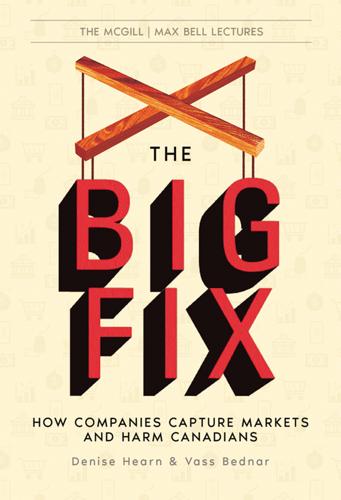
The Big Fix: How Companies Capture Markets and Harm Canadians
by Denise Hearn and Vass Bednar · 14 Oct 2024 · 175pp · 46,192 words
plays out in court. In Chokepoint Capitalism: How Big Tech and Big Content Captured Creative Labour Markets and How We’ll Win Them Back, authors Rebecca Giblin and Cory Doctorow describe how culture has been captured by “exploitative businesses creating insurmountable barriers to competition that enable them to capture what should rightfully
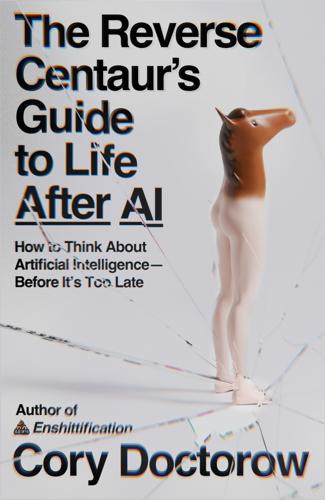
The Reverse Centaur's Guide to Life After AI: How to Think About Artificial Intelligence—Before It's Too Late
by Cory Doctorow · 22 Jun 2026 · 175pp · 51,295 words
executives. AI Has a Labor Issue (Not a Copyright Issue) 1. For more on Spotify, see Chokepoint Capitalism, the book about creative labor markets that Rebecca Giblin and I published with Beacon Press in 2022. 2. To learn more about the Bernstein case, and Cohn’s remarkable career, see her newly published