The Golden Passport: Harvard Business School, the Limits of Capitalism, and the Moral Failure of the MBA Elite
by Duff McDonald · 24 Apr 2017 · 827pp · 239,762 words
. Why have we gotten nowhere on climate change in this country? Because corporations have no incentive to change. To speak to their heart is bullshit. Quarterly capitalism is the ruling reality. If you’re going to change business, you are not going to do it by jawboning. The only thing that works
The Firm
by Duff McDonald · 1 Jun 2014 · 654pp · 120,154 words
it was incumbent on executives to fix the failures of “governance, decision-making, and leadership.” In it, Barton espoused a move from what he called “quarterly capitalism” to “long-term capitalism.” “In my view, the most striking difference between East and West is the time frame leaders consider when making major decisions
The End of Accounting and the Path Forward for Investors and Managers (Wiley Finance)
by Feng Gu · 26 Jun 2016
expense. For simplicity, we abstract here from this amortization, which will somewhat reduce our measure of the value created. 7. For simplicity, we subtract the quarterly capital expenditures, rather than a 3to 5-year average. 8. Based on 2.5 percent (10 percent annual) cost of capital times average Q2-2013 and
Makers and Takers: The Rise of Finance and the Fall of American Business
by Rana Foroohar · 16 May 2016 · 515pp · 132,295 words
Academic-Industry Research Network; author interview with William Lazonick for this book. 9. Author interview with Stiglitz for this book. 10. Hillary Clinton, “Moving Beyond Quarterly Capitalism,” lecture, New York University, July 24, 2015 (also published online on Medium.com). 11. Andrew Smithers, The Road to Recovery: How and Why Economic Policy
Big Business: A Love Letter to an American Anti-Hero
by Tyler Cowen · 8 Apr 2019 · 297pp · 84,009 words
world where they are banned.27 ARE COMPANIES TOO FOCUSED ON THE SHORT TERM? Another common complaint is that we live in a world of “quarterly capitalism,” or “short-termism,” as it is sometimes called. In this view, corporations focus on short-term earnings and neglect various forms of long-term investment
The Wires of War: Technology and the Global Struggle for Power
by Jacob Helberg · 11 Oct 2021 · 521pp · 118,183 words
of a 45 percent Competitiveness Tax Credit for businesses that invest in R&D, skills training, and setting global standards.33 We should also reform “quarterly capitalism,” as many have advocated.34 By revising the definition of “long-term” investments—taxing investments sold in the first few years as regular income, with
…
Atkinson, “The Case for a National Industrial Strategy to Counter China’s Technological Rise.” 34 Hillary Clinton, “Moving beyond quarterly capitalism,” Medium, July 24, 2015, https://medium.com/hillary-for-america/moving-beyond-quarterly-capitalism-7abec53733f6. 35 “President Obama Announces Two New Public-Private Manufacturing Innovation Institutes and Launches the First of Four New
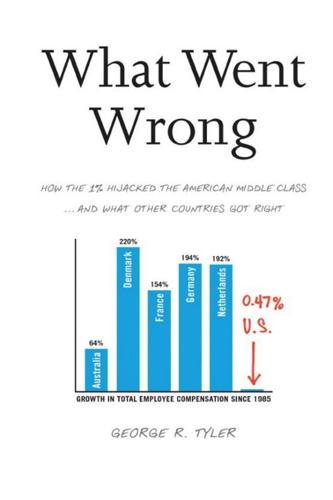
What Went Wrong: How the 1% Hijacked the American Middle Class . . . And What Other Countries Got Right
by George R. Tyler · 15 Jul 2013 · 772pp · 203,182 words
just 8 percent in the 1950s, outweighing traditional buy and hold investors. Thus, the vast majority of share traders have become a Greek chorus for quarterly capitalism and the short-termism of CEOs, with little interest and even less incentive to follow more detailed elements of corporate decision making. It’s as
…
incentives to pursue short-run rather than long-run gains.”37 The choice of American CEOs and boards to short-change investment in pursuit of quarterly capitalism is also revealed in an analysis by John R. Graham, Campbell R. Harvey, and Shiva Rajgopal. They surveyed 401 financial industry leaders in 2004, and
…
some 68 percent of R&D spending by the business community comes from manufacturers.49 Reaganomics: American Innovation Prospects Reduced to 43rd Among Global Leaders Quarterly capitalism is a cudgel, punishing firms that divert cash flow to long-term investments, and making R&D and innovation a luxury too few choose to
…
to terminate business community compensation practices that incentivize short-termism. Variable pay options linked to share prices should be largely banned in order to eliminate quarterly capitalism. Moreover, stock options thwart pay-for-performance goals because payouts are determined in too many instances by obsequious boards or gyrating share markets unreflective of
No Ordinary Disruption: The Four Global Forces Breaking All the Trends
by Richard Dobbs and James Manyika · 12 May 2015 · 389pp · 87,758 words
, which tend to belong to large asset owners such as pension funds.72 Outside investors and market pressures often drive publicly held companies into a “quarterly capitalism” rut. Given that companies borrow, invest, and make capital decisions over ten- and even thirty-year periods, this is problematic. Companies will need to revisit
Rethinking Capitalism: Economics and Policy for Sustainable and Inclusive Growth
by Michael Jacobs and Mariana Mazzucato · 31 Jul 2016 · 370pp · 102,823 words
. Tenure patterns for some of our most important life choices (marriage, jobs, money) are in secular decline.2 Some have called this the era of ‘quarterly capitalism’.3 These forces may be altering not just the way we act, but also the way we think. Neurologically, our brains are adapting to increasing
…
deficits public goods public organisations and change public policy and change evaluation role public service outsourcing public spending public–private investment partnerships Q quantitative easing quarterly capitalism R Reagan, Ronald recessions Reinhart, Carmen renewable energy policy rents and banks increase rent-seeking research and development (R&D) state organisations Ricardo, David risk