zero-interest-rate policy

back to index

36 results

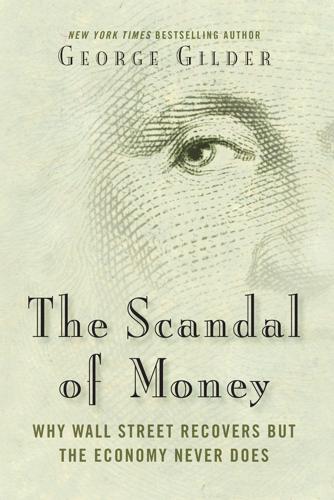
pages: 209 words: 53,236

The Scandal of Money
by George Gilder
Published 23 Feb 2016

Cesar Hidalgo, Why Information Grows: The Evolution of Order, from Atoms to Economies (New York, NY: Basic Books, 2015), 8, 142, and passim. 4.Charles Gave et al., Our Brave New World (Hong Kong: Gavekal Research, 2005) offers the definitive exposition of the rising role and dominance of the “platform company” model. 5.Nick Bilton, “Is Silicon Valley in Another Tech Bubble?,” Vanity Fair, September 2015. 6.Marc A. Miles, “The Fed’s Zero Interest Rate Policies Amount to a War on Jobs,” Forbes, June 4, 2013, http://www.forbes.com/sites/realspin/2013/06/04/the-feds-zero-interest-rate-policies-amount-to-a-war-on-jobs/#2715e4857a0b72333a807421. 7.David Malpass, “Pro-Growth Tools for the Frozen Fed,” Wall Street Journal, October 6, 2015. CHAPTER 12: WALL STREET SELLS ITS SOUL 1.Mike Konczal, “The Devastating Lifelong Consequences of Student Debt,” New Republic, June 24, 2014.

Government can properly foster the conditions under which knowledge—yielded by millions of falsifiable experiments in entrepreneurship—grows. But the lessons too many people learned under communism still constitute the central economic lesson: power cannot command wealth—surprising new knowledge—into being. Interest rates, for example, register the average expected returns across the economy. With a near-zero-interest-rate policy, the Fed falsely zeroes out the cost of time. This deception retards economic growth. Rather than creating new assets, low-cost money borrowed from tomorrow bids up existing assets today. It brings about no new learning and value, but merely destroys information by distorting the time value of money.

Today it handles more than 60 percent of world trade, denominates more than half the market capitalization of world stocks, and partakes in 87 percent of global currency trades.2 To advocates of paper, the lesson seemed unanswerable. Even in a global monetary crisis, exacerbated by wildly loose monetary policy in Washington, with quantitative easing following stimulative buying, and with an explicit zero-interest-rate policy, the full faith and credit of the U.S. government behind the dollar roundly trumped the intrinsic value and scarcity of gold. Paul Krugman gloated mercilessly in his New York Times column. He seemed to have a point. He rubbed in his argument by regularly quoting Milton Friedman’s case for floating currencies.3 Friedman held that floating currencies could respond to real changes in the economy far faster and more easily than real factors could adjust to a fixed standard.

pages: 479 words: 113,510

Fed Up: An Insider's Take on Why the Federal Reserve Is Bad for America
by Danielle Dimartino Booth
Published 14 Feb 2017

(Stein), 132 Williams, John, 79 Willumstad, Robert B., 138, 139 WorldCom, 107 Worthy, Ann, 245 Wright, Randall, 125 Yahoo, 12 Yellen, Janet, 6–7, 50, 59–60, 76, 84–89, 140, 164, 184, 213, 225, 231, 235–36, 239–40, 261–63 advocates for additional monetary stimulus, 172–74, 179–80, 182–83, 192–93, 194 balance sheet expansion under, 252 failure to see housing bubble, 86–89 at FOMC meetings under Bernanke, 78, 84–85, 157, 158, 161 inflation targeting and, 195 named president of San Francisco Fed, 86 nomination as Fed chair, 237 opposition to auditing of Fed, 254 outlook of, following Bear Stearns rescue, 157 raises fed funds rate, December 2015, 261 refusal to raise interest rates, 241, 251 testimony on living wills of, 246 on zero-interest-rate policy, 161 yen carry trade, 90–91 Zentner, Ellen, 207 Zero Hedge, 205 zero-interest-rate policy (ZIRP), 3, 8, 159–63, 175, 176, 218–21 * My husband will know what this means. What’s next on your reading list? Discover your next great read! * * * Get personalized book picks and up-to-date news about this author.

Bernanke was calm but insistent. His lifetime of study of the Great Depression indicated this was the only way. His sheer depth of knowledge about the Fed’s mishandling of that tragic period was undoubtedly intimidating. By the end of the meeting, the vote was unanimous. The FOMC officially adopted a zero-interest-rate policy in the hopes that companies teetering on the brink of insolvency would keep the lights on, keep employees on their payrolls, and keep consumers spending. It would even pay banks interest on deposits. Free cash. We’ll even pay you to take it! As they gathered their belongings, everyone shook hands, all very collegial despite the sometimes vigorous discussion.

Why was Janet Yellen, then president of the Federal Reserve Bank of San Francisco, astonishingly clueless as the housing market in her region imploded? And later, why couldn’t Yellen—an economist known for her brilliant forecasting skills—foresee the consequences of the Fed’s disastrous zero-interest-rate policies after she succeeded Bernanke as Fed chairman? Over the next nine years, as I scaled the outer walls of the Federal Reserve pyramid, always an outsider looking in, I grew more and more alarmed. The Fed leaders we entrusted with our financial fate had in fact precipitated the crisis.

pages: 829 words: 187,394

The Price of Time: The Real Story of Interest
by Edward Chancellor
Published 15 Aug 2022

The easy money regime threatened to end in what he called an ‘epoch-defining seismic rupture’, heralding the end of globalization, the return of capital controls and rising inflation.20 A few months after Lehman’s bankruptcy, Borio was warning about the dangers of keeping extreme monetary policies in place for too long.21 Over the following years, he stood apart from other monetary economists in alerting the world to the unintended consequences of the zero interest rate policy (ZIRP), the negative interest rate policy (NIRP) and other monetary innovations. ‘The highly abnormal is becoming uncomfortably normal,’ Borio bemoaned after the October 2014 bond market ‘flash crash’. As one year followed another, unconventional monetary policies became more unconventional.

Monetary policy, however, played an important but less obvious role. Between 1991 and 1995, the Bank of Japan lowered its policy rate from 6 to 0.5 per cent, on its way towards zero. Extremely low interest rates spread loan forbearance into the deepest reaches of the economy. IMF economists found that the zero interest rate policy helped banks to disguise their problem loans and relaxed pressure on policymakers to institute structural reforms, thereby contributing to the country’s economic torpor.19 As the pace of economic change slowed, Japan embarked upon a lost decade, seemingly incapable of regaining its former vigour.

So it is not surprising that eventually they give up and decide to spend their money.’17 Canadian household savings also fell to a record low.18 In Australia, savings remained depressed while household debt continued rising.19 Even the world’s former ‘savings superpower’ lost its mojo. When the Bank of Japan first implemented its zero interest rate policy in 1999, Japanese workers were stashing away more than a tenth of their incomes. Over the following years, household savings fell remorselessly, turning negative in 2014.20 As one commentator put it: ‘In a world of ultra-low rates, most households have no hope of wealth accumulation, no matter how much they save.

pages: 466 words: 127,728

The Death of Money: The Coming Collapse of the International Monetary System
by James Rickards
Published 7 Apr 2014

Housing prices are less transparent, but anecdotal evidence gathered from real estate listings and water-cooler chatter is sufficient for Americans to have a sense of their home values. Advocates of the wealth effect say that when stocks and home prices are going up, Americans feel richer and more prosperous and are willing to save less and spend more. The wealth effect is one pillar supporting the Fed’s zero-interest-rate policy and profligate money printing since 2008. The transmission channels are easy to follow. If rates are low, more Americans can afford mortgages, which increases home buying, resulting in higher prices for homes. Similarly, with low rates, brokers offer cheap margin loans to clients, which result in more stock buying and higher stock prices.

In essence, the Fed has impeded the healing process, delayed a return to normal economic growth, and worsened the income/wealth divide while creating a new problem—how to “exit” its failed policies. Another unintended consequence of Fed policy involves the impact on savers. The Federal Reserve’s zero-interest-rate policy causes a $400 billion-per-year wealth transfer from everyday Americans to large banks. This is because a normalized interest-rate environment of 2 percent would pay $400 billion to savers who leave money in the bank. Instead, those savers get nothing, and the benefit goes to banks that can relend the free money on a leveraged basis and make significant profits.

When policy interest-rate cuts are no longer possible because the rates are effectively zero, quantitative easing, designed in part to import inflation through currency devaluation, is the central bankers’ preferred technique. The Bank of England (BOE) has engaged in four rounds of quantitative easing (QE), beginning in March 2009. Subsequent rounds were launched in October 2011, February 2012, and July 2012. Increased asset purchases have ceased for the time being, but the BOE’s near-zero-interest-rate policy has continued. The BOE is refreshingly candid about the fact that it is targeting nominal rather than real growth, although it hopes that real growth might be a by-product. Its official explanation on the bond purchases to carry out QE states, “The purpose of the purchases was and is to inject money directly into the economy in order to boost nominal demand.

pages: 597 words: 172,130

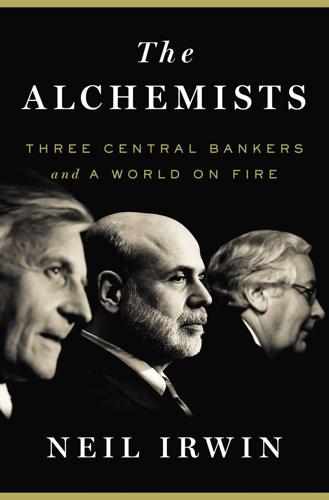
The Alchemists: Three Central Bankers and a World on Fire
by Neil Irwin
Published 4 Apr 2013

He inherited a once booming economy that was mired in nearly a decade of economic stagnation and falling prices. The usual tool a central bank uses to guide the economy was already proving ineffective. What could Hayami-san do to try to fix the Japanese economy? And, more importantly, what would he do? • • • Economists call it ZIRP: zero-interest-rate policy. The challenge that Hayami inherited—and which seemed at the time to be a uniquely Japanese phenomenon—was that the Bank of Japan had already cut rates to zero and the economy was still lousy. Cutting interest rates further isn’t very plausible. A negative rate would mean, in effect, charging bank customers to keep their money in savings accounts, and would lead to people taking their money out of banks to avoid that charge.

So in addition to cutting rates back to zero, the bank began buying bonds to increase the amount of money in the economy, aiming for the Japanese banking system to increase the number of yen on its books from four to five trillion, a rise then equivalent to about $8 billion. “The decision to end the zero-interest-rate policy was not wrong,” Hayami said in a press conference announcing the change in March 2001. Driven by the governor’s desire to save face, the action was something that no modern independent central bank had undertaken before. Almost against his will, Masaru Hayami had pioneered a very unusual type of monetary policy—one that Helicopter Ben and the Federal Reserve would adopt a decade later to fight the megacrisis.

In March 2009, he granted 60 Minutes the first television interview with a Fed chairman in twenty-two years, and pronounced on the air that there were certain “green shoots” visible signaling an economic recovery. In July, he gave a town-hall-style meeting at the Kansas City Fed; it was broadcast on PBS NewsHour over three consecutive evenings. His aggressive monetary policy moves—zero interest rate policy and $1.75 trillion in bond purchases that had been announced to that point—seemed to be having their desired impact of helping the U.S. economy pull out of its collapse. The recession, it would later be declared, officially bottomed out in June 2009. Some in the Obama administration even viewed Bernanke’s actions—particularly the public appearances—as part of a not terribly subtle campaign to position himself for reappointment.

The Permanent Portfolio
by Craig Rowland and J. M. Lawson
Published 27 Aug 2012

Kangaroos versus Eagles In 2011, the United States was still recovering from the problems caused by the real estate crash that started several years earlier. The result was that the central bank in the United States decided to adopt a very low interest rate policy (sometimes called “ZIRP”—Zero Interest Rate Policy) and had interest rates set very low at 0.25 percent. The official rate of inflation, however, was reported to be 2.96 percent. In real return terms, putting cash in your local bank account in 2011 would have earned perhaps 0.50 percent a year in interest, but with inflation at 2.96 percent a year, you would have seen a negative return after inflation.

Treasury bonds) central banks of (see Central banks) confiscation of assets by geographic diversification impacted by government regulations political risk caused by repatriation of assets by Grass, Claudio Great Depression Greenspan, Alan Gross, Bill Guardian Vaults Guggenheim Large Cap Core fund Hazlitt, Henry How You Can Profit from the Coming Devaluation (Browne) Hueppi, Otto IBOXX German 1 to 3 Year Treasury Exchange Traded Funds IBOXX German and Eurozone Bond Exchange Traded Funds Iceland, economy and investing in Identity theft Implementation of investment strategy: automatic reinvestments in basic method of best method of better method of costs associated with dogma vs. reality in dollar cost averaging considerations in good method of immediate vs. slow or partial international key concepts of levels of protection in multiple financial institutions for multiple fund providers for Permanent Portfolio portfolio-building services for risk elimination during sample portfolios steps to achieve Income: profession providing taxable (see Taxes) wage-price spiral Individual retirement accounts (IRAs): cash investments in creditor protection via gold assets in institutional diversification of funds in tax considerations with Inflation: bonds impacted by cash impacted by causes of commercial Permanent Portfolio fund inflation asset emphasis economic condition of Federal Reserve policy to allow Federal Reserve policy to control gold valuation impacted by returns adjusted for stocks impacted by Treasury Inflation-Protected Securities Whip Inflation Now (WIN) Campaign Inflation Proofing Your Investments (Browne and Coxon) Institutional diversification: commercial Permanent Portfolio funds lacking cyber attack impacts reduced by definition of fund manager risk avoidance via identity theft impacts reduced by implementation of Permanent Portfolio via methods of natural disaster impacts reduced by reasons for tax considerations with terrorism impacts reduced by Insurance coverage: CDIC FDIC of gold Lloyd's of London SIPC Interest income. See Dividends and interest Interest rates: bond price inverse correlation to cash returns impacted by credit rating impacting economic conditions impacting inflation control policy manipulating interest rate risk mortgage zero interest rate policy Intermediaries, international International investments: country-specific options for (see also specific countries by name) currency risk with developing country disclosure and reporting of economic conditions impacting financial safety through foreign bonds as foreign currency as geographic diversification through gold as intermediaries for international implementation of Permanent Portfolio international stock funds as political risk with repatriation of assets and emergency options for tax considerations with Internet: cyber attacks via gold purchases, sales and storage via Internet bubble resources available via Investments: bonds as (see Bonds) cash as (see Cash) diversification of (see Diversification) economic conditions impacting (see Economic conditions) gold as (see Gold) international (see International investments) performance of (see Performance) Permanent Portfolio strategy for (see Permanent Portfolio) rebalancing and maintenance of (see Rebalancing and maintenance) resources on risks related to (see Risks) safety of (see Financial safety) simplicity of stocks as (see Stocks) strategy implementation for (see Implementation of investment strategy) tax considerations for (see Taxes) variable IRAs.

See also Recessions and depressions Total Stock Market Index Trading costs Treasury Direct accounts Treasury Inflation-Protected Securities Treasury Money Market Funds Trotter, Frank 25/75 portfolio UBS United Kingdom, economy and investments in U.S. Federal Reserve: bail-out funds from gold holdings of inflation allowed by inflation control policy of zero interest rate policy of U.S. savings bonds U.S. Treasury bonds: long-term short-term Vanguard: sample portfolios with Vanguard Admiral Treasury Money Market Fund Vanguard Australian Shares Index Vanguard Cash Plus Index Vanguard Diversified Bond Index Vanguard European Bond Index Vanguard FTSE ex-U.S.

pages: 113 words: 37,885

Why Wall Street Matters
by William D. Cohan
Published 27 Feb 2017

Or that new regulations in the money-market industry have more than tripled the cost of the three-month London Interbank Offered Rate, or LIBOR, the short-term money rate that banks charge each other and on which most loans are based? Have you tried to get a loan or a mortgage lately? It’s not very easy, even for Ben Bernanke, the architect of the Fed’s “zero-interest-rate policy” that has kept interest rates as low as they have ever been in our nation’s history. In 2014, the newly private citizen Bernanke could not refinance the mortgage on his home because he no longer had a steady source of income. The additional irony of this anecdote is that despite the Fed’s zero-interest-rate policies, it’s nearly impossible for regular people to get their hands on it. What the government gives with one hand—virtually free money—it takes away with another, through new regulations that make actually getting any of that money harder than ever.
pages: 327 words: 90,542

The Age of Stagnation: Why Perpetual Growth Is Unattainable and the Global Economy Is in Peril
by Satyajit Das
Published 9 Feb 2016

A dynamic economy capable of high levels of growth, with the attendant ability to generate additional tax revenues and provide attractive investment opportunities, can maintain a higher level of debt than one with lower growth prospects. As British prime minister Lloyd George recognized: “Success means credit. Financiers never hesitate to lend to a prosperous concern.”8 In response to the GFC, central banks reduced official rates to historical lows, often to zero (known as ZIRP, or zero interest rate policy). When the ability to change the price of money (that is, the interest rate) became restricted as the rate went to zero, central banks increased the quantity of money, in a process known as quantitative easing (QE). If an economy is cash-based, this means printing money. In Weimar Germany, the government took over newspaper presses to print money to meet demand for banknotes.

The Bank of Japan committed to purchasing more than double the amount of government bonds that the US Fed purchased at the peak of its QE program. It was four times larger as a percentage of GDP. The policies were not new, having been tried repeatedly before. Since 1990, Japan has had more than fifteen stimulus packages. The Bank of Japan has maintained a zero interest rate policy for over fifteen years and implemented nine rounds of QE. Given that short-term rates were near zero and ten-year rates around 0.5 percent before the announcement of Prime Minister Abe's plan, the effects of the new fiscal and monetary initiatives on real economic activity are not likely to be significant or long-lasting.

The approach is that of Louis XIV's minister of finance, Jean-Baptiste Colbert: “the art of taxation consists in so plucking the goose as to get the most feathers with the least hissing.” Policymakers manipulate interest rates, keeping them below the true inflation rate to allow over-indebted borrowers to maintain unsustainably high levels of debt. Increasingly, zero interest rate policy has given way to negative interest rate policy, entailing an explicit transfer of wealth from savers to borrowers. In October 2014, coinciding with World Savings Week, one German bank announced that savers would have to pay the bank to deposit money. German savers termed it “punishment interest” or “the wrath of Draghi,” referring to the negative interest rates imposed by the European Central Bank.

pages: 328 words: 96,678

MegaThreats: Ten Dangerous Trends That Imperil Our Future, and How to Survive Them
by Nouriel Roubini
Published 17 Oct 2022

Prevailing wisdom in the Trump and Biden administrations saw more danger in spending too little than in spending too much. Thus, we have much larger budget deficits today than after the Global Financial Crisis. The United States and many other economies are prepared to spend and use unconventional monetary policy—a form of bailout—to restart economic activity. One zippy acronym is ZIRP—zero interest rate policy. A broader policy goes under the banner of quantitative easing or credit easing, which allows the Federal Reserve to inject cash into the economy by purchasing public and private debt, even debt on the fringes of investment grade. Those policies push short rates and long rates lower. Europe and Japan have actually implemented NIRP—negative interest rate policies.

By late 2020 and 2021 we were emerging from the pandemic with tons of debt, fiscal deficits spiking, and looser monetary policy than at any time in history. Have policy makers learned their lesson? Yes and no. They have signaled renewed inclination to finance huge deficits by printing money instead of issuing debt. Besides quantitative easing and zero interest rates, policy makers seem to want to make debt monetization a permanent feature of central banking. Where will that approach lead? To bubbles everywhere ready to burst: stocks, cryptocurrencies, hedge funds going crazy on risk, uninformed investors taking on short sellers over GameStop, millions of Gen Z and Gen X day traders spending their meager savings and fiscal transfers to bet on stocks, private equity groups and corporations borrowing like never before and, to top it off, housing prices going through the roof.

Across all major economies, interest rates were set close to, or even at or just below, zero, and held there for years on end. Despite this ultra-low rate, the major economies were mired in a funk with low growth and inflation below target; so what were central bankers to do? Initially, they devised a zero interest rate policy. Despite free money and a nifty acronym, ZIRP failed to revive stagnating markets and economies. Some central banks in Europe and Japan tested a negative interest rate policy, or NIRP. Instead of collecting interest on cash reserves residing in central bank coffers, commercial banks paid central banks to hold such reserves.

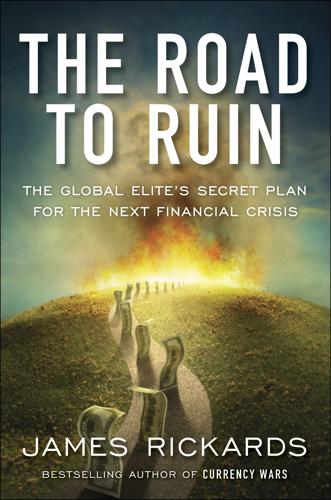
pages: 354 words: 105,322

The Road to Ruin: The Global Elites' Secret Plan for the Next Financial Crisis
by James Rickards
Published 15 Nov 2016

That made the conversation livelier because we could share impressions on personalities in addition to policy. I was especially interested in Jeremy Stein. Stein was a governor and FOMC member from May 2012 to May 2014, dates that overlapped with Jon’s time at the Fed. Stein struck me as the only governor with a technical grasp of how the Fed’s zero interest rate policy was creating hidden dangers and bubble dynamics. Some FOMC members at the time, including Dallas Fed president Richard Fisher, were outspoken about the need to raise rates and the dangers of not doing so. Yet Fisher, and the like-minded Charles Plosser of the Philadelphia Fed, had intuitive, even populist reasons for raising rates.

Decisions to raise or lower rates are not guided by gold inflows, but rather by whims, and spurious correlations between inflation and employment known as NAIRU (the non-accelerating inflation rate of unemployment) and the Phillips curve. Experience shows that Greenspan’s handling of the dot-com bubble was not so deft after all. His cleanup included keeping interest rates too low for too long, which led directly to the housing bubble and the 2008 financial collapse. Bernanke’s zero interest rate policy (continued by Yellen) from 2008 to 2015 repeated Greenspan’s mistake with catastrophic potential. The better analysis is that bubbles are not automatically dangerous. What matters is whether they are fueled by debt or not. The dot-com bubble was inflated by what Greenspan earlier called “irrational exuberance,” not debt, and did relatively little harm to the macroeconomy when it burst despite investor losses.

Deflation was deferred, not destroyed. Greenspan’s policies delayed deflation at the expense of asset bubbles, which burst beginning in 2007. Then the deflation, which never really went away, reemerged. The Federal Reserve, a one-trick pony, repeated the Greenspan blunder with Bernanke and Yellen’s zero interest rate policy from 2008 to 2015. The result is larger asset bubbles today. At no point have policymakers dealt with the underlying causes of deflation, which arise from demographics, technology, deleveraging, and neomercantilism from Mexico to Malaysia. One rejoinder in favor of free trade and open markets is that the United States is strong enough to absorb the costs of a rigged system while the world is enriched by job creation in other countries.

pages: 416 words: 124,469

The Lords of Easy Money: How the Federal Reserve Broke the American Economy
by Christopher Leonard
Published 11 Jan 2022

The strategy was like a military pincer movement that closes in on the opponent from two sides—from one direction there was all this new cash, and from the other direction there were the low rates that punished anyone for saving that cash. The Wall Street types developed a name for the strategy. They called it ZIRP, which was short for zero-interest-rate policy. Economists talked about ZIRP in terms of interest rates, but on Wall Street there was a deeper appreciation for the combined power of new money and low rates. The hedge funds and investors could see how ZIRP was reshaping the world, because they were the people who were doing it on ZIRP’s behalf

Quantitative easing was seen as a way to push monetary policy past the zero bound by pumping new dollars into the financial system after the zero bound had been reached. Another way to break past the zero bound is to issue negative-interest-rate debt, which the Fed has refrained from doing. ZIRP: This refers specifically to the Federal Reserve’s zero-interest-rate policy. More broadly, financiers use this term to describe the Fed’s policy between 2008 and roughly 2017, when the Fed kept interest rates pinned at zero, or very near zero, while pumping more cash into the financial system through quantitative easing. These were the most extreme easy-money policies in the history of the central bank.

Rowe Price Associates, 191 Trump, Donald, 159, 228–30, 238, 275, 276, 304 Capitol siege and, 299–300 China and, 235 coronavirus relief programs and, 276, 283–85 elected president, 228, 230 government institutions and, 228 Mnuchin and, 275, 276 monetary policy and, 233–34 Powell and, 229, 233–34 reelection bid lost by, 298, 299 workers and, 197–98, 230 Trump Organization, 166 Tucker, Paul, 103–4 Turkey, 216–17 Ullman, Christopher, 163 Unelected Power (Tucker), 103–4 unemployment, 8, 18, 24, 30, 32, 33, 56, 61, 62, 72–73, 76, 95, 103, 105, 126, 223, 232, 236, 238, 259 from coronavirus pandemic, 283, 284 quantitative easing and, 121 United Steel Workers, 190 University of California, Los Angeles, 103 University of Texas, 215 Vietnam War Hoenig in, 5, 37–41, 49 protests against, 37, 40 Volcker, Paul, 64, 67, 229, 231 Continental Illinois and, 66 FOMC and, 67 inflation and, 22, 56–57, 67, 68 inflation “cousins” formulation of, 81, 95 interest rates and, 22, 56–57, 72 Penn Square and, 65 Wallmine, 198 Wall Street, in central bank creation, 46–47 Wall Street Journal, 15, 19, 29, 34, 133, 134, 211, 213, 230, 236, 287, 298, 303–4 Warren, Elizabeth, 206, 211 Warsh, Kevin, 31–34, 112 Washington Post, 41, 152, 205, 284, 285 Watergate scandal, 41 wealth effect, 119, 148, 182, 194 Wells Fargo, 271 Williams, John, 246–47, 250, 255, 272 work, workers, 14, 168, 183, 224 coronavirus and, 283–85 cost of living and, 50 economic cycles and, 72–74 job creation, 50, 60, 92, 119, 131, 139, 168, 182, 232 jobless recovery, 74, 102 labor unions and, see labor unions manufacturing, 74, 188–89 operations moved to Mexico, 196–99 productivity, 302 Trump and, 197–98, 230 unemployment, see unemployment value of, 296 wages, 14, 62, 76, 182, 212, 238 white-collar, 73 World Bank, 162 world economy, see global economy World War II, 36, 41, 42, 292 Wuerffel, Nate, 246 Yellen, Janet, 12, 17, 29, 130, 136, 142, 222–24, 226–29, 233, 258, 291–92, 299 Citadel and, 290 Trump and, 228, 229, 275 yield, 20 defined, 351 yield, search for, 118–19, 212, 227, 232, 259 commercial real estate and, 214–16 corporate debt and stocks and, 212–13 defined, 350 developing nations and, 216–17 negative-interest-rate bonds and, 217–18 oil industry and, 213–14 yield curve, 20, 27, 51, 57, 65, 91, 146, 262 compression of, 344 defined, 351 inverted, 237, 347 Yorke, John, 58, 59, 64 Yum! Brands, 193 Zandi, Mark, 103 zero bound (zero interest rate), 7–8, 19, 21–24, 28, 116–19, 127, 145, 173, 175, 211, 219, 223, 225, 227, 247, 249, 267, 297 allocative effect of, 19, 20, 27 defined, 351 Hoenig’s predictions about, 34 media and, 108 risky loans and, 19–20 ZIRP (zero-interest-rate policy), 116–22, 130–31, 143, 145, 154, 170, 177, 178, 187, 200, 211, 217, 235, 244, 252, 262, 292, 295, 302–3, 343, 350 asset prices and, 119, 192 defined, 351–52 deflation and, 223 economic system reshaped after, 236 inflation and, 138–39 job creation and, 131 normalization (reversal) of, 221, 223–25, 227–29, 231, 232 Powell’s reversal of opinion on (Powell Pivot), 225–27, 236–37 repo market and, 251 Rexnord and, 187–88 Zobel, Patricia, 246 zombie companies, 298 Zurn Industries, 186 Zweig, Phillip L., 64 Simon & Schuster 1230 Avenue of the Americas New York, NY 10020 www.SimonandSchuster.com Copyright © 2022 by Christopher Leonard All rights reserved, including the right to reproduce this book or portions thereof in any form whatsoever.

pages: 333 words: 76,990

The Long Good Buy: Analysing Cycles in Markets
by Peter Oppenheimer
Published 3 May 2020

The US wave quickly became a global shock as credit markets and banks' balance sheets around the world became impaired. All of the main equity markets fell together and emerging markets (which have a higher beta and are most vulnerable to a collapse in world trade growth) suffered the largest declines. The rebound, triggered by zero interest rate policies and the start of US QE, also had a global impact, and emerging market equities (which had initially suffered most) rebounded strongly. Exhibit 9.1 The three ‘waves’ of the financial crisis (total return performance in USD) SOURCE: Goldman Sachs Global Investment Research. But the recovery was then interrupted as the crisis extended to Europe.

One other implication of this is the hit to banks' margins. Faced with both weak loan growth and negative interest rates, there is a strong headwind to performance. For example, in a study of 6,558 banks from 33 OECD countries between 2012 and 2016, research shows that the introduction of zero interest rate policy reduced bank lending.5 Interestingly, a comparison of the relative performance of banks with their broader equity markets shows that Japanese banks have underperformed fairly consistently since the end of their financial crisis in 1990 and the start of low growth and negative rates. A similar pattern has emerged in Europe since the start of the recent financial crisis in 2008 and the weak growth and negative interest rates that have followed.

The Volatility Smile
by Emanuel Derman,Michael B.Miller
Published 6 Sep 2016

E., 125, 126 White, Alan, 325, 351, 352, 363 Wilmott, Paul, 8, 125, 126 Yields: and forward rates, 260–261 negative, of short-term government bonds, 154n.1 Yield curves, 134–135 Yield to maturity: as bond metric, 10 time to maturity vs., 138–139 Zero correlation: mean-reverting volatility with, 369–375 stochastic volatility with, 362–368 Zero correlation smile: and moneyness, 353–356 as symmetric, 356–360 Zero dividend yield: in Black-Scholes-Merton model, 237–238 valuing down-and-out barrier option under geometric Brownian motion with zero riskless rate and, 207–211 Zero-interest-rate policy (ZIRP), 154n.1 Zero riskless rate: in Black-Scholes-Merton model, 237–238 valuing down-and-out barrier option under geometric Brownian motion with zero dividend yield and, 207–211 ZIRP (zero-interest-rate policy), 154n.1

In other words, the option has the same terminal value as the forward when ST ≥ K and is worth more when 1 You might pay more than $100 to store $100 if keeping $100 under your mattress was dangerous or inconvenient and it was worth paying a fee to store your money safely. That’s exactly what’s happened in recent years: The zero-interest-rate policy (ZIRP) of central banks has led to a situation where investors are paying to lend their money to the government for safekeeping, so yields on some short-term government bonds have occasionally turned slightly negative. The possibility of negative rates has required the reworking of many standard stochastic interest rate models. 155 No-Arbitrage Bounds on the Smile Payoff K Call Option FIGURE 9.1 ST Forward Value of a Call and Forward at Expiration ST < K.

pages: 126 words: 37,081

Men Without Work
by Nicholas Eberstadt
Published 4 Sep 2016

Since stock prices are strongly shaped by expectations of future profits, it appears investors are counting on the happy days continuing for some time to come. Impressive as this upswing in measured wealth appears on paper, though, there is also an element of artificiality to it. From the 2008 crash to this day, the Federal Reserve has deliberately inflated U.S. asset values through its unprecedented and prolonged “zero interest rate” policies, interventions that are, unsurprisingly, proving difficult to unwind. A less cheerful picture emerges if we look at macroeconomic trends. Here, U.S. economic performance since the start of the century might best be described as mediocre and its future prospects no better than guarded.

pages: 741 words: 179,454

Extreme Money: Masters of the Universe and the Cult of Risk
by Satyajit Das
Published 14 Oct 2011

The prevailing thinking was from Will Rogers: “If stupidity got us into this mess, then why can’t it get us out?” Botox Economics Government spending, industry support schemes such as “cash for clunkers,” tax cuts, investment incentives, and subsidies all boosted activity. Low or zero interest rate policies (ZIRP) engineered a recovery in stocks and financial markets. Historically low interest rates, especially in dollars, made anything offering reasonable income look attractive. One analyst told investors: “We like the junkiest of the junk.”1 Capital injections into banks, central bank purchases of toxic assets and explicit government support for bank borrowings helped stabilize the financial system.

, 96 Whyte, William, 296 Wiedeking, Wendelin, 257 Wilde, Oscar, 53 Williams, Robbie, 157 Williams, Robin, 164 Williams, Rowan, 346 Williams, Tennessee, 339 Wilson, Harold, 40 WIN (whatever is necessary), 342 winner’s curse, 241 Wire, The, 333 Wired, 99 WIT (whatever it takes), 342 Wizard of Oz, 26 Wolf, Eric, 144 Wolf, Martin, 280 Woodstock, 252, 262 Woodstock Experience, 255 Woolf, Virginia, 179 World Economic Forum (2011), 312 WorldCom, 54, 154, 283 worst-case daily change, 247 worst-off, 211 Wriston, Walter, 89 Wurstelprater, 163 X–Y–Z Xiaochua, Zhou, 363 Xiaoping, Deng, 85 Yale, 232 Yale Endowment, 124 Yasgu, Max, 252 Yellen, Janet, 298 yen carry trade, 40 You the Living, 50 YSP (yield spread premium), 184 Z tranche, 170, 178 Zabel, William, 62 zaibatsu, 139 Zambian kwatcha, 21 Zelie, Mademoiselle, 23 zero interest rate policies (ZIRP), 348 Zertifikate, 332 Ziegler, Jean, 334 Zimbabwe, 22 Zimbabwe dollar, 22 Zuccaro, Robert, 98 In an increasingly competitive world, it is quality of thinking that gives an edge—an idea that opens new doors, a technique that solves a problem, or an insight that simply helps make sense of it all.

pages: 268 words: 74,724

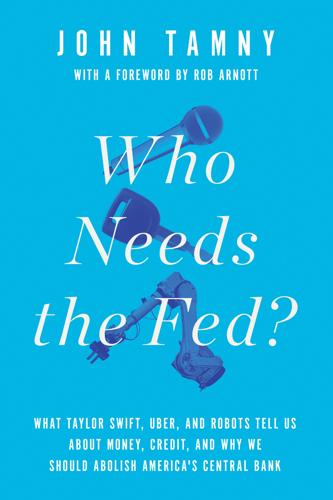
Who Needs the Fed?: What Taylor Swift, Uber, and Robots Tell Us About Money, Credit, and Why We Should Abolish America's Central Bank
by John Tamny
Published 30 Apr 2016

Based on the somewhat startling observations in the following chapters, we can only conclude that price controls on credit cannot lead to economic prosperity. Tamny’s conclusions are controversial. He suggests that the Fed is unnecessary and has the potential to do far more harm than good. He suggests that the protracted “zero interest rate policy” cannot possibly have helped to fuel the second-largest equity bull market in history. He suggests that artificially controlling the government’s cost of capital guarantees a misallocation of resources away from the private sector to the public sector, funding current public-sector spending at the expense of future growth.

pages: 261 words: 86,905

How to Speak Money: What the Money People Say--And What It Really Means
by John Lanchester
Published 5 Oct 2014

They’re the same thing: renminbi means “the people’s currency,” and it was the name given the new currency at the foundation of the People’s Republic of China in 1949. Yuan means “dollar” and is the unit of the currency; so renminbi is like sterling and yuan is like pound. In practice, Mandarin-speaking Chinese tend to use the colloquial kuai, roughly the same as the American “buck.” zirp A zero-interest-rate policy, in which a government or central bank holds interest rates at zero. This effectively reduces the cost of borrowing to nothing, and is a desperate measure, since under most circumstances it would certainly lead to sharp inflation. The exception is when the economy is in so much trouble that the government or bank has to use every tool at its disposal: a ZIRP is what it would use after it had already used the kitchen sink.

pages: 313 words: 94,415

Enshittification: Why Everything Suddenly Got Worse and What to Do About It
by Cory Doctorow
Published 6 Oct 2025

We are living through a Great Enshittening. Somehow, humans have unleashed the Enshittocene, in which all of our artifacts and hyperobjects are turning into piles of shit. What is it about this moment that allowed this contagion to spread so fast and so far? Some will tell you that this is just the end of the zero interest rate policy (ZIRP), which followed on from the Great Financial Crisis of 2008, when central bankers around the world cut interest rates to zero (at times even tipping them into negative territory). The end of the era of “free money.” When the prime rate goes to zero, it becomes very cheap for companies and their investors to borrow, and so, the theory goes, they have a lot of money to throw around on goodies like ad-free search or social media that shows you the things you want to see instead of the things that make money for the platform.
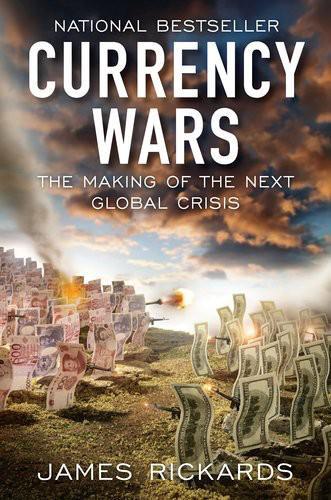
pages: 381 words: 101,559

Currency Wars: The Making of the Next Gobal Crisis
by James Rickards
Published 10 Nov 2011

By early 2011, home prices nationwide had returned to the levels of mid-2003 and seemed headed for further declines. It appeared there would be no wealth effect from housing this time around. The Fed did have greater success in propping up the stock market. The Dow Jones Industrial Average increased almost 90 percent from March 2009 through April 2011. The Fed’s zero interest rate policy left investors with few places to go if they wanted returns above zero. Yet the stock rally also failed to produce the desired wealth effects. Some investors made money, but many more stayed away from stocks because they had lost confidence in the market after 2008. Faced with its inability to generate a wealth effect, the Fed turned to its only other behavioral tool—instilling fear of inflation in consumers.

pages: 391 words: 97,018

Better, Stronger, Faster: The Myth of American Decline . . . And the Rise of a New Economy
by Daniel Gross
Published 7 May 2012

But Nishimura’s takeaway was an optimistic one. In the 1990s Japanese policymakers deliberated and delayed before embarking on a regime of interest rate cuts, stimulus measures, an expansion of bank deposit insurance, a partial nationalization of failed institutions, bank capital injections, a zero-interest-rate policy, quantitative easing, and still more stimulus. The United States, he said, had essentially undertaken the same response, with one significant difference: speed. It took the United States just eighteen months to conduct the aggressive fiscal and monetary actions that Japan waited twelve years to carry out.
Systematic Trading: A Unique New Method for Designing Trading and Investing Systems
by Robert Carver
Published 13 Sep 2015

With a short position the European equity volatility index future (V2TX) is a markedly negative skew instrument (as discussed in the skew concept box, page 32), but as you’ll see later you’ll only allocate 10% of your portfolio to it. None of the instruments have especially low volatility as I write this chapter, as long as you avoid trading the closest Eurodollar delivery months (where volatility is very low due to zero interest rate policies). For this reason I recommend trading Eurodollar around three years out; much beyond that and the liquidity starts to drop off. Selecting trading rules You will use both of the trading rules introduced in chapter six: the trend following EWMAC rule and the carry rule. Your trend following rules and measures of price volatility will be based on a series of stitched futures prices using the ‘Panama method’.158 For carry, as appendix B explains, the optimal calculation requires that you’re not trading the nearest contract, but one further in the future.

pages: 1,202 words: 424,886

Stigum's Money Market, 4E
by Marcia Stigum and Anthony Crescenzi
Published 9 Feb 2007

/Euromarkets, arbitrage U.S. government/Treasury securities (see Treasury securities) value basis factors affecting negative positive Treasury futures zero valuing options variable-rate CDs variable-rate demand obligation (VRDO) advantages backups bonding out mechanics money funds municipal securities (munis) pricing the put vega, options volatility example historical implied options Volcker’s Saturday Night Special volume, brokers’ market VRDO (see variable-rate demand obligation) Web sites (see Internet) Wednesday close, federal funds market weekly cycle, bill market when-issued (WI) trading municipal securities (munis) Treasury notes WI trading (see when-issued trading) wire-transfer, Fedwire Funds Transfer Service World Bank, portfolios Yankee CDs year-end rate bias, commercial paper yield auctions, Treasury yield curve bonds crystal ball curve traders Fed interest rates long-term rates policy anticipation hypothesis portfolios predictive power recession probabilities repos riding the yield curve risk premium swaps curve technical analysis trading Treasury securities Treasury yield curve yield-enhancement trade, Treasury futures yield spreads CDs portfolios yield value of, 1/32, duration yields asset-backed paper money funds MTNs municipal securities (munis) real yields zero-coupon approach, hedging zero-coupon bonds duration immunizing a portfolio zero interest-rate policy (ZIRP), Japan zero-sum game, options zero value basis, Treasury futures zeros, 3-year zeros, barriers ZIRP (see zero interest-rate policy)

Treasury securities (in billions of dollars) recent years. Both Japan’s yearly deficits and its overall debt level were extraordinarily high in the late 1990s and early 2000s, yet its interest rates were extraordinarily low—the lowest in the industrialized world. More important influences were the Bank of Japan’s zero interest-rate policy (ZIRP) and the persistence of deflation in Japan. These two influences—the benchmark rate and the inflation rate—have been much more dominant influences on government bond rates than debts and deficits. In the United States a shift from surpluses to deficits in the early 2000s was accompanied by a decline in market interest rates.

pages: 372 words: 107,587

The End of Growth: Adapting to Our New Economic Reality
by Richard Heinberg
Published 1 Jun 2011

Rather, what seems to be happening is that the efforts of the US Federal government and the Federal Reserve have temporarily more or less succeeded in balancing out the otherwise massively deflationary impacts of defaults, bankruptcies, and falling property values. With its new functions, the Fed is acting as the commercial bank of last resort, transferring debt (mostly in the form of MBSs and Treasuries) from the private sector to the public sector. The Fed’s zero-interest-rate policy has given a huge hidden subsidy to banks by allowing them to borrow Fed money for nothing and then lend it to the government at a 3 percent interest rate. But this is still not inflationary, because the Federal Reserve is merely picking up the slack left by the collapse of credit in the private sector.

pages: 350 words: 109,220

In FED We Trust: Ben Bernanke's War on the Great Panic
by David Wessel
Published 3 Aug 2009

He also welcomed the prospect of an administration prepared to be more aggressive and to spend more money to fight the Great Panic. Fiscal policy — spending taxpayer money — was increasingly important because the Fed was entering territory that it had only ruminated about in the Greenspan era: zero interest rate policy, or ZIRP in Fedspeak. Bernanke knew that Geithner’s absence alone wouldn’t ensure peace among the various FOMC factions. For weeks, he had been laboring to make the twelve regional Fed presidents feel more involved in decision making. One-at-a-time phone calls from Bernanke and Kohn clearly couldn’t keep up with the pace of developments, so Bernanke had begun convening biweekly videoconference staff “briefings” for the entire FOMC.

pages: 376 words: 109,092

Paper Promises
by Philip Coggan
Published 1 Dec 2011

Much of that debt was secured against property, which has fallen 30 – 40 per cent in price. Nominal GDP growth has been weak for the best part of twenty years and in late 2010, the stock market was a quarter of its end-1980s level. Japan has been stuck in the doldrums despite its use of QE, and a near-zero interest rate policy. Fiscal stimulus has been used extensively, leaving Japan with gross debt of 200 per cent of GDP in 2011. Monetary policy has failed to revive activity in Japan. As Richard Koo points out in his book, The Holy Grail of Macro Economics: Lessons From Japan’s Great Recession,11 economists had previously thought that if you cut interest rates low enough, people would always borrow.

pages: 385 words: 101,761

Creative Intelligence: Harnessing the Power to Create, Connect, and Inspire
by Bruce Nussbaum
Published 5 Mar 2013

Goizueta, Coca-Cola Chairman Noted for Company Turnaround, Dies at 65,” New York Times, October 19, 1997, accessed September 13, 2012, http://www.nytimes.com/1997/10/19/us/ roberto-c-goizueta-coca-cola-chairman-noted-for-company-turnaround-dies-at-65.html. 231 After talking to Wall Street: interview with Professor Ho at a copresentation she gave with Gillian Tett of the Financial Times, March 10, 2010, at Columbia University; Karen Ho, Liquidated: An Ethnography of Wall Street (Durham, NC: Duke University Press, 2009). 231 The value of millions of houses remains: Binyamin Appelbaum, “Cautious Moves on Foreclosures Haunting Obama,” New York Times, August 19, 2012, accessed September 14, 2012, http://www.nytimes.com/2012/08/20/business/economy/ slow-response-to-housing-crisis-now-weighs-on-obama.html; Les Christie, “Troubled Homeowners Get a Lifeline,” CNN Money, October 24, 2011, accessed September 14, 2012, http://money.cnn.com/2011/10/24/real_estate/ housing_refinance/index.htm. 231 Interest rates, zero for many: David Shulman, “The Downside of the Fed’s Zero Rate Policy,” US News and World Report, April 30, 2012, accessed September 14, 2012, http://www.usnews.com/opinion/blogs/ economic-intelligence/2012/04/30/the-downside-of-the-feds-zero-interest-rate-policy. 231 the volatility of the markets: Tami Luhby, “Credit Freeze and Your Paycheck,” CNN Money, September 28, 2008, accessed September 14, 2012, http://money.cnn.com/2008/09/28/news/economy/ main_street_impact/index.htm?postversion=2008092811; Colin Barr, “How It Got This Bad,” CNN Money, September 26, 2008, accessed September 14, 2012, http://money.cnn.com/2008/09/26/news/ leverage.fortune; Martin Wolf and Chris Giles, “Transcript: Larry Summers Interview,” Financial Times, April 2, 2010, accessed September 14, 2012, http://www.ft.com/intl/cms/s/0/ 3c023d9c-3dba-11df-bdbb-00144feabdc0.html#axzz24r1TJX1h. 232 It took years for economists: Marcus Baram, “Who’s Whining Now?

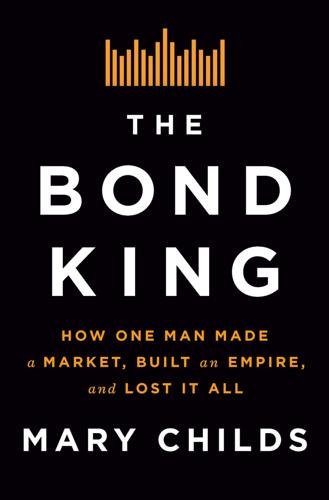
pages: 367 words: 110,161

The Bond King: How One Man Made a Market, Built an Empire, and Lost It All
by Mary Childs
Published 15 Mar 2022

That summer, he would decide that the trade floor was too quiet and abruptly institute an 8 A.M. conga line, which snaked around the trading desks in fitful, forced celebration. A few months later, he began a Song of the Day. Those on the floor could choose a song; Gross kicked things off with Cake’s “Short Skirt/Long Jacket.” Another day, someone requested “Turning Japanese,” a reference to the debate among wonks and market watchers about whether the Fed’s zero-interest-rate policy would yield a “lost decade” as in Japan. Another day: “Shape of My Heart” by Sting—Gross messaged that song’s suggester that Gross himself had been about to recommend it. Gross loved it. So, more must be better. Not long after, he instituted a Friday “closing bell” song when trading stopped at 1 P.M.

pages: 492 words: 118,882

The Blockchain Alternative: Rethinking Macroeconomic Policy and Economic Theory
by Kariappa Bheemaiah
Published 26 Feb 2017

Buiter The Precariat: The New Dangerous Class (2011), Guy Standing Inventing the Future: Postcapitalism and a World Without Work (2015), Nick Srnicek and Alex Williams Raising the Floor: How a Universal Basic Income Can Renew Our Economy and Rebuild the American Dream (2016), Andy Stern Index A Aadhaar program Agent Based Computational Economics (ABCE) models complexity economists developments El Farol problem and minority games Kim-Markowitz Portfolio Insurers Model Santa Fe artificial stock market model Agent based modelling (ABM) aggregate behavioural trends axiomatisation, linearization and generalization black-boxing bottom-up approach challenge computational modelling paradigm conceptualizing, individual agents EBM enacting agent interaction environmental factors environment creation individual agent parameters and modelling decisions simulation designing specifying agent behaviour Alaska Anti-Money Laundering (AML) ARPANet Artificial Neural Networks (ANN) Atlantic model Automatic Speech Recognition (ASR) Autor-Levy-Murnane (ALM) B Bandits’ Club BankID system Basic Income Earth Network (BIEN) Bitnation Blockchain ARPANet break down points decentralized communication emails fiat currency functions Jiggery Pokery accounts malware protocols Satoshi skeleton keys smart contract TCP/IP protocol technological and financial innovation trade finance Blockchain-based regulatory framework (BRF) BlockVerify C Capitalism ALM hypotheses and SBTC Blockchain and CoCo canonical model cashlessenvironment See(Multiple currencies) categories classification definition of de-skilling process economic hypothesis education and training levels EMN fiat currency CBDC commercial banks debt-based money digital cash digital monetary framework fractional banking system framework ideas and methods non-bank private sector sovereign digital currency transition fiscal policy cashless environment central bank concept of control spending definition of exogenous and endogenous function fractional banking system Kelton, Stephanie near-zero interest rates policy instrument QE and QQE tendency ultra-low inflation helicopter drops business insider ceteris paribus Chatbots Chicago Plan comparative charts fractional banking keywords technology UBI higher-skilled workers ICT technology industry categories Jiggery Pokery accounts advantages bias information Blockchain CFTC digital environment Enron scandal limitations private/self-regulation public function regulatory framework tech-led firms lending and payments CAMELS evaluation consumers and SMEs cryptographic laws fundamental limitations governments ILP KYB process lending sector mobile banking payments industry regulatory pressures rehypothecation ripple protocol sectors share leveraging effect technology marketing money cashless system crime and taxation economy IRS money Seigniorage tax evasion markets and regulation market structure multiple currency mechanisms occupational categories ONET database policies economic landscape financialization monetary and fiscal policy money creation methods The Chicago Plan transformation probabilities regulation routine and non-routine routinization hypothesis Sarbanes-Oxley Act SBTC scalability issue skill-biased employment skills and technological advancement skills downgrading process trades See(Trade finance) UBI Alaska deployment Mincome, Canada Namibia Cashless system Cellular automata (CA) Central bank digital currency (CBDC) Centre for Economic Policy Research (CEPR) Chicago Plan Clearing House Interbank Payments System (CHIPS) Collateralised Debt Obligations (CDOs) Collateralized Loan Obligations (CLOs) Complexity economics agent challenges consequential decisions deterministic and axiomatized models dynamics education emergence exogenous and endogenous changes feedback loops information affects agents macroeconoic movements network science non-linearity path dependence power laws self-adapting individual agents technology andinvention See(Technology and invention) Walrasian approach Computing Congressional Research Service (CRS) Constant absolute risk aversion (CARA) Contingent convertible (CoCo) Credit Default Swaps (CDSs) CredyCo Cryptid Cryptographic law Currency mechanisms Current Account Switching System (CASS) D Data analysis techniques Debt and money broad and base money China’s productivity credit economic pressures export-led growth fractional banking See also((Fractional Reserve banking) GDP growth households junk bonds long-lasting effects private and public sectors problems pubilc and private level reaganomics real estate industry ripple effects security and ownership societal level UK DigID Digital trade documents (DOCS) Dodd-Frank Act Dynamic Stochastic General Equilibrium (DSGE) model E EBM SeeEquation based modelling (EBM) Economic entropy vs. economic equilibrium assemblages and adaptations complexity economics complexity theory DSGE based models EMH human uncertainty principle’ LHC machine-like system operating neuroscience findings reflexivity RET risk assessment scientific method technology and economy Economic flexibility Efficient markets hypothesis (EMH) eID system Electronic Discrete Variable Automatic Computer (EDVAC) Elliptical curve cryptography (ECC) EMH SeeEfficient Market Hypothesis (EMH) Equation based modelling (EBM) Equilibrium business-cycle models Equilibrium economic models contract theory contact incompleteness efficiency wages explicit contracts implicit contracts intellectual framework labor market flexibility menu cost risk sharing DSGE models Federal Reserve system implicit contracts macroeconomic models of business cycle NK models non-optimizing households principles RBC models RET ‘rigidity’ of wage and price change SIGE steady state equilibrium, economy structure Taylor rule FRB/US model Keynesian macroeconomic theory RBC models Romer’s analysis tests statistical models Estonian government European Migration Network (EMN) Exogenous and endogenous function Explicit contracts F Feedback loop Fiat currency CBDC commercial banks debt-based money digital cash digital monetary framework framework ideas and methods non-bank private sector sovereign digital currency transition Financialization de facto definition of eastern economic association enemy of my enemy is my friend FT slogans Palley, Thomas I.

pages: 424 words: 119,679

It's Better Than It Looks: Reasons for Optimism in an Age of Fear
by Gregg Easterbrook
Published 20 Feb 2018

• Calculating from Census Bureau population projections and spending forecasts of the Congressional Budget Office, by 2047, US per-capita debt will be $235,000. Each American household will owe more than four years’ worth of wages toward what previous generations borrowed. That scary number for 2047 assumes interest rates stay low, and thus the government can borrow at low cost. The Federal Reserve cleaved to ZIRP—zero-interest-rate policy—for the entire Obama presidency. Had, under Obama, the price of Treasury notes been at the postwar average, his two terms would have added not $7.3 trillion but $10 trillion to the national debt. How interest rates stayed low for so long without triggering inflation is hotly debated by economists.
pages: 513 words: 141,153

The Spider Network: The Wild Story of a Math Genius, a Gang of Backstabbing Bankers, and One of the Greatest Scams in Financial History
by David Enrich
Published 21 Mar 2017

He had a way of reassuring a struggling Hayes, who drew comfort because he knew that Read also was a market expert. He could feel his pain. “Keep positive, mate,” Read commiserated. “Your luck will turn.” Read was right. That spring, the Bank of Japan had raised interest rates to 0.25 percent, abandoning its long-standing zero-interest-rate policy. Virtually overnight, trading products linked to Japanese interest rates went from an obscure backwater to a major moneymaker—gambling on future volatility no longer looked like a fool’s errand. Hayes found himself at the center of that small, exciting world; he had dutifully learned everything there was to learn about the dull Japanese market.

pages: 385 words: 128,358

Inside the House of Money: Top Hedge Fund Traders on Profiting in a Global Market
by Steven Drobny
Published 31 Mar 2006

It taught me the lesson that you can be right and lose all your money.Also, 286 INSIDE THE HOUSE OF MONEY if a stock is going to zero it doesn’t matter where you short it, you’re still going to make 100 percent because you can short on the way down.You made just as much money shorting $100 million of Enron at $25 as you did shorting $100 million of Enron at $50. It’s better to have more conviction and do twice as much. I’m waiting on this trade in short-term Japanese rates now, which may be the trade of the decade when Japan’s zero interest rate policy ends. I don’t need to be early on that and I may even wait until they raise rates for the first time, because once they move, this thing will be in motion. Have you become more patient with experience? Yes, and also more willing to miss things. If you were to ask me my biggest mistakes over the past two or three years, two of them have been misses.

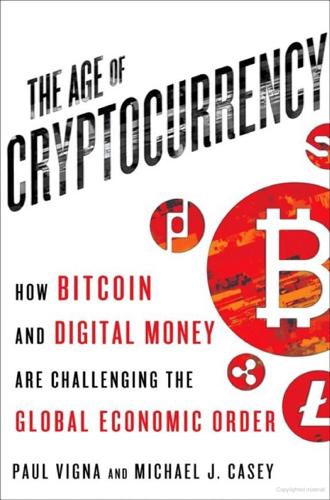
pages: 457 words: 128,838

The Age of Cryptocurrency: How Bitcoin and Digital Money Are Challenging the Global Economic Order
by Paul Vigna and Michael J. Casey
Published 27 Jan 2015

Wall Street’s lobbyists continue to finance a huge part of Congress’s political campaign needs, giving them undue influence over reform. In part that’s because we are still letting central bankers do our dirty work, allowing the drug of easy money to keep things afloat while Washington locks itself in acrimonious, self-interested gridlock. The Fed’s zero-interest-rate policies and more than $3 trillion in bond-buying, along with similar actions from its counterparts in Europe and Japan, have forestalled disaster. But little has been done to resolve the long-term fiscal imbalances in the United States or to restructure a financial system dominated by the same TBTF (too big to fail) banks.

pages: 491 words: 131,769

Crisis Economics: A Crash Course in the Future of Finance
by Nouriel Roubini and Stephen Mihm
Published 10 May 2010

Economists who swear fealty to Keynes argue that Japan failed to implement the appropriate fiscal stimulus and monetary policy in time. They point out that the government waited two years after the collapse of the bubble to start its stimulus spending. Even worse, the Bank of Japan took eight years to cut interest rates from 8 percent to 0 percent. Then it moved away from this zero-interest-rate policy (better known as ZIRP) too soon. Just as FDR curtailed fiscal and monetary policies in 1937, ushering in a severe recession, Japan triggered a recession that lasted from 1998 to 2000. By the same logic, the United States, should it curtail stimulus spending or tighten the monetary reins while the recovery has barely started, risks repeating this mistake today.

pages: 590 words: 153,208

Wealth and Poverty: A New Edition for the Twenty-First Century
by George Gilder
Published 30 Apr 1981

I have come to believe that a major cause of these problems is a monetary system that allows governments to escape their debts and confiscate savings by routinely cheapening the value of their money. The currency, which should function as a predictable standard of value and carrier of global commerce, has become an unpredictable speculative extension of it. Manifesting this phenomenon is the zero interest rate policy of the Federal Reserve, which diverts the wealth of savers to favored governments and corporations while creating shortages for everyone else. As leading supply-side economist David Malpass writes, “When something of value is free, it runs out fast and only the well connected get any....

pages: 566 words: 155,428

After the Music Stopped: The Financial Crisis, the Response, and the Work Ahead
by Alan S. Blinder
Published 24 Jan 2013

At that meeting, the Fed also began publishing different FOMC members’ forecasts of how the federal funds rate should or would evolve over the coming three years, just as they forecast future GDP, unemployment, and inflation rates. The views on where the federal funds rate should be at the end of 2014 varied enormously—from the 0-to-25-basis-points range that had prevailed since December 2008 (six of the seventeen members) to 2.5 percent or higher (four members). Two members even said that the near-zero interest-rate policy should continue into 2016. They looked like a rather fractious bunch, which they were. TIMING IS EVERYTHING That covers the what of the Fed’s exit. How about the when? If the Fed keeps monetary policy too loose for too long, it will overstimulate the economy, leading to higher inflation.

Money and Government: The Past and Future of Economics
by Robert Skidelsky
Published 13 Nov 2018

Since this stood at 20 per cent, far higher than the near-zero level in Western banks, it gave the People’s Bank of China a great deal of flexibility. The Bank of Japan, having tried QE from 2001 to 2006, without any success, did not re-embark on QE proper until 2013 as part of ‘Abenonomics’, when it announced that it was pursuing ‘aggressive monetary easing through its commitment to continue with a virtually zero interest-rate policy and purchases of financial assets for as long as the Bank judges appropriate’ to achieve its 2 per cent inflation target (Morimoto (2013), p. 5). 32 Robert Lucas, quoted in Skidelsky (2009), p. 47. 33 Congdon (2007), p. 282. 34 A simple illustration is given in Ryan-Collins, et al. (2014 (2011)), p. 19. 35 Kaldor (1983a), p. 21.