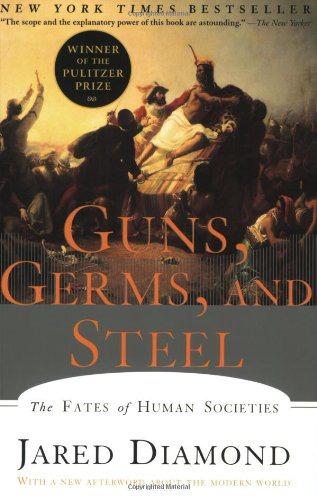
Guns, germs, and steel: the fates of human societies
by
Jared M. Diamond
Published 15 Jul 2005
Guns, Germs and Steel Guns, Germs and Steel Guns, Germs and Steel Guns, Germs and Steel WHY IS WORLD HISTORY LIKE AN ONION? THIS BOOK ATTEMPTS TO PROVIDE A SHORT HISTORY OF everybody for the last 13,000 years. The question motivating the book is: Why did history unfold differently on different continents? In case this question immediately makes you shudder at the thought that you are about to read a racist treatise, you aren't: as you will see, the answers to the question don't involve human racial differences at all. The book's emphasis is on the search for ultimate explanations, and on pushing back the chain of historical causation as far as possible.
…
Finally, peoples of some areas ecologically suitable for food produc- tion neither evolved nor acquired agriculture in prehistoric times at all; they persisted as hunter-gatherers until the modern world finally swept upon them. The peoples of areas with a head start on food production thereby gained a head start on the path leading toward guns, germs, and steel. The result was a long series of collisions between the haves and the have-nots of history. How can we explain these geographic differences in the times and modes of onset of food production? That question, one of the most important problems of prehistory, will be the subject of the next five chap- ters. Guns, Germs and Steel CHAPTER 6 To FARM OR NOT TO FARM F ORMERLY, ALL PEOPLE ON EARTH WERE HUNTER-GATHER- ers. Why did any of them adopt food production at all?
…
Among the dozens of Zulu chiefdoms, the Mtetwa chiefdom enjoyed no advantage whatsoever of technology, writing, or germs over the other chiefdoms, which it nevertheless suc- ceeded in defeating. Its advantage lay solely in the spheres of government and ideology. The resulting Zulu state was thereby enabled to conquer a fraction of a continent for nearly a century. Guns, Germs and Steel PART TWO AROUND THE WORLD IN FIVE CHAPTERS Guns, Germs and Steel CHAPTER 15 YALI'S PEOPLE W HEN MY WIFE, MARIE, AND I WERE VACATIONING IN Australia one summer, we decided to visit a site with well- preserved Aboriginal rock paintings in the desert near the town of Menindee. While I knew of the Australian desert's reputation for dryness and summer heat, I had already spent long periods working under hot, dry conditions in the Californian desert and New Guinea savanna, so I consid- ered myself experienced enough to deal with the minor challenges we would face as tourists in Australia.
The Patterning Instinct: A Cultural History of Humanity's Search for Meaning
by
Jeremy Lent
Published 22 May 2017
smtid=3&psid=57 (accessed June 20, 2016); H. Koning, Columbus: His Enterprise: Exploding the Myth (New York: Monthly Review Press, 1976), 53–54. 37. David E. Stannard, American Holocaust: Columbus and the Conquest of the New World (New York: Oxford University Press, 1992), 75–81; Diamond, Guns, Germs, and Steel, 67–74. 38. Diamond, Guns, Germs, and Steel, 74–81. 39. Anthony Aveni, Empires of Time: Calendars, Clocks, and Cultures (Boulder, CO: University Press of Colorado, 2002), 241; Stannard, American Holocaust, 76. 40. Stannard, American Holocaust, 109–11. 41. Cited in ibid. 42. Cited in ibid. 43. Cited in ibid., 227. 44.
…
The history of ideas is endlessly captivating because well-known sequences of political and cultural events of the past, again and again, appear in a new light when we look at them through a different narrative lens. I have no doubt that this is the reason for the tremendous success of books like Jared Diamond's Guns, Germs, and Steel and Yuval Harari's Sapiens, and of documentaries like Kenneth Clark's Civilisation and Jacob Bronowski's The Ascent of Man. The Patterning Instinct by Jeremy Lent continues this tradition of broad interdisciplinary historical narratives, written in nontechnical language, eminently readable, entertaining, yet sophisticated and intellectually fascinating.
…
A more useful investigation, according to the postmodernist critique, would be to recognize the multiplicity of discourses created by various cultures and, rather than try to distill some essential meaning from them, trace how certain social and political groups used these discourses to maintain or enhance their own power relative to others.5 The postmodernist critique has had a profound effect on the social sciences, and even when it hasn't been fully accepted, some of its principles have helped shape the current norms of many academic disciplines, including history. A major step in establishing this new standard was the publication by Jared Diamond of Guns, Germs, and Steel in 1997. This book, which has deservedly become a modern classic, investigates one of the crucial questions of history: why have the Eurasian civilizations been so successful in establishing hegemony over the people of other continents? Diamond claims the reasons can be found not in genes or culture but in geography.
The Ages of Globalization
by
Jeffrey D. Sachs
Published 2 Jun 2020
The largest contiguous zone of shared agriculture potential is the east-west axis of Eurasia, a wheat-growing belt that stretches ten thousand kilometers from the Atlantic coast of Portugal to the Pacific coast of China. Jared Diamond, one of the great modern explicators of economic history and economic development, has emphasized in his wonderful book Guns, Germs, and Steel that Eurasia’s long east-west axis facilitated the dissemination of technologies within ecological zones.6 Wheat, which emerged originally in the Fertile Crescent (in today’s Turkey, Iraq, and eastern Mediterranean), diffused west into Europe and east into Asia. Horse domestication, which emerged first in the Pontic-Caspian region (spanning the Black Sea and the Caspian Sea north of the Caucasus), diffused west into Europe and east into China.
…
Kees Klein Goldewijk, Arthur Beusen, and Peter Janssen, “Long-Term Dynamic Modeling of Global Population and Built-up Area in a Spatially Explicit Way: HYDE 3.1,” Holocene 20, no. 4 (2010): 565–73. 4. David Reich, Who We Are and How We Got Here (New York: Random House, 2018), 100. 5. Reich, Who We Are and How We Got Here, 113. 6. Jared Diamond, Guns, Germs, and Steel (New York: Norton, 1997), xx. 7. A famous and influential account of the distinctive geographical, political, and social features of these early alluvial societies is Karl S. Wittfogel’s Oriental Despotism: a Comparative Study of Total Power (New Haven, CT: Yale University Press, 1957). Wittfogel argued that the need for major public works to control river flooding and irrigation gave rise to strong, indeed despotic, states.
…
Kennedy, “Commencement Address at American University,” Washington, D.C., June 10, 1963, https://www.jfklibrary.org/archives/other-resources/john-f-kennedy-speeches/american-university-19630610. Further Readings 1: Seven Ages of Globalization Davis, Mike. Late Victorian Holocausts: El Niño Famines and the Making of the Third World. Brooklyn: Verso, 2001. Diamond, Jared. Guns, Germs, and Steel. New York: Norton, 1997. Jared Diamond’s book is a masterpiece of concision, insight, and sheer joy of discovery. He explains beautifully the deep role of physical geography in shaping our world. Kordsmeyer, Tobias L., Pádraig Mac Carron, and R. I. M. Dunbar. “Sizes of Permanent Campsite Communities Reflect Constraints on Natural Human Communities.”
A Manual for Writers of Research Papers, Theses, and Dissertations, Eighth Edition: Chicago Style for Students and Researchers
by
Kate L. Turabian
Published 14 Apr 2007
Single Author or Editor N: Note Number. Author's First and Last Names, Title of Book: Subtitle of Book (Place of Publication: Publisher's Name, Date of Publication), XX–XX. 1. Jared Diamond, Guns, Germs, and Steel: The Fates of Human Societies (New York: W. W. Norton and Company, 1997), 47–48. B: Author's Last Name, Author's First Name. Title of Book: Subtitle of Book. Place of Publication: Publisher's Name, Date of Publication. Diamond, Jared. Guns, Germs, and Steel: The Fates of Human Societies. New York: W. W. Norton and Company, 1997. For a book with an editor instead of an author, adapt the pattern as follows: N: Note Number.
…
Philadelphia, 1950. 17.1.6 Facts of Publication The facts of publication usually include three elements: the place (city) of publication, the publisher's name, and the date (year) of publication. In notes, these elements are enclosed in parentheses; in bibliography entries, they are not. N: 1. Jared Diamond, Guns, Germs, and Steel: The Fates of Human Societies (New York: W. W. Norton and Company, 1997), 47. B: Diamond, Jared. Guns, Germs, and Steel: The Fates of Human Societies. New York: W. W. Norton and Company, 1997. For books published before the twentieth century, or for which the information does not appear within the work, you may omit publishers' names as well as places of publication.
…
Author #1's Last Name, Author #2's Last Name, and Author #3's Last Name, XX–XX. 15. Appleby, Hunt, and Jacob, 140. * * * 3. Four or More Authors N: Note Number. Author #1's Last Name et al., XX–XX. 10. Hall et al., 91–93. * * * Author-Title Notes * * * 4. Books N: Note Number. Author's Last Name, Shortened Title, XX–XX. 2. Diamond, Guns, Germs, and Steel, 85–90. For books by more than one author, follow the pattern for authors' names in templates 2 and 3. * * * 5. Articles N: Note Number. Author's Last Name, “Shortened Title,” XX–XX. 8. Nayar, “Marvelous Excesses,” 225. For articles by more than one author, follow the pattern for authors' names in templates 2 and 3
A Short History of Progress
by
Ronald Wright
Published 2 Jan 2004
The Australian exception is probably a result of the dry and unreliable climate, and perhaps of a dearth of native plants with crop potential. Australia was populated much earlier than the Americas, and the food crunch — the extinction of big game — may have happened at a time when world climatic instability made agricultural experiments impossible. 28. For example, Jared Diamond’s Guns, Germs, and Steel: The Fates of Human Societies (New York: W. W. Norton, 1997), which is informative on germs but should not be relied on for archaeological and historical data or interpretation. In particular, the dating and description of New World agriculture is flawed, and his portrayal of Atahuallpa’s overthrow and the other Spanish conquests omits important data and strikes me as tendentious. 29.
…
Parasitic infections spread by crowded living and unsafe water were common, and the heavily exploited lower classes were also malnourished. 74. The main crop was millet, until wheat appeared around 1300 B.C. It took wheat 6,000 years to reach China after its domestication on the far side of the continent, hardly the rapid transit of technology in the Old World argued by Diamond (Guns, Germs, and Steel). 75. The main trade item was silk, which flowed indirectly from China to Rome along the Silk Road. The two empires had only hazy ideas of each other’s existence. 76. Chinese records show nearly one famine every year in at least one province from 108 B.C. to 1910 (Ponting, Green History, p. 105).
…
New York: Simon & Schuster, 1996. Daws, Gavan. A Dream of Islands. Honolulu: Mutual Publishing, 1980. Denevan, William. “The Pristine Myth: The Landscape of the Americas in 1492.” In The Americas Before and After Columbus. Edited by Karl Butzer. Oxford: Blackwell, 1992. Diamond, Jared. Guns, Germs, and Steel: The Fates of Human Societies. New York: W. W. Norton, 1997. Dickens, Charles. Hard Times. Harmondsworth, UK: Penguin, 1969. Originally published in 1854. Dillehay, Tom D., ed. Monte Verde: A Late Pleistocene Settlement in Chile. Washington, DC: Smithsonian Books, 1989. Edwards, Clinton R.
The Great Turning: From Empire to Earth Community
by
David C. Korten
Published 1 Jan 2001
Encyclopaedia Britannica 2003, deluxe ed. CD, s.v. “Human Evolution”; Philip Lee Ralph et al., Western Civilizations: Their History and Their Culture, vol. 1, 9th ed. (New York: W.W. Norton, 1997), 6–8. 7. Jared Diamond, Guns, Germs, and Steel: The Fates of Human Societies (New York: W. W. Norton, 1999), 267–68. 8. Burns, Western Civilizations, 124. 9. Diamond, Guns, Germs, and Steel, 16. 10. Eisler, Chalice and Blade, 16–21. 11. Merlin Stone, When God Was a Woman (San Diego: Harcourt Brace, 1976), 2–4. 12. Eisler, Chalice and Blade, 28. 13. Brian Swimme and Thomas Berry, The Universe Story (San Francisco: HarperSanFrancisco, 1992), 168–84. 14.
…
Some were so desperate in their impoverishment that they “voluntarily” chose slavery over starvation, much as the desperately poor now “voluntarily” present themselves to companies offering sweatshop work under slavelike conditions or sign up for military service. The demand for slaves made trafficking in slaves acquired through kidnapping and piracy one of the earliest and most profitable forms of commerce.26 TURNING TO EMPIRE: A SCALE PERSPECTIVE In contrast to Eisler’s analysis, Jared Diamond, in Guns, Germs, and Steel, deals with the transition to Empire as purely a response to the practical need to organize large numbers of unrelated people into peaceful and coherent social units. Small Is Equitable In the early gatherer-hunter days, the survival of the band typically required that all able-bodied members contribute to gathering food, which largely precluded class-based social stratification.
…
Chapter 6: Ancient Empire 1. Ilarion (Larry) Merculief, “The Gifts from the Four Directions,” YES! A Journal of Positive Futures, Spring 2004, 44–45. Based on his studies of oral prophecy. 2. These sources include Ralph et al., Western Civilizations; Burns, Western Civilizations; Diamond¸ Guns, Germs, and Steel; Will Durant, Heroes of History: A Brief History of Civilization from Ancient Times to the Dawn of the Modern Age (New York: Simon & Schuster, 2001); Encyclopaedia Britannica 2003, deluxe ed. CD; and a variety of Web resources, including the BBC Internet service history collection, http://www.bbc.co.uk/history/ (accessed September 10, 2005); and http://www.historyguide.org/. 3.
Wonderland: How Play Made the Modern World
by
Steven Johnson
Published 15 Nov 2016
Clove harvesting This still doesn’t answer the question of why Europeans had to travel so far, assuming we aren’t satisfied with Elizabeth’s providential explanation. Why weren’t the Spanish hills teeming with pepper vines? Here the ecosystems approach to human history, most famously presented in Jared Diamond’s Guns, Germs, and Steel, offers the most enlightening explanation. Diamond argued that civilization first took root in Mediterranean climates because those climates featured short rainy seasons and long dry seasons, which encouraged the cultivation of large-seeded grains like wheat and barley that became central to modern agriculture.
…
(Fruits evolved a different strategy, creating seeds that could survive digestion, and ensuring a wide distribution by wrapping those seeds in a delicious sugary flesh.) The pungency of pepper that Pliny decried originally served as a kind of chemical weapon, threatening to burn any creature that dared to eat the plant’s berries. The story of pepper is thus a kind of inverted version of Diamond’s account in Guns, Germs, and Steel: civilization took root in Mediterranean climates because large-seeded grains of wheat and barley were nearby and easy to consume; the global market of the spice trade arose because pepper grew only in distant tropical climates whose biodiversity had made it advantageous for the pepper berries to be painful to consume.
…
Vol. 17. DA Talboys, 1841. Delany, Paul. “Constantinus Africanus’ ‘De Coitu’: A Translation.” Chaucer Review (1969): 55–65. Devlin, Keith. The Unfinished Game: Pascal, Fermat, and the Seventeenth-Century Letter that Made the World Modern. New York: Basic Books, 2010. Diamond, Jared. Guns, Germs, and Steel: The Fates of Human Societies. New York: W. W. Norton & Company, 1999. Douthwaite, Julia V., and Daniel Richter. “The Frankenstein of the French Revolution: Nogaret’s Automaton Tale of 1790.” European Romantic Review 20:3 (July 2009): 381–411. Duffy, Cian, and Peter Howell. Cultures of the Sublime: Selected Readings, 1750–1830.
Rope: How a Bundle of Twisted Fibers Became the Backbone of Civilization
by
Tim Queeney
Published 11 Aug 2025
Dapenkeng artifacts have been sourced to the Philippines in 3000 BCE, then to islands in Indonesia like Borneo, Celebes, and Timor circa 2500 BCE, and then Java and Sumatra in 2000 BCE, and still further east to the Solomon Islands by 1600 BCE.4 One of the ways archaeologists have tracked the steady movement of the seafaring people outward from their origin is via a stone tool quite appropriate for our story. In his book Guns, Germs, and Steel, Jared Diamond noted: “One specific type of artifact linking Taiwan’s Ta-p’en-k’eng [Dapenkeng] culture to later Pacific island cultures is a bark beater, a stone implement used for pounding the fibrous bark of a certain tree species into rope.”5 This outward movement across hundreds of miles of open ocean at a time started in Taiwan in the fourth century BCE and ended when voyagers reached Easter Island/Rapa Nui between 500 and 1000 CE.
…
Quipus and Witches’ Knots: The Role of the Knot in Primitive and Ancient Cultures. Lawrence, KS: The University of Kansas Press, 1967. Deming, Alison Hawthorne. Rope. New York: Penguin Books, 2009. Dennison, Matthew. Livia, Empress of Rome. New York: St. Martin’s Press, 2010. Diamond, Jared. Guns, Germs, and Steel: The Fates of Human Societies. New York: W. W. Norton, 1999. Dibner, Bern. The Atlantic Cable. Norwalk, CT: The Burndy Library, 1959. Dickens, Charles. Oliver Twist. Oxford: Oxford University Press, 1989. Dolin, Eric Jay. Leviathan: The History of Whaling in America. New York: W. W. Norton, 2007.
…
Pitts, How to Build Stonehenge, 123. 25. Waldron, Great Wall of China, 27. 26. Keay, China: A History, 402. 27. Man, Great Wall, 249. 28. Man, 250. STRAND THREE: CORDAGE GETS TO WORK 1. Thompson, “Recollections of the Voyage of Rediscovery.” 2. Thompson. 3. Thompson. 4. Diamond, Guns, Germs, and Steel, 340. 5. Diamond, 340. 6. Thomas, Last Navigator, 53. 7. Lewis, We, the Navigators, 78. 8. Irwin, Prehistoric Exploration, 44. 9. Finney, “Voyaging,” 347. 10. Casson, Ancient Mariners, 61. 11. Casson, 62. 12. Casson, 51. 13. “Names of Istanbul.” 14. Casson, Ancient Mariners, 83. 15.
Falling Behind: Explaining the Development Gap Between Latin America and the United States
by
Francis Fukuyama
Published 1 Jan 2006
Angus Maddison, The World Economy: A Millennial Perspective (Paris: OECD, 2003), p. 262. 3. See Daron Acemoglu, Simon Johnson, and James A. Robinson, “Reversal of Fortune: Geography and Institutions in the Making of the Modern World Income Distribution,” Quarterly Journal of Economics 118 (2002): 1231–1294. 4. Jared M. Diamond, Guns, Germs and Steel: The Fate of Human Societies (New York: Norton, 1997). 5. W. George Lovell and Christopher Lutz, “Conquest and Population: Maya Demography in Historical Perspective,” Latin American Research Review 29 (1994): 133–140. 6. Barry Bogin and Ryan Keep, “Eight Thousand Years of Economic and Political History in Latin America Revealed by Anthropometry,” Annals of Human Biology 26 (1999): 333–351. 7.
…
Taylor (Cambridge, MA: Harvard University Press, 1998), p. 26. 11. Robert M. Solow, “Technical Change and the Aggregate Production Function,” Review of Economics and Statistics 39 (1957): 312–320. 12. Charles de Secondat Montesquieu, The Spirit of the Laws (New York: Cambridge University Press, 1989 [1748]). 13. Diamond, Guns, Germs and Steel, p. 358. 14. Jeffrey D. Sachs, Tropical Underdevelopment, NBER Working Paper 8119 (Cambridge, MA: National Bureau of Economic Research, 2001), p. 2. 15. Anthony G. Hopkins, An Economic History of West Africa (New York: AddisonWesley and Longman, 1973). 16. Max Weber, The Protestant Ethic and the Spirit of Capitalism (London: Allen and Unwin, 1930). 17.
…
Robinson, and Simon Johnson, “The Colonial Origins of Comparative Development: An Empirical Investigation,” American Economic Review 91, no. 5 (2001): 1369–1401; Acemoglu, Robinson, and Johnson, “Reversal of Fortune: Geography and Institutions in the Making of the Modern World Income Distribution,” Quarterly Journal of Economics 107 (2002): 1231–1294; Dani Rodrik and Arvind Subramanian, “The Primacy of Institutions (and What This Does and Does Not Mean),” Finance and Development 40, no. 2 (2003): 31–34; Daniel Kaufmann, Aart Kraay, and Massimo Mastruzzi, Governance Matters IV: Governance Indicators for 1996–2004 (Washington, DC: World Bank Institute, 2005); and Ajay Chhibber, R. Kyle Peters, and Barbara J. Yale, eds., Reform and Growth: Evaluating the World Bank Experience (New Brunswick, NJ: Transaction, 2006). 5. Jared Diamond, Guns, Germs, and Steel: The Fates of Human Societies (New York: Norton, 1997); Jeffrey Sachs and Andrew Warner, Natural Resource Abundance and Economic Growth, NBER Working Paper 5398 (Cambridge, MA: National Bureau of Economic Research, 1995); Jeffrey Sachs and John W. McArthur, Institutions and Geography: Comment on Acemoglu, Johnson, and Robinson (2000), NBER Working Paper 8114 (Cambridge, MA: National Bureau of Economic Research, 2001). 6.
Dead Aid: Why Aid Is Not Working and How There Is a Better Way for Africa
by
Dambisa Moyo
Published 17 Mar 2009
Many reasons have been offered to account for why African countries are not working: in particular, geographical, historical, cultural, tribal and institutional. While each of them is convincing in explaining Africa’s poor showing, they do not tell the whole story. One argument, advanced by geographical determinists such as Jared Diamond in Guns, Germs and Steel (1997), is that a country’s wealth and success depend on its geographical environment and topography. Certain environments are easier to manipulate than others and, as such, societies that can domesticate plants and animals with relative ease are likely to be more prosperous. At a minimum, a country’s climate, location, flora, fauna and terrain affect the ability of people to provide food for consumption and for export, which ultimately has an impact on a country’s economic growth.
…
Kelly, ‘Agricultural Growth Linkages in Sub-Saharan Africa’, International Food Policy Research Institute, Research Report 107, 1998 Devarajan, Shanta and Vinaya Swaroop, ‘The Implications of Foreign Aid Fungibility for Development Assistance’, The World Bank Development Research Group Working Paper WPS2022, October 1998 Devarajan, S., A. S. Rajkumar and V. Swaroop, ‘What Does Aid to Africa Finance?’, The World Bank Development Research Group Working Paper WPS2092, August 1999 Diamond, Jared, Guns, Germs and Steel: A Short History of Everybody for the Last 13,000 Years, New York: Vintage, 1998 Diamond, Larry, ‘Promoting Real Reform in Africa’, in Democratic Reform in Africa: The Quality of Progress, ed. E. Gyimah-Boadi, Boulder, Colo.: Lynne Reinner, 2004, pp. 263–92 Diamond, L. and M. Plattner, Democratization in Africa, Baltimore: Johns Hopkins University Press, 1998 Dixon, Hugh, D.
…
Morgan) 82–3 emerging markets 78–81, 85, 90–91 Empire: How Britain Made the Modern World (Ferguson) 34 EMT (Cambodia) 132 Ending Africa’s Poverty Tap (Sachs) 96 Energy Information Administration (US) 103 Enhanced Structural Adjustment Facility 19 Enron 83 Equatorial Guinea 106, 120 Ethiopia 72, 110, 117 European Investment Bank (EIB) 89–90, 107 European Union 94, 118–19 Everything But Arms 2001 (Europe) 118 exports 63–4 Extractive Industries Transparency Initiative (EITI) 49 finance see investment Financial Institutions (report) 87 Financing for Development conference 45–6 Fitch rating agency 83, 97 Food Aid 45 Food for Peace Program (US) 16 foreign direct investment (FDI) 98–106, 111–14, 120, 124, 133, 147 France 36, 115 free-market system 72–3 Freund, C. 133 Friedman, Milton 20 G8 90 Gabon 77, 87, 93, 106, 118, 120, 146 Gambia 72, 106 Gazprom (Russia) 112 Geldof, Bob 26–7 GEMLOC Program 90–91 GEMX index 91–2 Germany 36 Ghana access to banking 131 bond issues 77, 87, 89, 93, 96–7 and capital markets 146 favourable view of China 109 GDP contraction 16 and long-term debt 87–8 Giuliano, Paola 136 Global Emerging Markets Local Currency Bond Program (GEMLOC) 90–91 globalizers (winning/non-/losing) 114 Grameen Bank 126–32, 138–9 Greece 125 Grossman, H. I. 59 Guns, Germs and Steel (Diamond) 29 Hadjimichael, M. T. D. 46 Heavily Indebted Poorest Country debt relief programme (HIPC) 53 HIV–AIDS pandemic 4–5, 7, 71–2 Hu Jintao 104, 108 Human Development Report (1994) 52 Hungary 85–6 IMF (International Monetary Fund) aid warning 47 appointment of Irwin Blumenthal 53 debt crisis 18–19 and foreign capital 63 inception 11–13 and Malawi 55–6 and ‘nit-picking’ 108–9 Structural Adjustment Facilities 21 In Search of Prosperity (Rodrik) 34 India 112, 117, 123, 132, 134, 137–8 India–Africa Forum 112, 123 Indonesia 34, 56 Industrial and Commercial Bank (China) 106 inflation 61–5 innovation 139–40 International Bank for Reconstruction and Development see World Bank International Development Association (IDA) 37–8 International Development and Food Assistance Act (US 1975) 16 International Peace Research Institute (Stockholm) 59 International Remittance Network 136 International Trade Organization 11 investment bonds 77–83, 87–96 borrowing costs 84–5 credit ratings 78, 83, 87–8 emerging markets 79–81, 85 portfolio diversification 80–82 Ireland 37, 125 Israel 134 Italy 125 Ivory Coast 109–10 Jamaica 136 Japan 99, 102–3, 112, 125 Johannesburg Stock Exchange 4 John Paul II, Pope 26 joint liability 129 Jubilee Debt Campaign 26 Kagame, President Paul 27–8, 148–9 Kanbur, Ravi 54 Kariba dam 15 Kenya and EBA 118 and exports 62 favourable view of China 109 fragile democracy 72 HIV prevalence rates 3 and long-term debt 87–8 money transfer systems 136 population 124 and rampant corruption 48 stake in the economy 152 trade-oriented commodity-driven economy 146 turbulent elections 2008 33 Keynes, John Maynard 11 Kibaki, Mwai 33 Kiva 130 Kurtzman, Joel 51 Lambsdorff, Graf 51 Landes, David 33–4, 147 least-developed countries (LDC) 123 Lensink, R. 136 Lesotho 118 life expectancy 5 Lin Yifu, Justin 153 Live Aid 26 Lumumba, Patrice 14 Lundin, Lukas 98 M-Pesa (money transfer system) 136 Mahajan, Vijay 132 McLiesh, Caralee 101 McNamara, Robert 16, 17 maize scandal (Malawi) 56 Malawi 55–6, 106, 117, 145 Mali 71–2, 94, 109–10, 116 Maren, Michael 60 Markit (data/index firm) 91 Marshall, George C. 12 Marshall Plan 12–13, 35–8 Mauritania 120 Mauritius 34, 89 Maystadt, Philippe 107 Mengistu Haile Mariam 14, 23 Mexico 18, 82, 84, 117, 132, 144, 151 micro-finance 126–32, 140 middle class 57–8 Millennium Challenge Corporation aid campaign (US) 40, 56 Millennium Development Goals (MDG) 45, 96–7 Mkapa, President Benjamin 26 Mobutu Sese Seko, President 14, 22–3, 48, 53, 108 Monterrey Consensus 2002 74 Moody’s Investors Service 83 morality 150 ‘More Aid for the Poorest’ (UK white paper) 16 mosquito net producer (example) 44–5, 114, 122, 130–31 Mozambique 117, 134 Mugabe, Grace 146 Mugabe, Robert 108, 146–7 Mwanawasa, President Levy 53 Mystery of Capital, The (de Soto) 137–8 Na’m, Moisés 107 Namibia 89, 93 ‘negative corruption’ 57; see also corruption Netherlands 63 New York City 151; see also United States New Zealand 121 Nicaragua 151 Nigeria and AGOA duty-free benefits 118 aid from World Bank 107–8 assets looted 48 banking sector 4 beneficiary of FDI 105 and the bond index 92 and corruption 23 cotton revenues 116 favourable view of China 109 humanitarian catastrophe 26 independence 71 and long-term credit ratings 88 Maiduguri money find 137 many tribes 32 natural-gas reserves development 112 rebuilding colonial-era railway 106 remittances 133 ‘No Donor Money, No Loans’ policy 128 North, Douglass 41 Norway 73 ODA (official aid) 25 Odinga, Raila 33 oil 17–18, 48–9, 82, 105–6, 108–9, 120 oil crisis 1979 17–18 Olson, Mancur 41 Olympics 2008 108 Organization of Economic Cooperation and Development (OECD) 115 Oxfam 117 Pakistan 34, 124 Pan-African Infrastructure Development Fund (PAIDF) 95 Paris Club of creditors 108 PEPFAR (AIDS Relief) 7 Peru 151 Peters Projection Map 121 Pew Report 2007 109 Philippines, the 135 PIMCO (bond investment organization) 91 Poland 8–6 Ponzi schemes 130 ‘positive’ corruption 56, 59; see also corruption Private Equity investments 4–5 programme aid 21 Protestantism 31 Przeworski, Adam 43 Raiffeisen, Friedrich 131 Rajan, Raghuram G. 142 Ramalho, Rita 101 Ramesh, Jairam 123 Reagan, Ronald 20, 22 Reichel, R. 46 remittances 133–6 Resource Flows to Africa (UN) 133 Revolutionary United Front (Sierra Leone) 59 Rodrik, Dani 34 Rosenstein-Rodan, Paul 39 Ruiz-Arranz, Marta 136 Russia 84, 87, 112 Rwanda 27, 32, 148 Sachs, Jeffrey 96–7 Sani Abacha, President 48 São Tomé and Principe 106 savings 137–40 Schulze-Delitzsch, Herman 131 Scottish Banks 139–40 Second Conference of Chinese and African Entrepreneurs 114 securitization 96 Sen, Amartya 42 Senegal 109–10 Short, Clare 56 Sierra Leone 59 Singapore 152 Singh, Manmohan 123 small/medium enterprises (SMEs) 125 social capital 58–9 Somalia 60, 118, 133 South Africa abandoning foreign aid 144 and AGOA duty-free benefits 118 and bond issues 89, 92–3 and credit league tables 82 1997 stock market fall 84 not reliant on aid 150 and PAIDF 95 remittances 133 setting an example 78 South Korea 45, 82, 87 Sovereign Wealth Funds 112 Spain 86 Spatafora, N. 133 stabilization programme 20 Standard & Poor’s rating agency 83, 87–8 Standard Bank 106 sterilization 64–5 stock market liquidity 4 Structural Adjustment Facilities 20–21 Subramanian, Arvind 142 subsidies 115–16 Sudan 105–6, 108, 120 sugar production 116–17 Svensson, J. 39, 52 Swaziland 5, 106 Sweden 73 Tanzam Railway 103–4 Tanzania 26, 56, 97, 103–4, 110, 124, 131 taxation 52, 66 Thailand 57 Thatcher, Margaret 20, 67 Togo 94, 116 Tokyo International Conference on African Development 112 Toxopeus, H. 136 trade 17, 19–21, 38–40, 62, 64, 112, 114, 117–24 Transparency International 51, 56, 71 Turkey 93, 112, 117 Uganda aid-fuelled corruption 53 and bonds 65, 97 favourable view of China 109 and HIV–AIDS 71 improved economic growth 101 plunderers and despots 108 population 124 remittances 134 trade-oriented commodity-driven economy 146 UN Conference on Trade and Development (UNCTAD) 102 United Kingdom 108, 120 United Nations Development Programme (UNDP) 25 United Nations Human Development Report 5 United States and African Growth and Opportunity Act 118 aid history 12–17, 40 bond comparisons 80 diplomatic ties with Zimbabwe 108 Energy Information Administration 103 Food For Peace budget 45 freer trade access for African countries 149 influence compared to China 109–10 and Malawi 56 public’s desire on aid 74 Soft Banks 139 and subsidies 115–16 trading partner status 119 2006 foreign aid 99–100 US Farm Security and Rural Investment Act 2005 115 USSR 14, 19, 24 Venezuela 86 venture capital (VC) 139 Wade, President Abdoulaye 149 Washington Consensus 21–2 Wealth and Poverty of Nations, The (Landes) 33–4, 147 Weber, Max 31 Weder, Beatrice 52 Wen Jibao 104, 114 West African Economic and Monetary Union 88 What makes Democracies endure?
Fluke: Chance, Chaos, and Why Everything We Do Matters
by
Brian Klaas
Published 23 Jan 2024
It became a scholarly sin to even consider whether some aspects of human history—including gross injustices and inequalities—were determined not exclusively by choice, but partly by geological chance. In the late 1990s, the geographer and ornithologist Jared Diamond brought geographic determinism back into vogue. His book Guns, Germs, and Steel was a surprise international bestseller, reviving ideas that had long ago been relegated to the intellectual fringe. Diamond argued that modern inequalities are derived not from innate intellectual capacity or cultural strength, but from geographical endowments that made it harder for some societies to thrive, while others got lucky, with the ideal conditions to build advanced civilizations.
…
Diamond argued that modern inequalities are derived not from innate intellectual capacity or cultural strength, but from geographical endowments that made it harder for some societies to thrive, while others got lucky, with the ideal conditions to build advanced civilizations. The earth doesn’t fairly distribute resources, predators, or diseases across space, and those unfair geological and geographical variations have manifested in a profoundly unequal modern world. In Guns, Germs, and Steel, Diamond observes that human history was also diverted by the shape and orientation of the continents—an idea known as the continental axis theory. Climate, habitat, vegetation, soil, and wildlife are mostly dictated by latitude, not longitude. Move north or south, and the climate changes drastically, which means you need different strategies to survive.
…
Through these mechanisms, the arbitrary nature of climate, geographical terrain, and the geology of soils has shaped who we are and how our history has unfolded. The debate just lies over how much is driven by human action—and how much is due to the lottery of earth. Critics have nonetheless accused Guns, Germs, and Steel of resurrecting the racism embedded in previous geographic explanations for global inequality. Diamond emphatically disavows racism. But academic vultures circled. Some pointed to factual errors or debatable evidence in some parts of the text, which were worthy of serious critique. But others went much further, dismissing the basic premise of his argument altogether, unfairly lumping Diamond in with odious thinkers from eras past simply because he advanced the obviously true position that we are creatures affected by the geographical accidents of our landscapes, our crops, our diseases, and our resources.
Getting Better: Why Global Development Is Succeeding--And How We Can Improve the World Even More
by
Charles Kenny
Published 31 Jan 2011
We are better off because we are better bred. Or, according to Robert Barro of Harvard, we are richer because we follow the right religion. Kipling would be overjoyed.26 On the other hand, the less eugenically or theologically inclined can look at the same data and divine an interpretation more akin to Jared Diamond’s in Guns, Germs and Steel regarding the importance of extremely initial conditions. Diamond argues that the West triumphed over the Rest because Europe sat at the end of a continent broader than it was long, thus containing much larger contiguous ecological areas compared to the landmasses of Africa or the New World.
…
Current Anthropology 29, no. 2. Devarajan, S., W. R. Easterly, and H. Pack. 2003. “Low Investment Is Not the Constraint on African Development.” Economic Development and Cultural Change 51, no. 3. Diamond, J. 1993. The Third Chimpanzee: The Evolution and Future of the Human Animal. New York: Harper. ———. 1997. Guns, Germs and Steel: The Fate of Human Societies. New York: W. W. Norton. ———. 2005. Collapse: How Societies Choose to Fail or Succeed. New York: Penguin. Diamond, L. 2007. The Spirit of Democracy: The Struggle to Build Free Societies Throughout the World. New York: Times Books. Diener E., and C. Diener. 1995.
…
effects of slave trade in escaping Malthusian trap factors for evaluating progress fiscal crisis and improvements in global health limits to progress in quality of life linking GDP and improved quality of life measuring success in need for policies in positive influence of India and China on real-world patterns vs. models of theories of growth why care about See also Historic development patterns; Policymaking Global income advantages of wealthy costs of improving quality of life divergence between rich and poor as factor in quality of life famine and relation to gaps in growth of gaps seen in India increases in links between quality of life and growth in measuring with GDP Millennium Development Goals for and quality of life rapid economic growth in East Asia setting policies for economic growth See also Economic growth Global innovation banks Goklany, Indur Golden Arches Theory Governments acceptable violence in civilian deaths by demanding human rights from effect of economic policies promoting sanitation technology role played in quality of life setting policies for economic growth supporting diffusion of technology and ideas trends toward greater democracy war and long-term economic growth See also Human rights Green Revolution Gross domestic product. See GDP Growth. See Economic growth Guns, Germs, and Steel (Diamond) Haiti’s development Happiness as factor in charting growth surveys on personal Harrod, Sir Roy Health cause for optimism conditional cash transfers for converging technologies in cultural factors in declining costs of improving drug companies research focus for global effect of disease on colonization ensuring affordable services family size and child mortality rates GDP and infant mortality rates generic drugs and global giving better services for money global changes in impact on economic performance improved food supplies and improving quality of services income growth’s effect on life expectancy and budgets for link between poverty and Millennium Development Goals for policies influencing public education and related to other trends sanitation technology starvation in Africa stimulating demand for services technology and delivery of services See also Fertility; Mortality rates; Vaccinations Heilbroner, Robert Helms, Jesse Historic development patterns about cross-country studies advantages of wealthier countries African economic growth changes in mortality rates declining health costs GDP in eighteenth century United Kingdom health in periods of growth income’s purchasing power India vs.
Why Information Grows: The Evolution of Order, From Atoms to Economies
by
Cesar Hidalgo
Published 1 Jun 2015
Of course, reproducing this “Lord of the Flies” scenario experimentally is unfeasible, but there are examples in our past that tell us that knowhow is often lost when social groups are isolated, and that the knowhow available in some locations is hard to reproduce, even when the attempts to do so are fantastic. Consider the following three examples. First, we have the stories of the native populations that lost technologies when isolated. As Jared Diamond tells us in Guns, Germs, and Steel: “The extreme case is that of Aboriginal Tasmanians, who abandoned even bone tools and fishing to become the society with the simplest technology in the modern world. Aboriginal Australians may have adopted and then abandoned bows and arrows. Torres Islanders abandoned canoes, while Gaua Islanders abandoned and then readopted them.
…
For a colloquial account of the Shenzhen ecosystem, see Joichi Ito, “Shenzen Trip Report: Visiting the World’s Manufacturing Ecosystem,” Pulse blog, LinkedIn, August 17, 2014, www.linkedin.com/pulse/article/20140817060936-1391-shenzhen-trip-report-visiting-the-world-s-manufacturing-ecosystem. CHAPTER 11: THE MARRIAGE OF KNOWLEDGE, KNOWHOW, AND INFORMATION 1. Jared M. Diamond, Guns, Germs and Steel: The Fates of Human Societies (New York: Random House, 1998). 2. Greg Grandin, Fordlandia: The Rise and Fall of Henry Ford’s Forgotten Jungle City (New York: Metropolitan Books, 2009). CHAPTER 12: THE EVOLUTION OF PHYSICAL ORDER, FROM ATOMS TO ECONOMIES 1. And if you provide such an environment with the flow of energy needed to generate and support the growth of information, you will also be elevating its temperature.
…
Willard, 28 Gorilla Glass screen, 92 Governance, social capital and, 151 Government bureaucratic burden and, 103 role in French economy, 122–123 Granovetter, Mark, 109, 111, 112–113, 114–115, 179 Graphical user interfaces, 120, 142 Guardiola, Josep “Pep,” 73–74 Guitar, augmentation of our capacities and, 66–67 Guns, Germs, and Steel (Diamond), 169–170 Haber, Fritz, 58 Hadza people, 117 Hanaman, Franjo, 59 Hartley, Ralph, xvii Hayek, Friedrich, xiv Health care sector, costs as overbureaucratized network, 104, 106 Heisenberg, Werner, 39 Helmholtz, Hermann von, 28 Hemingway, Ernest, 70 Herr, Hugh, 50–51, 61, 178 Hidalgo, Iris, 3–4 High-trust societies, 115, 120–121, 122, 123 Homophily, formation of social networks and, 114 Honduras, exports, 132 HP (Hewlett-Packard), 142 Human capital, 148–149, 152 export data and diversity of, 154–156 Humans augmentation of capacities, 66–67 computational capacity of matter and, 178, 179–180 as embodiment of knowledge and knowhow, 8 The Human Use of Human Beings (Wiener), 70–71 IBM, 95 Ideas, knowledge/knowhow vs., 61–62 Imagination, crystallized.
Empires of the Weak: The Real Story of European Expansion and the Creation of the New World Order
by
Jason Sharman
Published 5 Feb 2019
In a sentiment that was widely replicated elsewhere, African rulers referred to themselves as “lords of the land,” while the European interlopers were the “masters of water.”2 Sometimes this relationship operated on a basis of rough equality, but often Europeans had to implicitly or explicitly subordinate themselves in showing deference to local rulers. Though it does not get much coverage in this book, disease was a crucial factor in explaining the different patterns of European expansion, as popularized in Jared Diamond’s Guns, Germs, and Steel. The spectacular destruction wreaked by Europeans in the Americas, particularly the Spanish, owed a great deal to the cataclysmic effects of disease in precipitating the collapse of the largest and most structured polities in the region, and gravely weakening the rest.3 In contrast, in Africa the advantage was reversed, with locals having a greater tolerance to ambient diseases, while Europeans, and their horses and pack animals, suffered daunting mortality rates.
…
Local powers like the Safavid Persians and the Mughals created mighty empires, while even some of the smaller polities of Southeast Asia had populations as large or larger than Portugal or the Netherlands.92 Parker and others have seen the fact that first the Portuguese in the 1500s, and later the Dutch and English from the 1600s, built empires in the Indian Ocean, despite the lack of any general technological advantage, as clinching proof of the military revolution thesis, and in particular the social and political underpinnings of Western military effectiveness. As one historian puts it, “Moroccans, Ottomans, Gujaratis, Burmese, Malays, Japanese, Chinese, and countless other peoples had guns, germs and steel, too, so what else lies behind the rise of Europe?” Parker draws an important distinction between the Islamic empires and East Asia. He holds that unlike the Muslim powers, the combination of advanced technology and centralized, military-fiscal states made China, Japan, and Korea impervious to the Western threat until the nineteenth century.
…
Cambridge: Cambridge University Press. de Armond, Louis. 1954. “Frontier Warfare in Colonial Chile.” Pacific Historical Review 23 (2): 125–132. de la Garza, Andrew. 2016. The Mughal Empire at War: Babur, Akbar and the Indian Military Revolution, 1500–1605. Abingdon, UK: Routledge. Diamond, Jared. 1997. Guns, Germs and Steel: The Fates of Human Societies. New York: W. W. Norton. DiMaggio, Paul J., and Walter W. Powell. 1983. “The Iron Cage Revisited: Institutional Isomorphism and Collective Rationality in Organizational Fields.” American Sociological Review 48 (2): 147–160. Disney, A. R. 2009. A History of Portugal and the Portuguese Empire.
Who's Your City?: How the Creative Economy Is Making Where to Live the Most Important Decision of Your Life
by
Richard Florida
Published 28 Jun 2009
Thus the longer-run issues facing these regions may have as much to do with their psychological makeup, or what Rentfrow calls their “psychosocial environment,” as their business climate and economic structure. There are several other reasons why personalities might cluster. The first of these, as Rentfrow and Gosling explain, has to do with the physical environment. It is widely acknowledged that physical environments shape cultures and societies. In his book Guns, Germs, and Steel, Jared Diamond points out the physical attributes that shaped the propulsive growth of northern Europe. Jeffrey Sachs, director of the Earth Institute at Columbia University, has shown that coastal locations have consistently higher rates of economic growth than those inland.9 Rentfrow and Gosling argue that physical factors such as climate and environs can similarly affect our personalities.
…
Potter, “The Geography of Personality: A Theory of Emergence, Persistence, Expression of Regional Variation in Personality Traits,” Perspectives on Psychological Science, 2008. 6 Margaret Mead, Sex and Temperament in Primitive Societies, Morrow, 1935; Ruth Benedict, The Chrysanthemum and the Sword: Patterns of Japanese Culture, Houghton Mifflin, 1946. 7 S. E. Krug, and R. W. Kulhavy, “Personality Differences Across Regions of the United States,” Journal of Social Psychology 91, 1973, pp. 73-79. 8 If you are so inclined, you can take the test or just have a look at it. See www.outofservice.com/bigfive. 9 Jared Diamond, Guns, Germs, and Steel, Norton, 1997; Jeffery Sachs and Jordan Rappaport, “The United States as a Coastal Nation,” Journal of Economic Growth 8, 1, March 2003, pp. 5-46. 10 Max Weber, The Protestant Ethic and the Spirit of Capitalism, Dover, 2003 (1st ed., 1905); Ronald Inglehart, Modernization and Postmodernization: Cultural, Economic, and Political Change in 43 Societies, Princeton University Press, 1997. 11 Peterson analyzed data for the fifty largest U.S. cities, those with populations of 300,000 and above, giving him a sample of 203,000 people.
…
Global nomads Global slums Globalization backlash to clustering and communications technologies and place and of real estate spikiness of Globe and Mail Goldman Sachs Gosling, Sam Gottman, Jean Grand Rapids, Michigan Granovetter, Mark the Greenhornes Gross domestic product (GDP) Guadalajara Gucci Gulden, Timothy Guns, Germs, and Steel (Diamond) Gyourko, Joseph Handbook of Sociology Hangzhou Happiness community creative work and distance and health and life decisions and major decisions and money and networking and place and relationships and self-expression and sources of United States rates of where factor in See also Place and Happiness Survey Harford, Tim Hargadon, Andrew Harvard Health and sanitation (fig.)
Atomic Habits: An Easy & Proven Way to Build Good Habits & Break Bad Ones
by
James Clear
Published 15 Oct 2018
Habit formation is the process by which a behavior becomes progressively more automatic through repetition. The amount of time you have been performing a habit is not as important as the number of times you have performed it. 12 The Law of Least Effort IN HIS AWARD-WINNING BOOK, Guns, Germs, and Steel, anthropologist and biologist Jared Diamond points out a simple fact: different continents have different shapes. At first glance, this statement seems rather obvious and unimportant, but it turns out to have a profound impact on human behavior. The primary axis of the Americas runs from north to south.
…
habits form based on frequency, not time: Hermann Ebbinghaus was the first person to describe learning curves in his 1885 book Über das Gedächtnis. Hermann Ebbinghaus, Memory: A Contribution to Experimental Psychology (United States: Scholar Select, 2016). CHAPTER 12 this difference in shape played a significant role in the spread of agriculture: Jared Diamond, Guns, Germs, and Steel: The Fates of Human Societies (New York: Norton, 1997). It is human nature to follow the Law of Least Effort: Deepak Chopra uses the phrase “law of least effort” to describe one of his Seven Spiritual Laws of Yoga. This concept is not related to the principle I am discussing here. a garden hose that is bent in the middle: This analogy is a modified version of an idea Josh Waitzkin mentioned in his interview with Tim Ferriss.
…
See also specific numbered laws four-step process of building a habit 1. cue, 47–48 2. craving, 48 3. response, 48–49 4. reward, 49 habit loop, 49–51 lessons from, 259–64 problem phase and solution phase, 51–53 4th Law of Behavior Change (Make It Satisfying) habit contract, 207–10 habit tracking, 198–99 instant gratification, 188–93 making the cues of bad habits unsatisfying, 205–206 Safeguard soap in Pakistan example, 184–85 Frankl, Victor, 260 Franklin, Benjamin, 196 frequency’s effect on habits, 145–47 friction associated with a behavior, 152–58 garden hose example of reducing, 153 Japanese factory example of eliminating wasted time and effort, 154–55 to prevent unwanted behavior, 157–58 “gateway habit,” 163 genes, 218–21, 226–27 goals effect on happiness, 26 fleeting nature of, 25 shared by winners and losers, 24–25 short-term effects of, 26–27 vs. systems, 23–24 the Goldilocks Rule flow state, 224, 232–33 the Goldilocks Zone, 232 tennis example, 231 good habits creating (table), 96, 136, 178, 212 Two-Minute Rule, 162–67 Goodhart, Charles, 203 Goodhart’s Law, 203 Graham, Paul, 247–48 greylag geese and supernormal stimuli, 102 Guerrouj, Hicham El, 217–18, 225 Guns, Germs, and Steel (Diamond), 149–51 habit contract Bryan Harris weight loss example, 208–209 defined, 208 seat belt law example, 207–208 Thomas Frank alarm example, 210 habit line, 145–47 habit loop, 49–51 habits of avoidance, 191–92 benefits of, 46–47, 239 breaking bad habits (table), 97, 137, 179, 213 in the business world, 265 changing your mind-set about, 130–31 creating good habits (table), 96, 136, 178, 212 downside of, 239–40 effect on the rest of your day, 160, 162 eliminating bad habits, 94–95 as the embodiment of identity, 36–38 formation of, 44–46, 145–47 four-step process of building a habit, 47–53, 259–64 “gateway habit,” 163 identity-based, 31, 39–40 imitation of others’ habits the close, 116–18 the many, 118–21 the powerful, 121–22 importance of, 40–41 outcome-based, 31 and parenting, 267 reframing habits to highlight their benefits, 131–32 short-term and long-term consequences of, 188–90 sticking with, 230–31 suitability for your personality, 221–22 Two-Minute Rule, 162–67 using implementation intention to start, 71–72 Habits Academy, 8 habit shaping, 165–67 Habits Scorecard, 64–66 habit stacking combining temptation bundling with, 110–11 explained, 74–79 habit tracking, 196–200, 202–204 handwashing in Pakistan example of a satisfying behavior change, 184–85 happiness as the absence of desire, 259–60 and goals, 26 relativity of, 263 Harris, Bryan, 208–209 Hebb, Donald, 143 Hebb’s Law, 143 herring gulls and supernormal stimuli, 101–102 hope, 264 Hreha, Jason, 45 Hugo, Victor, 169–70 The Hunchback of Notre Dame (Hugo), 169–70 hyperbolic discounting (time inconsistency), 188–89 identity accepting blanket personal statements as facts, 35 and behavior change, 29–32, 34–36 behavior that is at odds with the self, 32–33 habits as the embodiment of, 36–38, 247–49 identity-based habits, 31, 39–40 letting a single belief define you, 247–49 pride in a particular aspect of one’s identity, 33–34 reinforcing your desired identity by using the Two-Minute Rule, 165 two-step process of changing your identity, 39–40 implementation intention, 69–72 improvements, making small, 231–32, 233, 253 instant gratification, 188–93 Johnson, Magic, 243–44 journaling, 165 Jung, Carl, 62 Kamb, Steve, 117–18 Kubitz, Andrew, 109 Lao Tzu, 249 Tao Te Ching, 249 Latimore, Ed, 132 Lewes, George H., 144 long-term potentiation, 143 Los Angeles Lakers example of reflection and review, 242–44 Luby, Stephen, 183–85 MacMullan, Jackie, 243–44 Martin, Steve, 229–30, 231 Massachusetts General Hospital cafeteria example of environment design change, 81–82 Massimino, Mike, 117 mastery, 240–42 Mate, Gabor, 219 McKeown, Greg, 165 measurements usefulness of, 202–204 visual, 195–96 Mike (Turkish travel guide/ex-smoker), 125–26 Milner, Peter, 105 mind-set shifts from “have to” to “get to,” 130–31 motivation rituals, 132–33 reframing habits to highlight their benefits, 131–32 motion vs. action, 142–43 motivation the Goldilocks Rule, 231–33 maximum motivation, 232 rituals, 132–33 and taking action, 260–61 Murphy, Morgan, 91 negative compounding, 19 Nietzsche, Friedrich, 260 nonconscious activities, 34n nonscale victories, 203–204 novelty, 234 Nuckols, Oswald, 156 observations, 260 obstacles to getting what you want, 152 Olds, James, 105 Olwell, Patty, 93 1 percent changes Career Best Effort program (CBE), 242–44 compounding effect of making changes, 15–16, 17–18 Sorites Paradox, 251–52 operant conditioning, 9–10 opportunities, choosing the right combining your skills to reduce the competition, 225–26 explore/exploit trade-off, 223–25 importance of, 222–23 specialization, 226 outcomes and behavior change, 29–31 outcome-based habits, 31 pain, 206–207 Paper Clip Strategy of visual progress measurements, 195–96 parenting applications of habit strategies, 267 Patterson, John Henry, 171–72 Phelps, Michael, 217–18, 225 photography class example of active practice, 141–42, 144 Plateau of Latent Potential, 21–23 pleasure anticipating vs. experiencing, 106–108 image of, 260 repeating a behavior when it’s a satisfying sensory experience, 184–86, 264 Safeguard soap example, 184–85 Plomin, Robert, 220 Pointing-and-Calling subway safety system, 62–63 positive compounding, 19 The Power of Habit (Duhigg), 9, 47n predictions, making after perceiving cues, 128–29 the human brain as a prediction machine, 60–61 Premack, David, 110 Premack’s Principle, 110 pride manicure example, 33 in a particular aspect of one’s identity, 33–34 priming your environment to make the next action easy, 156–58 problem phase of a habit loop, 51–53 process and behavior change, 30–31 professionals vs. amateurs, 236 progress, 262 proximity’s effect on behavior, 116–18 quitting smoking, 32, 125–26 reading resources Atomic Habits newsletter, 257 business applications of habit strategies, 265 parenting applications of habit strategies, 267 recovering when habits break down, 200–202 reflection and review author’s Annual Review and Integrity Report, 245–46 benefits of, 246–47 Career Best Effort program (CBE) example, 242–44 Chris Rock example, 245 Eliud Kipchoge example, 244–45 flexibility and adaptation, 247–49 importance of, 244–45 Katie Ledecky example, 245 reframing habits to highlight their benefits, 131–32 reinforcement, 191–93 repetition as active practice of a new habit, 144 automaticity, 144–46 to master a habit, 143 photography class example of active practice, 141–42, 144 responding to things based on emotions, 261–62 rewards after sacrifice, 262 immediate vs. delayed, 187–90 purpose of, 49 reinforcement, 191–93 training yourself to delay gratification, 190–93 variable rewards, 235 “wanting” vs.
Political Order and Political Decay: From the Industrial Revolution to the Globalization of Democracy
by
Francis Fukuyama
Published 29 Sep 2014
Engerman, “Explaining the Relative Efficiency of Slave Agriculture in the Antebellum South,” American Economic Review 67, no. 3 (1977): 275–96. 9. William H. Prescott, History of the Conquest of Peru (Philadelphia: J. B. Lippincott, 1902), and Prescott, History of the Conquest of Mexico (Philadelphia: J. B. Lippincott, 1904); Hugh Thomas, The Conquest of Mexico (London: Hutchinson, 1993); Diamond, Guns, Germs, and Steel. 10. Diamond, Guns, Germs, and Steel, pp. 67–81. 11. Ferrel Heady, Public Administration: A Comparative Perspective, 6th ed. (New York: Marcel Dekker, 2001), pp. 163–64; Jean-Claude Garcia-Zamor, “Administrative Practices of the Aztecs, Incas, and Mayas: Lessons for Modern Development Administration,” International Journal of Public Administration 21, no. 1 (1998): 145–71.
…
Sachs estimated that the incidence of intensive malaria alone shaves 1.3 percentage points off of the potential per capita growth rates of countries in the tropics.3 Sachs’s argument reproduces, in a sense, the first of Montesquieu’s causal channels in a more modern form: hot southern climates directly affect economic performance not by making people lazy and pleasure loving but by debilitating them with chronic diseases that hinder their ability to work and flourish. Jared Diamond’s metahistorical work Guns, Germs, and Steel similarly points to material obstacles to development that were primarily the products of geography and climate. Europe’s ability to dominate other parts of the world has to do with a number of geographical factors like the east-west lines of communication that link the Eurasian continent compared to the north-south axes of South America across different climatic zones that pose big obstacles to movement.
…
Jeffrey Sachs, “Tropical Underdevelopment” (Cambridge, MA: National Bureau of Economic Research Working Paper No. 8119, 2001); John L. Gallup and Jeffrey D. Sachs, “The Economic Burden of Malaria,” American Journal of Tropical Medicine and Hygiene 64, no. 1–2 (2001): 85–96. 4. Jared Diamond, Guns, Germs, and Steel: The Fates of Human Societies (New York: Norton, 1997). 5. See for example North and Thomas, The Rise of the Western World. 6. Stanley L. Engerman and Kenneth L. Sokoloff, “Factor Endowments, Institutions, and Differential Paths of Growth Among New World Economies: A View from Economic Historians of the United States,” in Stephen Haber, ed., How Latin America Fell Behind: Essays on the Economic Histories of Brazil and Mexico, 1800–1914 (Stanford, CA: Stanford University Press, 1997); Stanley L.
Seasteading: How Floating Nations Will Restore the Environment, Enrich the Poor, Cure the Sick, and Liberate Humanity From Politicians
by
Joe Quirk
and
Patri Friedman
Published 21 Mar 2017
And I hope it wasn’t with gazelles, because there’s got to be this winnowing process of figuring out what species to grow, and gazelles obviously weren’t going to be it. Another guy went and got a goat, and said, ‘Maybe I’ll try it with this.’ Another guy went and got sheep. Another guy got a cow. And gradually we figured it out. Jared Diamond does a great job in Guns, Germs, and Steel: The Fates of Human Societies talking about the winnowing process that we went through on land to identify the nine mammals and four birds that we’ve domesticated from all the available land animals in the wild. The same winnowing process has to go on in the ocean. We’ve got to figure this out.
…
If the Italian merchant Marco Polo’s tales are true, he arrived in China in 1271 to find a futuristic wonder world far surpassing what he had known in Europe. Polo described with astonishment the size of the cities, the complexity of commercial activity, the elegance of the ships, and the impossibly numerous canals. How could the most technologically dynamic culture in the world fall into abrupt regression? In his book Guns, Germs, and Steel, Jared Diamond proposes that innovation in China was stifled by the lack of competitive governance. China is mostly an expansive flatland of fertile river plains. Once a great ruler was able to control it, technological innovations could be prevented from threatening the status quo. There was no frontier or enclave to which scholars, inventors, and dissidents could flee with their novel notions.
…
His quest across the ocean wasn’t nearly as arduous as his quest for royal sponsorship: Will Durant and Ariel Durant, The Reformation: The Story of Civilization, vol. 6 (New York: Simon & Schuster, 1957). See also www.onehundredbestbooks.com/note12.htm. innovation in China was stifled by the lack of competitive governance: Jared M. Diamond, Guns, Germs, and Steel: The Fates of Human Societies (New York: Norton, 1999). See also “The Story Of . . . The Shapes of the Continents,” on the website of PBS, accessed October 6, 2016, www.pbs.org/gunsgermssteel/variables/continents.html. See also P. Turchin, “Why Europe Is Not China,” September 29, 2012, https://evolution-institute.org/blog/why-europe-is-not-china.
When China Rules the World: The End of the Western World and the Rise of the Middle Kingdom
by
Martin Jacques
Published 12 Nov 2009
.: Belknap Press of Harvard University Press, 2005), is a formidable account of the huge expansion of Chinese territory that took place under the Qing dynasty. Edward L. Dreyer, Zheng He: China and the Oceans in the Early Ming Dynasty, 1405-1433 (New York: Pearson Longman, 2007), examines one of the most remarkable achievements in Chinese history. Although Jared Diamond, Guns, Germs and Steel: A Short History of Everybody for the Last 13,000 Years (London: Vintage, 1998), only has a little about China, in a few short pages he demonstrates just how untypical Chinese civilization is in the broader global story. There are many books that deal with Europe’s rise and the failure of China to industrialize from the end of the eighteenth century.
…
Arms Exports, Peace and Security’, in Leni Wild and David Mepham, eds, The New Sinosphere (London: Institute for Public Policy Research, 2006) Cwiertka, Katarzyna, ‘Culinary Globalization and Japan’, Japan Echo, 26:3 ( June 1999) Dabringhaus, Sabine, and Roderich Ptak, eds, China and Her Neighbours: Borders, Visions of the Other, Foreign Policy 10th to 19th Century (Wiesbaden: Harrassowitz, 1999) Davies, Norman, Europe: A History (Oxford: Oxford University Press, 1996) Davis, David Brion, Inhuman Bondage: The Rise and Fall of Slavery in the New World (New York: Oxford University Press, 2005) Dean, Kenneth, ‘Despotic Empire/Nation-State: Local Responses to Chinese Nationalism in an Age of Global Capitalism’, in Chen Kuan-Hsing, ed., Trajectories: Inter-Asia Cultural Studies (London: Routledge, 1998) Dentsu Institute for Human Studies, Life in the Era of Globalisation: Uncertain Germans and Japanese Versus Confident Americans and British, the Second Comparative Analysis of Global Values (Tokyo: July 1998) Desai, Meghnad, ‘India and China: An Essay in Comparative Political Economy’, seminar paper, Asia Research Centre, London School of Economics, 2003. Revised version available to download from www.imf.org. Diamond, Jared, Guns, Germs and Steel: A Short History of Everybody for the Last 13,000 Years (London: Vintage, 1998) Dikötter, Frank, ed., The Construction of Racial Identities in China and Japan: Historical and Contemporary Perspectives (London: Hurst and Company, 1997) ——The Discourse of Race in Modern China (London: Hurst and Company, 1992) ——introduction to his The Construction of Racial Identities in China and Japan ——‘Racial Discourse in China: Continuities and Permutations’, in his The Construction of Racial Identities in China and Japan Dittmer, Lowell, ‘Ghost of the Strategic Triangle: The Sino-Russian Partnership’, in Zhao Suisheng, ed., Chinese Foreign Policy: Pragmatism and Strategic Behavior (New York: M.
…
, unpublished paper, 2005, pp. 5-8; Zheng Yongnian, Will China Become Democratic?: Elite, Class and Regime Transition (Singapore: Eastern Universities Press, 2004), p. 85. 4 . Jacques Gernet, A History of Chinese Civilization, 2nd edn (Cambridge: Cambridge University Press, 1997), pp. 103-6; Jared Diamond, Guns, Germs and Steel: A Short History of Everybody for the Last 13,000 Years (London: Vintage, 1998), pp. 323; also pp. 413-16. 5 . Fairbank and Goldman, China, p. 61. 6 . Ibid., pp. 80, 114, 116, 120. 7 . Mark Elvin, The Pattern of the Chinese Past (London: Eyre Methuen, 1973), pp. 21-2. 8 . Fairbank and Goldman, China, p. 56. 9 .
The Journey of Humanity: The Origins of Wealth and Inequality
by
Oded Galor
Published 22 Mar 2022
The rapid diffusion of agricultural practices within this vast region was enabled by the east–west orientation of these continents and the feasibility of the dispersal of plants, animals and technologies along similar lines of latitude without encountering major natural obstacles. In contrast, as argued by the American geographer and historian Jared Diamond in his Pulitzer Prize-winning book Guns, Germs and Steel, sub-Saharan Africa and the Americas, which contained far fewer domesticable species of plants and animals, experienced the transition to agriculture significantly later.[21] Despite an early onset of agriculture in Meso-America and in some regions of Africa, the diffusion of agricultural practices was slower within these areas because the north–south orientation of these continents created major differences in climate and soil between regions.
…
Desmet, Klaus, Ignacio Ortuño-Ortín and Romain Wacziarg, ‘Culture, ethnicity, and diversity’, American Economic Review 107, no. 9 (2017): 2479–2513. Diamond, Jared, Collapse: How Societies Choose to Succeed or Fail, Viking Penguin, 2005. Diamond, Jared M., ‘Taiwan’s gift to the world’, Nature 403, no. 6771 (2000): 709–10. Diamond, Jared, Guns, Germs and Steel: The Fates of Human Societies, Vintage, 1997. Dickens, Charles, The Adventures of Oliver Twist, Ticknor and Fields, 1868. Dittmar, Jeremiah E., ‘Information Technology and Economic Change: The Impact of the Printing Press’, The Quarterly Journal of Economics 126, no. 3 (2011): 1133–72.
…
A B C D E F G H I J K L M N O P Q R S T U V W X Y Z A Abbasid Caliphate (750–1258), 176, 184 abortion, 87–8 Aeneid (Virgil), 59 aeroplanes, 111 Africa agriculture in, 21, 179–80, 188–9 colonialism in, 157, 158, 187 diversity in, 220–32 emigration from, 127 fertility rates in, 112 Homo sapiens emergence in, 5, 18–20, 30, 119, 120, 124, 218–32, 221, 222, 237 income per capita in, 106 industrialisation in, 241 institutions in, 157, 187 livestock in, 179–80 living standards in, 7 malaria in, 180 marriage in, 87 Neolithic Revolution in, 202, 203, 204, 207 poverty in, 113 slave trade in, 173–4, 187 trade in, 136 trust in, 173–4 tsetse flies, 180 African Americans, 130–31, 155, 156, 215–17 Afrobarometer 173–4 Age of Enlightenment (c.1637–1800), 27, 58, 66, 170–71, 182, 212 agriculture climate and, 13, 15, 20, 21, 25, 155, 181, 186–7, 193–5, 203–4 comparative advantage in, 181, 211–12, 237 cooperation and, 168–9 diseases and, 8, 180 education and, 77, 81–3, 109, 140 future orientation and, 187–90, 213 gender roles and, 191–2 Green Revolution, 111, 117 hydraulic hypothesis, 184 innovations in, 61, 64, 181 institutions and, 208–10 irrigation, 22, 23, 120, 141–2, 160, 168, 184, 190 labour productivity, 131–2 livestock, 179–80, 203 Neolithic Revolution, see Neolithic Revolution soil and, 8, 21, 30, 141, 155, 186, 187, 191, 198, 204, 209, 236 Akkadian Empire (c.2334–2154 BCE), 23 algebra, 69 altitude, 51 American Civil War (1861–5), 62 Amsterdam, Netherlands, 40 Anatolia, 23, 40, 206 Angola, 154 antibiotics, 111 Aquinas, Thomas, 163 Arabian Nights, 59 Arctic region, 195 Argentina, 77, 154 Arkwright, Richard, 59, 72 Arrow, Kenneth, 172 art, 20, 22, 58, 62, 120, 216 Asia agriculture in, 188, 192 East–West orientation, 203 fertility rates in, 112 income per capita in, 106 industrialisation in, 241 living standards in, 7 marriage in, 87 Neolithic Revolution in, 202, 203 trade in, 136 see also Middle East Assyrian Empire (2500–609 BCE), 40 Athens, 40 Atlantic triangular trade, 136 Australia, 49, 106, 153, 154, 157 Austronesians, 206–7 automobiles, 61, 97, 101, 107, 111 Aztec civilisation, 154, 205 B Bab-el-Mandeb Strait, 19 Babylonian Empire (1895–539 BCE), 40 Bandy, Robert, 217 Banfield, Edward, 172 Bantu people, 207 Battle of the Books, The (Swift), 169 Belgium, 37, 64, 65, 72, 75, 138 Bell, Alexander Graham, 104 Berry, Charles ‘Chuck’, 216 Bessemer, Henry, 60 bicycles, 61 bifurcation theory, 46 Bill of Rights (1689), 148 biodiversity, 9, 29, 33, 202, 210, 236 Black Death (1346–53), 34–5, 36, 149–50, 159, 212 Blake, William, 57 Boas, Franz, 168 Bolivia, 131, 154, 229 Boserup, Ester, 191 brain, 14–17 Brazil, 103, 154, 216 Brexit (2016–20), 110 Brown, Moses, 72 Brown University, 1, 72, 239 Buddhism, 63 Byzantine Empire (395–1453), 48 C Caesar, Julius, 184 caloric yields, 189 Calvinism, 164 Cameroon, 207 Canada, 77, 108, 138, 154 canals, 61 Card, Addie, 78 cargo cults, 233–4 Caribbean, 113, 154, 155, 157, 186 Carthage, 23 Cartwright, Edmund, 59 Çatalhöyük, 23, 40 Catholicism, 148, 163, 217 Central America, see under Meso-America central heating, 101 centralised civilisations, 182–7 cephalopods, 14 de Cervantes, Miguel, 59 Chaplin, Charles, 105 Charlemagne, Emperor of the Romans, 184 Charles II, King of England and Scotland, 148 chemistry, 61, 69 Chicago, Illinois, 60 childbirth, 2, 41, 83 children education of, 8, 52–5, 62–83, 88–91, 94–8, 122, 129, 175 labour of, 57, 67, 78–83, 89, 93, 99, 122 mortality of, 2, 29, 41, 57, 89, 98, 121, 127, 128, 180 quantity–quality trade-off, 52–5, 88–91 Chile, 77, 146, 154 China agricultural productivity, 131 Black Death in (c. 1331–54), 34 centralised authority in, 182, 183, 184–6 coal mining in, 181 collectivism in, 190 dictatorship in, 146 diversity and, 226–9 education in, 64, 91 fertility rates in, 91 geography of, 182 growth in, 115 gunpowder, development of, 47, 61 income per capita in, 210 industrial regions, 108 naval exploration, 213 Neolithic Revolution in, 3, 21, 23, 122, 206, 210 New World crops in, 37–9 one-child policy (1979–2015), 112 Opium War, First (1839–42), 61 poverty in, 113, 114 printing, development of, 48 technological development in, 121, 176, 184 writing development of, 24 cholera, 205 Christianity, 63 Catholicism, 148, 163, 217 Protestantism, 63, 90, 163–4, 175, 184, 217 wealth, views on, 163 civil law systems, 154 civil liberties, 127 civilisations, dawn of, 22–5, 208–10, 236 class conflict, 73, 74, 78 climate, 13, 15, 20, 21, 25, 155, 181, 186–7, 193–5, 203–4 climate change, 116–18, 123, 241 coal mining, 59, 60, 71, 181 Cobbett, William, 86 Collapse (Diamond), 33 Colombia, 154 colonialism, 135–7, 140, 147, 152–9, 168, 175, 205, 235 Columbia, 103 Columbian Exchange, 35–9, 94–6, 195 Columbus, Christopher, 35, 47, 182–3 Comenius, John Amos, 65 common law systems, 154 Communist Manifesto, The (Marx and Engels), 62, 73 comparative advantage, 71, 137, 140, 141, 211–12 competition, 182–6, 198 concrete, 61 de Condorcet, Nicolas, 27 Confucianism, 63 consumption vs investment strategy, 188–90, 213 contraception, 85–6, 118 convergent evolution, 14–15 cooking, 15, 17 cooperation, 8, 168–9, 175, 236 Copernicus, Nicolaus, 44 Corinth, 40 Cortés, Hernán, 205 Covid-19 pandemic, 115, 130, 240 Crime and Punishment (Dostoevsky), 59 critical junctures, 212 Crompton, Samuel, 59 Cuba, 216 Cuitláhuac, Emperor of Tenochtitlan, 205 cultural traits, 51–5, 141, 161, 163–77, 187–98, 213 collectivism, 190–91 cooperation, 8, 168–9, 175, 236 entrepreneurship, 52, 72, 165, 182, 184, 193, 197 future orientation, 52, 141, 165, 169–71, 175, 187–90, 197–8, 213, 238 gender equality, see gender equality geography and, 181, 187–90, 208–10, 236 growth and, 169–71 human capital investment, 52–5, 80, 88–91, 94–8, 122, 165, 175 immigration and, 174 individualism, 165, 176, 190–91, 197 institutions and, 182 language and, 195–8 loss aversion, 192–5 prosperity and, 174–7 Protestant ethic, 164–5, 175, 184 racism and, 168 social hierarchies, 197 survival advantage of, 168 technology and, 52–5, 121, 169–70, 176, 231 transmission of, 171 trust, 8, 165, 172–4, 175, 236 Cyprus, 40 D Dante, 59 Darby, Abraham, 60 Darwin, Charles, 27, 50 decline of generations, 169 deindustrialisation, 107–10, 139, 140 democracy, 78, 151–2, 155, 160, 172–3 social capital and, 172–3 demographic dividend, 117 demographic transition, 6, 85–100, 106, 112–18, 175, 176, 198, 240 human capital and, 88–91, 112, 175, 211 Denmark, 104 Detroit, Michigan, 107–8, 217 Diamond, Jared, 21, 29, 32–3, 202, 203 Dickens, Charles, 57 dictatorships, 146 see also extractive institutions diet, 2, 25, 28, 30, 33, 95, 101, 107 diphtheria, 102 diseases, 2, 8, 40, 94, 102, 204–5, 236 agriculture and, 8, 180 Black Death (1346–53), 34–5, 36, 149–50, 159, 212 colonialism and, 156–7 germ theory, 102 immunity to, 51, 205 malaria, 156, 180, 205 sleeping sickness, 180 Spanish flu pandemic (1918–20), 106, 240 vaccinations, 102 diversity, 6, 9, 19, 142, 160, 215–32, 227–8, 237 innovation and, 9, 215–16, 226–30 measurement of, 223–4 origins of, 219–22 prosperity and, 217–18, 222, 224–32 Divine Comedy (Dante), 59 division of labour, 22, 191–2, 196–7, 204 Domino, Fats, 216 Don Quixote (Cervantes), 59 Dostoevsky, Fyodor, 59 double-entry bookkeeping, 65 E East Germany (1949–90), 144 Easter Island, 32, 207 economic ice age, 39–41 Edison, Thomas, 60, 104 Education Act (UK, 1902), 76 education, 8, 52–5, 62–83, 88–98, 99, 118, 129, 238 agriculture and, 77, 81–3, 109, 140 child labour and, 57, 67, 78–83, 122 fertility rates and, 89–98, 99, 113, 122 human capital, see human capital industrialisation and, 64, 67–83, 89, 99, 109, 140 inequality and, 127, 140 investment in, 52–5, 80, 88–91, 94–8, 122, 165 land ownership and, 77, 155 technology and, 62–83, 99, 109, 110, 111–12 trade and, 137 universal public, 73–9 women and, 91, 92, 112 Egypt, 3, 20, 23, 24, 40, 63, 87, 88, 121, 207 Einstein, Albert, 44 electricity, 61, 101, 129, 130, 144 elevators, 61 Elizabeth I, Queen of England, 147 Engels, Friedrich, 27, 62, 73 England, 3, 35, 37, 91, 147 Enlightenment (c.1637–1800), 27, 58, 66, 170–71, 182, 212 entrepreneurship, 52, 72, 165, 182, 184, 197 environmental degradation, 116–18, 241 Epic of Gilgamesh, 59 Ethiopia, 131, 229 Euphrates River, 20, 23, 206, 236 Europe income per capita, 106 industrialisation, see industrialisation institutions see institutions living standards in, 7, 41 Neolithic agriculture in, 35–7, 94–6, 188, 190, 192 Black Death (1346–53), 34–5, 36, 149–50, 159, 212 colonialism, 135–7, 140, 147, 152–9, 168, 175 competition in, 182–3, 184 East–West orientation, 203 economic growth in, 115 education in, 64–7 Enlightenment (c.1637–1800), 27, 58, 66, 170–71, 182, 212 fertility rates in, 85–6, 122 future orientation in, 190, 213 gender equality in, 92 geography of, 184–5 immigration to, 127, 192 Revolution in, 202, 203 New World crops in, 35–7, 94–6, 190 Protestant ethic in, 164–5, 175, 184 technological development in, 58, 61–2, 97, 212 trade in, 135–7 European Marriage Pattern, 86 European Miracle, 182, 213 European Social Survey, 189, 194 European Union (EU), 110 extinctions, 32, 88, 116, 167, 193, 203 extractive vs inclusive institutions, 145–61, 172, 186–7, 198, 209, 236 eye, evolution of, 14, 51 eyeglasses, 64 F Factory Acts (UK), 80 famines, 29, 40, 102, 193 Irish Famine (1845–9), 37, 96 Faust (Goethe), 59 feedback loops, 17, 48 feminism, 97 Ferdinand II, King of Aragon, 183 Fertile Crescent, 20, 21, 23, 33, 40, 48, 122, 202–4, 206, 210, 214, 226 fertility rates, 6, 85–98, 87, 112, 113, 117–18, 122, 123, 232 trade and, 137–8 feudalism, 62, 73, 147, 149–50, 159, 172 film, 105 financial crisis (2008), 115 Finland, 40 Florence, Italy, 34 food surpluses, 4, 28–41, 85, 94, 95 Ford, Henry, 107 France Black Death in, 34 colonialism, 153, 154 education in, 64, 67, 68, 70–71, 72, 75, 147 fertility rates in, 90 geography of, 185 guilds in, 150 industrialisation in, 109, 110, 138 late blight in, 37 life expectancy in, 40 living standards in, 147 Napoleonic Wars (1803–15), 62, 146, 153 Protestantism in, 164 trade in, 137 Fresnes-sur-Escaut, France, 70 future orientation, 52, 141, 165, 168–71, 175, 187–90, 197–8, 213, 236, 238 G Ganges River, 236 Gates, William ‘Bill’, 118 gender equality, 8, 91–4, 99, 106, 118, 122, 236 geography and, 191–2 language and, 196–7 wage gap, 91–4, 99, 122 general relativity, theory of, 44 General Social Survey, 194 Genoa, Republic of (c. 1000–1797), 183 geography, 179–99, 236 competition and, 182–6 future orientation and, 187–90, 197–8, 213 gender equality and, 191–2 individualism in, 190–91 institutions and, 181, 182, 186–7, 207, 208–10 language and, 195–8 loss aversion and, 192–5 Neolithic Revolution and, 203–4, 208–10, 212–14 geometry, 69 germ theory, 102 Germany, 64, 67, 75, 93, 110, 112, 137, 138, 164, 197 glass, 61 global warming, 116–18, 123 globalisation, 115, 137, 235 Godwin, William, 27 Goethe, Johann Wolfgang von, 59 Goldin, Claudia, 111 grass analogy, 140–42 Great Depression (1929–39), 106, 115, 240 Great Fire of London (1666), 150 Great Migration (1916–70), 215 Great Pyramid, Giza, 24 Greece, 3, 18, 23, 40, 48, 58, 63, 88, 121, 160, 170, 213 Green Revolution, 111, 117 Greenland, 33, 49 guilds, 150 gunpowder, 47, 61 Guns, Germs and Steel (Diamond), 21 Gutenberg, Johannes, 48–9, 64, 104 H Habsburg Empire (1282–1918), 173 Hamburg, Germany, 34 Hamlet (Shakespeare), 59 hands, evolution of, 17 Hargreaves, James, 59 Hawaii, 48 head starts, 29, 34, 48, 146, 181, 185, 201–2, 204, 206, 210–12, 236–7 agricultural comparative advantage and, 181, 211–12, 237 Hegel, Georg Wilhelm Friedrich, 9 Henry IV, King of France, 147 Henry VII King of England, 183 hierarchical societies, 98, 172, 197, 207, 208–10 high-yield crops, 111, 190, 213 Hill, Rowland, 104 Hine, Lewis, 78 Hobbes, Thomas, 2 Hofstede, Geert, 188 Holy Roman Empire (800–1806), 165, 172, 173 Homo erectus, 18 Homo technologicus, 119 Hong Kong, 154 hookworm, 90 hot-air balloons, 61 Huayna Capac, Incan Emperor, 205 Hugo, Victor, 59, 62 human capital, 6, 52–5, 66–73, 88–91, 93, 103, 111–12, 232 child labour and, 80, 81, 83, 122 colonialism and, 158 demographic transition and, 88–91, 112, 175, 232 dictatorships and, 146 industrialisation and, 66–73, 74, 76, 80, 81, 83, 109, 110, 140, 211 investment in, 52–5, 80, 88–91, 94–8, 122, 165, 175 resource curse and, 181 technology and, 62–83, 99, 109, 110, 111–12 human rights, 127 humanism, 170 Hume, David, 182 hunter-gatherer societies, 6, 17, 18, 20, 21–2, 30, 33–4, 203, 206, 207 hydraulic hypothesis, 184 I Ice Age, 18, 19 immigration, see migration Inca civilisation, 154, 205 inclusive vs extractive institutions, 145–61, 172, 186–7, 198, 209, 236 income effect, 89, 93 income per capita, 4, 8, 31, 102, 106, 109, 117, 122, 130, 131–5 diversity and, 229 future orientation and, 198 inequality, 131–5, 132, 134, 210 institutions and, 155, 160 trade and, 137 India, 23, 111, 112, 113, 131, 138, 154, 210 individualism, 165, 176, 190–91, 197 Indonesia, 154, 207 Industrial Revolution (1760–1840), see industrialisation industrialisation, 6, 45–7, 55, 57–62, 85, 86, 109, 121, 124, 139, 181, 198–9, 240 agriculture and, 181, 202 decline of, 107–10, 139, 140 education and, 64, 66–83, 89, 99, 109, 110, 140, 211 environment and, 116, 123, 241 institutions and, 147–51 skilled labour and, 67, 71, 137 trade and, 136, 138 inequality, 7, 9–10, 44, 74, 106 climate and, 155, 203–4 colonialism and, 135, 137, 140, 152–9, 235 cultural traits and, 163–77 diversity and, 215–32 education and, 127, 140 geography and, 179–99, 203–4 institutions and, 147–61, 172 legal systems and, 154–5 Neolithic Revolution and, 201–14, 236–7 trade and, 135–40 infant mortality, 2, 29, 41, 57, 89, 98, 121, 127, 128, 180 influenza, 205 innovation, 6, 58, 59, 111 age of growth, 111 climate change and, 118, 123 competition and, 184, 186, 198 cooking and, 17 diversity and, 9, 215–16, 226–30 education and, 53, 91, 99 food surpluses and, 4 industrialisation and, 58, 61–2, 65, 83 institutions and, 144, 161 literacy and, 72 Malthusian epoch, 4, 47, 48 Neolithic Revolution, 23, 120, 204 population size and, 47, 48, 120, 204 institutions, 147–61, 172, 175, 182–7, 198, 204, 213 climate and, 155–6 colonialism and, 152—9, 175 competition and, 182–6 democracy, 151–2, 172 geography and, 181, 182, 186–7, 198, 207, 208–10 technology and, 147–51, 176, 231 International Monetary Fund (IMF), 234 International Organization for Standardization, 111 Internet, 101, 111, 130 Inuit, 49, 195—6 invertebrates, 14 investment vs consumption strategy, 188–90, 213 Ireland, 36–7, 91, 94–6, 175 iron ore, 60 irrigation, 22, 23, 120, 141–2, 160, 168, 184, 190 Isabella I, Queen of Castile, 183 Islam, 63 Israel, 2, 13, 18, 201 Italy, 112, 127, 137, 147, 160, 171–3, 185 J Jacquard, Joseph-Marie, 150 James II and VII, King of England and Scotland, 148, 159 Japan, 62, 77, 112, 146, 210, 213, 226, 233 Jericho, 3, 22–3, 24 Jerusalem, 1–2 Jewish people; Judaism, 63, 88–9, 166–7, 169 João II, King of Portugal, 182–3 Joshua ben Gamla, 166 Judaean Revolt (66–70 CE), 166 Judah ha-Nasi, 166 K Kahneman, Daniel, 192 Kant, Immanuel, 170 Karataş, 40 Kay, John, 59 Kenya, 131 kettle analogy, 43, 46, 100 Keynes, John Maynard, 115 Khirokitia, 40 Khoisan, 207 Kitson, James, 75 Korea, 77, 91, 143, 144, 146, 151, 159, 171, 177, 185, 212, 226, 231 L labour productivity, 131 lactase persistence, 24–5 land ownership of, 77, 155 strategies of use, 188–90 see also agriculture landlocked countries, 181 language, 195–8, 221–2 Latin America, see Central America; South America law of diminishing marginal productivity, 133 Lee, William, 147 legal systems, 154–5 Leo X, Pope, 163 Lerna, 40 life expectancy, 2, 41, 57, 89, 99, 102–3, 103, 114, 121, 127, 128, 130 light bulbs, 60 linguistic niche hypothesis, 196 literacy, 2, 63–8, 66, 70–71, 72, 88, 92, 95, 107, 112 Judaism and, 166, 167 Ottoman Empire and, 184 Protestant Reformation and, 90, 164, 165, 167 literature, 58, 59, 62, 216 livestock, 179–80 living standards, 1–10, 28, 94, 99, 101–7, 114, 121–4, 127–31, 240 diversity and, 217–18, 222, 224–32 hunter-gatherer societies, 30, 33 Malthusian thesis and, 3–5, 6, 28–41, 240 London, England, 34, 150 long-term orientation, see future orientation loss aversion, 192–5 lost paradise myth, 34 Lumière brothers, 105 Luther, Martin, 90, 163 Luxembourg, 160 M Madagascar, 207 Madrid, Spain, 40 Mahabharata, 59 maize, 21, 35, 37–9, 190, 203 malaria, 156, 180, 205 Malthus, Thomas, 3–5, 27–30, 50 Malthusian epoch, 3–5, 6, 27–41, 45–7, 83, 85, 99–100, 102, 112, 151, 156, 232 cultural traits and, 52, 54, 89, 94, 95, 97, 98, 188, 193 economic ice age, 39–41 geography and, 181, 188, 193 population composition, 50, 54 population swings, 6, 33–9 poverty trap, 5, 25, 45, 121, 235, 240 Mamluk Sultanate (1250–1517), 48 manufacturing, 107–10 Marconi, Guglielmo, 104 marriage, 86–7, 87 Marx, Karl, 9, 27, 62, 73, 74, 78 Mary II, King of England and Scotland, 148 Massachusetts, United States, 81 Mayan civilisation, 3, 33, 46, 121, 154 McCloskey, Deirdre, 57–8 McLean, Malcolm, 111 measles, 205 mechanical drawing, 69 Mediterranean Sea, 13, 19, 20, 127, 213 Meiji Restoration (1868), 62, 146, 213 Memphis, Egypt, 23 Meso-America colonialism in, 154, 155, 156, 157, 158, 186–7, 205–6 diversity in, 220–21 emigration from, 127 fertility rates in, 112 income per capita in, 106 industrialisation in, 241 institutions in, 156, 157, 158, 160, 186–7, 236 land ownership in, 77, 155 living conditions in, 7 Malthusian crises in, 33 Neolithic Revolution in, 21, 202, 203, 204, 205–6 population density in, 154, 156 poverty in, 113 trade in, 136 writing, development of, 24 Mesolithic period, 40 Mesopotamia, 23, 24, 40, 59 see also Fertile Crescent Methodism, 164 Mexico, 103, 108, 111, 154, 205 microscopes, 64 middle class, 62, 152 Middle East agriculture in, 20, 21, 23, 192, 202–4, 206, 210, 214 emigration from, 127 hunter-gatherer societies in, 33 life expectancy in, 40 marriage in, 87 Neolithic Revolution in, 20, 21, 23, 40, 48, 122, 192, 202–4, 206, 210, 214 migration, 127, 174, 217, 218 Mill, John Stuart, 27 mining, 59, 60, 61, 70, 71 Misérables, Les (Hugo), 59 mita system, 152–3 Mitochondrial Eve, 18 Modernisation Hypothesis, 152 Mokyr, Joel, 170 Mongol Empire (1206–1368), 34 Morse, Samuel, 60 mosquitoes, 180 moths, 51 Mount Carmel, Israel, 13, 18 multicultural societies, 218 Murasaki Shikibu, 59 music, 58, 215–16 N nanotechnology, 119 Naples, Italy, 40 Napoleon, Emperor of the French, 184 Napoleonic Wars (1803–15), 62, 146, 153 Native Americans, 33, 155 Natufian culture (13,000–9500 BCE), 20 Nea Nikomedeia, 40 Neanderthals, 13 Neolithic Revolution, 6, 9, 20–25, 29–41, 46, 48, 51, 120, 122, 199, 201–14, 210, 236–7 diseases and, 204–5 geography and, 199, 203–4 head start and, 29, 34, 48, 202, 204, 206, 210–12, 236–7 technology and, 29–30, 48, 120, 201–2, 204, 206, 207, 209–12 Netherlands, 37, 40, 64, 65, 75, 147, 148, 164, 213 New Guinea, 21, 207 New World crops, 35–9, 94–6, 195 New York City, 23, 60, 61, 217 New Zealand, 106, 153, 154, 157, 207 Newcomen, Thomas, 59 Nigeria, 207 Nile River, 18, 20, 23, 206, 207, 236 North America, 7, 41, 58, 62, 98 colonialism in, 37, 153, 154, 155, 157, 158 economic growth in, 115 fertility rates in, 85 industrialisation, 60, 72, 107, 241 institutions in, 153, 154, 155, 157, 158, 160, 175 land ownership in, 77, 155 Malthusian crises in, 33 Neolithic Revolution in, 202, 203, 204 technological development in, 58, 61–2 North Korea, 143, 144, 146, 151, 159, 171, 177, 212, 231 North, Douglass, 145 Norway, 104 nuclear energy, 44, 111 numeracy, 63, 67, 88 nurturing strategy, 53 O obesity, 171, 198 Oceania, 7, 32, 87, 105, 202, 203, 207 Ohalo II site, Israel, 201 oil crisis (1973), 115 Opium War, First (1839–42), 61 opportunity cost, 89, 93 Ottoman Empire (1299–1922), 1–2, 64, 173, 182, 183–4 Out of Africa hypothesis, 5, 18–20, 30, 119, 120, 124, 218–32, 221, 222, 237 outsourcing, 115 Owen, Robert, 75 P Pakistan, 111 Palmer, Robert, 215 paper, 61 Paraguay, 103 Paris, France, 34, 40, 150 Pasteur, Louis, 102 Paul the Apostle, 163 Pawtucket, Rhode Island, 72 pendulum clocks, 64 per capita income, see income per capita Perry, Matthew, 62 Persia, 48, 63, 121, 213 Peru, 152–3, 205 Pharisees, 166 phase transition, 43–6, 50, 83, 98, 99–100, 122, 151 Philippines, 207 phonographs, 104 Pickford, Mary, 105 Pitcairn Islands, 33 Pizarro, Francisco, 205 Plato, 9 Pleistocene period, 19 ploughing, 191–2 pneumonia, 205 politeness distinctions, 197 political extremism, 106 political fragmentation, 182–7, 207 pollution, 116–18 Polynesia, 32, 48 population, 46–55, 47 composition of, 50–55 demographic transition, 6, 85–100, 106, 112–18, 175 diseases and, 204–5 diversity of, 9, 142, 160, 177, 214, 215–32, 237 institutions and, 208 labour and, 34–5 Malthusian thesis, 3–5, 6, 28–41, 46, 50, 156 technology and, 5, 29–30, 31, 47–55, 89, 120–24, 156, 179, 181, 202, 211 unified growth theory, 46–55 Portugal, 38, 153, 154, 182–3 positive feedback loops, 17, 48 postal services, 104 potatoes, 36–7, 94–6 poverty, 113–14, 114 poverty trap, 5, 25, 45, 121, 235, 240 Presley, Elvis, 216 printing, 48–9, 64–5, 104, 183–4, 213 production lines, 61 property rights, 92, 144–6, 148, 154, 155, 167, 197, 198, 204, 234 Protestantism, 217 cultural traits, 164–5, 175, 184 Reformation (1517–1648), 63, 90, 163–4, 184 proximate vs ultimate factors, 9, 140–42, 198 Prussia (1525–1918), 68–9, 72, 90, 146, 153, 165 Puritans, 175 Putnam, Robert, 172 Pygmies, 207 Q Qing Empire (1636–1912), 61 Quakers, 175 quantity–quality trade-off, 52–5, 88–91 quantum mechanics, 44 quasi-natural historical experiments, 38–9, 70, 90 Quebec, 54 R racism, 106, 168, 198, 215, 216, 217 radio, 101, 104–5, 111 Rational Optimist, The (Ridley), 216 Red Sea, 19 Reformation (1517–1648), 63, 90, 163 refrigerators, 101 Renaissance (c. 1400–1600), 64, 170 resource curse, 181 Ricardo, David, 27, 144 rice, 190 Ridley, Matt, 216 Roberts, Richard, 80 rock ’n’ roll music, 215–16 Rockefeller Sanitary Commission, 90 Rome, ancient, 1–2, 40, 46, 63, 88, 121, 166, 170, 212 Rome, city of, 23 Roosevelt, Franklin, 217 Royal African Company, 148 rule of law, 144, 186, 204 running water, 101 Russian Empire (1721–1917), 73, 77 Russian Revolution (1917), 73 Rust Belt, 108, 110 S Sadducees, 166 Sahara Desert, 21, 179, 204, 214, 236 Sámi, 195–6 Scandinavia, 185, 211 science, 20, 22, 58, 69, 75, 120, 216 Scotland, 175 Scramble for Africa (1884–1914), 158 Sea of Galilee, 201 serial founder effect, 219–22 Seven Years War (1756–63), 154 sewerage, 101 Shakespeare, William, 59 Shimon ben Shetach, 166 Siberia, 236 silk, 81 Silk Road, 34 Sinai Peninsula, 18 Singapore, 146, 154 skin pigmentation, 51 skyscrapers, 60, 61 Slater, Samuel, 72 slavery, 8, 106, 136, 148–9, 154, 155, 168, 198, 236 sleeping sickness, 180 smallpox, 96, 102, 205 Smith, Adam, 144 smoking, 198 social capital, 172–3, 175 social cohesion, 9, 160, 167, 175, 186, 197, 218, 226, 229–31, 234, 237 social hierarchies, 98, 172, 197, 207, 208–10 soil, 8, 21, 30, 141, 155, 186, 187, 191, 198, 204, 209, 236 Solow, Robert, 132–3 Song Empire (960–1279), 176, 184 South America agricultural productivity in, 131 colonialism in, 154, 156, 157, 158, 186–7, 205 diversity in, 220–21 emigration from, 127 fertility rates in, 112 geography of, 186–7 income per capita in, 106 industrialisation in, 241 institutions in, 154, 156, 157, 158, 160, 186–7 land ownership in, 77, 155 living standards in, 7 Neolithic Revolution in, 202, 203, 204, 205–6 population density in, 154, 156 poverty in, 113 trade in, 136 South East Asia, 19, 20, 21, 131, 180, 184, 202 South Korea, 77, 91, 144, 146, 151, 159, 171, 177, 210, 212, 231 Soviet Union (1922–91), 59 Spaichi, Hans, 150 Spain, 40, 148–9, 152–3, 154, 183, 185, 205 Spanish flu pandemic (1918–20), 106, 240 Sputnik 1 launch (1957), 59 squirrels, 1, 239 Sri Lanka, 103 state formation, 208–10 steam engines, 59, 60, 70–71, 97 steam locomotives, 60, 97 steel, 60, 61 Stockholm, Sweden, 97–8 subsistence, 1, 4–5, 20, 32, 33, 36–7, 39, 94–6 substitution effect, 89, 93 Sumer (c. 4500–1900 BCE), 23, 24, 59 Sweden, 40, 93, 97–8, 104, 137, 138, 160 Swift, Jonathan, 169 Switzerland, 72, 104, 138, 160, 164, 185 T Taiwan, 77, 146, 206 Tale of Genji, The (Shikibu), 59 Tanna, Vanuatu, 233–4, 237–8 Tasmania, 49 taxation, 175, 208, 209, 211, 234 technology, 3, 20, 22, 24, 25, 111–12, 120–24, 147, 240 accelerations, 58–62 agricultural comparative advantage and, 181, 211–12, 237 competition and, 182–6 cultural traits and, 52–5, 121, 169–70, 176, 231 diversity and, 215–16, 226–30 education and, 62–83, 99, 109, 110, 111–12 hands, evolution of, 17 head starts, 29, 34, 48, 146, 181, 185, 201–2, 204, 206, 210–12, 236–7 institutions and, 147–51, 176, 231 living standards and, 104 Neolithic Revolution and, 29–30, 48, 120, 201–2, 204, 206, 207, 209–12 population and, 5, 29–30, 31, 47–55, 89, 120–24, 156, 179, 181, 202, 211 regressions in, 49 Tel Aswad, Syria, 201 Tel Jericho, West Bank, 201 telegraph, 60, 104 telephones, 104 telescopes, 64 television, 101, 111 textiles, 72, 79, 80, 93, 138, 147 Theory of Everything, 44 theory of general relativity, 44 thrifty gene hypothesis, 171 Tigris River, 20, 23, 206, 236 Titanic, 105 toilets, 101 Tonga, 48 trade, 135–40, 144, 185, 235 fertility rates and, 137–8 geography and, 181, 185 Transcaucasia, 21 Trump, Donald, 109–10 trust, 8, 165, 172–4, 175, 236 tsetse flies, 180 Turkey, 23, 40, 210 Tversky, Amos, 192 typhus, 37 U Uganda, 131 ultimate vs proximate factors, 9, 140–42, 198 unified growth theory, 44–55 United Kingdom Brexit (2016–20), 110 child labour in, 80–81 colonialism, 61, 138, 147, 153–5 education in, 67–8, 71–2, 75–6, 78, 91, 96–7 fertility rates in, 91, 83, 97 gender wage gap in, 93 geography of, 185 income per capita in, 210 industrial decline in, 108, 110 industrialisation in, 59, 67–8, 71–2, 75, 96–7, 138, 147, 148, 181 institutions in, 147–51, 154–5, 159 literacy in, 65 Neolithic Revolution in, 210 Opium War, First (1839–42), 61 postal service in, 104 Protestantism in, 164 trade in, 136–7 United Nations, 13 United States African Americans, 130–31, 155, 156, 215–17 agricultural productivity, 131 Apollo program (1961–72), 59 child labour in, 78, 81–3 Civil War (1861–5), 62 education in, 75, 77, 90 fertility rates in, 85, 92, 93 future orientation, 190 gender wage gap in, 93 Great Migration (1916–70), 215 hookworm in, 90 immigration to, 127, 192, 217 income per capita in, 106 industrial decline in, 107–8, 109–10 industrialisation in, 60–61, 67, 69, 71, 72, 138 infant mortality in, 130–31 institutions in, 155, 157, 175 land ownership in, 77 life expectancy in, 130 living standards in, 101, 103, 105, 106, 130 Pacific War (1941–5), 233 Ur, 23 urbanisation, 149, 153, 167, 211–12, 237 Uruguay, 77 Uruk, 23 V vaccinations, 102 Vanuatu, 48, 233–4, 237–8 Venice, Republic of (697–1797), 183 vertebrates, 14 Vietnam, 146 Vikings, 47 Virgil, 59 vitamin D, 51 Voltaire, 154 W wages, 39, 40 Black Death and, 34–5, 36, 149 fertility rates and, 89, 93 women, 91–4, 99, 122 Wallace, Alfred Russel, 27 War of the Worlds, The (Wells), 105 war, 39, 102, 123, 149, 154 washing machines, 101 Washington Consensus, 234 Watt, James, 59 Weber, Max, 164 welfare state, 74 Wells, Herbert George, 105 Wesley, John, 164 wheat, 21, 23, 28, 34, 36, 40, 94, 111, 133, 136, 190, 201, 202, 203 whooping cough, 102 Why Nations Fail (Acemoglu and Robinson), 145–6 William III and II, King of England and Scotland, 148, 159 Wittfogel, Karl, 184 Wizard of Oz, The (1939 film), 105 women childbirth, 2, 41, 83 education of, 91, 92, 112 gender wage gap, 91–4, 99, 122 woodwork, 61 World Bank, 112, 113, 234 World Values Survey, 189, 192, 194 World War I (1914–18), 105, 106, 136, 240 World War II (1939–45), 106, 115, 233, 240 writing, 24, 59 Y Yangtze River, 122, 185, 236 yellow fever, 156 Z Zealots, 166 A B C D E F G H I J K L M N O P Q R S T U V W X Y Z About the Author Oded Galor is Herbert H.
Giving the Devil His Due: Reflections of a Scientific Humanist
by
Michael Shermer
Published 8 Apr 2020
Here a 100-fold population increase produces a 10,000-fold dyadic rise. Scale that up to cities of 200,000 or 2,000,000 and the potential for conflict multiplies beyond comprehension and, along with, it the laws and regulations needed to insure relative harmony and efficiency. As Diamond explains in his 1996 book Guns, Germs, and Steel, Once the threshold of “several hundred,” below which everyone can know everyone else, has been crossed, increasing numbers of dyads become pairs of unrelated strangers. Hence, a large society that continues to leave conflict resolution to all of its members is guaranteed to blow up. That factor alone would explain why societies of thousands can exist only if they develop centralized authority to monopolize force and resolve conflict.4 Musk has said that “the threshold for a self-sustaining city on Mars or a civilization would be a million people.”
…
For example, policy experiments showed that teaching abstinence in sex education classes does not stop teens from having sex,16 and criminalizing abortions did not curb the practice.17 In both cases, information and contraception works better.18 We can’t run laboratory-like experiments in real-world governance, but we can use the comparative method to compare the outcomes of different economic and political systems, which is what Jared Diamond did in Guns, Germs, and Steel to explain the differential rates of development of different peoples around the world over the past 13,000 years.19 A dramatic experiment began in August of 1945 when North and South Korea were divided at the thirty-eighth parallel. Both countries began the experiment with an annual average per capita GDP of $854 and were in lock-step through the 1970s when South Korea implemented economic measures to grow their economy and North Korea turned into a full-fledged dictatorship.
…
SXSW conference, March, https://bit.ly/2tD8zsx 2. Kibbe, Matt. 2014. Don’t Hurt People and Don’t Take Their Stuff: A Libertarian Manifesto. New York: William Morrow. 3. Quoted in Madison, James. 2006. Selected Writings of James Madison. Ralph Ketcham (Ed.). Indianapolis, IN: Hackett Publishing, 122. 4. Diamond, Jared. 1996. Guns, Germs, and Steel. New York: W. W. Norton, p. 268. 5. Jefferson, Thomas. 1804. “Letter to Judge John Tyler Washington.” June 28. https://bit.ly/292vEbR 6. Personal correspondence, June 30, 2018. https://bit.ly/2KruElT 7. Personal correspondence, August 3, 2018. 8. Personal correspondence, June 17, 2019. https://bit.ly/2J181SN Chapter 15 The Sandy Hook Effect 1.
The Musical Human: A History of Life on Earth
by
Michael Spitzer
Published 31 Mar 2021
The musical casualties of colonialism, slavery and globalisation were local traditions adjudged to be ‘primitive’, in short natural, but not in a good way. How did this come to pass? Asking how Cortés, with only a handful of adventurers, was able to take down a civilisation, Jared Diamond proposed that this was achieved through guns, germs and steel.26 However, Diamond’s materialist argument has been criticised on the grounds that guns, germs and steel could only have been effective within the framework of an idea. That idea was the Western concept of progress, a view of time as linear, contrasting with the Aztec’s circular model of history. This idea permitted the Spaniards to feel superior to Aztec culture, and to feel no compunction about ‘civilising’ its singers with European counterpoint.
…
The Gupta Empire in India, the Umayyad and Abbasid Caliphates in the Middle East and the Song Dynasty in China all experienced a ‘renaissance’ (a cultural and technological efflorescence) far earlier than Europe. This is the case also for their musical achievements. Why, then, did Western music conquer the world after the sixteenth century? There is a temptation to look for musical equivalents to guns, germs and steel, picked by the American writer and polymath Jared Diamond as the West’s three secret weapons.6 Western music’s three ‘killer apps’ are notes, notation and polyphony. These increasingly come to define Western music in the period up to 1600, and they are characteristically absent in the other great musical civilisations, each of which emphasised other dimensions neglected in the West.
…
See Christopher Page, The Christian West and its Singers: The First Thousand Years (New Haven: Yale University Press, 2010), pp. 11–13. 3Ibid., pp. 270–4. 4Anthony Birley, Hadrian: The Restless Emperor (New York: Routledge, 1997), p. 134. 5For some of Mesomedes’ songs, see Charles Cosgrove, An Ancient Christian Hymn with Musical Notation: Papyrus Oxyrhynchus 1786: Text and Commentary (Tübingen: Mohr Siebeck, 2011), p. 141. 6Jared Diamond, Guns, Germs, and Steel: The Fates of Human Societies (New York: W. W. Norton, 1997). 7Karen Armstrong, A History of God (London: Vintage, 1999), p. 37. 8Janet Abu-Lughod, Before European Hegemony: The World System A.D. 1250–1350 (Oxford: Oxford University Press, 1991). 9Edward Henry, ‘The Rationalization of Intensity in Indian Music’, Ethnomusicology, 46/1 (2002), pp. 33–55. 10Page, The Christian West, p. 256. 11James McKinnon, ‘Desert Monasticism and the Later Fourth-Century Psalmodic Movement’, Music and Letters 75/4 (1994), pp. 505–19. 12Alexander Lingas, ‘Music’, in Elizabeth Jeffreys, John Haldon and Robin Cormack (eds), The Oxford Handbook of Byzantine Studies (New York: Oxford University Press, 2008), pp. 915–38 (p. 925). 13James McKinnon, ‘Proprization: The Roman Mass’, Cantus Planus, Papers Read at the Fifth Meeting, Éger Hungary (1994), pp. 15–22. 14Page, The Christian West, p. 264. 15James McKinnon, ‘Musical Instruments in Medieval Psalm Commentaries and Psalters’, Journal of the American Musicology Society 21/1 (1968), pp. 3–20 (p. 4). 16Alexander Lingas, ‘Medieval Byzantine chant and the sound of Orthodoxy’, in Andrew Louth and Augustine Casiday (eds), Byzantine Orthodoxies, Papers from the 36th Spring Symposium of Byzantine Studies (Aldershot: Ashgate, 2006), pp. 131–50 (pp. 142–3). 17Page, The Christian West, pp. 458–9. 18Ibid., p. 445. 19Catherine Bradley, Polyphony in Medieval Paris: The Art of Composing with Plainchant (Cambridge: Cambridge University Press, 2018). 20Cited in Piero Weiss and Richard Taruskin, Music in the Western World (New York: Schirmer, 2008), pp. 60–1. 21Niceta of Remesiana, On the Benefit of Psalmody, trans.
The Enigma of Capital: And the Crises of Capitalism
by
David Harvey
Published 1 Jan 2010
But such simplifications are both unwarranted and dangerously misleading. We are, in fact, surrounded with dangerously oversimplistic monocausal explanations. In his bestselling 2005 book The World is Flat, the journalist Thomas L. Friedman shamelessly espouses a version of technological determinism (which he mistakenly attributes to Marx). Jared Diamond’s Guns, Germs and Steel (1997) argues that the relation to nature is what counts, thus transforming human evolution into a tale of environmental determinism. Africa is poor for environmental reasons, not, he says, because of racial inferiorities or (what he does not say) because of centuries of imperialist plundering, beginning with the slave trade.
…
By and large (and there are, of course, always wonderful exceptions) anthropologists prefer to view the messiness of the global as intractable in order to justify an exclusive focus on local ethnographies; sociologists focus on something called community or, until recently, confine their studies within state borders; and economists place all economic activity on the head of a pin. The complex geography of it all, from local to global, is either ignored or reduced to some banal version of physical geographical determinism of the sort peddled recently by Jared Diamond in Guns, Germs and Steel or by the economist Jeffrey Sachs in The End of Poverty (2005) or, even worse, revives dangerous (because sometimes self-fulfilling) theories of Darwinian struggles between states for geopolitical domination. The result is a doubly serious lacuna. We do not well understand what happens where and why and how events here affect conditions elsewhere.
…
Index Numbers in italics indicate Figures; those in bold indicate a Table. 11 September 2001 attacks 38, 41–2 subject to perpetual renewal and transformation 128 A Abu Dhabi 222 Académie Française 91 accumulation by dispossession 48–9, 244 acid deposition 75, 187 activity spheres 121–4, 128, 130 deindustrialised working-class area 151 and ‘green revolution’ 185–6 institutional and administrative arrangements 123 ‘mental conceptions of the world’ 123 patterns of relations between 196 production and labour processes 123 relations to nature 123 the reproduction of daily life and of the species 123 slums 152 social relations 123 subject to perpetual renewal and transformation 128 suburbs 150 technologies and organisational forms 123 uneven development between and among them 128–9 Adelphia 100 advertising industry 106 affective bonds 194 Afghanistan: US interventionism 210 Africa civil wars 148 land bought up in 220 neocolonialism 208 population growth 146 agribusiness 50 agriculture collectivisation of 250 diminishing returns in 72 ‘green revolution’ 185–6 ‘high farming’ 82 itinerant labourers 147 subsidies 79 AIG 5 alcoholism 151 Allen, Paul 98 Allende, Salvador 203 Amazonia 161, 188 American Bankers Association 8 American Revolution 61 anarchists 253, 254 anti-capitalist revolutionary movement 228 anti-racism 258 anti-Semitism 62 après moi le déluge 64, 71 Argentina Debt Crisis (2000–2002) 6, 243, 246, 261 Arizona, foreclosure wave in 1 Arrighi, Giovanni: The Long Twentieth Century 35, 204 asbestos 74 Asia Asian Currency Crisis (1997–98) 141, 261 collapse of export markets 141 growth 218 population growth 146 asset stripping 49, 50, 245 asset traders 40 asset values 1, 6, 21, 23, 26, 29, 46, 223, 261 Association of South East Asian Nations (ASEAN) 200 Athabaska tar sands, Canada 83 austerity programmes 246, 251 automobile industry 14, 15, 23, 56, 67, 68, 77, 121, 160–61 Detroit 5, 15, 16, 91, 108, 195, 216 autonomista movement 233, 234, 254 B Baader-Meinhof Gang 254 Bakunin, Michael 225 Balzac, Honoré 156 Bangalore, software development in 195 Bangkok 243 Bank of England 53, 54 massive liquidity injections in stock markets 261 Bank of International Settlements, Basel 51, 55, 200 Bank of New England 261 Bankers Trust 25 banking bail-outs 5, 218 bank shares become almost worthless 5 bankers’ pay and bonuses 12, 56, 218 ‘boutique investment banks’ 12 de-leveraging 30 debt-deposit ratio 30 deposit banks 20 French banks nationalised 198 international networks of finance houses 163 investment banks 2, 19, 20, 28, 219 irresponsible behaviour 10–11 lending 51 liquidity injections by central banks vii, 261 mysterious workings of central banks 54 ‘national bail-out’ 30–31 property market-led Nordic and Japanese bank crises 261 regional European banks 4 regular banks stash away cash 12, 220 rising tide of ‘moral hazard’ in international bank lending practices 19 ‘shadow banking’ system 8, 21, 24 sympathy with ‘Bonnie and Clyde’ bank robbers 56 Baran, Paul and Sweezey, Paul: Monopoly Capital 52, 113 Barings Bank 37, 100, 190 Baucus, Max 220 Bavaria, automotive engineering in 195 Beijing declaration (1995) 258 Berlin: cross-border leasing 14 Bernanke, Ben 236 ‘Big Bang’ (1986) 20, 37 Big Bang unification of global stock, options and currency trading markets 262 billionaire class 29, 110, 223 biodiversity 74, 251 biomass 78 biomedical engineering 98 biopiracy 245, 251 Birmingham 27 Bismarck, Prince Otto von 168 Black, Fischer 100 Blackstone 50 Blair, Tony 255 Blair government 197 blockbusting neighbourhoods 248 Bloomberg, Mayor Michael 20, 98, 174 Bolivarian movement 226, 256 bonuses, Wall Street 2, 12 Borlaug, Norman 186 bourgeoisie 48, 89, 95, 167, 176 ‘boutique investment banks’ 12 Brazil automobile industry 16 capital flight crisis (1999) 261 containerisation 16 an export-dominated economy 6 follows Japanese model 92 landless movement 257 lending to 19 the right to the city movement 257 workers’ party 256 Bretton Woods Agreement (1944) 31, 32, 51, 55, 171 British Academy 235 British empire 14 Brown, Gordon 27, 45 Budd, Alan 15 Buenos Aires 243 Buffett, Warren 173 building booms 173–4 Bush, George W. 5, 42, 45 business associations 195 C California, foreclosure wave in 1, 2 Canada, tightly regulated banks in 141 ‘cap and trade’ markets in pollution rights 221 capital bank 30 centralisation of 95, 110, 113 circulation of 90, 93, 108, 114, 116, 122, 124, 128, 158, 159, 182, 183, 191 cultural 21 devalued 46 embedded in the land 191 expansion of 58, 67, 68 exploitations of 102 export 19, 158 fixed 191, 213 industrial 40–41, 56 insufficient initial money capital 47 investment 93, 203 and labour 56, 88, 169–70 liquid money 20 mobility 59, 63, 64, 161–2, 191, 213 and nature 88 as a process 40 reproduction of 58 scarcity 50 surplus 16, 28, 29, 50–51, 84, 88, 100, 158, 166, 167, 172, 173, 174, 206, 215, 216, 217 capital accumulation 107, 108, 123, 182, 183, 191, 211 and the activity spheres 128 barriers to 12, 16, 47, 65–6, 69–70, 159 compound rate 28, 74, 75, 97, 126, 135, 215 continuity of endless 74 at the core of human evolutionary dynamics 121 dynamics of 188, 197 geographic landscape of 185 geographical dynamics of 67, 143 and governance 201 lagging 130 laws of 113, 154, 160 main centres of 192 market-based 180 Mumbai redevelopment 178 ‘nature’ affected by 122 and population growth 144–7 and social struggles 105 start of 159 capital circulation barriers to 45 continuity of 68 industrial/production capital 40–41 inherently risky 52 interruption in the process 41–2, 50 spatial movement 42 speculative 52, 53 capital controls 198 capital flow continuity 41, 47, 67, 117 defined vi global 20 importance of understanding vi, vii-viii interrupted, slowed down or suspended vi systematic misallocation of 70 taxation of vi wealth creation vi capital gains 112 capital strike 60 capital surplus absorption 31–2, 94, 97, 98, 101, 163 capital-labour relation 77 capitalism and communism 224–5 corporate 1691 ‘creative-destructive’ tendencies in 46 crisis of vi, 40, 42, 117, 130 end of 72 evolution of 117, 118, 120 expansion at a compound rate 45 first contradiction of 77 geographical development of 143 geographical mobility 161 global 36, 110 historical geography of 76, 117, 118, 121, 174, 180, 200, 202, 204 industrial 58, 109, 242 internal contradictions 115 irrationality of 11, 215, 246 market-led 203 positive and negative aspects 120 and poverty 72 relies on the beneficence of nature 71 removal of 260 rise of 135, 192, 194, 204, 228, 248–9, 258 ‘second contradiction of’ 77, 78 social relations in 101 and socialism 224 speculative 160 survival of 46, 57, 66, 86, 107, 112, 113, 116, 130, 144, 229, 246 uneven geographical development of 211, 213 volatile 145 Capitalism, Nature, Socialism journal 77 capitalist creed 103 capitalist development considered over time 121–4 ‘eras’ of 97 capitalist exploitation 104 capitalist logic 205 capitalist reinvestment 110–11 capitalists, types of 40 Carnegie, Andrew 98 Carnegie foundation 44 Carnegie Mellon University, Pittsburgh, Pennsylvania 195 Carson, Rachel: Silent Spring 187 Case Shiller Composite Indices SA 3 Catholic Church 194, 254 cell phones 131, 150, 152 Central American Free Trade Association (CAFTA) 200 centralisation 10, 11, 165, 201 Certificates of Deposit 262 chambers of commerce 195, 203 Channel Tunnel 50 Chiapas, Mexico 207, 226 Chicago Board Options Exchange 262 Chicago Currency Futures Market 262 ‘Chicago School’ 246 Chile, lending to 19 China ‘barefoot doctors’ 137 bilateral trade with Latin America 173 capital accumulation issue 70 cheap retail goods 64 collapse of communism 16 collapse of export markets 141 Cultural Revolution 137 Deng’s announcement 159 falling exports 6 follows Japanese model 92 ‘Great Leap Forward’ 137, 138 growth 35, 59, 137, 144–5, 213, 218, 222 health care 137 huge foreign exchange reserves 141, 206 infant mortality 59 infrastructural investment 222 labour income and household consumption (1980–2005) 14 market closed after communists took power (1949) 108 market forcibly opened 108 and oil market 83 one child per family policy 137, 146 one-party rule 199 opening-up of 58 plundering of wealth from 109, 113 proletarianisation 60 protests in 38 and rare earth metals 188 recession (1997) 172 ‘silk road’ 163 trading networks 163 unemployment 6 unrest in 66 urbanisation 172–3 and US consumerism 109 Chinese Central Bank 4, 173 Chinese Communist Party 180, 200, 256 chlorofluoral carbons (CFCs) 74, 76, 187 chronometer 91, 156 Church, the 249 CIA (Central Intelligence Agency) 169 circular and cumulative causation 196 Citibank 19 City Bank 261 city centres, Disneyfication of 131 City of London 20, 35, 45, 162, 219 class consciousness 232, 242, 244 class inequalities 240–41 class organisation 62 class politics 62 class power 10, 11, 12, 61, 130, 180 class relations, radical reconstitution of 98 class struggle 56, 63, 65, 96, 102, 127, 134, 193, 242, 258 Clausewitz, Carl von 213 Cleveland, foreclosure crisis in 2 Cleveland, foreclosures on housing in 1 Clinton, Bill 11, 12, 17, 44, 45 co-evolution 132, 136, 138, 168, 185, 186, 195, 197, 228, 232 in three cases 149–53 coal reserves 79, 188 coercive laws of competition see under competition Cold War 31, 34, 92 Collateralised Bond Obligations (CBOs) 262 Collateralised Debt Obligations (CDOs) 36, 142, 261, 262 Collateralised Mortgage Obligations (CMOs) 262 colonialism 212 communications, innovations in 42, 93 communism 228, 233, 242, 249 collapse of 16, 58, 63 compared with socialism 224 as a loaded term 259–60 orthodox communists 253 revolutionary 136 traditional institutionalised 259 companies joint stock 49 limited 49 comparative advantage 92 competition 15, 26, 43, 70 between financial centres 20 coercive laws of 43, 71, 90, 95, 158, 159, 161 and expansion of production 113 and falling prices 29, 116 fostering 52 global economic 92, 131 and innovation 90, 91 inter-capitalist 31 inter-state 209, 256 internalised 210 interterritorial 202 spatial 164 and the workforce 61 competitive advantage 109 computerised trading 262 computers 41, 99, 158–9 consortia 50, 220 consumerism 95, 109, 168, 175, 240 consumerist excess 176 credit-fuelled 118 niche 131 suburban 171 containerisation 16 Continental Illinois Bank 261 cooperatives 234, 242 corporate fraud 245 corruption 43, 69 cotton industry 67, 144, 162 credit cards fees vii, 245 rise of the industry 17 credit crunch 140 Credit Default swaps 262 Crédit Immobilièr 54 Crédit Mobilier 54 Crédit Mobilier and Immobilier 168 credit swaps 21 credit system and austerity programmes 246 crisis within 52 and the current crisis 118 and effective demand problem 112 an inadequate configuration of 52 predatory practices 245 role of 115 social and economic power in 115 crises crises of disproportionality 70 crisis of underconsumption 107, 111 east Asia (1997–8) 6, 8, 35, 49, 246 financial crisis of 1997–8 198, 206 financial crisis of 2008 34, 108, 114, 115 general 45–6 inevitable 71 language of crisis 27 legitimation 217 necessary 71 property market 8 role of 246–7 savings and loan crisis (US, 1984–92) 8 short sharp 8, 10 south-east Asia (1997–8) 6, 8, 35, 49, 246 cross-border leasing 142–3 cultural choice 238 ‘cultural industries’ 21 cultural preferences 73–4 Cultural Revolution 137 currency currency swaps 262 futures market 24, 32 global 32–3, 34 options markets on 262 customs barriers 42, 43 cyberspace 190 D Darwin, Charles 120 DDT 74, 187 de-leveraging 30 debt-financing 17, 131, 141, 169 decentralisation 165, 201 decolonisation 31, 208, 212 deficit financing 35, 111 deforestation 74, 143 deindustrialisation 33, 43, 88, 131, 150, 157, 243 Deleuze, Gilles 128 demand consumer 107, 109 effective 107, 110–14, 116, 118, 221, 222 lack of 47 worker 108 Democratic Party (US) 11 Deng Xiaoping 159 deregulation 11, 16, 54, 131 derivatives 8 currency 21 heavy losses in (US) 261 derivatives markets creation of 29, 85 unregulated 99, 100, 219 Descartes, René 156 desertification 74 Detroit auto industry 5, 15, 16, 91, 108, 195, 216 foreclosures on housing in 1 Deutsches Bank 20 devaluation 32, 47, 116 of bank capital 30 of prior investments 93 developing countries: transformation of daily lives 94–5 Developing Countries Debt Crisis 19, 261 development path building alliances 230 common objectives 230–31 development not the same as growth 229–30 impacts and feedbacks from other spaces in the global economy 230 Diamond, Jared: Guns, Germs and Steel 132–3, 154 diasporas 147, 155, 163 Dickens, Charles: Bleak House 90 disease 75, 85 dispossession anti-communist insurgent movements against 250–51 of arbitrary feudal institutions 249 of the capital class 260 China 179–80 first category 242–4 India 178–9, 180 movements against 247–52 second category 242, 244–5 Seoul 179 types of 247 under socialism and communism 250 Domar, Evsey 71 Dongguan, China 36 dot-com bubble 29, 261 Dow 35,000 prediction 21 drug trade 45, 49 Dubai: over-investment 10 Dubai World 174, 222 Durban conference on anti-racism (2009) 258 E ‘earth days’ 72, 171 east Asia crash of 1997–8 6, 8, 35, 49, 246 labour reserves 64 movement of production to 43 proletarianisation 62 state-centric economies 226 wage rates 62 eastern European countries 37 eBay 190 economic crisis (1848) 167 economists, and the current financial crisis 235–6 ecosystems 74, 75, 76 Ecuador, and remittances 38 education 59, 63, 127, 128, 221, 224, 257 electronics industry 68 Elizabeth II, Queen vi-vii, 235, 236, 238–9 employment casual part-time low-paid female 150 chronic job insecurity 93 culture of the workplace 104 deskilling 93 reskilling 93 services 149 Engels, Friedrich 89, 98, 115, 157, 237 The Housing Question 176–7, 178 Enron 8, 24, 52, 53, 100, 261 entertainment industries 41 environment: modified by human action 84–5 environmental movement 78 environmental sciences 186–7 equipment 58, 66–7 equity futures 262 equity index swaps 262 equity values 262 ethanol plants 80 ethnic cleansings 247 ethnicity issues 104 Eurodollars 262 Europe negative population growth in western Europe 146 reconstruction of economy after Second World War 202 rsouevolutions of 1848 243 European Union 200, 226 eastern European countries 37 elections (June 2009) 143 unemployment 140 evolution punctuated equilibrium theory of natural evolution 130 social 133 theory of 120, 129 exchange rates 24, 32, 198 exports, falling 141 external economies 162 F Factory Act (1848) 127 factory inspectors 127 ‘failed states’ 69 Fannie Mae (US government-chartered mortgage institution) 4, 17, 173, 223 fascism 169, 203, 233 Federal Deposit Insurance Corporation (FDIC) 8 rescue of Continental Illinois Bank 261 Federal Reserve System (the Fed) 2, 17, 54, 116, 219, 236, 248 and asset values 6 cuts interest rates 5, 261 massive liquidity injections in stock markets 261 rescue of Continental Illinois Bank 261 feminists, and colonisation of urban neighbourhoods 248 fertilisers 186 feudalism 135, 138, 228 finance capitalists 40 financial institutions awash with credit 17 bankruptcies 261 control of supply and demand for housing 17 nationalisations 261 financial services 99 Financial Times 12 financialisation 30, 35, 98, 245 Finland: Nordic cris (1992) 8 Flint strike, Michigan (1936–7) 243 Florida, foreclosure wave in 1, 2 Forbes magazine 29, 223 Ford, Henry 64, 98, 160, 161, 188, 189 Ford foundation 44, 186 Fordism 136 Fordlandia 188, 189 foreclosed businesses 245 foreclosed properties 220 fossil fuels 78 Foucault, Michel 134 Fourierists 168 France acceptance of state interventions 200 financial crisis (1868) 168 French banks nationalised 198 immigration 14 Paris Commune 168 pro-natal policies 59 strikes in 38 train network 28 Franco-Prussian War (1870) 168 fraud 43, 49 Freddie Mac (US government-chartered mortgage institution) 4, 17, 173, 223 free trade 10, 33, 90, 131 agreements 42 French Communist Party 52 French Revolution 61 Friedman, Thomas L.: The World is Flat 132 futures, energy 24 futures markets 21 Certificates of Deposit 262 currency 24 Eurodollars 262 Treasury instruments 262 G G7/G8/G20 51, 200 Galileo Galilei 89 Gates, Bill 98, 173, 221 Gates foundation 44 gays, and colonisation of urban neighbourhoods 247, 248 GDP growth (1950–2030) 27 Gehry, Frank 203 Geithner, Tim 11 gender issues 104, 151 General Motors 5 General Motors Acceptance Corporation 23 genetic engineering 84, 98 genetic modification 186 genetically modified organisms (GMOs) 186 gentrification 131, 256, 257 geographical determinism 210 geopolitics 209, 210, 213, 256 Germany acceptance of state interventions 199–200 cross-border leasing 142–3 an export-dominated economy 6 falling exports 141 invasion of US auto market 15 Nazi expansionism 209 neoliberal orthodoxies 141 Turkish immigrants 14 Weimar inflation 141 Glass-Steagall act (1933) 20 Global Crossing 100 global warming 73, 77, 121, 122, 187 globalisation 157 Glyn, Andrew et al: ‘British Capitalism, Workers and the Profits Squeeze’ 65 Goethe, Johann Wolfgang von 156 gold reserves 108, 112, 116 Goldman Sachs 5, 11, 20, 163, 173, 219 Google Earth 156 Gould, Stephen Jay 98, 130 governance 151, 197, 198, 199, 201, 208, 220 governmentality 134 GPS systems 156 Gramsci, Antonio 257 Grandin, Greg: Fordlandia 188, 189 grassroots organisations (GROS) 254 Great Depression (1920s) 46, 170 ‘Great Leap Forward’ 137, 138, 250 ‘Great Society’ anti-poverty programmes 32 Greater London Council 197 Greece sovereign debt 222 student unrest in 38 ‘green communes’ 130 Green Party (Germany) 256 ‘green revolution’ 185–6 Greenspan, Alan 44 Greider, William: Secrets of the Temple 54 growth balanced 71 compound 27, 28, 48, 50, 54, 70, 75, 78, 86 economic 70–71, 83, 138 negative 6 stop in 45 Guggenheim Museu, Bilbao 203 Gulf States collapse of oil-revenue based building boom 38 oil production 6 surplus petrodollars 19, 28 Gulf wars 210 gun trade 44 H habitat loss 74, 251 Haiti, and remittances 38 Hanseatic League 163 Harrison, John 91 Harrod, Roy 70–71 Harvey, David: A Brief History of Neoliberalism 130 Harvey, William vii Haushofer, Karl 209 Haussmann, Baron 49, 167–8, 169, 171, 176 Hawken, Paul: Blessed Unrest 133 Hayek, Friedrich 233 health care 28–9, 59, 63, 220, 221, 224 reneging on obligations 49 Health Care Bill 220 hedge funds 8, 21, 49, 261 managers 44 hedging 24, 36 Hegel, Georg Wilhelm Friedrich 133 hegemony 35–6, 212, 213, 216 Heidegger, Martin 234 Helú, Carlos Slim 29 heterogeneity 214 Hitler, Adolf 141 HIV/AIDS pandemic 1 Holloway, John: Change the World without Taking Power 133 homogeneity 214 Hong Kong excessive urban development 8 rise of (1970s) 35 sweatshops 16 horizontal networking 254 household debt 17 housing 146–7, 149, 150, 221, 224 asset value crisis 1, 174 foreclosure crises 1–2, 166 mortgage finance 170 values 1–2 HSBC 20, 163 Hubbert, M.
The Great Convergence: Information Technology and the New Globalization
by
Richard Baldwin
Published 14 Nov 2016
Population density rose in regions with long growing seasons and reliable water sources. With lots of people and lots of food clustered in proximity, humans gradually learned how to reverse the mobility balance. Food production was moved to people rather than people to food. This was the Agriculture Revolution (also called the Neolithic Revolution). Jared Diamond’s Guns, Germs, and Steel offers fascinating conjectures on how it might have happened.2 With climate and population density so closely linked, it is no surprise that all the early Eurasian production / consumption clusters lay in a narrow range of latitudes—roughly 20 degrees to 35 degrees north (Figure 6). River valleys were favored since the runoff from annual flooding solved the problem of soil exhaustion—a problem that locked most of humanity into nomadic patterns that prevented agglomeration and large-scale civilizations.
…
Baldwin, Economic Development: Theory, History, Policy (New York: John Wiley and Sons, 1957). 1. HUMANIZING THE GLOBE AND THE FIRST BUNDLING 1. Vincent Macaulay, et al., “Single, Rapid Coastal Settlement of Asia Revealed by Analysis of Complete Mitochondrial Genomes,” Science 308, no. 5724 (2005): 1034–1036. 2. Jared Diamond, Guns, Germs, and Steel: The Fates of Human Societies (New York: W. W. Norton, 1997). 3. Ian Morris, Why the West Rules—for Now: The Patterns of History and What They Reveal about the Future (London: Farrar, Straus and Giroux, 2010). 4. William J. Bernstein, A Splendid Exchange: How Trade Shaped the World (New York: Atlantic Monthly Press, 2008). 5.
…
See also Old Globalization (Phase Three) (first unbundling) (1820 to about 1990); steam revolution Great Divergence (Pomeranz), 59 Greece, 27, 29, 208. See also A7/global South/developing nations Grossman, Gene, 127, 137, 193, 211 Group of Seven nations. See G7/global North/developed nations Guns, Germs, and Steel (Diamond), 24 GVCs. See global value chains Haberler, Gottfried, 99 “Haberler Report” (Haberler), 99 Hai Ha company, 275–276 Hall, Bob, 162 Hawking, Stephen, 111 “headquarter” economics, 104 Heckscher, Eli, 127 Helpman, Elhanan, 127, 193, 211 Hengduan Shan Mountains, 27 “high development theory,” 243 Hirschman, Albert, 187 Hobson, John, 38 home market effect, 190–191 Honda, 145–146 Hong Kong, 86, 151 Hoover, Herbert, 65–66 Hopkins, Anthony, 38 “How Bombardier’s Experiment Became Ground Zero for Mexico’s Economic Revolution” (Gallant), 79–80 humanization (globalization Phase One), 18, 21–44, 22f, 109 Hummels, David, 85 I6 (Industrializing Six), 2–3f, 86–89, 90f, 91–96, 110, 136, 151–154, 153f, 162 ICT (information and communication technology), 6–7; Africa/Latin America and, 98; comparative advantage and, 139; fractionalization and, 199–201; future and, 285–286, 291; G7 comparative advantage and, 139; G7 production and, 143; Great Convergence and, 193–196, 194f; growth figures, 81–82, 84f; incomes and, 162; Indian and, 96; industrial clustering and, 143; laws underpinning, 82–85; less controllability and, 174–175; migration compared, 139; moving people and, 288–290; national governments and, 174–175; Netherlands an, 235; New Globalization (second unbundling) and, 8, 19, 79–110, 85–109, 133f; parts and components exports and, 153f, 257, 258–259; policies and, 285–286; sectors sequencing and, 266; skilled vs. unskilled workers and, 205; staged development strategy and, 256–257; three-constraints view and, 131; workers and, 168–169.
Civilization: The West and the Rest
by
Niall Ferguson
Published 28 Feb 2011
Many historians today would agree that there were few really profound differences between the eastern and western ends of Eurasia in the 1500s. Both regions were early adopters of agriculture, market-based exchange and urban-centred state structures.27 But there was one crucial institutional difference. In China a monolithic empire had been consolidated, while Europe remained politically fragmented. In Guns, Germs and Steel, Jared Diamond explained why Eurasia had advanced ahead of the rest of the world.28 But not until his essay ‘How to Get Rich’ (1999) did he offer an answer to the question of why one end of Eurasia forged so far ahead of the other. The answer was that, in the plains of Eastern Eurasia, monolithic Oriental empires stifled innovation, while in mountainous, river-divided Western Eurasia, multiple monarchies and city-states engaged in creative competition and communication.29 It is an appealing answer.
…
The work ethic To use the language of today’s computerized, synchronized world, these were the six killer applications – the killer apps – that allowed a minority of mankind originating on the western edge of Eurasia to dominate the world for the better part of 500 years. Now, before you indignantly write to me objecting that I have missed out some crucial aspect of Western ascendancy, such as capitalism or freedom or democracy (or for that matter guns, germs and steel), please read the following brief definitions: 1. Competition – a decentralization of both political and economic life, which created the launch-pad for both nation-states and capitalism 2. Science – a way of studying, understanding and ultimately changing the natural world, which gave the West (among other things) a major military advantage over the Rest 3.
…
Pomeranz, Great Divergence. 22. Elvin, Pattern of the Chinese Past. 23. Clark, Farewell to Alms. 24. Johnson, Rasselas, pp. 56f. 25. Murray, Human Accomplishment. 26. Landes, Wealth and Poverty. 27. Hibbs and Olsson, ‘Geography’; Bockstette et al., ‘States and Markets’. 28. Diamond, Guns, Germs and Steel. 29. Diamond, ‘How to Get Rich’. 30. See e.g. Roberts, Triumph of the West. 31. See North, Understanding the Process of Economic Change; North et al., Violence and Social Orders. 32. Clark, Farewell to Alms, pp. 337–42. 33. Rajan and Zingales, ‘Persistence of Underdevelopment’; Chaudhary et al., ‘Big BRICs, Weak Foundations’. 34.
More: The 10,000-Year Rise of the World Economy
by
Philip Coggan
Published 6 Feb 2020
Powelson, The Story of Land, op. cit. 41. Standage, op. cit. 42. Kassia St Clair, The Golden Thread: How Fabric Changed History 43. The first authenticated use of the wheel was in the Black Sea area around 3400BCE; see Jared Diamond, Guns, Germs and Steel 44. James D. Mauseth, Plants & People 45. John Keay, India: A History 46. Wood, The Story of India, op. cit. 47. Diamond, Guns, Germs and Steel, op. cit. 48. Jan Bakker, Stephan Maurer, Jörn-Steffen Pischke and Ferdinand Rauch, “Trade and growth in the Iron Age”, August 23rd 2018, https://voxeu.org/article/trade-and-growth-iron-age 49. Alain Bresson, “Capitalism and the ancient Greek economy”, The Cambridge History of Capitalism, Volume 1, op. cit. 50.
…
Lyudmila Trut, Irina Oskina and Anastasiya Kharlamova, “Animal evolution during domestication: the domesticated fox as a model”, Institute of Cytology and Genetics, Siberian Branch of Russian Academy of Sciences, Novosibirsk, Russia 18. Ed Yong, “A new origin story for dogs”, https://www.theatlantic.com/science/archive/2016/06/the-origin-of-dogs/484976/ 19. Diamond, Guns, Germs and Steel, op. cit. 20. Discovery is in inverted commas because, of course, the land was already inhabited. Indeed, the Vikings had reached Newfoundland a few centuries beforehand. But their travels were unknown in the rest of medieval Europe. 21. Standage, An Edible History of Humanity, op. cit. 22.
…
“The political economy of British imperialism: measures of benefits and support”, The Journal of Economic History, vol. 42, no. 1, 1982 De Callataÿ, François “The Graeco-Roman economy in the super long-run: lead, copper and shipwrecks”, Journal of Roman Archaeology, vol. 18, 2005 Derry, T.K., and Williams, Trevor I. A Short History of Technology, Dover Publications, 1993 De Vries, Jan The Industrious Revolution: Consumer Behavior and the Household Economy, 1650 to the Present, Cambridge University Press, 2008 Diamond, Jared Collapse: How Societies Choose to Fail or Survive, Allen Lane, 2005 —— Guns, Germs and Steel, Vintage, 1998 Dikötter, Frank Mao’s Great Famine: The History of China’s Most Devastating Catastrophe 1958–1962, Bloomsbury, 2017 Domanski, Dietrich, Scatigna, Michela, and Zabai, Anna “Wealth inequality and monetary policy”, BIS, March 2016, https://www.bis.org/publ/qtrpdf/r_qt1603f.htm Donkin, Richard Blood, Sweat & Tears: The Evolution of Work, Texere Publishing, 2001 Dormael, Armand van Bretton Woods: Birth of a Monetary System, Palgrave, 1978 Drutman, Lee The Business of America is Lobbying: How Corporations Became Politicized and Politics Became More Corporate, Oxford University Press, 2015 Easterly, William The Elusive Quest for Growth: Economists’ Adventures and Misadventures in the Tropics, MIT Press Edens, Christopher “Dynamics of trade in the ancient Mesopotamian world system”, American Anthropologist, vol. 94, no. 1, 1992 Edgerton, David The Rise and Fall of the British Nation: A Twentieth-Century History, Penguin, 2018 —— The Shock of the Old: Technology and Global History since 1900, Profile Books, 2019 Eichengreen, Barry The European Economy since 1945: Coordinated Capitalism and Beyond, Princeton University Press, 2008 —— Globalizing Capital: A History of the International Monetary System, Princeton University Press, 2008 —— Golden Fetters: The Gold Standard and the Great Depression 1919–1939, Oxford University Press, 1995 —— “The British economy between the wars”, April 2002, https://eml.berkeley.edu/~eichengr/research/floudjohnsonchaptersep16–03.pdf Eichengreen, Barry, and Hatton, Tim “Interwar unemployment in international perspective”, IRLE, http://www.irle.berkeley.edu/files/1998/Interwar-Unemployment-In-International-Perspective.pdf Eichengreen, Barry, and Mitchener, Kris “The Great Depression as a credit boom gone wrong”, BIS working papers, no. 137, https://www.bis.org/publ/work137.pdf, 2004 Eichengreen, Barry, and Wypolsz, Charles “The unstable EMS”, https://www.brookings.edu/wp-content/uploads/1993/01/1993a_bpea_eichengreen_wyplosz_branson_dornbusch.pdf Eltis, David, and Engerman, Stanley L.
The Dawn of Everything: A New History of Humanity
by
David Graeber
and
David Wengrow
Published 18 Oct 2021
Now that we have a clearer idea of what Amerindian slavery actually involved, let us return to the Pacific Coast of North America and try to understand some of the specific conditions that made chattel slavery so prevalent on the Northwest Coast, and so unusual in California. We’ll start with a piece of oral history, an old story. IN WHICH WE CONSIDER ‘THE STORY OF THE WOGIES’ – AN INDIGENOUS CAUTIONARY TALE ABOUT THE DANGERS OF TRYING TO GET RICH QUICK BY ENSLAVING OTHERS (AND INDULGE OURSELVES IN AN ASIDE ON ‘GUNS, GERMS AND STEEL’) The story we’re about to recount is first attested in 1873 by the geographer A. W. Chase. Chase claims it was related to him by people of the Chetco Nation of Oregon. It concerns the origins of the word ‘Wogie’ (pronounced ‘Wâgeh’), which across much of the coastal region was an indigenous term for white settlers.
…
Having forced their victims into servitude, growing ‘fat and lazy’ on the proceeds, it’s the Chetcos’ newfound sloth that makes them unable to pursue the fleeing Wogies. The Wogies come out of the whole affair on top by virtue of their pacifism, industriousness, craft skills and capacity for innovation; indeed, they get to make a lethal return – in spirit, at least – as Euro-American settlers equipped with ‘guns, germs, and steel’.46 Taking this into account, the tale of the Wogies points to some intriguing possibilities. Most importantly, it indicates that the rejection of slavery among groups in the region between California and the Northwest Coast had strong ethical and political dimensions. And indeed, once one starts looking, it’s not hard to find further evidence for this.
…
The landscape modifications involved may seem small-scale – little more than ecological tinkering – to our eyes, but they were onerous enough by local standards, and crucial in extending the range of domestic species.9 Of course, there were always paths of least resistance, topographical features and climatic regimes conducive or less conducive to the Neolithic economy. The east-west axis of Eurasia discussed by Jared Diamond in his Guns, Germs and Steel (1997) or the ‘lucky latitudes’ of Ian Morris’s Why the West Rules – For Now (2010) are ecological corridors of this sort. Eurasia, as these authors point out, has few equivalents to the sharp climatic variations of the Americas, or indeed of Africa. Terrestrial species can travel across the breadth of the Eurasian continent without crossing boundaries between tropical and temperate zones.
Were You Born on the Wrong Continent?
by
Thomas Geoghegan
Published 20 Sep 2011
And we were up in the air—and soon they were bringing brötchen and I was already in Europe. I pulled out some of my notes from 1997, and I had packed my trusty copy of Wolfgang Streeck’s “German Capitalism: Does It Exist? Can It Survive?” I expected in Berlin people would argue about the German model as they had before. But what I read on the plane was Jared Diamond’s Guns, Germs, and Steel: The Fates of Human Societies. Yes, I know, it was a bestseller, so I broke my rule in buying it. But in a way it gets at part of the difference between the European and American models. For long ago, Diamond writes, we humans faced the choice between the “hunter/nomad” and “farmer” ways of life.
…
Still, I recall his central, disheartening point that the German model, with its works councils and the rest, was simply too hard to copy in other countries. Global capitalism would force Germany into our simpler Anglo-American top-down corporate model, which everyone would use everywhere. In a way, he was making the same point as Jared Diamond in Guns, Germs, and Steel. Diamond argued that certain aspects of human cultures survive if they are “blueprintable,” i.e., if they can be copied and used elsewhere. To Streeck, the democratic German model lacked just that quality. It was not blueprintable, which the Anglo-American corporate model was. It was too complicated, with its co-determination and worker control.
…
Army strikes union resorts/ex-spas unionization rates in the manufacturing sector wage-setting and works councils youth membership The Germans (Craig) Gerschenkron, Alexander Ghilarducci, Teresa Gibbon, Edward Gibbons, James Gini coefficient Giscard d’Estaing, Valery Glass-Steagall Act globalization and German capitalism and labor market flexibility “Globalization and Income Inequality” (Harjes) “Glühwein Festival” (Hamburg) Goethe-Institute Goldman Sachs Gordon, Robert Gramm, Phil Grass, Günter Green Party and European social democracies German coalition government and Agenda 2010 German coalition government and wages/unemployment German coalition government and welfare German coalition government and works councils Germany green technology Greenspan, Alan Guardian (UK) gun ownership Guns, Germs, and Steel: The Fates of Human Societies (Diamond) Gutteres, António Habermas, Jürgen Halliburton Hamburg, Germany Harjes, Thomas health care spending Heine, Heinrich Heinz (retired German labor leader) Hemingway, Ernest Herodotus Hesbaugh, Ted Hitler, Adolf Hitler’s Willing Executioners (Goldhagen) Hobsbawm, Eric Holocaust hours worked and GDP leisure time and standard-of-living How to Lie with Statistics (Huff) Huff, Darrell human capital Humboldt University (Berlin) IBZ Guest House (Berlin) IG Metall (German union) and CDU’s 2009 victory over SDP foreign-born members Frankfurt May Day parade (2001) works councils youth membership “Incentive for Working Hard” (Conference Board, May 2001) income equality/inequality An Inconvenient Truth (film) International Labor Organization (ILO) International Monetary Fund Iraq war Jesuits and papal social democracy jobs/employment artists big business employees cross-subsidies European social democracies and German unemployment Germany high-skill jobs and high-end precision goods manufacturing workforce and percent of adults holding an associate degree public employees (public-sector civil service jobs) self-employment skilled-labor shortage small business employees types of jobs available unemployment rates for college graduates U.S.
Exceptional People: How Migration Shaped Our World and Will Define Our Future
by
Ian Goldin
,
Geoffrey Cameron
and
Meera Balarajan
Published 20 Dec 2010
Wells, 2002. 23. Fagan, 2007. 24. Ibid. 25. Christian, 2005: 234. 26. Pasternak, 2004: 139. 27. Harzig, Hoerder, and Gabaccia, 2009: 13. 28. New Scientist. 2009. “French Immigrants Founded British Farms,” 5 December 2009, p. 17. 29. Christian, 2005. 30. Ibid.: 181. 31. Jared Diamond. 1998. Guns, Germs and Steel. Vintage: London, p. 106. 32. Manning, 2005: 74; Brian Sykes. 2001. The Seven Daughters of Eve. London: Corgi Books, p. 329. 33. Ornella Semino and Giuseppe Passarino et al. 2000. “The Genetic Legacy of Paleolithic Homo sapiens sapiens in Extant Europeans: A Y-Chromosome Perspective,” Science 290: 1155–1159. 34.
…
International Migration: Globalization's Last Frontier. London: Zed Books. 16. David Christian. 2005. Maps of Time: An Introduction to Big History. London: University of California Press, p. 393. 17. Patrick Manning. 2005. Migration in World History. London: Routledge, p. 108. 18. Jared Diamond. 1998. Guns, Germs and Steel. Vintage: London, p. 210. 19. Ibid.: 77–78. 20. Colin Bundy. 1988. The Rise and Fall of the South African Peasantry. London: James Currey. 21. Cited in Steve Olson. 2002. Mapping Human History. Boston: Mariner, p. 224. 22. Diamond, 1998: 44. 23. Daron Acemoglu, Simon Johnson, and James Robinson. 2001.
…
“Mobility and Human Development,” Working Paper 14, International Migration Institute, James Martin 21st Century School, University of Oxford. Oxford, UK: International Migration Institute. Demeny, Paul. 2004. “Population Policy Dilemmas in Europe at the Dawn of the Twenty-First Century,” Population and Development Review 29(1): 1-28. Diamond, Jared. 1998. Guns, Germs and Steel. Vintage: London. Dobbs, Lou. 2005. “Border Insecurity; Criminal Illegal Aliens; Deadly Imports; Illegal Alien Amnesty,” CNN Transcript, 14 April 2005. Available at http://edition.cnn.com/TRANSCRIPTS/0504/14/ldt.01.html. Docquier, Frederic, and Abdeslam Marfouk. 2006. “International Migration by Education Attainment, 1990-2000,” in Caglar Ozden and Maurice Schiff (eds.), International Migration, Remittances and Brain Drain.
The Great Surge: The Ascent of the Developing World
by
Steven Radelet
Published 10 Nov 2015
The late Harvard professor David Landes argued in The Wealth and Poverty of Nations: Why Some Are So Rich and Some So Poor that Europe’s ascendancy had much to do with its culture, work ethic, attitudes toward science and religion, and social organization, and that these centuries-old differences reverberate today. Jared Diamond, in Guns, Germs, and Steel: The Fates of Human Societies, reached a different conclusion, finding that Europe’s prosperity was largely the result of differences in geography, demography, and ecology that can be traced back to the beginnings of the domestication of plants and animals. Economists Daron Acemoglu, Simon Johnson, and James Robinson argued that where European colonizers faced serious health threats from disease (think the Belgian Congo in the late nineteenth century), they set up repressive institutions to extract resources through violence, and that these tactics and institutions established hundreds of years ago are central to understanding institutions in developing countries today.5 Other researchers suggest that differences in income today date back to inventions from three thousand years ago, or even further to the timing of the migration of different groups out of Africa to form new societies around the world.
…
Other geographical factors also strongly affect development prospects. Soil quality and rainfall are critical to agricultural development, food production, and nutrition, and therefore long-term development. Jared Diamond showed how some of these factors have affected income levels around the world for centuries in his classic Guns, Germs, and Steel. The most salient points echo today in understanding why some developing countries have begun to move forward while others have remained behind. Indonesia’s most populous island of Java has some of the world’s richest soils, together with plentiful rainfall. When these advantages were combined with better technologies—the new seed varieties and fertilizers introduced as part of the Green Revolution—and effective economic management, the result was an agricultural boom that laid the basis for rapid economic growth and poverty reduction.
…
W., 143 Delhi, 287 democracy, 3, 5, 6–7, 9, 16, 21, 22, 23, 97, 146–50, 162, 232, 294, 296, 303, 309 in Africa, 135, 145 Asian values and, 121, 122–23 in Brazil, 186–87 capitalism and, 146, 149 development and, 125 expansion of, 248–49 failures of, 11, 263–64, 273 famines and, 128 and fundamentalist Islam, 265 globalization and, 157 improved governance and, 197–99, 199 lack of attention to increasing, 10 measurement of, 106–15, 110 and oil-exporting countries, 114–15 pessimism over, 120–25 poor countries as, 98 poverty and, 121 in retreat after World War I, 146–47 reversals in, 113–14 rise of, 103–6, 105, 110 slowing down of growth of, 233 demographics, changing, 21 dengue fever, 205 Deng Xiaoping, 43, 185, 289 reforms of, 35, 192 resignation of, ix–x, 123, 134–35 Derg, 100, 187 Desai, Raj, 260 developing countries, 9, 40 challenges to, 294 lack of growth in, 8, 11 as playing substantial role in global markets, 52 skilled leadership needed for, 234 trade between, 47, 262 see also progress in developing countries Development as Freedom (Sen), 19, 127 development assistance, 307–8 development traps, 118 Dhaka, 277 Diamandis, Peter, 300 Diamond, Jared, 13 Diamond, Larry, 110–11, 186 diamonds, 206, 207, 284, 285 Diaoyu, 288 Diarra, Adama, 265 diarrhea, 10, 73, 75, 92, 94, 173, 215 dictatorships, 6, 7, 11, 99–101, 102, 125–29, 143–45, 222–23 private investments and, 223 Dietrich, Simone, 223 Dioura, Cheick, 265 diphtheria, 94, 161 disaster relief, 38 disease, 4, 15, 19, 21, 205, 266–68, 294 attention to, 10 noncommunicable, 268 see also specific diseases Djiguiba, Ansema, 108 Djiguiba, Sulamo, 108 Doe, Samuel, 99, 145 Doha round, 258, 298 Dollar, David, 65, 225 Dominican Republic, 6, 36, 47 aid to, 223 cocoa farmers in, 163 democracy in, 7, 106 exports from, 56 fall of poverty in, 36 growth in, 6, 45, 50, 128 Douglas DC-8, 168 drought, 171, 215 Drought Tolerant Maize for Africa Project, 171 Duarte, José Napoleón, 100 Dubai, 155 Duflo, Esther, 14, 31, 88 Dunning, Thad, 223 Duvalier, François “Papa Doc,” 222 Duvalier, Jean-Claude “Baby Doc,” 127 Duvalier family, 11, 100, 114, 141 East Asia, 5, 7, 50, 167 extreme poverty in, 36 growth in, 141 Easterlin, Richard, 86 Easterly, William, 213 Eastern Europe, 36, 141, 147, 148 trade and, 159 East Germany, x, 134 Ebola, 8, 10, 20, 22, 82, 205, 255, 266 economic growth, 37–38, 47–51, 49, 51, 86, 213 aid and, 224–27 cause of, 52–53 democracy and, 128–29 and poor, 63–65 sustainability of, 61–63 economic reforms, 192–97, 193, 194, 195, 196 Ecuador, 36, 47, 106 education, 4, 5, 6, 16, 24, 31, 77, 85–89, 88, 94–96, 154, 161, 164, 190–91, 191, 232, 247–48, 251, 258, 260–61, 262, 303, 306, 307 in Afghanistan, 215 aid and, 226 in Asia, 201 in Brazil, 187 conflict and, 118–19 of girls, 85–90 health and, 89–93, 205 Egypt: coup in, 113, 124–25, 185 demonstrations in, 281 ORT in, 173 poverty in, 36–37 in Six-Day War, 285 Ehrlich, Paul, 274, 275 Eichengreen, Barry, 236 election monitoring organizations, 110 elections, 198, 262 electricity, 216, 233, 278 electronics, 56, 165 El Salvador, 36, 39, 121 child mortality in, 84 democracy in, 123 dictatorship in, 99–100 war in, 100 End of History and the Last Man, The (Fukuyama), 148–49 energy, 21, 22, 162, 233, 235, 261, 258, 275, 277, 292, 293 environmental degradation, 1, 4, 8, 63, 163 Equatorial Guinea, 114, 184, 223 eRanger “ambulance,” 175 Eritrea, 49, 50 Ershad, Hussain Muhammad, 144 Essay on the Principle of Population, An (Malthus), 270 Essebsi, Beji, 124 Estrada, Joseph, 264 Ethiopia, 141, 144, 159, 285 aid to, 224 China’s example followed by, 266 dictatorship in, 100 growth in, 7, 50, 125, 238, 261 HIV in, 174 individual leadership in, 187 textiles from, 56 Europe, 19, 25, 167, 292, 300 democracy in, 296 leadership needed by, 234 post–World War II boom in, 262 European Union, 202, 259, 297 Executive Index of Electoral Competitiveness, 108 Extractive Industries Transparency Initiative, 306 factories, 165, 235 in Indonesia, 201 Falkland Islands, 100 famine, 4, 10, 128, 232 in Bangladesh, 271 in China, 35 after global food crisis (2007), 12 Fascism, 104, 124, 146, 147, 184, 265, 309 Fate of Young Democracies, The (Kapstein and Converse), 198 fertility rates, 73–74, 80–81, 84–85, 85, 95, 306 finance, 45, 158–61, 163, 234, 241, 305 financial flows, 17, 156, 157, 160, 306 Finland, malaria in, 210 flood, 171, 215, 226 floods, 281 Florecot, 47 food, 56, 79–80, 213, 233, 277, 280, 307 Food and Agriculture Organization, 79, 280 food assistance, 38 food prices, 54, 273, 301–2 food production, 294, 301 food security, 21, 22 Ford Foundation, 170 foreign aid, 10, 12, 18–19, 209–27 bureaucracy of, 222 criticisms of, 218–24 debate over, 213–14, 227 and diversion of government funds, 221–22 growth and, 224–27 monitoring of, 222 as poorly designed, 221 priorities of, 221 foreign direct investment (FDI), 149, 154, 157, 165 foreign exchange reserves, 192 forest loss, 280 Fossati-Bellani, Gabriel, 44 fossil fuels, 301 France, 47, 68, 140 Franco, Itamar, 186 freedom, 127, 131, 161, 198–99, 232 Freedom House, 107–8, 113, 182, 198 Freedom in the World index, 107–8 free markets, 148–49 free trade, 163–64 Friedman, Milton, 213 fuel efficiency standards, 297 Fujimori, Alberto, 185 Fukuyama, Francis, 148–49, 186, 288, 296 fundamentalist Islam, 124 G-7, 298 G-20, 298 Galiani, Sebastian, 227 Gallup, John, 210 Gambia, The, 113, 124, 190 Gandhi, Mohandas K., 293, 294 Gang of Four, 185 Gap, 164 garments, 56, 59 gas, 44, 139 Gates, Bill, 83–84, 213, 217 Gates, Robert, 20 Gdańsk, 103 Gelb, Alan, 205 General Agreement on Tariffs and Trade (GATT), 156, 258 General Electric, 159 genetically modified foods (GMOs), 171–73 genocide, 142 Georgia, 50, 143 growth in, 128, 238 Germany, 250, 298 germ theory, 77 Gerring, John, 129, 248 Getting Better (Kenny), 93 Ghana, 37, 127 aid to, 223 coastal vs. isolated areas in, 201 data entry firms in, 178 democracy in, 106, 122, 188–90 growth in, 6, 7, 22, 45, 50, 128, 261 oil exported by, 53 reforms in, 192 trade encouraged by, 155 Gill, Indermit, 261 Gini coefficient, 66, 70 glasnost, 134 Global Alliance for Vaccines and Immunizations (GAVI), 95, 161 global financial crisis, 12, 52–53, 113, 191, 233, 235, 257, 264, 269, 295, 305 global food crisis, 12, 280–81 Global Fund to Fight AIDS, Tuberculosis and Malaria, 95, 212 Global Health 2035 Commission, 91, 245, 267, 284, 306 global integration, 52 globalization, 17, 19, 131, 150, 158–61, 160, 162, 163–66, 183, 200, 207, 264, 287–88 technology and, 166 Global Malaria Eradication Program, 211–12 gold, 139, 152, 206 Golden Rice, 172 Gorbachev, Mikhail, 133, 134, 143 Gordon, Robert, 257–58 governance, 4, 5, 8, 17, 184, 197–99, 199, 201, 292–93, 294, 304, 307, 309 aid and, 214 and poverty traps, 15 and resource curse, 206 see also democracy Great Britain, 47, 68 colonialism of, 140 Zimbabwe’s independence from, 180 Great Depression, 126, 146 Great Famine, 284 Great Leap Forward, 35, 81, 128, 153 Greece, 105 Green Bay, Wisc., 60 Greenland, 280 Green Revolution, 38, 79, 170–73, 204, 214, 215, 274, 302 Guatemala, 18, 36 coup in, 100 war in, 145 Guinea: demonstrations in, 281 Ebola in, 82 health system in, 266 violence in, 206 Guinea-Bissau, 49, 50 guinea worm, 214 Guns, Germs, and Steel (Diamond), 13 Guntur, 31 H1N1 flu, 20, 82, 267, 269 Hafizibad, 178–79 Haiti, 8, 10, 11, 49, 50, 185, 213 aid to, 224 child mortality in, 82 and democracy, 248 demonstrations in, 281 dictatorship in, 100, 114, 127, 141, 222 earthquake in, 224 health improvements in, 93 lack of growth in, 50 poor governance in, 106, 114 Hansen, Henrik, 226 Harris, Gardiner, 270 Hartwick’s rule, 62 Havel, Václav, 143, 149, 184 Haves and the Have-Nots, The (Milanovic), 65 health, 3, 4, 5, 6, 7–8, 16, 17, 24, 94–96, 154, 161, 164, 166, 178, 232, 233, 234, 245–46, 248, 258, 260–61, 262, 266–69, 303, 306, 307 aid and, 226 in Asia, 201 in Brazil, 187 in China, 201 conflict and, 118–19 education and, 89–93, 205 and poverty traps, 15 technology and, 173–75, 179, 293 health care, 86 health services, 248 Heath, Rachel, 59 He Fan, 298 Henry, O., 97 Hindu nationalists, 287 Hitler, Adolf, 127, 146 HIV/AIDS, 20, 75, 81–82, 83, 94, 95, 173, 174–75, 182, 205, 214, 221, 246, 266 Hobbes, Thomas, 24 Honduras: coup in, 97–98 crime in, 264 war in, 145 Hong Kong: British control of, 153 and globalization, 155 growth in, 147 hookworm, 205 housing, 24, 307 humanitarian relief, 213 human rights groups, 110 Hungary, 7, 143 illiberalism in, 255, 263 protests in, 134 trade encouraged by, 155 Huntington, Samuel, 104, 105, 112, 121, 122, 146, 197, 265, 296 Hussein I, King of Jordan, 187 illiberal democracy, 264 immunization, 94, 178 income, 3, 5, 8, 17, 25, 31, 32, 40, 77, 94, 294 in Africa, 12 in China, 201 climbing, 240–41, 240 doubling of, 4, 5–6, 44 education, health and, 89–93 falling, 11, 49 income inequality, 65–71 between countries, 69–71, 70 within countries, 65–69 incubators, 175 independence from colonialism, 140–43 India, 3, 7, 22, 32–33, 37, 127, 159, 203, 289, 292, 297 colonialism in, 140 data entry firms in, 178 demand in, 53 as democracy, 98, 122, 123, 126 economic reforms in, 192 emigration from, 284 floods in, 281 future of, 234 growth in, 6, 8–9, 17, 21, 45, 50, 71, 128, 235, 237 inequality in, 69–70 infrastructure financing in, 259–60 innovation in, 302 malaria in, 211 natural capital in, 63 Pakistan’s wars with, 141, 145 poverty reduction in, 244 slowdown in growth of, 237, 255, 257, 262 software companies in, 56 terrorism in, 287 trade encouraged by, 155 universities in, 247 water demand in, 279 Zheng He’s trip to, 152 Indian Institute of Technology, 247 Indonesia, 10, 36, 124, 127, 184, 289 agriculture in, 58–59, 204 aid for schools in, 216 aid to, 214, 223 benign dictatorship in, 126 child mortality in, 85 colonial legacy in, 136–40 demand in, 53 democracy in, 106, 112, 114, 115, 122, 123, 124, 250 demonstrations in, 281 as dictatorship, 99, 122 factories in, 201 fertility rates in, 85, 85 growth in, 6, 7, 22, 38–39, 50, 71, 125–26, 128, 147, 233, 238, 242, 262 healthcare in, 95 individual leadership in, 187 Nikes from, 56 population growth in, 85 rice yields in, 215–16 terrorism in, 286 timber, 223 Zheng He’s trip to, 152 industrial equipment, 165 industrial revolution, 24, 25, 77, 135, 166, 300 industry, 45, 56, 260 inequality, 258 infant mortality, 92, 118, 175, 306 in South Africa, 183 infectious diseases, 92 inflation, 11, 192 in Africa, 12 information, 166, 234 information revolution, 175–79, 176 infrastructure, 164, 201, 207, 262 aid projects for, 216 Inkatha Freedom Party, 182, 185 innovation, 234, 258, 292, 294 in China, 236 Institute of World Economics and Politics, 298 institutions, 200, 294, 297–98, 303–4 and resource curse, 206 insurance companies, 241 insurance markets, 305 interest rates, 233, 305 Intergovernmental Panel on Climate Change (IPCC), 282 International Maize and Wheat Improvement Center (CIMMYT), 171 International Monetary Fund (IMF), 102, 235, 237, 239, 258, 259, 260, 298, 309 International Rice Research Institute (IRRI), 171, 215–16 internet, 162, 175, 233, 300 investment, 6, 20, 22, 52, 156, 157, 166, 301, 304–5, 306 in Africa, 12 in technology, 234, 246 Iran, 114, 124 coup in, 100 Zheng He’s trip to, 152 Iraq, 8, 114, 118, 124, 285 US invasion of, 8, 118, 124, 146 Ireland, 284 iron, 25, 53, 159 Islam, 124 fundamentalist, 265 Islamabad, 287 Israel, 106, 285 Istanbul, 201, 206 Istanbul Technical University, 247 Italy, 47, 104 ivory, 152, 206 Jakarta, 137 Jamaica, 49, 50 Jamison, Dean, 246 Japan, 19, 20, 21, 146, 167, 201, 288, 290, 292, 298, 300 as democracy, 122, 123, 126, 250, 296 colonialism in Indonesia, 137 industrialization of, 25–26 leadership needed by, 234 post–World War II boom in, 262 reforms in, 295 slowing of progress in, 250, 255, 257 Jarka, Lamine Jusu, 104 Java, 152, 204 Jensen, Robert, 177 job training, 38 Johannesburg, 58 Johnson, Simon, 13 Johnson Sirleaf, Ellen, 3, 120, 184, 185, 209, 217 Jordan, 285 growth in, 45 individual leadership in, 187 life expectancy in, 78 poverty in, 36 JSI Research and Training Institute, 173 Kabila, Laurent, 185 Kagan, Robert, 253 Kampala, 177 Kaplan, Robert, 11 Kapstein, Ethan, 198 Karimov, Islam, 8, 127, 144, 185 Kathmandu, 203, 206 Kazakhstan, 36, 106, 115, 285 Kelly, James, 254 Kenny, Charles, 11, 93 Kenya, 18, 169 accounting firms in, 56 data entry firms in, 178 horticulture in, 169 Zheng He’s trip to, 152 Kerekou, Mathieu, 144 Kharas, Homi, 240–41, 261 Khatun, Jahanara, 270, 272 Khmer Rouge, 114 Khrushchev, Nikita, 250 Kim, Jim Yong, 231, 242 Kim Il Sung, 100, 144, 184 Kirkpatrick, Jeanne, 124 Kissinger, Henry, 271 Kodari, 203 Kolkata, 203 Korean War, 81, 100, 141, 145 Kosovo, and democracy, 248 Kotler, Steven, 300 Kraay, Aart, 65 Kufuor, John, 189–90 Ku Klux Klan, 124, 265 Kurlantzick, Josh, 263 Kuwait, 47 Kuznets, Simon, 66 KwaZulu-Natal, 182 Kyrgyzstan, 205, 285 labor unions, 102 Lancet, 91, 245, 267, 284, 306 Landes, David, 13 Laos, 184 Latin America, 11, 36, 146 colonialism in, 140 economic growth in, 255 growth in, 50, 141 inequality in, 67–68 megacities in, 277 reforms in, 192 Latvia, growth in, 128 Laveran, Alphonse, 211 leadership, 16, 17–18, 131, 184–87, 200, 201, 234, 303–4 Lebitsa, Masetumo, 57 Lee, Jong-Wha, 87 Lee Kuan Yew, 7, 121, 122, 123, 125, 127 Lensink, Robert, 226 Lesotho, 57, 103 Levine, Ruth, 214 Levi Strauss & Co., 165 Lewis, Arthur, 66 Liberia, 3, 11, 18, 159, 184, 185, 285 aid to, 217 democracy in, 106, 145 Ebola in, 82 growth in, 7, 50 health system in, 266 infrastructure investment in, 216 violence in, 120, 145, 146, 206, 209, 217 Libya, 115 life expectancy, 78–79, 79, 92, 93, 232, 266, 271, 294 Lipset, Seymour Martin, 121 literacy programs, 161, 162, 176, 178–79 literacy rates, 87 Liu Yingsheng, 153 London, 24, 201 Lord’s Resistance Army, 287 Lukashenko, Alexander, 85 Maathai, Wangari, 18 McAfee, Andrew, 166, 300 Macapagal-Arroyo, Gloria, 264 McLean, Malcolm, 167 Madagascar, 49, 50, 263 Mahbubani, Kishore, 241 malaria, 6, 10, 14, 73, 75, 92, 94, 205, 209–13, 221, 246, 302 Malawi, 103, 122, 175, 208 Malaysia, 136 benign dictatorship in, 126 and democracy, 248, 250 forest loss in, 280 malaria in, 211 Zheng He’s trip to, 152 Maldives, 152, 284 Mali, 206 child mortality in, 84 coup in, 114, 264–65 democracy in, 103, 108, 122, 123, 263 economic problems in, 255 as landlocked, 205 poverty in, 122 malnutrition, 73, 80 Malthus, Thomas, 270, 273–74, 275 Mandela, Nelson, 17, 149, 180, 182–83, 184, 198, 309 released from jail, 103, 143, 148 Mandelbaum, Michael, 11 manufacturing, 25, 37–39, 45, 56, 67, 156, 260, 261–62 in China, 235–36 Mao Tse-tung, ix, 35, 81, 102, 123, 127, 134, 185 Maputo, 44 Marcos, Ferdinand, 11, 100, 103, 104, 109, 127, 141, 143, 148, 222 Mariam, Mengistu Haile, 144 Marrakesh, 206 Marshall Islands, 284 Maseru Tapestries and Mats, 57 Massmart Holdings Ltd., 46 Matela Weavers, 57 maternal mortality rates, 246 Mauritania, 281 Mauritius: aid to, 216 child mortality in, 84 as democracy, 98 growth in, 5, 37, 50, 126, 128 Mbasogo, Teodoro Obiang Nguema, 184 Mearsheimer, John, 290–91 measles, 92, 94, 161 Mecca, Zheng He’s trip to, 152 medical equipment, 20, 165 medicine, 21, 31 megacities, 277 Meiji Restoration, 25–26, 146 Melaka, 136 Menchú Tum, Rigoberta, 18 Mexico, 159, 162 default by, 101–2 democracy strengthening in, 115 demonstrations in, 281 emigration from, 284 growth in, 235 Micklethwait, John, 295 middle class, 20, 240–41 Middle East, 36, 184, 256, 265 conflict in, 146 democracy and, 265 financing in, 259 growth in, 50 life expectancy in, 82–83 oil from, 201 trade and, 159 middle-income trap, 261 Milanovic, Branko, 65, 70 Millennium Challenge Corporation, 216 Millennium Development Goals (MDGs), 18, 30–31, 95, 217, 242 Millennium Summit, 217 Mills, John Atta, 189 minerals, 22, 152, 205–6 Ming China, 151–53 minimum wage, 165 mining, 278 Ministry of Finance, Gambia, The 190 Mitteri Bridge, 203 Mobarak, Mushfiq, 59 Mobile Alliance for Maternal Action (MAMA), 178 mobile devices, 47 mobile phones, 157, 175–78, 176 Mobilink-UNESCO, 179 Mobutu Sese Seko, 11, 100, 127, 141, 143, 145, 222 Moi, Daniel Arap, 103 Moldova, 6, 7, 36, 143 Mongolia, 108 aid to, 223 coal and iron ore exported by, 53 democracy in, 104, 122, 123, 144 growth in, 6, 7, 45, 128 Moran, Ted, 164–65 Moreira, Sandrina Berthault, 226 Morocco: demonstrations in, 281 growth in, 6, 50 individual leadership in, 187 inequality in, 67 poverty in, 36 Morrisson, Christian, 25, 27, 28 mosquitoes, 212 Moyo, Dambisa, 12 Mozal aluminum smelter, 44 Mozambique, 11, 18, 43–45, 159 aid to, 214, 216 aluminum exported by, 53 and democracy, 248 demonstrations in, 281 growth in, 6, 50, 261 inequality in, 67 infrastructure investment in, 216 reforms in, 192 state-owned farms in, 195 war in, 100, 145 M-Pesa, 47 Mubarak, Hosni, 113, 125, 185 Mugabe, Robert, 8, 106, 113, 127, 144, 181, 182, 185, 221 Mumbai, 287 Museveni, Yoweri, 112, 187 Musharraf, Pervez, 113 Mussolini, Benito, 104, 146 Myanmar, 9, 22, 112, 144, 184, 208, 263 child mortality in, 82 cyclones in, 281 health improvements in, 93 Namibia, ix, x, 37 democracy in, 135 growth in, 50 life expectancy in, 266 war in, 100, 145 National Academy of Sciences, US, 172 National Constituent Assembly, Tunisia, 124 National Institutes of Health, US, 302 natural capital, 62–63 Natural Resource Governance Institute, 306 Nazarbayev, Nursultan, 106 Nazism, 124, 146, 265, 309 Ndebele tribe, 180 Nepal, 37, 174, 203–4, 208 democracy in, 107, 122, 123 demonstrations in, 281 as landlocked, 202, 205 poverty in, 122 Netherlands, 47 Indonesian colonialism of, 136–37, 138, 139 New Development Bank, 259 New Orleans, La., 201 New York, N.Y., 201, 277 New York Times, 104, 176–77, 270 New Zealand, 25, 78, 167, 202, 231 Nicaragua, 11, 36 democracy in, 104 war in, 100, 145 Niger, 208 agriculture in, 204 democracy in, 124, 263 as landlocked, 202, 205 mobile phones in, 177–78 Nigeria, 115, 159, 243, 245, 287 dictatorship in, 99, 113 health technology in, 175 oil in, 285 per capita wealth in, 62 Nike, 165, 202 Nkomo, Joshua, 181 noncommunicable diseases (NCDs), 268 non-governmental organization (NGOs), 110, 221 Noriega, Manuel, 144 North Africa, 36 growth in, 50 life expectancy in, 82–83 trade and, 159 North American Free Trade Agreement (NAFTA), 156, 162 North Korea, 8, 9, 100, 144, 184, 192, 208, 243 nutrition, 232 Obama, Barack, 297 Obama administration, 297 O’Hanlon, Michael, 299 oil, 44, 53, 62, 67, 114–15, 201, 205, 285 in Equatorial Guinea, 223 in Indonesia, 138, 139 oil crises, 10 open markets, 131 Opium Wars, 153 oral rehydration therapy (ORT), 94, 173, 215 overfishing, 61 overtime regulations, 165 Paarlberg, Rob, 172 Pakistan, 37, 162, 243, 245, 285–86 conflict in, 118, 119 coup in, 113 and democracy, 263 emigration from, 284 factories in, 58 India’s wars with, 141, 145 terrorism in, 287 violence in, 146 Panama, 9 growth in, 50, 128, 238 US invasion of, 144 Panama Canal, 211 Panasonic, 202 Papua New Guineau, 50, 213 Paraguay, 50, 280 Park Chung-hee, 99, 122 patents, 157 Peace Corps, 75, 90, 202 pensions, 38, 241 People Power Revolution, 186 Perkins, Dwight, 235 pertussis, 94, 161 Peru, 159, 185, 285, 287 agriculture in, 56–57 copper exported by, 53 demonstrations in, 281 pharmaceuticals, 20, 165 Philippines, 7, 11, 17, 18, 100, 103, 121, 127, 184, 185, 201, 222, 289, 290, 297 call centers in, 178 corruption in, 264 democracy in, 104, 106, 109, 122, 123, 250, 263 growth in, 242 inequality in, 67 nickel exported by, 53 rice yields in, 215–16 transcribers in, 56 Piketty, Thomas, 68–69 Pinker, Steven, 115 Pinochet, Augusto, 107–8, 122, 141, 143–44, 187 Plano Real (“Real Plan”), 187 Plundered Planet, The (Collier), 292 pneumonia, 73 Poland, 6, 18, 36, 103, 143, 184, 186 protests in, 134 trade encouraged by, 155 universities in, 247 polio, 94, 119, 161, 215 Polity IV Project, 107, 109 pollution, 302 Population Bomb, The (Ehrlich), 274 population growth, 21, 80–81, 84, 95, 233, 234, 272, 273–77, 276 Portfolios of the Poor (Collins et al.), 32, 33–34 Port of Cotonou, 216 Portugal, 105, 123, 136 poverty, 94, 294 definitions and terminology of, 26–27 democracy and, 121 as exacerbated by conflicts, 119, 119 as man-made, 180 poverty, extreme, 5, 8, 25, 26, 27–30, 30, 31–35, 36, 41, 42, 118, 231, 232, 240, 241–45, 244, 256, 271 in China, 35, 36, 242 in Indonesia, 136 in South Africa, 183 poverty, reduction of, 3, 4, 5, 8, 17, 21, 27–31, 28, 30, 34–35 in Africa, 12 in China, 201 after global food crisis (2007), 12 ignorance of, 10 lack of attention to, 10 poverty traps, 14–16 pregnancy, 178 press, freedom of, 198–99 Preston, Samuel, 92 Preston curves, 92 Pritchett, Lant, 89, 235, 262 Programa Bolsa Família, 38, 67 progress in developing countries, x, 3–5, 45–53, 46, 49, 229, 237–39, 238 democratization and, see democracy factors for, 16–19 future of, 21–23 as good for West, 19–21 income growth in, 240–41, 240 investment in, 238 and long historical perspective, 13 and microlevel studies, 13–14 middle class emergence in, 240–41 pessimism about, 9–12 possible stalling of, 255–56 possible tripling of incomes in, 277–78 and poverty traps, 14–16 reduction of poverty in, see poverty, reduction of threats to, 291–92 transforming production in, 262–63 property rights, 142, 303 protein, 280 Protestant work ethic, 120–21 Publish What You Pay, 305 Punjab, 178–79 Putin, Vladimir, 224, 255 Radelet, John, 60 Rahman, Ziaur, 271 Rajan, Raghuram, 225, 237 Rajasthan, 33 Ramos, Fidel, 103 Ramos-Horta, José, 184 Ravallion, Martin, 27, 29, 64, 227, 243 Rawlings, Jerry, 188–89 Rebirth of Education, The (Pritchett), 89 recession (1980s), 10, 191 Reebok, 164 religion, freedom of, 198–99 religious bodies, 110 Reserve Bank, Zimbabwe, 181 resource curse, 54, 163, 206 resource demand, 21, 233, 272, 281 resource extraction, 162–63 resources, 275 in Africa, 261 resource wars, 284–86 retail trade, 37, 45 Return of History and the End of Dreams, The (Kagan), 253 Reuveny, Rafael, 272 Rhodes, Cecil, 180 Rhodesia, 43 rice, 139, 215–16 rickshaw drivers, 32–33 Ridley, Matt, 11 rights, 131, 161, 198–99 rinderpest, 215 Rio de Janeiro, 46, 58, 159, 201 river blindness, 214 roads, 169, 233, 235 aid for, 216 in South Africa, 202 Robinson, James, 13, 140, 249 robotics, 261, 301 Rockefeller Foundation, 170 Rodrik, Dani, 261, 263 Roll Back Malaria Partnership, 212 Romania, 36, 50, 134, 143 Romero, Óscar, 100 Roosevelt, Franklin, 100 Roosevelt, Theodore, 169 Ross, Ronald, 211 Royal Economic Society, 226 Russia, 47, 146, 222, 256 democracy in, 113, 263, 264 infrastructure financing in, 259–60 slowing of progress in, 250, 264 Ukraine invaded by, 192, 233 US aid banned by, 224 Rutagumirwa, Laban, 176–77 Rwanda, 144, 159 aid to, 214, 216, 224 China’s example followed by, 266 growth in, 6, 7, 45, 50, 125, 128, 261 individual leadership in, 187 as landlocked, 207 Sachs, Jeffrey, 14–15, 175, 205, 210, 213, 219 Safaricom, 47 salinity, 171, 215 Sall, Macky, 114 Samoa, 202 sanitation, 73, 77, 216, 303 Sargsyan, Vazgen, 113 Saudi Arabia, 115 savings rate, 201 schistosomiasis, 205 Schlesinger, Arthur, Jr., 121 Schumpeter, Joseph, 249 Second Machine Age, The (Brynjolfsson and McAfee), 166, 300 secular stagnation, 257 seed drill, 25 seeds, 171 semiconductors, 20 Sen, Amartya, 19, 123, 127, 128 Sendero Luminoso, 287 Senegal, 7, 37 aid to, 223, 224 corruption in, 114 democracy in, 123, 124, 263 demonstrations in, 281 growth in, 261 inequality in, 67 Senkaku islands, 288 Seoul, 201 September 11, 2001, terrorist attacks of, 269 services, 67, 260, 261–62 severe acute respiratory syndrome (SARS), 82, 267 Seychelles, 284 Shanghai, 201 Shenzhen, 91 Sherpas, 203 Shikha, 33–34 Shinawatra, Thaksin, 254–55, 264 Shinawatra, Yingluck, 255 Shining Path, 287 shipping, 202 shipping containers, 167–68 shock therapy, 219 shoes, 56, 139, 162, 262 Sierra Leone, 220, 285 democracy in, 104, 107 Ebola in, 82 growth in, 50 health system in, 266 violence in, 146, 206 Silk Road, 206 silks, 152 silver, 152 Simon, Julian, 294 Sin, Jaime, 18, 103 Singapore, 7, 16, 184 benign dictatorship in, 126 and democracy, 122, 248, 250 and globalization, 155 growth in, 125, 139, 147 universities in, 247 Singh, Manmohan, 192 Six-Day War, 285 skills and capabilities, 16, 190–92 slavery, 142, 156, 180, 206 smallpox, 214, 215 Smith, Adam, 151, 156, 200–201 Smith, David, 43 Smith, Marshall, 178–79 SMS text messages, 47, 178 Snow, John, 77 social safety net, 38, 39, 68, 164, 307 Sogolo, Nicéphore, 144 soil, 171, 215 Solow, Robert, 165 Somalia, 8, 9, 99, 119, 213, 243 aid to, 224 power vacuum in, 184 Zheng He’s trip to, 152 Somoza García, Anastasio, 100, 127 Song-Taaba Yalgré women’s cooperative, 178 South Africa, 7, 17, 18, 20, 22, 37, 43, 46, 127, 143, 145, 155, 182–83, 207 aid to, 223 apartheid in, 44, 57, 68, 100, 103, 135, 141, 180, 182 banks in, 56 corruption in, 264 economic growth in, 183, 235, 262 future of, 234 HIV in, 174 inequality in, 68 infrastructure financing in, 259–60 life expectancy in, 266 political turmoil in, 57 roads in, 202 universities in, 247 South Asia, 37, 50 Southeast Asia, 5, 12, 167 colonialism in, 140 growth in, 141 Southern Rhodesia, 180 South Jakarta, 286 South Korea, 36, 127, 159, 184, 201, 288, 290 aid to, 214, 216 benign dictatorship in, 126 democracy in, 104, 122, 126, 250 as dictatorship, 99, 122 and globalization, 155 growth in, 7, 16, 29, 71, 125, 139, 147, 236, 262 individual leadership in, 187 inequality in, 68 lack of resources in, 205 land redistribution in, 68 Soviet Union, x, 50, 126, 133–34, 145, 148, 298, 309 Afghanistan invaded by, 134, 146 collapse of, 16, 81, 103, 131, 135, 142, 156, 250, 251 countries controlled by, 141 dictatorships supported by, 100 malaria in, 210 Spain, 105, 123, 140 speech, freedom of, 198–99 Spence, Michael, 86, 165 Spratly Islands, 289 Sputnik, 147, 250 Sri Lanka, 11, 37 economic problems in, 255 engineers from, 56 malaria in, 211 Zheng He’s trip to, 152 Stalin, Joseph, 127 state-owned farms, 195 Stavins, Robert, 297 steam engine, 25, 300 Steinberg, James, 299 Stern, Nicholas, 213, 292 Stiglitz, Joseph, 213, 227 stock exchanges, 241 Strait of Malacca, 201 student associations, 110 Subic Bay Naval Station, 201 Subramanian, Arvind, 225 Sudan, 114, 115, 185, 206, 208, 285 aid to, 224 China’s example followed by, 266 violence in, 285 Suharto, 99, 112, 122, 126, 138–39, 144 Sumatra, 152 Summers, Lawrence, 88, 227, 235, 246, 257 Sustainable Development Goals, 217 Swaziland, life expectancy in, 266 sweatshops, 58 Sweden, 159 Switzerland, 27, 202 Sydney, 201 Syria, 8, 285 aid to, 224 conflict in, 118, 119, 146, 233, 255 in Six-Day War, 285 Taiwan, 29, 153, 201, 289, 290 aid to, 216 benign dictatorship in, 126 democracy in, 122, 126, 250 and globalization, 155 growth in, 125, 139, 147, 236, 262 individual leadership in, 187 lack of resources in, 205 Tajikstan, 205, 208 Tanzania: aid to, 214, 216 and democracy, 248 fruit markets in, 58 growth in, 45, 50, 238, 240, 261 purchasing power in, 27 reforms in, 192 Zheng He’s trip to, 152 tariffs, 44, 102, 155, 167, 193, 263, 305 Tarp, Finn, 226 tax revenues, 241, 247 Taylor, Charles, 99, 145 technology, x, 17, 19, 22, 94–96, 135, 150, 151–79, 183, 200, 206–7, 234, 245, 258, 294, 301 for agriculture, 170–71 for banking, 175, 179 in China, 154–55, 236 for education, 178–79 globalization and, 156, 166 for health, 173–75, 179, 293 terrorism and, 287–88 telecommunications, 158 Terai, 211 terms-of-trade ratio, 54 terrorism, 19, 20, 21, 146, 286–88 tetanus, 94, 161 textiles, 25, 56, 139, 152 Thailand, 9, 22, 36, 253–55, 265 benign dictatorship in, 126 child mortality in, 84 corruption in, 254, 264 and democracy, 248, 253–54, 255, 263 growth in, 139, 147, 262 protests in, 255, 263 Zheng He’s trip to, 152 Theroux, Paul, 12 Things Fall Apart (Achebe), 72 think tanks, 110 Third Wave, The (Huntington), 121 Thomas, Brendon, 90–91 Tiananmen Square, 148 Tibet, 203 Tigris, 285 timber, 61, 139, 206, 223, 285 Timbuktu, 206 Timor-Leste, 36, 139, 144, 184, 220 aid to, 223 democracy in, 106, 122 infrastructure investment in, 216 poverty in, 122 tin, 139 Tokyo, 201, 277 totalitarianism, 10–11, 16 tourism, 45 toys, 56, 139 trade, x, 6, 17, 20, 22, 52, 156, 157, 162–63, 193, 203, 204–5, 234, 257, 303 in agriculture, 273 Asian economic miracle and, 170, 201 growth of, 157, 158–59, 160 sea-based, 200–201 shipping containers and, 167–68 trade unions, 110 transportation, 166, 261 Truth and Reconciliation Commission, 182 T-shirts, 159, 164 Tuareg, 265 tuberculosis, 75, 94, 161, 205, 214 Tull, Jethro, 25 Tunisia: democracy in, 7, 106, 124, 255, 263 growth in, 50, 238 Turkey, 36, 127, 285 aid to, 223 authoritarian rule in, 255 demand in, 53 democracy in, 106, 123, 124, 263 future of, 234 growth in, 6, 7, 22, 235, 238 protests in, 263 trade encouraged by, 155 universities in, 247 Turkmenistan, 114, 266, 285 Tutu, Desmond, 18, 103, 185 Uganda, 106, 112, 144, 159, 287 aid to, 216 and democracy, 263, 264 growth in, 50 horticulture producers in, 169 individual leadership in, 187 inequality in, 67 infrastructure investment in, 216 mobile phones in, 176–77 Ukraine, 143, 192, 233 Ultimate Resource, The (Simon), 294 unemployment benefits, 38, 164 United Fruit Company, 223 United Nations, 79, 212, 217, 258, 275, 298, 309 United Nations’ International Labour Organization, 57 United States, 19, 47, 68, 148, 231, 292, 300 China’s relationship with, 298–99 countries controlled by, 141 coups supported by, 100 democracy criticized in, 126 democracy in, 112, 296 and dictatorships, 139, 222 Iraq invasion by, 8, 118, 124, 146 leadership needed by, 234 natural capital in, 63 Panama invaded by, 144 post–World War II boom in, 262 protection provided by, 289–90 in World War II, 137 universities, 247 urbanization, 4, 22, 233, 268, 276–77, 279 US Agency for International Development (USAID), 95, 170, 171, 216, 308 Uyuni Sal Flat, 205 Uzbekistan, 8, 145, 185, 281, 285 vaccines, 77, 94, 161, 214, 233, 302 Velvet Revolution, 103 Venezuela, 22, 47, 106, 115 and democracy, 248, 263, 264 economic problems in, 255 natural capital in, 63 Vereenigde Oostindische Compagnie (VOC), 136–37 Vietnam, 36, 106, 144, 289 aid to, 214, 224 China’s example followed by, 266 growth in, 7, 45, 50, 125, 128, 147, 262 individual leadership in, 187 inequality in, 67 life expectancy in, 78 rice yields in, 215–16 textiles from, 56 Zheng He’s trip to, 152 Vietnam War, 100, 138, 141, 145, 289 Vincent, Jeffrey, 61 violence, 6, 20, 290 decline in, 4, 115–20, 116, 117, 119, 145–46 poverty deepened by, 119, 119 and poverty traps, 15 over resources, 284–86 Vitamin A deficiency, 173–74 Viviano, Frank, 152 Wade, Abdoulaye, 114, 224 Wałesa, Lech, 18, 103, 143, 149, 184, 186 Walls, Peter, 181 Walmart, 46 Wang Huan, 90–91 war, 5 attention to, 10 and poverty traps, 15 reduction of, 3, 4, 6 watchdog groups, 110 water, 77, 80, 161, 216, 275, 277–80, 307 water conservation, 233 water pollution, 8 water shortages, 22, 73 Watt, James, 25 Wealth and Poverty of Nations, The (Landes), 13 Wealth of Nations, The (Smith), 200–201 Weber, Max, 120 West Africa, 8, 10, 22, 205 colonialism in, 140 West Bengal, 31 Western Samoa, 75, 202 What We Know (AAAS report), 281–82 “When Fast Growing Economies Slow Down” (Eichengreen et al.), 236 White, Howard, 226 white supremacy, 124 “Why Isn’t the Whole World Developed?”
Eat People: And Other Unapologetic Rules for Game-Changing Entrepreneurs
by
Andy Kessler
Published 1 Feb 2011
New Yorker magazine columnist and über-author Malcolm Gladwell has written tomes proving that someone’s success is just an accident or a freak. In Blink, he convinces us that we are prejudiced. In Outliers, Gladwell tries to persuade us that success has more to do with being in the right place at the right time, and putting in ten thousand hours of practice, than with having any inherent ability. In Guns, Germs, and Steel, Jared Diamond spends 425 pages (with really small letters on them) arguing that the real reason the Europeans beat out the South Americans and the Africans was because their continent was wide, east to west, with similar climates, instead of tall and narrow, north to south, with varying climates.
…
Ogden Gilder, George Gladwell, Malcolm Global economy as economic alliance and horizontal integration Gold standard Google advertising book digitization cloud computing job application test as “link server,” Maps, and Ajax and Mozilla and scale Voice YouTube purchase by Gordon, John Steele Gore, Al Government employees, as Sloppers Greed, and profits Griggs v. Duke Power Grove, Andy Guns, Germs, and Steel (Diamond) Halstead, Maurice Halstead length Haves and Have-nots Health care the edge in personalized medicine Hedge funds, abundance, finding for Helú, Carlos Slim Henne, Albert Hersov, Rob Hewlett-Packard Hierarchy of needs Hoff, Ted Horizontal integration benefits of computers and voice communication and global economy and innovation and intellectual property ownership meaning of and price United States example How Capitalism Saved America (DiLorenzo) How We Got Here (Kessler) Hulu Humans, adapting technology to Hybrid autos IBM, vertical integration ICQ instant messaging Imperialism Income, generational differences Industrialization, and specialization Innovation, and horizontal integration Instant messaging, virtual pipe of Insurance companies, as Thieves Integration, horizontal Intel Intellectual property and horizontal integration and price cuts Intelligence (IQ), parameters of Intelligence at the edge cloud computing in health care social networking Interest rates, and Fed Internet digitized products, lack of protection of evolution of horizontal layers peer to peer (P2P) virtual pipes See also Networks; specific companies Internet stocks Investment capital, money/highest returns connection iPad iPhone iPod iTunes Jenkins, Holman Jobs Creators eliminating with technology licensed occupations replacing with technology Servers Slackers Slimers Sloppers Sponges Super Sloppers Thieves Jobs, Steve Junk bonds Kamangar, Salar Katzenberg, Jeffrey Keynes, John Maynard Kindle Kittler, Fred Kluge, John Lawyers, as Sponges Lehman Brothers bankruptcy Licenses, employment-related LinkedIn Livingston, Robert Longshoremen, as Sloppers McCaw, Craig McKnight, Dr.
A History of the World in 6 Glasses
by
Tom Standage
Published 1 Jan 2005
I am partial to Fentiman's Curiosity Cola, an old-style cola that contains extracts of guarana berries and catuaba bark, both natural stimulants, as well as caffeine. Notes 1. A Stone-Age Brew The account of the adoption of cereal grains and the emergence of agriculture in the Near East follows Roaf, Cultural Atlas of Mesopotamia and the Ancient Near East; Bober, Art, Culture and Cuisine; and Diamond, Guns, Germs and Steel. The discussion of the probable origins of beer follows Katz and Voigt, "Bread and Beer"; Kavanagh, "Archaeological Parameters for the Beginnings of Beer"; Katz and Maytag, "Brewing an Ancient Beer"; Forbes, Studies in Ancient Technology; Hartman and Oppenheim, "On Beer and Brewing Techniques in Ancient Mesopotamia"; Ballinger, "Beer Production in the Ancient Near East"; and Braidwood et al., "Did Man Once Live by Beer Alone?"
…
Darby, William J., Paul Ghalioungui, and Louis Grivetti. Food: Gift of Osiris. London, New York, and San Francisco: Academic Press, 1977. Darnton, Robert. "An Early Information Society: News and Media in Eighteenth-Century Paris." American Historical Review 105, no.l (February 2000): 1-35. Diamond, Jared. Guns, Germs and Steel. London: Jonathan Cape, 1997. Dunkling, Leslie. The Guinness Drinking Companion. Middlesex: Guinness, 1982. Ellis, Aytoun. The Penny Universities: A History of the Coffee-houses. London: Seeker & Warburg, 1956. Ellison, Rosemary. "Diet in Mesopotamia: The Evidence of the Barley Ration Texts (c. 3000-1400 BQ."
Why geography matters: three challenges facing America : climate change, the rise of China, and global terrorism
by
Harm J. De Blij
Published 15 Nov 2007
Economists, anthropologists, and other social scientists sometimes take a spatial perspective as well although, as their writings suggest, they often lag behind. Geographers were amused (a few were annoyed) when the noted economist Paul Krugman began writing his columns in the New York Times and rediscovered spatial truisms that had long since been superseded in the geographic literature. The physiologist Jared Diamond's magisterial book Guns, Germs, and Steel was described by New York Times journalist John N. Wilford as "the best book on geography in recent years," but geographers noted some significant conceptual weaknesses in it (Diamond, 1997). Mr. Diamond not only took note of these caveats, but acted impressively on them: he joined the faculty of the Department of Geography at UCLA and wrote a successor volume that demonstrates his perception of geographic factors in the disintegration of once-thriving societies (Diamond, 2005).
…
"The 90 WHY GEOGRAPHY MATTERS well-known contrast between the energetic people of the most progressive parts of the temperate world and the inert inhabitants of the tropics," he wrote, "is largely due to climate." Small wonder that environmental determinism suffered the fate it did. Still, in recent years, the notion has been rediscovered and subjected to more rigorous analysis. Jared Diamond, who is on the faculty of the Department of Geography at UCLA, in his remarkable work Guns, Germs, and Steel, argues that it is not climate alone, but the environmental opportunities offered by a combination of natural conditions ranging from wildlife to plants and from water supply to relief that put certain peoples at an advantage over others (Diamond, 1997). Lose those opportunities, and progress is halted.
…
See also global warming Greenland, 69, 76, 77, 85 Green Revolution, 105 Greenwich Observatory, 31 Grenada, 146 Grosvenor, Gilbert H., 18, 19 Grosvenor, Gilbert M., 18-19 Grove, Jean, 6 Guangzhou (formerly Canton), China, 37, 133, 141 Guatemala, 180 Guayaquil, Equador, 176, 180 Guinea, 183,260 Guinea-Bissau, 185 Gulf War (1991), 102, 113, 155, 167. 192 Gulf War (2003) Abu Ghraib scandal, 194 international reactions, 251, 252 invasion, 189-90, 193-94 lessons from, 194-96, 276-77 and Saudi regime, 167 U.S. understanding of Iraq, 21-22, 42, 190 Guns, Germs, and Steel (Diamond), 7, 90 Guyana, 180 Gypsies (Roma), 212 Hadean, 58,59 Hadith on religious conversion, 165 hailstorms, 80 Hainan, China, 133, 141 Haiti, 176, 180 Hall, Stephen S., 24 Hambali (Indonesian terrorist), 177-78 Hamburg, Germany, 177 Han Dynasty, 77, 134, 135, 137. 138 Hanseatic League, 224 Hansen, James, 82 Harbin, China, 142 Harris, S., 164 Harvard University, 13, 15 Haushofer, Karl, 111 Hawaii, United States, 27 Hertslet, Edward, 118 Hilton Hotel bombing, Taba, Egypt (2004), 161 Hindu culture, 102, 165 historical geography, 11 HIV (human immunodeficiency virus), 104.
What Technology Wants
by
Kevin Kelly
Published 14 Jul 2010
Metalwork does not have to follow claywork (pottery), but it always does. Geographer Neil Roberts examined the parallel paths of domestication of crops and animals on four continents. Because the potential biological raw material on each continent varies so greatly (a theme explored in full by Jared Diamond in Guns, Germs, and Steel), only a few native species of crops or animals are first tamed on more than one landmass. Contrary to earlier assumptions, agriculture and animal husbandry were not invented once and then diffused around the world. Rather, as Roberts states, “Bio-archeological evidence taken overall indicates that global diffusion of domesticates was rare prior to the last 500 years.
…
Molecular Biology and Evolution, 25 (2), p. 472. http://mbe.oxfordjournals.org/cgi/content/full/25/2/468. 24 before the dawn of agriculture 10,000 years ago: United States Census Bureau. (2008) “Historical Estimates of World Population.” United States Census Bureau. http://www.census.gov/ipc/www/worldhis.html. 24 they reached the edges of Asia: Kirkpatrick Sale. (2006) After Eden: The Evolution of Human Domination. Durham, NC: Duke University Press, p. 34. 24 to fill the whole of the New World: Jared M. Diamond. (1997) Guns, Germs, and Steel: The Fates of Human Societies. New York: W. W. Norton, pp. 50-51. 24 “the world’s most rugged terrain”: Ibid., p. 51. 24 tailored hides in graves: Kirkpatrick Sale. (2006) After Eden: The Evolution of Human Domination. Durham, NC: Duke University Press, p. 68. 24 woven net and loose fabrics on them: Ibid., p. 77. 25 individuals at one time: Juan Luis de Arsuaga, Andy Klatt, et al. (2002) The Neanderthal’s Necklace: In Search of the First Thinkers.
…
as long-term trend see also choices Freeland, Stephen Friedel, Robert Friend, Tad Fromm, Erich Fuller, Buckminster fur trappers fuzzy logic Gaiman, Neil Galileo Galilei games, finite vs. infinite Gardner, James Garreau, Joel Gaston, Jerry Gauss, Karl Friedrich genes see also DNA; mutations gene therapy genetically modified organisms banning of genetic cloning genetic codes randomly generated genetic engineering genetic information genetics Mendelian genetic testing genotechnology Gent, George geoengineering Geremek, Bronislaw Germany Gift of Good Land, The (Berry) Gillooly, James Gladwell, Malcolm global warming Godfrey, Laurie Goldilocks zones Goodwin, Brian Gould, Stephen Jay grandmother effect Gray, Elisha gray goo scenario Greeks, ancient crossbows of Moirae of warfare of green anarchy green cities green technology Guide to Technology (Beckmann) gunpowder Guns, Germs, and Steel (Diamond) habitat destruction Hadamard, Jacques Hagstrom, Warren Harbord, James Harry Potter series (Rowling) Hawken, Paul heat death Heidegger, Martin helmet evolution Hemple Bay tribe Henry, Joseph Henry VIII, king of England Hillis, Danny hippie movement Hitchcock, Alfred Hobbes, Thomas Homer hominins African origin of ecological alterations effected by life expectancy of live grandparents lacked by reproductive effectiveness of tools of Homo erectus Homo sapiens as entity vs. tendency see also Neanderthals Homo sapiens sapiens, see Sapiens honeyguide bird Hoover Dam howler monkey hunter-gatherers biophilia of breast-feeding duration among child mortality of deforestation’s effect on diet of disposable culture of fertility rate of gathering by hungry periods endured by hunting by leisure time of Paleolithic rhythm of social norms of social organization of surplus production avoided by tools of tribal warfare of youthful demographic of Hurst, Laurence hydrogen ice ages ichthyosaurs idea factories ideas Illich, Ivan Incas India Industrial Revolution inevitability evolutionary forecasting fostered by hastening vs. postponement of meanings of ubiquity in see also convergence; inventions, convergence of information computation and definitions of genetic scientific compression of Innocent II, pope innovations Intellectual Ventures intelligenation intelligence of animals artificial charismatic collective diversity of internet and of plants internet Amish and contingent development of as intelligent superorganism original purpose of potential abuses of search engines of socializing effect of technophilia and uneven diffusion of wiki engines of inventions breakthrough coevolution of of early Sapiens as exaptations Frankenstein syndrome and overly futuristic patenting of potentially harmful, see technology, potential dangers of as predicted war deterrents in scientific method secondary see also language inventions, convergence of acceleration of ancient, on different continents archaeological evidence of archetypal forms of in arts choice as contradicted by contingent details of developmental sequence in domestication in idea factories for individual geniuses vs.
The botany of desire: a plant's-eye view of the world
by
Michael Pollan
Published 27 May 2002
Coppinger, Raymond P., and Charles Kay Smith. “The Domestication of Evolution,” Environmental Conservation, vol. 10, no. 4, Winter 1983, pp. 283–91. This essay puts domestication into the context of evolution, suggesting that what constitutes “fitness” in nature fundamentally changed during the Neolithic era. Diamond, Jared. Guns, Germs, and Steel: The Fates of Human Societies (New York: W. W. Norton, 1997). Excellent on the history and botany of domestication, why some species participate and others do not. Eiseley, Loren. The Immense Journey (New York: Vintage Books, 1959). As much myth as science, this book manages to dramatize the rise of the angiosperms.
…
Still the wisest voice on the connections between agriculture and everything else. ———. Life Is a Miracle: An Essay Against Modern Superstition (Washington, D.C.: Counterpoint, 2000). ———. The Unsettling of America: Culture & Agriculture (San Francisco: Sierra Club Books, 1977). Diamond, Jared. Guns, Germs, and Steel, op. cit. Fowler, Cary, and Pat Mooney. Shattering: Food, Politics, and the Loss of Genetic Diversity (Tucson: University of Arizona Press, 1996). Gallagher, Catherine, and Stephen Greenblatt. Practicing New Historicism (Chicago: University of Chicago Press, 2000). See especially Chapter 4, “The Potato in the Materialist Imagination,” written by Gallagher.
Against the Grain: A Deep History of the Earliest States
by
James C. Scott
Published 21 Aug 2017
For the most remarkable and brilliantly illustrated survey of the origins of agriculture with an emphasis on trade, see Sherratt, “The Origins of Farming in South-West Asia.” 7. I ignore, in this context, the weedy escapees, rather like pigs, that do manage to thrive outside the domus: oats, rye, vetch, false flax, carrot, radish, and sunflower. 8. Diamond, Guns, Germs, and Steel, 172–174. 9. Of the first four-footed domesticates, the pig and the goat can and have slipped easily from the domestic sphere to “ferality” with remarkable success. 10. For an extended development of the domus in the context of Europe, see Hodder, The Domestication of Europe. 11. For the Berlaev experiments, see Trut, “Early Canine Domestication.” 12.
…
Deacon, Robert T. “Deforestation and Ownership: Evidence from Historical Accounts and Contemporary Data.” Land Economics 75, no. 3 (1999): 341–359. Diakanoff, M. Structure of Society and State in Early Dynastic Sumer. Malibu, Calif.: Monographs of the Ancient Near East, 1, no. 3 (1974). Diamond, Jared. Guns, Germs, and Steel: The Fates of Human Societies. New York: Norton, 1977. Dickson, D. Bruce. “Circumscription by Anthropogenic Environmental Destruction: An Expansion of Carneiro’s (1970) Theory of the Origin of the State.” American Antiquity 52, no. 4 (1987): 709–716. Di Cosmo, Nicola. “State Formation and Periodization in Inner Asian History.”
The Global Minotaur
by
Yanis Varoufakis
and
Paul Mason
Published 4 Jul 2015
In 1991, after the housing market downturn; in the late 1990s, following a series of crises (e.g. the LTCM collapse following Russia’s default, the East Asian Crisis); in 2001 when the dotcom bubble popped; and, lastly, the run on the stock market following the 9/11 tragedy of that same year. 11. These words were written by Karl Marx in 1844, in the text entitled Economic and Philosophical Manuscripts. Chapter 2 1. See Jared Diamond (2006) Guns, Germs and Steel, New York: Norton. 2. Ibn Khaldun (1967) The Muqaddimah: An introduction to history, trans. Franz Rosenthal, Bollingen Series XLIII, Princeton, NJ: Princeton University Press. 3. For a good account of such calamities, see Carmen Reinhart and Kenneth Rogoff (2009) This Time Is Different: Eight centuries of financial folly, Princeton, NJ: Princeton University Press. 4.
…
Bernanke, B. (2004) Essays on the Great Depression, Princeton, NJ: Princeton University Press. Condorcet, M. de (1979) Sketch for a Historical Picture of the Progress of the Human Mind, trans. June Barraclough, Westport, CT: Hyperion Press. Deleuze, G. (1968) Difference and Repetition, New York: Columbia University Press. Diamond, Jared (2006) Guns, Germs and Steel, New York: Norton. Eliot, T. S. (1942) Little Gidding, London: Faber & Faber. Evans-Pritchard, E. E. (1937, 1976) Witchcraft, Oracles and Magic among the Azande, Oxford: Clarendon. Evans-Pritchard, E. E. (1940) The Nuer: A description of the modes of livelihood and political institutions of a Nilotic people, Oxford: Clarendon.
Cities: The First 6,000 Years
by
Monica L. Smith
Published 31 Mar 2019
Perhaps the starkest historical example is when Spanish soldier-explorers arrived as a ragtag band in the capital of the Aztecs in central Mexico in 1519, barely a generation after the first reports of a “new world” were carried back to Spain by an errant Christopher Columbus. The Spanish adventurers of that swashbuckling era included little bands of fighters, governors, and priests dispatched across the Atlantic whose conquests and colonialism ultimately created the Americas as we know them today. Made famous by Jared Diamond’s Guns, Germs, and Steel and by other scholarly treatments of the before and after of the colonial encounter, the contact that was to have such a cataclysmic effect on our planet was initiated on a very modest scale. In thinking of those first meetings between the representatives of two entirely different civilizations, we have to remember how the small group of Spanish men had been traveling across the world on an uncharted journey that was, for its day, much like our own explorations of outer space.
…
See ancient Egypt electricity, 232 electric scooters, 141 Ellis, Steven, 167 Emerald Buddha (Bangkok), 168 Enannatum, 61 engineering, 205–11 Enlil, 31 entertainment, 162–64, 233 entrepreneurship, 194–201 Epic of Gilgamesh, 247 ethnic differences, 244–45 “ethnic” neighborhoods, 169 Euphrates River, 85 evolution, 9, 91–92 eyes eye beads, 78–79 idols at Tell Brak, 66, 77–79 “walls as the eyes of a city,” 194, 242 watchfulness as an urban characteristic, 79 “failed states,” 260 Fall of the Magician, The (Pieter van der Heyden), 202 farmers’ markets, 199 fashion, 176–79, 259 feedback loop, 8, 163–64 Feroz Shah Tughluq, 238 “Fertile Crescent,” 84, 85 field walking, 59–62 first cities, 75–87 Fiske, Neil, 196–97 flooding, 48, 49, 85, 131, 139, 256 “flow,” 33–40, 86, 221–22 food, 167–69, 222, 234–36 food waste, 156–57 Forrier, Pietro, 32 Fox, Richard, 11 “Fragile Crescent,” 85–86, 90, 255 Fujiwara, waterways, 136–37 future tense, 93, 94, 99 Gandy, Matthew, 138 Ganges River, 27, 228, 254 Gate of the Unclean Women, 31 gates (gateways), 123–27, 215–16 German Oriental Society, 82 Ghost Festivals, 158 Gift, The (Mauss), 104 gift exchange, 103–4 Giza Plateau, 209–10 Göbekli Tepe, 69–71, 77, 117, 120, 213, 249 graffiti, 4, 162 “grammar,” 92–93 Grand Canal, 108, 147 Grand Palace (Bangkok), 168 Grand Trunk Road, 147 Granovetter, Mark, 98 grave markers, 196 Great Baths of Mohenjo Daro, 131–32 Great Pyramid of Tenochtitlan, 205–7, 250 Great Stink of London, 139 Greece, ancient. See ancient Greece “green infrastructure,” 229–30 Grieco, Margaret, 115 Grooming, Gossip, and the Evolution of Language (Dunbar), 91–92 guard platforms, 215–16 guidebooks, 162–64 Gulf of Mexico, 146 Guns, Germs, and Steel (Diamond), 21 hairstyles, 177 hand axes, 100, 102, 108, 155 Han dynasty tombs, 178 Harappa, 56, 131, 215, 257 Haussmann, Georges-Eugène, 109, 138 Herculaneum, 254 Holborn Viaduct, 118 holidays, 234 homelessness, 174, 214 Homo sapiens, 96 Houston, Texas, planning, 145–47 Huangpu East Bank Urban Forest, 231 human migration, 95–99, 106–8, 114–15 Hurricane Maria, 258–59 hurricanes, 90, 258–59 hyenas, 230 “if-then” phrasing, 94–95 Inanna, 83 Inca Empire (Inka), 23–25, 144 urban collapse, 254–55 inconspicuous consumption, 103 Industrial Revolution, 187, 221 industrial waste, 157 Indus culture, 36, 56 beads, 197–98 urban collapse, 256–57, 283n water infrastructure, 131–32 inequality, 26, 192 infrastructure, 26, 119–49, 244, 245–46 city walls, 121–29 diurnal cycle and, 233–34 engineering and middle managers, 205–11 middle-class life and, 223–25 people and pathways, 140–45, 224–25 planning, 145–49 waste, 133–40 water, 129–33, 223–24 insurance, 217–19 “intellectual property,” 193 internet, 15–17, 40, 240, 256 Ishtar Gate of Babylon, 57, 128 isotope analysis, 234 Iyengar, Sheena, 211 Jacobs, Jane, 269n jajmani, 171–72, 175 Jansen, Michael, 131 Jasaw, 251 Jayavarman VII, 251 jewelry, 101–3 Jewish weddings, 158 Jing, Zhichun, 244 Jones, Christopher, 251 Jorvik Viking Centre (York), 58 Julius Caesar, 124, 228 Juvenal, 134–35, 217 Kenoyer, Mark, 56, 78, 198 Kibri-Dagan, 204–5 Kinshasa, 260 Koldewey, Robert, 57 Koreatowns, 169 Kyoto, 163 Lagash, 83 landscape learning, 71–72, 96–97 landscaping, 231 language, 91–95, 99, 107–8 Las Vegas Mandalay Bay, 206, 207 legal history (laws), 190–94, 217–18 Lemanski, Charlotte, 224–25 Leptiminus, 59, 155, 236 lex rivi Hiberiensis, 193 LIDAR (Light Detection and Ranging), 63–64, 87 Liechty, Mark, 188–89 life of city.
The WEIRDest People in the World: How the West Became Psychologically Peculiar and Particularly Prosperous
by
Joseph Henrich
Published 7 Sep 2020
First, the Head of the Department of Economics, Anji Redish, suggested that I might teach a course called “The Wealth and Poverty of Nations” to fulfill my teaching obligation in the department. She’d noticed that when I was a graduate student at UCLA, I had taught a seminar based on Jared Diamond’s book Guns, Germs, and Steel. This teaching opportunity led me deep into the literature in economics on why countries differ in prosperity, and why the Industrial Revolution occurred in Europe but not elsewhere. Topically, this research naturally fit my long-running anthropological interest in the evolution of human societies, although anthropologists usually didn’t try to explain things that occurred after the rise of ancient states.
…
Guns, Germs, and Other Factors By 1000 CE, at the beginning of Europe’s transformation, the world was already highly economically unequal and likely quite psychologically diverse. Propelled by the early development of food production, the most prosperous and urbanized societies were all in Eurasia—in the Middle East, India, and China. Highlighting this pattern in his Pulitzer Prize–winning book Guns, Germs, and Steel, Jared Diamond argues that Eurasia, and particularly the Middle East, got a big head start in the formation of complex societies because these regions ended up with many of the world’s most productive crops and best mammalian candidates for domestication. Eurasia got the wild ancestors of wheat, barley, millet, oats, and rice, along with cows, horses, pigs, goats, sheep, water buffaloes, and camels.
…
Conclusions about interventions, programs, and approaches for improving executive functions that appear justified and those that, despite much hype, do not. Developmental Cognitive Neuroscience 18, 34–48. Diamond, J. (1999). Invention is the mother of necessity. The New York Times Magazine, 142–44 (April 18). Diamond, J. M. (1997). Guns, Germs, and Steel: The Fates of Human Societies. New York: W. W. Norton. Diamond, J. M. (2005). Collapse: How Societies Choose to Fail or Succeed. New York: Viking. Diamond, J. M. (2012). The World Until Yesterday: What Can We Learn from Traditional Societies? New York: Viking. Diener, E., and Diener, M. (1995).
Incognito: The Secret Lives of the Brain
by
David Eagleman
Published 29 May 2011
Ganiban, et al.,“Genetic variation in the vasopressin receptor 1a gene (AVPR1A) associates with pair-bonding behavior in humans.” PNAS 105, no.37 (2008): 14153–56. 40 Winston, Human Instinct. 41 Fisher, Anatomy of Love. Chapter 5. The Brain Is a Team of Rivals 1 See Marvin Minsky’s 1986 book Society of Mind. 2 Diamond, Guns, Germs, and Steel. 3 For a concrete illustration of the advantages and shortcomings of a “society” architecture, consider the concept of subsumption architecture, pioneered by the roboticist Rodney Brooks (Brooks, “A robust layered”). The basic unit of organization in the subsumption architecture is a module.
…
Freedom Evolves. New York: Viking Books. Denno, D. W. 2009. “Consciousness and culpability in American criminal law.” Waseda Proceedings of Comparative Law, vol. 12, 115–26. Devinsky, O., and G. Lai. 2008. “Spirituality and religion in epilepsy.” Epilepsy Behaviour 12 (4): 636–43. Diamond, J. 1999. Guns, Germs, and Steel. New York: Norton. d’Orsi, G. and P. Tinuper. 2006. “ ‘I heard voices …’: From semiology, a historical review, and a new hypothesis on the presumed epilepsy of Joan of Arc.” Epilepsy and Behaviour 9 (1): 152–57. Dully, H. and C. Fleming. 2007. My Lobotomy. New York: Crown. Eadie, M. and P.
The Sixth Extinction: An Unnatural History
by
Elizabeth Kolbert
Published 11 Feb 2014
Wallace, The World of Life: A Manifestation of Creative Power, Directive Mind and Ultimate Purpose (New York: Moffat, Yard, 1911), 264. “When the chronology of extinction”: Paul S. Martin, “Prehistoric Overkill,” in Pleistocene Extinctions: The Search for a Cause, edited by Paul S. Martin and H. E. Wright (New Haven, Conn.: Yale University Press, 1967), 115. “Personally, I can’t fathom”: Jared Diamond, Guns, Germs, and Steel: The Fates of Human Societies (New York: Norton, 1997), 43. Then, rather abruptly: Susan Rule et al., “The Aftermath of Megafaunal Extinction: Ecosystem Transformation in Pleistocene Australia,” Science 335 (2012): 1483–86. Alroy has used computer simulations: John Alroy, “A Multispecies Overkill Simulation of the End-Pleistocene Megafaunal Mass Extinction,” Science 292 (2001): 1893–96.
…
Native and Naturalized Trees of Massachusetts. Amherst: Cooperative Extension Service, University of Massachusetts, 1978. Diamond, Jared. “The Island Dilemma: Lessons of Modern Biogeographic Studies for the Design of Natural Reserves.” Biological Conservation 7 (1975): 129–46. Diamond, Jared. Guns, Germs, and Steel: The Fates of Human Societies. New York: Norton, 2005. Dobbs, David. Reef Madness: Charles Darwin, Alexander Agassiz, and the Meaning of Coral. New York: Pantheon, 2005. Ellis, Erle C., and Navin Ramankutty. “Putting People in the Map: Anthropogenic Biomes of the World.” Frontiers in Ecology and the Environment 6 (2008): 439–47.
A History of the World in Seven Cheap Things: A Guide to Capitalism, Nature, and the Future of the Planet
by
Raj Patel
and
Jason W. Moore
Published 16 Oct 2017
It was equipped with a colonial mandate, seventeen ships, twelve hundred men, livestock—and their attendant diseases, which scythed through the Indigenous population. Yet while it certainly involved bloody murder, colonialism was never exclusively an act of brute force. Columbus and his descendants had weapons but also an organization and language that legitimated their use of that force. Capitalism may have claimed the New World with guns, germs, and steel,2 but the New World’s order was kept through race, police, and profits. These technologies of hegemony and order are the subject of our final chapter. In the case of every cheap thing so far, we’ve seen organized acts of resistance. Women, wageworkers, Indigenous People, and even those members of the ruling class on whose fortunes the sun has set—all have fought, more or less successfully, against the requirement of their subservience.
…
The First Modern Economy: Success, Failure, and Perseverance of the Dutch Economy, 1500–1815. Cambridge: Cambridge University Press. DeWitte, Sharon N. 2015. “Setting the Stage for Medieval Plague: Pre–Black Death Trends in Survival and Mortality.” American Journal of Physical Anthropology 158, no. 3: 441–51. Diamond, Jared M. 2005. Guns, Germs, and Steel: The Fates of Human Societies. New York: W.W. Norton. Dirección General de Estadística, ed. 1955. Tercer censo agrícola ganadero y ejidal, 1950. Mexico City: Dirección General de Estadística. Disney, Anthony R. 2009. A History of Portugal and the Portuguese Empire. Vol 2. Cambridge: Cambridge University Press.
Bourgeois Dignity: Why Economics Can't Explain the Modern World
by
Deirdre N. McCloskey
Published 15 Nov 2011
The Indian writer Mishra, in the course of a savage review in the London Review of Books of what he claims are Ferguson’s neo-imperialist notions (for which claim Ferguson spoke of a suit for libel), presupposes a big “role of imperialism’s structural violence in the making of the modern world.”11 But modern prosperity, as India’s vigorous recent experience of it shows, has nothing to do with late nineteenth-century imperialism by Europeans. Mishra’s anti-imperialist error matches the pro-imperialist one. Mishra and Ferguson slide together toward the same historical mistake—that Europe became rich by “dominating.” It didn’t. The appeal to “dominance” is a flaw in Jared Diamond’s otherwise splendid book Guns, Germs, and Steel (1997). He plausibly argues on geographic grounds that Eurasia was bound to be the scene for the Great Enrichment. Because domesticable plants and animals could easily be shared across the east-west orientation of Eurasia from Spain to Japan, and not across the north-south orientation of the rest of the world, some place in Eurasia and not New Guinea or Africa or the New World was going to be the place originally with towns and writing and a chance at industrialization (although consider Mayan and Incas; consider African empires).
…
If stout Cortez had failed, and if the Spaniards had been satisfied to trade with the Aztecs and Mayans and Incas instead of putting them to the sword, and to the corvée, the main, agricultural effects of the Columbian Exchange would nonetheless have taken place. The European conquest of other parts of the world came in the sixteenth and seventeenth centuries from unusual daring (think again of Cortez, or Pizarro, or Clive of India) and from guns, germs, and steel. The greater triumph of imperialism awaited the nineteenth century, giving even little European countries like Belgium extensive empires thanks to gunboats, high-muzzle-velocity carbines, and well-ordered armies, backed by the intercontinental shipping by steam to deploy them quickly. Britain won the (Second) Boer War because it could after a while concentrate great masses of soldiers gathered from Home and Empire to defeat the Afrikaners, who at first had the upper hand in mobility and intelligence.
…
And he claimed that so-called merchants in such societies, in particular in the ancient Near East, were in fact temple or governmental officials, not anything like the bourgeois merchants of modern betterment. The eighteenth-century-BCE mentalité, said Polanyi, was not capitalist. Polanyist notions of this sort have found their way secondhand into such works as Diamond’s Guns, Germs, and Steel (1997): “The Mesopotamian temple was the center not only of religion but of economic redistribution,” “large societies can function economically only if they have a redistributive economy,” and so forth.14 But the tale of ancient anti-economism, as I and many other students of the matter say, appears to be mistaken.
The Moral Animal: Evolutionary Psychology and Everyday Life
by
Robert Wright
Published 1 Jan 1994
The consensus among archaeologists is that farming arose anew at least five times—three times in the New World, twice in the Old World—and possibly seven. Surely this is no coincidence. Of course, different cultures reached this threshold at different speeds. We’ve already seen some reasons for lags in cultural evolution, and there are others. The biologist Jared Diamond, in his book Guns, Germs, and Steel, has explained many such disparities via geography. For example: some areas are more blessed with readily domesticable species than others. And species spread east–west more easily than north–south because the climate changes less, so Eurasia was a better place for crops to diffuse than were the Americas or Africa.
…
(in press) Keeping It Living: Traditional Plant Tending and Cultivation on the Northwest Coast. University of Washington Press. de Waal, Frans (1982) Chimpanzee Politics. Johns Hopkins University Press. Diamond, Jared (1992) The Third Chimpanzee: The Evolution and Future of the Human Animal. HarperPerennial. ——— (1997) Guns, Germs, and Steel: The Fates of Human Societies. W. W. Norton. Dobzhansky, Theodosius (1968) “Teilhard de Chardin and the Orientation of Evolution.” Zygon 3:242–58. Dray, W. H. (1967) “Philosophy of History,” in Edwards, ed. (1967). Drennan, Robert (1991) “Pre-Hispanic Chiefdom Trajectories in Mesoamerica, Central America, and Northern South America,” in Earle, ed. (1991).
…
Gauguin, Paul gene-meme co-evolution: biological assets necessary for language and likelihood of non-human species’ potential for social life and tool use and genetics: inter-gene cooperation non-zero-sum interactions and parasitism among genes see also gene-meme co-evolution Genghis Khan Germany germ-line sequestration Gernet, Jacques Gibbon, Edward Gilder, George global concord global consciousness complexity and human race as brain of biosphere organism status of human species Teilhard de Chardin’s views on global economy national rule and negative aspects global governance “chaos” and “order” scenarios economic incentives eventual triumph of freedom and history of leadership’s importance to lethal technologies and moral/spiritual solutions to problems of nationalism and non-zero-sum interactions and peaceful progress toward possible forms of privacy concerns regulatory reach security incentives slowing change through regulation sovereignty lost through supranational organizations and trust issue warfare and see also tribalism God: defining characteristics directionality and “divine Logos” principle evil and good and omnipotent God of Judeo-Christian doctrine scientific evidence for see also life’s meaning Goethe, J. W. von Goodall, Jane goodness: future of growth of origin of see also morality Goths Gould, James Gould, Stephen Jay grasping ability Gray, Elisha Great Illusion, The (Angell) Great Wall of China Greece ancient history Grotius, Hugo guilds Guns, Germs, and Steel (Diamond) Gupta empire Guttman scale analysis Haida Indians Hallucigenia, Hamilton, William D. Hanafite school hands Hanseatic League Hardin, Garrett harness technology Harris, Marvin Hawaiian dam Hayden, Brian Hayek, Friedrich von Heaven’s Gate commune Hegel, G. W. F. Hiawatha hierarchical control historical directionality: see cultural evolution Historical Inevitability (Berlin) Hitler, Adolf Holy Roman Empire Homer Horace horticultural societies How the Irish Saved Civilization (Cahill) Hucker, Charles O.

Nonzero: The Logic of Human Destiny
by
Robert Wright
Published 28 Dec 2010
The consensus among archaeologists is that farming arose anew at least five times—three times in the New World, twice in the Old World—and possibly seven. Surely this is no coincidence. Of course, different cultures reached this threshold at different speeds. We’ve already seen some reasons for lags in cultural evolution, and there are others. The biologist Jared Diamond, in his book Guns, Germs, and Steel, has explained many such disparities via geography. For example: some areas are more blessed with readily domesticable species than others. And species spread east–west more easily than north–south because the climate changes less, so Eurasia was a better place for crops to diffuse than were the Americas or Africa.
…
(in press) Keeping It Living: Traditional Plant Tending and Cultivation on the Northwest Coast. University of Washington Press. de Waal, Frans (1982) Chimpanzee Politics. Johns Hopkins University Press. Diamond, Jared (1992) The Third Chimpanzee: The Evolution and Future of the Human Animal. HarperPerennial. ——— (1997) Guns, Germs, and Steel: The Fates of Human Societies. W. W. Norton. Dobzhansky, Theodosius (1968) “Teilhard de Chardin and the Orientation of Evolution.” Zygon 3:242–58. Dray, W. H. (1967) “Philosophy of History,” in Edwards, ed. (1967). Drennan, Robert (1991) “Pre-Hispanic Chiefdom Trajectories in Mesoamerica, Central America, and Northern South America,” in Earle, ed. (1991).
…
Gauguin, Paul gene-meme co-evolution: biological assets necessary for language and likelihood of non-human species’ potential for social life and tool use and genetics: inter-gene cooperation non-zero-sum interactions and parasitism among genes see also gene-meme co-evolution Genghis Khan Germany germ-line sequestration Gernet, Jacques Gibbon, Edward Gilder, George global concord global consciousness complexity and human race as brain of biosphere organism status of human species Teilhard de Chardin’s views on global economy national rule and negative aspects global governance “chaos” and “order” scenarios economic incentives eventual triumph of freedom and history of leadership’s importance to lethal technologies and moral/spiritual solutions to problems of nationalism and non-zero-sum interactions and peaceful progress toward possible forms of privacy concerns regulatory reach security incentives slowing change through regulation sovereignty lost through supranational organizations and trust issue warfare and see also tribalism God: defining characteristics directionality and “divine Logos” principle evil and good and omnipotent God of Judeo-Christian doctrine scientific evidence for see also life’s meaning Goethe, J. W. von Goodall, Jane goodness: future of growth of origin of see also morality Goths Gould, James Gould, Stephen Jay grasping ability Gray, Elisha Great Illusion, The (Angell) Great Wall of China Greece ancient history Grotius, Hugo guilds Guns, Germs, and Steel (Diamond) Gupta empire Guttman scale analysis Haida Indians Hallucigenia, Hamilton, William D. Hanafite school hands Hanseatic League Hardin, Garrett harness technology Harris, Marvin Hawaiian dam Hayden, Brian Hayek, Friedrich von Heaven’s Gate commune Hegel, G. W. F. Hiawatha hierarchical control historical directionality: see cultural evolution Historical Inevitability (Berlin) Hitler, Adolf Holy Roman Empire Homer Horace horticultural societies How the Irish Saved Civilization (Cahill) Hucker, Charles O.
The Butterfly Defect: How Globalization Creates Systemic Risks, and What to Do About It
by
Ian Goldin
and
Mike Mariathasan
Published 15 Mar 2014
Stern (New York: Oxford University Press for the United Nations Development Programme), 284–304. 22. In the absence of a unique definition of the term pandemic, Morens, Folkers, and Fauci (2009) state that most definitions characterize a pandemic as an “extensive epidemic” (1018). 23. Chen, Evans, and Cash, 1999. 24. Ibid. See also Jared Diamond, 2005, Guns, Germs and Steel: The Fate of Human Societies (London: Vintage). 25. Edwin D. Kilbourne, 2006, “Influenza Pandemics of the 20th Century,” Emerging Infectious Diseases 12 (1): 9–14; and David M. Morens and Anthony S. Fauci, 2007, “The 1918 Influenza Pandemic: Insights for the 21st Century,” Journal of Infectious Diseases 195: 1018–1028. 26.
…
In Balancing the Banks: Global Lessons from the Financial Crisis, ed. Mathias Dewatripont, Jean-Charles Rochet, and Jean Tirole. Princeton, NJ: Prince ton University Press, 107–130. Diamandis, Peter H., and Stephen Kotler. 2012. Abundance: The Future Is Better Than You Think. New York: Free Press. Diamond, Jared. 2005. Guns, Germs and Steel: The Fate of Human Societies. London: Vintage. DiJohn, Joseph, and Karen Allen. 2009. “The Burnham Transportation Plan of Chicago: 100 Years Later.” Transport Research Forum, 16–18 March. Accessed 25 January 2013. http://www.trforum.org/forum/downloads/2009_32_BurnhamTransportation_paper.pdf.
The Uninhabitable Earth: Life After Warming
by
David Wallace-Wells
Published 19 Feb 2019
These are no longer outlier accounts of what you may have learned about in middle school as the Agricultural Revolution, which you probably were taught marked the real beginning of history. Modern humans have been around for 200,000 years, but farming for only about 12,000—an innovation that ended hunting and gathering, bringing about cities and political structures, and with them what we now think of as “civilization.” But even Jared Diamond—whose Guns, Germs, and Steel gave an ecological and geographical account of the rise of the industrial West, and whose Collapse is a kind of forerunner text for this recent wave of reconsiderations—has called the Neolithic Revolution “the worst mistake in the history of the human race.” The argument does not even rely on anything that followed later: industrialization, fossil fuels, or the damage they now threaten to unleash on the planet and the fragile civilization briefly erected on its slippery surface.
…
Wells published his influential version, The Outline of History; in it, he declared that “the history of mankind,” which he traced through forty chapters from “The Earth in Space and Time” to “The Next Stage of History,” “is a history of more or less blind endeavours to conceive a common purpose in relation to which all men may live happily.” It sold millions of copies and was translated into dozens of languages, and it casts a shadow over nearly every project of popular, long-view history undertaken since, from Kenneth Clark’s Civilisation to Jared Diamond’s Guns, Germs, and Steel. Sapiens: That this kind of total skepticism won Harari such an admiring audience among so many leading avatars of technocratic progress is one of the curiosities of the TED Talk age. But the skepticism also flatters, especially those inclined by their own sense of accomplishment to contemplate the longest sweeps of history.
Origin Story: A Big History of Everything
by
David Christian
Published 21 May 2018
Figures from Christian, Maps of Time, 143. 30. Marshall Sahlins, “The Original Affluent Society,” Stone Age Economics (London: Tavistock, 1972), 1–39. Chapter 8. Farming: Threshold 7 1. Vaclav Smil, Harvesting the Biosphere: What We Have Taken from Nature (Cambridge, MA: MIT Press, 2013). 2. Jared Diamond, Guns, Germs, and Steel: The Fates of Human Societies (London: Vintage, 1998), develops the idea of a natural experiment in its final chapter. 3. See http://www.theaustralian.com.au/national-affairs/indigenous/aborigines-were-building-stone-houses-9000-years-ago/news-story/30ef4873a7c8aaa2b80d01a12680df77. 4. A fine recent overview of changing gender roles in human history is Merry E.
…
Chris Scarre, ed., The Human Past: World Prehistory and the Development of Human Societies (London: Thames and Hudson, 2005), 214–15. 7. Bruce Pascoe, Dark Emu: Black Seeds: Agriculture or Accident? (Broome, Australia: Magabala Books, 2014), describes many indigenous Australian cultivation techniques; the sickles are described at loc. 456, Kindle. 8. This is a central argument of Jared Diamond’s wonderful Guns, Germs, and Steel. 9. Peter Bellwood, First Migrants: Ancient Migration in Global Perspective (Malden, MA: Wiley-Blackwell, 2013), 124. 10. Smil, Harvesting the Biosphere, loc. 2075, Kindle. 11. Merry Wiesner-Hanks, ed., Cambridge World History, vol. 2 (Cambridge: Cambridge University Press, 2015), 221, 224–28. 12.
Collapse: How Societies Choose to Fail or Succeed
by
Jared Diamond
Published 2 Jan 2008
Diamond’s many awards are the National Medal of Science, the Tyler Prize for Environmental Achievement, Japan’s Cosmos Prize, a MacArthur Foundation Fellowship, and the Lewis Thomas Prize honoring the Scientist as Poet, presented by the Rockefeller University. He has published more than two hundred articles in Discover, Natural History, Nature, and Geo magazines. His previous books include The Third Sex and The Third Chimpanzee. His most recent book, Guns, Germs, and Steel, was awarded the Pulitzer Prize. Chosen as Best Book of the Year by The Washington Post, The Boston Globe, the Los Angeles Times, the San Francisco Chronicle, The Economiser, and Discover Praise for Collapse “Extraordinary in erudition and originality, compelling in [its] ability to relate the digitized pandemonium of the present to the hushed agrarian sunrises of the far past.”
…
Kaplan, The Washington Post “Diamond looks to the past and present to sound a warning for the future.” —Newsweek “Rendering complex history and science into entertaining prose, Diamond reminds us that those who ignore history are bound to repeat it.” —People (four stars) “Taken together Guns, Germs, and Steel and Collapse represent one of the most significant projects embarked upon by any intellectual of our generation. They are magnificent books: extraordinary in erudition and originality, compelling in their ability to relate the digitized pandemonium of the present to the hushed agrarian sunrises of the far past.
…
Especially in historical sciences (like evolutionary biology and historical geology), where it’s impossible to manipulate the past experimentally, one has no choice except to renounce laboratory experiments in favor of natural ones. This book employs the comparative method to understand societal collapses to which environmental problems contribute. My previous book (Guns, Germs, and Steel: The Fates of Human Societies) had applied the comparative method to the opposite problem: the differing rates of buildup of human societies on different continents over the last 13,000 years. In the present book focusing instead on collapses rather than on buildups, I compare many past and present societies that differed with respect to environmental fragility, relations with neighbors, political institutions, and other “input” variables postulated to influence a society’s stability.
Living in a Material World: The Commodity Connection
by
Kevin Morrison
Published 15 Jul 2008
The origin of corn is still the subject of some debate, but the most accepted view is that it came from Mexico and spread throughout the Americas over thousands of years. Maize was domesticated from AGRICULTURE | 97 a wild plant called teosinte in Mexico. The evolution from teosinte to corn is quite dramatic. Jared Diamond wrote in his book Guns, Germs, and Steel that teosinte’s value as a food crop would not have impressed hunter gatherers: it was less productive in the wild than wild wheat and it produced much less seed (Diamond, 1997). For teosinte to become a useful crop, it had to undergo drastic changes in its reproductive biology . . . Diamond even suggests that the virtues of wheat and barley and the difficulties posed by teosinte may have been a significant factor in the differing developments of the New World and Eurasian human societies.
…
De Soto, H. (2000)The Mystery of Capital – Why Capitalism Triumphs in the West and Fails Everywhere Else, Black Swan. DG Environment (2007) Water Scarcity and Droughts, second interim report, June. Dial, J.B. (1996) speech at the FIA/SFE Asia-Pacific Futures Forum, Sydney, Australia, December 6. Diamond, J. (1997) Guns, Germs and Steel: The Fates of Human Societies, W.W. Norton. Domanski, D. and Health, A. (2007) Financial Investors and Commodity Markets, BIS Quarterly Review, March. Dudley, K.M. (2000) Debt and Dispossession: Farm Loss in America’s Heartland, University of Chicago Press, Chicago. Dumett, R. (1985) Africa’s Strategic Minerals During the Second World War, The Journal of African History, 26(4), 381–408.
The Cold War: A New History
by
John Lewis Gaddis
Published 1 Jan 2005
I have altered this quotation slightly to make it apply to Cold War empires in addition to the colonial empires Schell focuses on. 2 The quotes, together with this account of Khrushchev’s deposition, come from William Taubman, Khrushchev: The Man and His Era (New York: Norton, 2003), pp. 13, 15; and from Sergei Khrushchev, Khrushchev on Khrushchev: An Inside Account of the Man and His Era, edited and translated by William Taubman (Boston: Little, Brown, 1990), pp. 157–58. 3 For two fine discussions of this, see Jared Diamond, Guns, Germs, and Steel: The Fates of Human Societies (New York: Norton, 1997), as well as J. R. McNeill and William H. McNeill, The Human Web: A Bird’s-Eye View of World History (New York: Norton, 2003). 4 I am especially drawing here on Erez Manela, “The Wilsonian Moment: Self Determination and the International Origins of Anticolonial Nationalism, 1917–1920,” Ph.D.
…
Operation PB Success: The United States and Guatemala, 1952–1954. Washington: Central Intelligence Agency, 1994. Dallek, Robert. Flawed Giant: Lyndon Johnson and His Times, 1961–1973. New York: Oxford University Press, 1998. ———. Franklin D. Roosevelt and American Foreign Policy, 1932–1945. New York: Oxford University Press, 1979. Diamond, Jared. Guns, Germs, and Steel: The Fates of Human Societies. New York: Norton, 1997. Disraeli, Benjamin. Sybil; or, The Two Nations. New York: Oxford University Press, 1991; first published in 1845. Djilas, Milovan. Conversations with Stalin. Translated by Michael B. Petrovich. New York: Harcourt, Brace & World, 1962.
The Divide: A Brief Guide to Global Inequality and Its Solutions
by
Jason Hickel
Published 3 May 2017
GK$, according to the Maddison Project database, 2013. 10 ‘The gap between the …’ As measured in GDP per capita, 2005 US$, according to World Development Indicators. 11 ‘Others guessed that …’ The argument that underdevelopment has to do with climate and geography has been made by Jared Diamond, Guns, Germs, and Steel: The Fates of Human Societies (New York: W. W. Norton, 1997). 12 ‘Maybe it has to do with …’ The argument that the fortunes of rich countries and poor countries is down to the quality of their institutions has been made most famously by Daren Acemoglu and James Robinson, Why Nations Fail: The Origins of Power, Prosperity, and Poverty (New York: Crown Business, 2012).
…
See ‘The original affluent society’ in his Stone Age Economics (Chicago: Aldine-Atherton, 1972). 2 ‘They were healthier, stronger, taller …’ Steckel and Rose (eds), The Backbone of History. See also: Karl Widerquist and Grant McCall, Prehistoric Myths in Modern Political Philosophy (Edinburgh: Edinburgh University Press, 2017); Jared Diamond, Guns, Germs and Steel: The Fates of Human Societies (New York: W. W. Norton, 1997); Yuval Noah Harari, Sapiens: A Brief History of Humankind (London: Random House, 2014). 3 ‘In the Americas of the …’ According to George Murdoch’s Ethno-graphic Atlas (representing data from 1500 to 1960, with the majority from the 19th century), only about 20 per cent of societies in America north of the Isthmus lived in compact, permanent settlements and depended on agriculture for the majority of their subsistence.
Superminds: The Surprising Power of People and Computers Thinking Together
by
Thomas W. Malone
Published 14 May 2018
Benjamin Kuipers, “An Existing, Ecologically-Successful Genus of Collectively Intelligent Artificial Creatures,” presented at the Collective Intelligence Conference, MIT, Cambridge, MA, April 2012, https://arxiv.org/pdf/1204.4116.pdf. 10. Marshall Sahlins, Stone Age Economics (New York: Taylor & Francis, 1972); Jared Diamond, Guns, Germs, and Steel: The Fates of Human Societies (New York: W. W. Norton, 1997), chapters 4 and 6; Yuval Noah Harari, Sapiens: A Brief History of Humankind (New York: HarperCollins, 2015), chapter 5. 11. Diamond, Guns, Germs, and Steel, 112. 12. Ibid., 105. 13. John Stuart Mill, Utilitarianism, ed. Roger Crisp (1861; repr., Oxford, UK: Oxford University Press, 1998); Jeremy Bentham, An Introduction to the Principles of Morals and Legislation (1789; repr., Oxford, UK: Clarendon Press, 1907); Julia Driver, “The History of Utilitarianism,” in Stanford Encyclopedia of Philosophy (Winter 2014 edition), ed.
The AI Economy: Work, Wealth and Welfare in the Robot Age
by
Roger Bootle
Published 4 Sep 2019
Cowen, T. (2013) Average is Over, New York: Dutton. Darwin, C. (1868) The Variations of Animals and Plants under Domestication, London: John Murray. Davies, P. (2019) The Demon in the Machine, London: Allen Lane. Dawkins, R. (2006) The God Delusion, London: Penguin. Diamond, J. (1997) Guns, Germs and Steel, London: Jonathan Cape. Fisher, M. (1991) The Millionaire’s Book of Quotations, London: Thorsons. Ford, M. (2015) The Rise of the Robots, London: Oneworld. Gordon, R. (2012) Is US Economic Growth Over? Faltering Innovation Confronts Six Headwinds, Cambridge, MA: National Bureau of Economic Research.
…
They reckon that the effect of correcting mismeasurement was to raise TFP growth in the tech sector and to reduce it everywhere else, with next to no net effect on the economy overall. See Bryne, D., Oliner, S., and Sichel, D., Prices of High-Tech Products, Mismeasurements, and Pace of Innovation, Cambridge, MA, National Bureau of Economic Research, 2017. 32 See Diamond, J. (1997) Guns, Germs and Steel, London: Jonathan Cape. 33 Romer, P. (2008) Economic Growth (Library of Economics and Liberty) http://www.econlib.org/library/Enc/Economicgrowth.html. Chapter 2 1 Prime Minister of Canada at the World Economic Forum in Davos. 2 Rod Brooks gave four dollars per hour as the approximate cost of Baxter in response to a question at the Techonomy 2012 Conference in Tucson, Arizona, on November 12, 2012, during a panel discussion with Andrew McAfee. 3 Templeton, J. (1993) 16 Rules for Investment Success, California: Franklin Templeton Distributors, Inc. 4 Rifkin, J. (1995) The End of Work, New York: Putnam Publishing Group. 5 Susskind, R. and Susskind, D. (2017) The Future of the Professions: How Technology will Transform the Work of Human Experts, Oxford: Oxford University Press, p. 175. 6 Quoted in Kelly, K. (2016, The Inevitable: Understanding the 12 Technological Forces that Will Shape our Future, New York: Penguin, p. 49. 7 This is known as Amara’s law after the scientist Roy Amara.
Growth: A Reckoning
by
Daniel Susskind
Published 16 Apr 2024
In response, this fourth tribe has gone deeper, searching for more fundamental explanations, the prime movers of progress that require no deeper account.58 One family of these fundamental explanations is geographic. The scientist Jared Diamond, for example, built his hugely influential book Guns, Germs, and Steel on the belief that geography is at the core of growth. In this account, Eurasia left the hunter-gatherer lifestyle before other continents because its hospitable environment supported a wider variety of animals and plants for domestication, and its consistent climate (due to its east-west orientation) allowed for agricultural innovations to spread more easily.
…
Abrahamovitz, Moses, 287n31 Acemoglu, Daron, 45, 47, 211 Akerlof, George, 158 ‘Alignment Problem’, 124–7 Allen, Robert, 5–6, 209–10, 278n5 Alphabet (company), R&D (Research & Development), 188 AlphaFold (AI system), 200–2 Amazon, patents, 182 Anfinsen, Christian, 201 anti-globalization movements, 119 Apollo space mission, 189–90 Arrhenius, Svante, 100 artificial intelligence (AI): applications, 108–9; and medicine, 200; ‘paperclip maximiser’ thought experiment, 124–5; social narratives around, 244–5 Athenaeus, 178 Atkinson, Anthony, 104 Attenborough, David, 150 Attlee, Clement, 263 Australia, patents, 182 automation: threat of, 107–10; tradeoffs, 241–5 Autor, David, 116 Bacon, Francis, 46 Bankman-Fried, Sam, 261 Barnes & Noble, 182 Becker, Gary, 36 Beckerman, Wilfred, 160, 167, 222, 313n41 Bell, Daniel, 145 Bell Labs (company), 189 Bellman, Richard, 159 Berlin, Isaiah, 91, 145, 166, 173, 202, 305n53, 320n50 Bernanke, Ben, 76 Berne Convention, 181 Berners-Lee, Tim, 185 Beveridge, William, 77 Bhagwati, Jagdish, 116 Black Death, 16–18 black markets, and GDP, 134–5 Blair, Tony, 115, 268, 311n15 Blake, William, 209 Bohr, Niels, 191 Boisguillenber, Pierre Le Pesant de, 62 Bostrom, Nick, 125, 259 Boulding, Kenneth, 316n3 Bowman, James, 189 Boyle, James, 184 Bretton Woods Conference, 66 BRIC group, 174–5 Britain: Brexit referendum, 263–4; National Health Service (NHS), 128; Office for National Statistics, 134–5 Broadberry, Stephen, 278n10 capital fundamentalism, 30, 33 capitalism, and economic growth, 218–20 Caplan, Bryan, 143 carbon tax, 241 Carroll, Lewis, Through the Looking-Glass, 22 Chang, Ha-Joon, 246 Chang, Ruth, 315n59 China: industrial robots, 211; joins the WTO, 256–7 Chivers, Tom, 150 Chu, Steven, 151 Churchill, Winston, 95, 263 citizen assemblies, 266 Clark, Colin, 64 Clark, Gregory, 4–5, 10, 12–13, 278n5 climate change, and economic growth, 97–101, 235–41 Climate Change Conference (Egypt, 2022), 237 Club of Rome, The Limits of Growth (1972), 153–4 Cold War, and economic growth, 67–73 Coleridge, Samuel Taylor, 14 Collins, Robert, 333n2 communities, cost of globalization, 118–19 comparative advantage, theory of, 114–15 consensus conferences, 266 copyright, 179, 181 Covid-19 pandemic: and key workers, 138; and modelling, 224; technological consequences of, 212–16; vaccine, 200, 214; and work, 75 Cowen, Tyler, 85–6, 175, 187 Coyle, Diane, 293n3 Creative Commons (organization), 185 Daley, William, 293n6 Daly, Herman, Toward a Steady-State Economy (1973), 154 Darwin, Charles, 280n30 DeepMind (company), 189, 200, 202, 244 Deepwater Horizon oil spill (2010), 136 degrowth movement, 149–51 DeLong, Brad, Slouching Towards Utopia, 176 Dene, William de la, 17 Dennett, Daniel, 281n35 Diamond, Jared, Guns, Germs, and Steel, 45–6 Diderot, Denis, 179 digital technology, and political power, 111–14 diminishing returns, law of, 20–2 Domar, Evsey, 28, 58, 73, 285n20, 294n11, 294n12 see also Harrod-Domar model Dorling, Danny, 327n2 Dorsey, Jack, 113 DuPont (company), 189 Dworkin, Ronald, 112 Easterlin, Richard, 86 Easterly, William, 30 econometrics, 42–3 Economist, The (journal), 33 Edward III of England, 17 ‘effective altruism’, 259 Ehrlich, Paul, The Population Bomb (1968), 154 Einstein, Albert, 191, 196 Eliot, T.
Why the West Rules--For Now: The Patterns of History, and What They Reveal About the Future
by
Ian Morris
Published 11 Oct 2010
Because they had no rivals, most Chinese emperors worried more about how trade might enrich undesirable groups like merchants than they did about getting more riches for themselves; and because the state was so powerful, they could stamp out this alarming practice. In the 1430s they banned oceanic voyages, and in the 1470s perhaps destroyed Zheng’s records, ending the great age of Chinese exploration. The biologist and geographer Jared Diamond makes a similar case in his classic Guns, Germs, and Steel. His main goal is to explain why it was societies within the band of latitude that runs from China to the Mediterranean Sea that developed the first civilizations, but he also suggests that Europe rather than China came to dominate the modern world because Europe’s peninsulas made it easy for small kingdoms to hold out against would-be conquerors, favoring political fragmentation, while China’s rounder coastline favored centralized rulers over petty princes.
…
They passed their smartness on with their genes and languages when they spread across Europe; Europeans took it along when they colonized other parts of the globe after 1500 CE; and that is why the West rules. Like the racist theories discussed in Chapter 1, this is almost certainly wrong, for reasons the evolutionist and geographer Jared Diamond laid out forcefully in his classic book Guns, Germs, and Steel. Nature, Diamond observed, is just not fair. Agriculture appeared in the Hilly Flanks thousands of years earlier than anywhere else not because the people living here were uniquely smart, but because geography gave them a head start. There are 200,000 species of plants in the world today, Diamond observed, but only a couple of thousand are edible, and only a couple of hundred have much potential for domestication.
…
The Industrious Revolution: Consumer Behavior and the Household Economy, 1650 to the Present. Cambridge, UK: Cambridge University Press, 2008. de Vries, Jan, and Ad van der Woude. The First Modern Economy: Success, Failure, and Perseverance in the Dutch Economy, 1500–1815. Cambridge, UK: Cambridge University Press, 1997. Diamond, Jared. Guns, Germs, and Steel: The Fates of Human Societies. New York: Norton, 1997. Di Cosmo, Nicola. Ancient China and Its Enemies. Cambridge, UK: Cambridge University Press, 2002. Di Cosmo, Nicola, Allen Frank, and Peter Golden, eds. The Cambridge History of Inner Asia: The Chingissid Age. Cambridge, UK: Cambridge University Press, 2009. ———.
Viruses: A Very Short Introduction (Very Short Introductions)
by
Crawford, Dorothy H.
Published 27 Jul 2011
McMichael, ‘Environmental and Social Influences on Emerging Infectious Diseases: Past, Present and Future’, Philosophical Transactions of the Royal Society, London, B 359 (2004): 1049–58. M. E. J. Woolhouse, ‘Population Biology of Emerging and Re-emerging Pathogens’, Trends in Microbiology, 10 (Suppl., 2002): S3–S7. strong aid="H5A4V">Chapter 5 J. Diamond, Guns, Germs and Steel: A Short History of Everybody for the Last 13,000 Years, (Vintage, 1998). P. Aaby, ‘Is Susceptibility to Severe Infection in Low-Income Countries Inherited or Acquired?id="H5A53">Journal of Internal Medicine, 261 (2007): 112–22. P. Sharp and B. H. Hahn, ‘The Evolution of HIV-1 and the Origin of AIDS’, Philosophical Transactions of the Royal Society, London, B, 2010.
Digital Disconnect: How Capitalism Is Turning the Internet Against Democracy
by
Robert W. McChesney
Published 5 Mar 2013
For the classic explanation of this process, see Morton H. Fried, The Evolution of Political Society: An Essay in Political Anthropology (New York: McGraw-Hill, 1967). 4. Marcel Mazoyer and Laurence Roudart, A History of World Agriculture: From the Neolithic Age to the Current Crisis (New York: Monthly Review Press, 2006). 5. Jared Diamond, Guns, Germs, and Steel: The Fate of Human Societies (New York: W.W. Norton, 1997), 235. 6. See Ellen Meiksins Wood, Liberty and Property: A Social History of Political Thought from Renaissance to Enlightenment (London: Verso, 2012); Ellen Meiksins Wood, The Origins of Capitalism: A Longer View (New York: Verso, 2002). 7.
…
Marcel Mazoyer and Laurence Roudart, A History of World Agriculture: From the Neolithic Age to the Current Crisis (New York: Monthly Review Press, 2006). 23. Wayne M. Senner, ed., The Origins of Writing (Lincoln: University of Nebraska Press, 1989); and Stephen D. Houston, ed., The First Writing: Script Invention as History and Process (Cambridge, UK: Cambridge University Press, 2004). 24. Cited in Jared Diamond, Guns, Germs, and Steel: The Fate of Human Societies (New York: W.W. Norton, 1997), 235. 25. Carr, Shallows, 53. 26. The classic works are Elizabeth L. Eisenstein, The Printing Press as an Agent of Change: Communications and Cultural Transformations in Early Modern Europe (Cambridge, UK: Cambridge University Press, 1979), and The Printing Revolution in Early Modern Europe (Cambridge, UK: Cambridge University Press, 1983); Adrian Johns, The Nature of the Book: Print and Knowledge in the Making (Chicago: University of Chicago Press, 1998). 27.
The Origins of Political Order: From Prehuman Times to the French Revolution
by
Francis Fukuyama
Published 11 Apr 2011
Ibid., p. 26. 22 Ertman, Birth of the Leviathan, pp. 118–19. 23 Kamen, Spain’s Road to Empire, p. 28. 24 Parker, The Army of Flanders, chap. 3. 25 Ertman, Birth of the Leviathan, p. 120. 26 Thompson, “Castile,” pp. 148–49. 27 J. H. Elliott, Empires of the Atlantic World: Britain and Spain in America, 1492–1830 (New Haven: Yale University Press, 2006), p. 20. 28 Ibid., p. 40. 29 Ibid., p. 127. 30 See Jared Diamond, Guns, Germs, and Steel: The Fates of Human Societies (New York: Norton, 1997), pp. 210–12. 31 Kamen, Spain’s Road to Empire, p. 273. For a detailed description of the conflict between indigenous landowners and ladino settlers in Central America, and the Spanish government’s attempts to protect the former, see David Browning, El Salvador: Landscape and Society (Oxford: Clarendon Press, 1971), pp. 78–125. 32 Elliott, Empires of the Atlantic World, p. 169. 33 Ibid., p. 170. 34 Ibid., p. 175. 35 It also convinced the philosopher Georg F.
…
See also Boserup, Economic and Demographic Relationships in Development (Baltimore: Johns Hopkins University Press, 1990). 12 Livi-Bacci, Population and Nutrition, p. 119. 13 Livi-Bacci, Concise History of World Population, p. 36. 14 See Marcus Noland and Stephan Haggard, Famine in North Korea: Markets, Aid, and Reform (New York: Columbia University Press, 2007). 15 This is the subject of Jared Diamond, Collapse: How Societies Choose to Fail or Succeed (New York: Viking, 2005). 16 Livi-Bacci, Concise History of World Population, p. 31; Maddison, Growth and Interaction in the World Economy, p. 7. 17 Livi-Bacci, Concise History of World Population, p. 31. 18 Livi-Bacci, Population and Nutrition, p. 20; Diamond, Guns, Germs, and Steel; Boserup, Population and Technological Change, pp. 35–36. 19 LeBlanc and Register, Constant Battles, pp. 68–71. 20 See Paul Collier, The Bottom Billion: Why the Poorest Countries Are Failing and What Can Be Done About It (New York: Oxford University Press, 2007). 21 Knack and Keefer, “Institutions and Economic Performance”; Dani Rodrik and Arvind Subramanian, “The Primacy of Institutions (and what this does and does not mean),” Finance and Development 40, no. 2 (2003): 31–34; Kaufmann, Kraay, and Mastruzzi, Governance Matters IV. 22 Jeffrey Sachs, The End of Poverty: Economic Possibilities for Our Time (New York: Penguin, 2005). 23 See Melissa Thomas, “Great Expectations: Rich Donors and Poor Country Governments,” Social Science Research Network working paper, January 27, 2009. 24 Stephen Haber, Noel Maurer, and Armando Razo, The Politics of Property Rights (New York: Cambridge University Press, 2003); and Mushtaq H.
…
Duncan M. 1968. Religion, Law, and the State in India. London: Faber. ———. 1973. History of Indian Law (Dharmasastra). Leiden: E. J. Brill. Derry, Thomas K. 1979. A History of Scandinavia: Norway, Sweden, Denmark, Finland and Iceland. Minneapolis: University of Minnesota Press. Diamond, Jared. 1997. Guns, Germs, and Steel: The Fates of Human Societies. New York: Norton. ———. 2005. Collapse: How Societies Choose to Fail or Succeed. New York: Viking. Diamond, Larry. 1992. “Economic Development and Democracy Reconsidered.” American Behavioral Scientist 15(4–5):450–99. ———. 2008. The Spirit of Democracy: The Struggle to Build Free Societies Throughout the World.
Triumph of the City: How Our Greatest Invention Makes Us Richer, Smarter, Greener, Healthier, and Happier
by
Edward L. Glaeser
Published 1 Jan 2011
Census Bureau, American Community Survey, 2008 Data Profile for the United States and the County of New York, generated using American FactFinder. 168 Pack animals . . . human geography: Lay, Ways of the World, 7. 168 Pack animals made cities possible: Bairoch, Cities and Economic Development, 11-14. 168 Wheels seem to have originated in Mesopotamia: Lay, Ways of the World, 27. 168 The Incas never developed the wheel: Diamond, Guns, Germs, and Steel, 248. 168 Paving returned . . . since the Roman era: Lay, Ways of the World, 62, 112. 168 breeding and training... elite transport technology: Ibid., 20. 169 father of the bus: Ibid., 128. 169 the paving and the population: Ibid. 169 first public transit in New York City: Burrows and Wallace, Gotham; and “New York City Transit—History and Chronology,” Metropolitan Transit Authority, www.mta.info/nyct/facts/ffhist.htm. 169 the omnibus easily doubled that range: Glaeser et al., “Why Do the Poor Live in Cities?”
…
Six Tycoons: The Lives of John Jacob Astor, Cornelius Vanderbilt, Andrew Carnegie, John D. Rockefeller, Henry Ford, and Joseph P. Kennedy. London: Spiramus, 2008. Design for London. “Housing for a Compact City,” June 2003, www.london.gov.uk/archive/mayor/auu/docs/housing_compact_city_1.pdf. Diamond, Jared. Guns, Germs and Steel: The Fates of Human Societies, rev. ed. New York: Norton, 2005. Dimbleby, Jonathan. The Prince of Wales. Boston: Little, Brown, 1994. DiPasquale, Denise, and Edward L. Glaeser. “The Los Angeles Riot and the Economics of Urban Unrest.” Journal of Urban Economics 43, no. 1 (Jan. 1998): 52-78.
The End of Jobs: Money, Meaning and Freedom Without the 9-To-5
by
Taylor Pearson
Published 27 Jun 2015
See Benjamin Franklin, An American Life 42. For more details on LinkedIn’s approach to Apprenticeships, see: The Alliance - Ben Casnocha and Reid Hoffman 43. To download a version of this hiring process for your use, visit taylorpearson.me/eoj Section 5 44. For a fuller treatment see Guns, Germs and Steel by Jared Diamond 45. Drucker, the Collected works of management 46. http://eh.net/encyclopedia/hours-of-work-in-u-s-history/ 47. http://www.huffingtonpost.com/2014/07/17/map-happiness-benchmark_n_5592194.html Chapter 11 48. DeMarco, MJ (2011-01-04). The Millionaire Fastlane: Crack the Code to Wealth and Live Rich for a Lifetime (p. 74).
Clock of the Long Now
by
Stewart Brand
Published 1 Jan 1999
Milton Greenberg, The GI Bill (New York: Lickle, 1997). RECOMMENDED BIBLIOGRAPHY Many books informed The Clock of the Long Now. These are the ones I loved. The Myth of the Eternal Return, Mircea Eliade (Princeton, NJ: Princeton Univ., 1949, 1954) Humanity’s love of timelessness. Guns, Germs, and Steel, Jared Diamond (New York: Norton, 1997) Biogeography made agriculture, made civilization. Time Frame, Charles Boyle, ed., 24 volumes, (Richmond, VA: Time-Life, 1990) The 10,000 year story. The Complete Pyramids, Mark Lehner (London: Thames & Hudson, 1997) The most durable signal through time.
Infinity in the Palm of Your Hand: Fifty Wonders That Reveal an Extraordinary Universe
by
Marcus Chown
Published 22 Apr 2019
The dependence of large communities on crops also made them vulnerable to famines caused by failures of those crops. And when many people lived together in close proximity, diseases spread easily—sometimes with devastating effects. 8. The Grandmother Advantage 1. “The Origin of Menopause: Why Do Women Outlive Fertility?” by Tabitha Powledge (Scientific American, 3 April 2008). 9. Lost Tribe 1. Guns, Germs, and Steel: A Short History of Everybody for the Last 13,000 Years by Jared Diamond (Vintage, 1998). 2. For more on this, see What a Wonderful World by Marcus Chown (Faber, 2014). 3. “Oldest Known Human Fossil Outside Africa Discovered in Israel” by Hannah Devlin (Guardian, 25 January 2018: https://www.theguardian.com/science/2018/jan/25/oldest-known-human-fossil-outside-africa-discovered-in-israel). 4.
The Blank Slate: The Modern Denial of Human Nature
by
Steven Pinker
Published 1 Jan 2002
Cultures do not exist as simply static “differences” to be celebrated but compete with one another as better and worse ways of getting things done—better and worse, not from the standpoint of some observer, but from the standpoint of the peoples themselves, as they cope and aspire amid the gritty realities of life.23 The physiologist Jared Diamond is a proponent of ideas in evolutionary psychology and of consilience between the sciences and the humanities, particularly history.24 In Guns, Germs, and Steel he rejected the standard assumption that history is just one damn thing after another and tried to explain the sweep of human history over tens of thousands of years in the context of human evolution and ecology.25 Sowell and Diamond have made an authoritative case that the fates of human societies come neither from chance nor from race but from the human drive to adopt the innovations of others, combined with the vicissitudes of geography and ecology.
…
Journal of Abnormal and Social Psychology, 51, 629–636. Devlin, K. 2000. The math gene: How mathematical thinking evolved and why numbers are like gossip. New York: Basic Books. Diamond, J. 1992. The third chimpanzee: The evolution and future of the human animal. New York: HarperCollins. Diamond, J. 1997. Guns, germs, and steel: The fates of human societies. New York: Norton. Diamond, J. 1998. Why is sex fun? The evolution of human sexuality. New York: Basic Books. Diamond, M., & Sigmundson, K. 1997. Sex reassignment at birth: Long-term review and clinical implications. Archives of Pediatric and Adolescent Medicine, 151, 298–304.
…
Goldblum, Jeff Golden Rule Goldin, Claudia Golding, William Goldman, Emma Good Morning America Gopnik, Adam gorillas Gorky, Maxim Gottfredson, Linda Gottschall, Jonathan Gould, Stephen Jay Gowaty, Patricia Graglia, F. Carolyn Great Chain of Being Great Society Green, Ronald Greene, Graham Grogger, Jeff group mind see also superorganism group selection Group Socialization theory public reaction to Gulag Archipelago, The (Solzhenitsyn) guns Guns, Germs, and Steel (Diamond) Guns of August, The (Tuchman) Gur, Batya Gur, Raquel Gypsies habit system Hacking, Ian Hadley, Robert Haidt, Jonathan Haldane, J. B. S. Halpern, Diane Hamilton, Alexander Hamilton, William Harris, Judith Rich Harris, Marvin “Harrison Bergeron” (Vonnegut) Harvey, William Hatch, Orrin Hausman, Patti Hawaiian language Hawkes, Kristen Hayek, Friedrich Healey, Bernadine Hebb,D.O.
How to Survive a Pandemic
by
Michael Greger, M.D., FACLM
Prevalence of hepatitis E virus antibodies in Canadian swine herds and identification of a novel variant of swine hepatitis E virus. Clinical and Diagnostic Laboratory Immunology 8:1213–9. 910. Darwin C. 1839. Chapter XIX: Australia. The Voyage of the Beagle. darwin.thefreelibrary.com/The-Voyage-of-the-Beagle/19-1. 911. Diamond J. 1997. Guns, Germs and Steel: The Fates of Human Societies (New York, NY: Norton and Company). 912. Diamond J. 1997. Guns, Germs and Steel: The Fates of Human Societies (New York, NY: Norton and Company). 913. Diamond J. 1992. The arrow of disease. Discover, October 13(10):64–73. 914. Armelagos GJ, Barnes KC, Lin J. 1996. Disease in human evolution: the re-emergence of infectious disease in the third epidemiological transition.
…
Between 1 and 2 percent of blood donors in the United States have been found to have been exposed to this virus.909 “Wherever the European has trod, death seems to pursue the aboriginal.”—Charles Darwin, 1836910 UCLA professor Jared Diamond explored how pivotal the domestication of farm animals was in the course of human history and medicine in his Pulitzer Prize–winning book Guns, Germs, and Steel. In the chapter “Lethal Gift of Livestock,” he argued convincingly that the diseases we contracted through the domestication of animals may have been critical for the European conquest of the Americas in which as many as 95 percent of the indigenous peoples were decimated by plagues the Europeans brought with them.
The Origins of the British
by
Stephen Oppenheimer
Published 1 Jul 2007
This sort of evidence suggests that the immediate intrusion of Norman people, at the invasion and in the few years following, amounted to no more than 1–5% of the total (see below)6 – certainly much less than the psychological threshold of 50% semantically implied by adjectives (e.g. ‘most’ and ‘largely’) often used in the past by historians. As Jared Diamond has so effectively argued, the ability of one population rapidly to exterminate or completely displace another came to us only after the Medieval period, with the advent of ‘guns, germs and steel’.7 I have already mentioned Francis Pryor, whose colours of continuity are clearly nailed to the mast. Given the genetic arguments I have put forward in previous chapters, I would be expected to agree with the long-term cultural and population continuity view expressed in both his popular books, Britain BC and Britain AD; and I guess I do agree, at least as far as the unlikelihood of extreme Srebrenica-style slaughter and ethnic cleansing is concerned: The arrival of the Saxons, the Adventus Saxonum, is supposed to have happened around AD 450.
…
Cunliffe, Barry (2002), The Extraordinary Voyage of Pytheas the Greek: The Man Who Discovered Britain (London: Penguin). Cunliffe, Barry (2003), The Celts: A Very Short Introduction (Oxford University Press). Cunliffe, Barry (2004) Facing the Ocean: The Atlantic and Its Peoples (Oxford University Press). Daniels, G. (2002), Human Blood Groups (Oxford: Blackwell). Diamond, J. (1997), Guns, Germs and Steel: The Fates of Human Societies (London: Jonathan Cape). Diamond, J. and Bellwood, P. (2003), ‘Farmers and their languages: the first expansions’, Science, 300: 597–603. Domesday Book [Hinde, T. (ed.) (2004), The Domesday Book: England’s Heritage, Then and Now (London: Salamander)]. Douglas, D.C. (1942), ‘Rollo of Normandy’, English Historical Review, 57: 414–36.
Upheaval: Turning Points for Nations in Crisis
by
Jared Diamond
Published 6 May 2019
CHAPTER 2: FINLAND’S WAR WITH THE SOVIET UNION It’s common practice in scholarly books to devote dozens of concluding pages to footnotes. Those footnotes guide readers to specialty journal articles and other sources available in research libraries, and providing the basis for detailed statements in the book’s text. That practice seemed appropriate for my earlier books (The Third Chimpanzee; Guns, Germs, and Steel; Why Is Sex Fun?; Collapse; and Natural Experiments of History), which made much use of articles on highly technical subjects for which most readers would have difficulty discovering sources—subjects such as the Neolithic distribution of large-seeded wild cereals, or the frequency of fish bones in medieval Greenland Viking garbage deposits.
…
Besides spending time with his wife Marie, his sons Max and Joshua, and his friends, Jared’s other main activities are daily bird walks from his house in a Los Angeles canyon, pumping iron in a gym several days a week, an Italian conversation lesson once a week, and playing the piano in classical chamber music groups. Also by JARED DIAMOND The World Until Yesterday Collapse Why Is Sex Fun? Guns, Germs, and Steel The Third Chimpanzee 1 Barry Rolett and Jared Diamond. Environmental predictors of pre-European deforestation on Pacific islands. Nature 431: 443–446 (2004). 2 Jared Diamond and James Robinson, eds. Natural Experiments of History. (Harvard University Press, Cambridge, MA, 2010). 3 Gabriel Almond, Scott Flanagan, and Robert Mundt, eds.
Empire of Cotton: A Global History
by
Sven Beckert
Published 2 Dec 2014
Edward Baines, History of the Cotton Manufacture in Great Britain (London: H. Fisher, R. Fisher, and P. Jackson, 1835), 5–6; see Kenneth Pomeranz, The Great Divergence: China, Europe, and the Making of the Modern World Economy (Princeton, NJ: Princeton University Press, 2000). 6. Jared Diamond, Guns, Germs, and Steel: The Fates of Human Societies (New York: Norton, 1998); David Landes, The Wealth and Poverty of Nations: Why Some Are So Rich and Some So Poor (New York: Norton, 1998); Niall Ferguson, The West and the Rest (New York: Allen Lane, 2011); Robert Brenner, “Agrarian Class Structure and Economic Development in Pre-industrial Europe,” Past and Present no. 70 (February 1976): 30–75; Robert Brenner, “The Agrarian Roots of European Capitalism,” Past and Present, no. 97 (November 1982): 16–113; E.
…
See David Landes, The Unbound Prometheus: Technical Change and Industrial Development in Western Europe from 1750 to the Present, 2nd ed. (New York: Cambridge University Press, 2003); David Landes, The Wealth and Poverty of Nations: Why Some Are So Rich and Some So Poor (New York: Norton, 1998); Niall Ferguson, Civilization: The West and the Rest (New York: Penguin, 2011); Jared Diamond, Guns, Germs, and Steel: The Fates of Human Societies (New York: Norton, 1998). For an overview see also Joseph E. Inikori, Africans and the Industrial Revolution in England: A Study in International Trade and Economic Development (New York: Cambridge University Press, 2002), chapter 2. 7. M. D. C. Crawford, The Heritage of Cotton: The Fibre of Two Worlds and Many Ages (New York: G.
…
For discussion of the great divergence see also David Landes, The Unbound Prometheus: Technical Change and Industrial Development in Western Europe from 1750 to the Present, 2nd ed. (New York: Cambridge University Press, 2003); David Landes, The Wealth and Poverty of Nations: Why Some Are So Rich and Some So Poor (New York: Norton, 1998); Niall Ferguson, Civilization: The West and the Rest (New York: Penguin, 2011); Jared Diamond, Guns, Germs, and Steel: The Fates of Human Societies (New York: Norton, 1998). For an overview see also Inikori, Africans and the Industrial Revolution in England, chapter 2. 29. This is also argued for the West Indies by Ragatz, Statistics, 10, 370. On the importance of sugar as a competitor to cotton see Imperial Department of Agriculture for the West Indies, Information Relating to Cotton Cultivation in the West Indies (Barbados: Commissioner of Agriculture for the West Indies, 1903).
In defense of food: an eater's manifesto
by
Michael Pollan
Published 15 Dec 2008
Sydney Morning Herald (April 7, 2006). ———. “Labels: An Unhealthy Trend.” The Age (December 30, 2005). ———. “Sorry Marge.” Meanjin. 61.4 (2002): 108–16. PART TWO: THE WESTERN DIET AND THE DISEASES OF CIVILIZATION On the Western diet and its links to the Western diseases: Diamond, Jared. Guns, Germs, and Steel (New York: W. W. Norton & Company, 1999). Diet of Man: Needs and Wants. Edited by John Yudkin (London: Applied Science Publishers Ltd., 1978). Drummond, J.C., and Anne Wilbraham. The Englishman’s Food: A History of Five Centuries of English Diet (Oxford: Alden Press, 1939). Milburn, Michael P.
A Short History of Humanity: How Migration Made Us Who We Are
by
Johannes Krause
and
Thomas Trappe
Published 8 Apr 2021
Annu Rev Anthropol, 1993. 22: 273–91. Farhi, D., and N. Dupin, Origins of syphilis and management in the immuno-competent patient: facts and controversies. Clin Dermatol, 2010. 28(5): 533–38. Crosby, A. W., The Columbian Exchange: Biological and Cultural Consequences of 1492. 2003. Praeger. Diamond, J. G., Guns, Germs and Steel. 1997. W. W. Norton. Winau, R., Seuchen und Plagen: Seit Armors Köcher vergiftete Pfeile führt. 2002. Fundiert. Schuenemann, V. J., et al., Historic Treponema pallidum genomes from Colonial Mexico retrieved from archaeological remains. PLoS Negl Trop Dis, 2018. 12(6): e0006447. Knauf, S., et al., Nonhuman primates across sub-Saharan Africa are infected with the yaws bacterium Treponema pallidum subsp. pertenue.
Why Nations Fail: The Origins of Power, Prosperity, and Poverty
by
Daron Acemoglu
and
James Robinson
Published 20 Mar 2012
Our interpretation of comparative economic development of the Americas builds on our own previous research with Simon Johnson, particularly Acemoglu, Johnson, and Robinson (2001, 2002), and has also been heavily influenced by Coatsworth (1978, 2008) and Engerman and Sokoloff (1997). CHAPTER 2 : THEORIES THAT DON’T WORK Jared Diamond’s views on world inequality are laid out in his book Guns, Germs and Steel (1997). Sachs (2006) sets out his own version of geographical determinism. Views about culture are widely spread throughout the academic literature but have never been brought together in one work. Weber (2002) argued that it was the Protestant Reformation that explained why it was Europe that had the Industrial Revolution.
…
Denny, Harold (1937). “Stalin Wins Poll by a Vote of 1005.” New York Times, December 14, 1937, p. 11. de Sahagún, Bernardino (1975). Florentine Codex: General History of the Things of New Spain. Book 12: The Conquest of Mexico. Santa Fe, N.M.: School of American Research. Diamond, Jared (1997). Guns, Germs and Steel. New York: W.W. Norton and Co. Dobb, Maurice (1963). Studies in the Development of Capitalism. Rev. ed. New York: International Publishers. Dosal, Paul J. (1995). Power in Transition: The Rise of Guatemala’s Industrial Oligarchy, 1871–1994. Westport, Conn.: Praeger. Douglas, Mary (1962).
The Relentless Revolution: A History of Capitalism
by
Joyce Appleby
Published 22 Dec 2009
There is no reason to think that societies won’t continue to modify and monitor their economies in pursuit of shared goals. A relentless revolution, yes, but not a mindless one. NOTES CHAPTER 1. THE PUZZLE OF CAPITALISM 1. Simon Winchester, “Historical Tremors,” New York Times, May 15, 2008. 2. Jared Diamond, Guns, Germs, and Steel: The Fate of Human Societies (New York, 1997). See also Gregory Clark, (Princeton, 2007). 3. David S. Landes, The Wealth and Poverty of Nations (New York, 1997); Alfred F. Crosby, Jr., The Measure of Reality: Quantification and Western Society, 1250–1600 (New York, 2000), reviewed by Roger Hart, Margaret Jacob, and Jack A.
…
Pomeranz and Topik, World That Trade Created, 130–32. 9. Jonathan Holland, ed., Puerto del Sol, 13 (2006): 4: 61–62; 14 (2007): 38–40. 10. Walter G. Moss, An Age of Progress?: Clashing Twentieth Century Forces (New York, 2008). 11. Hannah Arendt, The Origins of Totalitarianism (New York, 1951). 12. Jared Diamond, Guns, Germs and Steel: The Fates of Human Societies (New York, 1999), 56–57. 13. Lynn Hunt, Inventing Human Rights: A History (New York, 2007). 14. Kazushi Ohkawa and Henry Rosovsky, “Capital Formation in Japan,” in Kozo Yamamura, ed., The Economic Emergence of Modern Japan (New York, 1997), 208. 15. F. G. Notehelfer, “Meiji in the Rear-View Mirror: Top Down vs.
The Beginning of Infinity: Explanations That Transform the World
by
David Deutsch
Published 30 Jun 2011
And the progress that they did make – which led to the science of chemistry – depended strongly on how individual alchemists thought, and only peripherally on factors like which chemicals could be found nearby. The conditions for a beginning of infinity exist in almost every human habitation on Earth. In his book Guns, Germs and Steel, the biogeographer Jared Diamond takes the opposite view. He proposes what he calls an ‘ultimate explanation’ of why human history was so different on different continents. In particular, he seeks to explain why it was Europeans who sailed out to conquer the Americas, Australasia and Africa and not vice versa.
…
Quite generally, mechanical reinterpretations of human affairs not only lack explanatory power, they are morally wrong as well, for in effect they deny the humanity of the participants, casting them and their ideas merely as side effects of the landscape. Diamond says that his main reason for writing Guns, Germs and Steel was that, unless people are convinced that the relative success of Europeans was caused by biogeography, they will for ever be tempted by racist explanations. Well, not readers of this book, I trust! Presumably Diamond can look at ancient Athens, the Renaissance, the Enlightenment – all of them the quintessence of causation through the power of abstract ideas – and see no way of attributing those events to ideas and to people; he just takes it for granted that the only alternative to one reductionist, dehumanizing reinterpretation of events is another.
A Splendid Exchange: How Trade Shaped the World
by
William J. Bernstein
Published 5 May 2009
Quoted in Semple, 64, from Xenophon, Hellenes, II: 2:3. Chapter 3 1. Leila Hadley, A Journey with Elsa Cloud (New York: Penguin, 1998), 468. 2. Bertram Thomas, Arabia Felix (New York: Scribner, 1932), 172-174. 3. Richard W. Bulliet, The Camel and the Wheel (New York: Columbia University Press, 1990), 28-35. 4. Jared Diamond, Guns, Germs, and Steel (New York: Norton, 1999), 168-175. 5. Only the camel's sensitivity to moist climates and the tsetse fly, the vector for camel trypanosomiasis, prevents it from replacing the donkey over a much wider territory. 6. Bulliet, 37-78, 87-89, 281. 7. Ibid., 141-171. 8. Food and Agriculture Organization of the United Nations, accessed at http: //www.fao.org/AG/AGAlnfo/commissions/docs/greece04/App40.pdf; Australian camel population from Simon Worrall, "Full Speed Ahead," Smithsonian, 36:10 (January 2006): 93. 9.
…
Defoe's Review (New York: Columbia University Press, 1938). Defremery, C., and B. R. Sanguinetti, Voyages d'Ibn Battuta (Paris: 1979). Denison, Edward F., Why Growth Rates Differ (Washington DC: Brookings Institution, 1967). Derry, T. K., and Trevor I. Williams, A Short History of Technology (New York: Dover, 1993). Diamond, Jared, Guns, Germs, and Steel (New York: Norton, 1999). Disney, A. R., Twilight of the Pepper Empire (Cambridge, MA: Harvard University Press, 1978). Dixon, J. E., et al., "Obsidian and the Origins of Trade," Scientific American 218 (March 1968): 38-46. Dols, Michael W., The Black Death in the Middle East (Princeton: Princeton University Press, 1977).
The Technology Trap: Capital, Labor, and Power in the Age of Automation
by
Carl Benedikt Frey
Published 17 Jun 2019
For evidence suggesting that real wages in England in the period 1650–1800 were lower than previously thought, see J. Z. Stephenson, 2018, “ ‘Real’ Wages? Contractors, Workers, and Pay in London Building Trades, 1650–1800,” Economic History Review 71 (1): 106–32. 13. Mokyr, 1992a, The Lever of Riches, 151. 14. J. Diamond, 1998, Guns, Germs and Steel: A Short History of Everybody for the Last 13,000 Years (New York: Random House), chapter 13. 15. For a detailed summaryof supply-side hurdles to innovation, see Mokyr, 1992a, The Lever of Riches, chapter 7. 16. J. Mokyr, 2011, The Enlightened Economy: Britain and the Industrial Revolution, 1700–1850 (London: Penguin), Kindle. 17.
…
The Industrious Revolution: Consumer Behavior and the Household Economy, 1650 to the Present. Cambridge: Cambridge University Press. Diamond, J. 1987. “The Worst Mistake in the History of the Human Race.” Discover, May 1, 64–66. Diamond, J. 1993. “Ten Thousand Years of Solitude.” Discover, March 1, 48–57. Diamond, J. 1998. Guns, Germs and Steel: A Short History of Everybody for the Last 13,000 Years. New York: Random House. Dickens, C. [1854] 2017. Hard Times. Amazon Classics. Kindle. Disraeli, B. 1844. Coningsby. A Public Domain Book. Kindle Edition. Dittmar, J. E. 2011. “Information Technology and Economic Change: The Impact of the Printing Press.”
Equality
by
Darrin M. McMahon
Published 14 Nov 2023
Scheidel, Great Leveler, 33–42; Kent Flannery and Joyce Marcus, The Creation of Inequality: How Our Prehistoric Ancestors Set the Stage for Monarchy, Slavery, and Empire (Cambridge, MA: Harvard University Press, 2012), 207. 24. Jared Diamond, “The Worst Mistake in the History of the Human Race,” Discover, May 1987, 64–66. See, more broadly, his Gun, Germs, and Steel: The Fates of Human Societies (New York: W. W. Norton, 1999), esp. ch. 14 (“From Egalitarianism to Kleptocracy”). 25. Jean-Jacques Rousseau, Discourse on the Origin of Inequality, in The Basic Political Writings, trans. and ed. Donald A. Cress, intro. Peter Gay (Indianapolis: Hackett, 1987), 69.
…
Ara Norenzayan, Big Gods: How Religion Transformed Cooperation and Conflict (Princeton, NJ: Princeton University Press, 2013), 118–121 and passim. 27. Turchin, Ultra Society, 149–180; Robert L. Carneiro, The Muse of History and the Science of Culture (New York: Kluwer Academic, 2000). 28. Turchin, Ultra Society, 140–142; Diamond, Guns, Germs, and Steel, 278–292; Allen W. Johnson and Timothy Earle, The Evolution of Human Societies: From Foraging Group to Agrarian State, 2nd ed. (Stanford, CA: Stanford University Press, 2000); Morris, Foragers, 143. 29. Scott, Against the Grain, 8, 137–139, 219–256; James C. Scott, The Art of Not Being Governed: An Anarchist History of Upland Southeast Asia (New Haven, CT: Yale University Press, 2009); Benoît Dubreuil, Human Evolution and the Origin of Hierarchies: The State of Nature (Cambridge: Cambridge University Press), 188–227; Harari, Sapiens, 98. 30.
Survival of the Friendliest: Understanding Our Origins and Rediscovering Our Common Humanity
by
Brian Hare
and
Vanessa Woods
Published 13 Jul 2020
Andersson, “Studying Phenotypic Evolution in Domestic Animals: A Walk in the Footsteps of Charles Darwin” in Cold Spring Harbor Symposia on Quantitative Biology (2010). 7. Helmut Hemmer, Domestication: The Decline of Environmental Appreciation (Cambridge: Cambridge University Press, 1990). 8. Jared Diamond, “Evolution, Consequences and Future of Plant and Animal Domestication,” Nature 418, 700–707 (2002). 9. Jared Diamond, Guns, Germs, and Steel: The Fates of Human Societies (New York: W. W. Norton, 1999). 10. Lyudmila Trut, “Early Canid Domestication: The Farm-Fox Experiment; Foxes Bred for Tamability in a 40-year Experiment Exhibit Remarkable Transformations That Suggest an Interplay Between Behavioral Genetics and Development,” American Scientist 87, 160–69 (1999). 11.
Wealth, Poverty and Politics
by
Thomas Sowell
Published 31 Aug 2015
Fernand Braudel, The Mediterranean and the Mediterranean World in the Age of Philip II, translated by Siân Reynolds, Vol. I, p. 138. 56. Ibid. Chapter 3: Lands Epigraph: Tim Marshall, Prisoners of Geography: Ten Maps That Explain Everything About the World (New York: Scribner, 2015), p. 1. 1. Jared Diamond, Guns, Germs, and Steel: The Fates of Human Societies (New York: W.W. Norton, 1997), p. 367. 2. J.D. Mackie, A History of Scotland, second edition, revised and edited by Bruce Lenman and Geoffrey Parker (New York: Penguin Books, 1978), p. 13. 3. Darrell Haug Davis, The Geography of the Mountains of Eastern Kentucky (Frankfort: The Kentucky Geological Survey, 1924), p. ix. 4.
…
Huntington, The Clash of Civilizations and the Remaking of World Order (New York: Simon & Schuster, 1996), p. 49; Fernand Braudel, The Mediterranean and the Mediterranean World in the Age of Philip II, translated by Siân Reynolds (Berkeley: University of California Press, 1995), Vol. II, pp. 773–774. 20. Robert J. Sharer, The Ancient Maya, fifth edition (Stanford: Stanford University Press, 1994), p. 455. 21. Jared Diamond, Guns, Germs, and Steel: The Fates of Human Societies (New York: W.W. Norton, 1997), p. 367. 22. Ibid., p. 262. 23. Ibid., p. 367. 24. Ibid., p. 366. 25. Fernand Braudel, The Structures of Everyday Life: The Limits of the Possible, translated by Siân Reynolds (Berkeley: University of California Press, 1992), p. 343. 26.
The Secret of Our Success: How Culture Is Driving Human Evolution, Domesticating Our Species, and Making Us Smarter
by
Joseph Henrich
Published 27 Oct 2015
The older “rites of terror” were often filtered out by cultural evolution because, by binding smaller political units too tightly together, they threatened the integrity and stability of the new and larger political units encompassing them (Norenzayan et al., forthcoming). 12. For research on the evolution of religions with big, moralizing gods, see Norenzayan 2014, Atran and Henrich 2010, and Norenzayan et al., forthcoming. 13. See Diamond 1997. Much of Diamond’s famous argument in Guns, Germs, and Steel only makes sense in the light of the evolutionary foundations I’ve developed here. 14. See Henrich 2009b and also my next book. 15. See Henrich, Heine, and Norenzayan 2010a, 2010b, Apicella et al., forthcoming, Muthukrishna et al., n.d., and S. Heine 2008. 16. See Henrich, Boyd, and Richerson 2012. 17.
…
Leimgruber, and A. R. Greenberg. 2008. “Giving is self-rewarding for monkeys.” Proceedings of the National Academy of Sciences, USA 105 (36):13685–13689. doi:10.1073/pnas.0807060105. Diamond, J. 1978. “The Tasmanians: The longest isolation, the simplest technology.” Nature 273:185–186. ———. 1997. Guns, Germs, and Steel: The Fates of Human Societies. New York: W.W. Norton. Diamond, J., and P. Bellwood. 2003. “Farmers and their languages: The first expansions.” Science 300 (5619):597–603. Dove, M. 1993. “Uncertainty, humility and adaptation in the tropical forest: The agricultural augury of the Kantu.” Ethnology 32 (2):145–167.
The Life and Death of Ancient Cities: A Natural History
by
Greg Woolf
Published 14 May 2020
The seas were closed during the long winter months between October and the end of April and it would have been impossible to summon help, and nearly as difficult to flee. Besides, these were not empty lands. Most were inhabited by peoples whose technologies were on par with those of the newcomers. Even the first European settlers in the New World—for all their guns, germs, and steel—had huge difficulty in establishing themselves. Many early modern colonies perished, and others survived only with the help of indigenous peoples. The same must have been true in antiquity. Entrepôts survived not in the face of local opposition, but thanks to the support of indigenous chiefs.
…
Oxford: Oxford University Press. Descoeudres, Jean-Paul, ed. 1990. Greek Colonists and Native Populations: Proceedings of the First Australian Congress of Classical Archaeology Held in Honour of Emeritus Professor A. D. Trendall, Sydney, 9–14 July 1985. Oxford: Clarendon Press. Diamond, Jared. 1997. Guns, Germs and Steel: A Short History of Everybody for the Last 13,000 Years. London: Jonathon Cape. Diamond, Jared M. 2005. Collapse: How Societies Choose to Fail or Survive. London: Allen Lane. Diamond, Jared, and Peter Bellwood. 2003. “Farmers and Their Languages: The First Expansions.” Science 300: 597–603.
1491
by
Charles C. Mann
Published 8 Aug 2005
Crosby’s Columbian Exchange and Ecological Imperialism; John Hemming’s Conquest of the Incas; Karen Ordahl Kuppermann’s Indians and English; María Rostworowski de Diez Canseco’s History of the Inca Realm; and Neal Salisbury’s Manitou and Providence. As I stitched together the second section, books that kept my keyboard constant company included Ignacio Bernal’s The Olmec World; Jared Diamond’s Guns, Germs, and Steel; Brian Fagan’s Ancient North America; Stuart Fiedel’s Prehistory of the Americas; Nina Jablonski’s edited collection, The First Americans; the special issue of the Boletín de Arqueología PUCP edited by Peter Kaulicke and William Isbell; Alan Kolata’s The Tiwanaku; Mike Moseley’s marvelous Incas and Their Ancestors; and the historical writings of David Meltzer, which I hope he will someday combine into a book, so that people like me won’t have to keep piles of photocopies.
…
Toronto: Champlain Society (1672). Dermer, T. 1619. Letter to S. Purchas, in Purchas 1905–07, 19:129–34. Deuel, L. 1967. Conquistadors Without Swords: Archaeologists in the Americas. New York: St. Martin’s. Diamond, J. 2005. Collapse: How Societies Choose to Fail or Succeed. New York: Viking. ———. J. 1997. Guns, Germs, and Steel: The Fates of Human Societies. New York: Norton. Díaz del Castillo, B. 1963. The Conquest of New Spain. Trans. J. M. Cohen. New York: Penguin (1532). Diehl, R. A. 2005. “Patterns of Cultural Primacy.” Science 307:1055–56. ———. 1983. Tula: The Toltec Capital of Ancient Mexico. London: Thames and Hudson.
A Short History of Nearly Everything
by
Bill Bryson
Published 5 May 2003
Nature, “Wolbachia: A Tale of Sex and Survival,” May 11, 2001, p. 109. 36 “only about one microbe in a thousand . . .” National Geographic, “Bacteria,” August 1993, p. 39. 37 “microbes are still the number three killer . . .” Outside, July 1999, p. 88. 38 “once caused terrifying epidemics and then disappeared . . .” Diamond, Guns, Germs and Steel, p. 208. 39 “a disease called necrotizing fasciitis . . .” Gawande, Complications, p. 234. 40 “The time has come to close the book . . .” New Yorker, “No Profit, No Cure,” November 5, 2001, p. 46. 41 “some 90 percent of those strains . . .” Economist, “Disease Fights Back,” May 20, 1995, p. 15. 42 “in 1997 a hospital in Tokyo reported the appearance . . .”
…
Dennis, Jerry. The Bird in the Waterfall: A Natural History of Oceans, Rivers and Lakes. New York: HarperCollins, 1996. Desmond, Adrian, and James Moore. Darwin. London: Penguin Books, 1992. Dewar, Elaine. Bones: Discovering the First Americans. Toronto: Random House Canada, 2001. Diamond, Jared. Guns, Germs and Steel: The Fates of Human Societies. New York: Norton, 1997. Dickinson, Matt. The Other Side of Everest: Climbing the North Face Through the Killer Storm. New York: Times Books, 1997. Drury, Stephen. Stepping Stones: The Making of Our Home World. Oxford: Oxford University Press, 1999. Durant, Will, and Ariel Durant.
The Horse, the Wheel, and Language: How Bronze-Age Riders From the Eurasian Steppes Shaped the Modern World
by
David W. Anthony
Published 26 Jul 2010
From this time forward the people of the Eurasian steppes remained directly connected with the civilizations of Central Asia, South Asia, and Iran, and, through intermediaries, with China. The arid lands that occupied the center of the Eurasian continent began to play a role in transcontinental economies and politics. Jared Diamond, in Guns, Germs, and Steel, suggested that the cultures of Eurasia enjoyed an environmental advantage over those of Africa or the Americas partly because the Eurasian continent is oriented in an east-west direction, making it easier for innovations like farming, herding, and wheeled vehicles to spread rapidly between environments that were basically similar because they were on about the same latitude.1 But persistent cultural borders like the Ural frontier delayed the transmission of those innovations by thousands of years even within the single ecological zone of the steppes.
…
Salvini, pp. 189–217. Roma: Documenta Asiana VI ISMEA. Diakonov, I. M. 1988. Review of Archaeology and Language. Annual of Armenian Linguistics 9:79–87. ————. 1985. On the original home of the speakers of Indo-European. Journal of Indo-European Studies 13 (1–2): 93–173. Diamond, Jared. 1997. Guns, Germs, and Steel: The Fates of Human Societies. New York: Norton. DiCosmo, Nicola. 2002. Ancient China and Its Enemies: The Rise of Nomadic Power in East Asian History. Cambridge: Cambridge University Press. ————. 1999. State Formation and periodization in Inner Asian prehistory. Journal of World History 10 (1): 1–40. ————. 1994.
Prisoners of Geography: Ten Maps That Explain Everything About the World (Politics of Place)
by
Tim Marshall
Published 10 Oct 2016
After twenty-five years of frontline reporting, he now edits the website thewhatandthewhy.com and lives in London. ALSO BY TIM MARSHALL “Dirty Northern B*st*rds!” and Other Tales from the Terraces: The Story of Britain’s Football Chants Shadowplay: The Inside Story of the Overthrow of Slobodan Milosevic BIBLIOGRAPHY General References Diamond, Jared. Guns, Germs, and Steel. New York: W. W. Norton, 2005. Dodds, Klaus. Geopolitics: A Very Short Introduction. Oxford: Oxford University Press, 2007. Ikenberry, G. John. “The Illusion of Geopolitics.” Foreign Affairs 93, no. 3 (May/June 2014), 80–90. Keegan, John. Atlas of World War Two. London: Harper Collins, 2006.
An Edible History of Humanity
by
Tom Standage
Published 30 Jun 2009
“Agricultural Growth Linkages in Sub-Saharan Africa.” International Food Policy Research Institute Research Report No. 107. Washington, D.C.: International Food Policy Research Institute, 1998. Diamond, Jared. “Evolution, Consequences and Future of Plant and Animal Domestication.” Nature 418 (August 8, 2002): 700–707. ———. Guns, Germs, and Steel: The Fates of Human Societies. New York: W.W. Norton, 1997. ———. “The Worst Mistake in the History of the Human Race.” Discover, May 1987: 64–66. Doebley, John. “The Ge netics of Maize Evolution.” Annual Review of Genetics 38 (2004): 37–59. Doepke, Matthias. “Accounting for Fertility Decline During the Transition to Growth.”
Empty Planet: The Shock of Global Population Decline
by
Darrell Bricker
and
John Ibbitson
Published 5 Feb 2019
id=XAmdBAAAQBAJ 4 “Italy Is a ‘Dying Country’ Says Minister as Birth Rate Plummets,” Guardian, 13 February 2015. http://www.theguardian.com/world/2015/feb/13/italy-is-a-dying-country-says-minister-as-birth-rate-plummets 5 Robert Krulwich, “How Human Beings Almost Vanished from Earth in 70,000 B.C.,” NPR, 22 October 2012. http://www.npr.org/sections/krulwich/2012/10/22/163397584/how-human-beings-almost-vanished-from-earth-in-70-000-b-c 6 “The Toba Supervolconic Eruption of 74,000 Years Ago,” Access Cambridge Archeology (Cambridge University, 2014). https://www.access.arch.cam.ac.uk/calendar/the-toba-supervolcanic-eruption-of-74-000-years-ago 7 See, for example, Nicole Boivin et al., “Human Dispersal Across Diverse Environments of Asia During the Upper Pleistocene,” Quaternary International, 25 June 2013, 32. http://www.sciencedirect.com/science/article/pii/S1040618213000245 8 Sarah Gibbens, “Human Arrival in Australia Pushed Back 18,000 Years,” National Geographic, 20 July 2017. https://news.nationalgeographic.com/2017/07/australia-aboriginal-early-human-evolution-spd 9 Jared Diamond, Guns, Germs, and Steel: The Fates of Human Societies (New York: Norton, 1997), 41. 10 Ian Sample, “Could History of Humans in North America Be Rewritten by Broken Bones?” Guardian, 26 April 2017. https://www.theguardian.com/science/2017/apr/26/could-history-of-humans-in-north-america-be-rewritten-by-broken-mastodon-bones 11 Ian Morris, Why the West Rules—For Now: The Patterns of History and What They Reveal About the Future (New York: Farrar, Straus and Giroux, 2010), 296. 12 “Historical Estimates of World Population,” International Programs database, table (Washington, D.C.: United States Census Bureau, 25 July 2017). https://www.census.gov/population/international/data/worldpop/table_history.php 13 Ole J.
Ten Lessons for a Post-Pandemic World
by
Fareed Zakaria
Published 5 Oct 2020
Denevan (Madison: University of Wisconsin Press, 1992), cited in Alexander Koch et al., “Earth System Impacts of the European Arrival and Great Dying in the Americas After 1492,” Quaternary Science Reviews 207 (March 1, 2019): 13–36, https://www.sciencedirect.com/science/article/pii/S0277379118307261. 6 600 men facing an Aztec Empire . . . “the psychological implications”: William H. McNeill, Plagues and Peoples (Garden City, NY: Anchor Press, 1976), Introduction, 23–24; see also Jared Diamond, Guns, Germs, and Steel: The Fate of Human Societies (New York: W. W. Norton, 1999). 7 killed some 50 million people: Centers for Disease Control and Prevention, National Center for Immunization and Respiratory Diseases, “Partner Key Messages on the 1918 Influenza Pandemic Commemoration,” August 10, 2018, https://www.cdc.gov/flu/pandemic-resources/1918-commemoration/key-messages.htm. 7 the number that died in the fighting: 20 million deaths in World War I: Nadège Mougel, “World War I Casualties,” trans.
Framers: Human Advantage in an Age of Technology and Turmoil
by
Kenneth Cukier
,
Viktor Mayer-Schönberger
and
Francis de Véricourt
Published 10 May 2021
See also: “Silicon Valley Is Changing, and Its Lead over Other Tech Hubs Narrowing,” Economist, September 1, 2018, https://www.economist.com/briefing/2018/09/01/silicon-valley-is-changing-and-its-lead-over-other-tech-hubs-narrowing; “Why Startups Are Leaving Silicon Valley,” Economist, August 30, 2018, https://www.economist.com/leaders/2018/08/30/why-startups-are-leaving-silicon-valley. Imperial China and Europe’s fragmented states: Joel Mokyr, A Culture of Growth: The Origins of the Modern Economy (Princeton, NJ: Princeton University Press, 2016). See also: Jared Diamond, Guns, Germs, and Steel: The Fates of Human Societies (New York: Norton, 1997). A readable romp is: John Micklethwait and Adrian Wooldridge, The Fourth Revolution: The Global Race to Reinvent the State (New York: Penguin, 2015). On Collison’s “progress studies”: Interview with Patrick Collison by Kenneth Cukier, January 2020.
More Than You Know: Finding Financial Wisdom in Unconventional Places (Updated and Expanded)
by
Michael J. Mauboussin
Published 1 Jan 2006
Santa Fe Institute Working Paper 99-12-076, 1999. Dawkins, Richard. The Blind Watchmaker: Why the Evidence of Evolution Reveals a Universe Without Design. New York: W.W. Norton, 1996. Dennett, Daniel C. Darwin’s Dangerous Idea: Evolution and the Meanings of Life. New York: Simon & Schuster, 1995. Diamond, Jared. Guns, Germs, and Steel: The Fates of Human Society. New York: W. W. Norton, 1997. Gladwell, Malcolm. The Tipping Point: How Little Things Can Make a Big Difference. New York: Little, Brown, 2000. Hagstrom, Robert G. Investing: The Last Liberal Art. New York: Texere, 2002. LeBaron, Blake. “Financial Market Efficiency in a Coevolutionary Environment.”
Richard Dawkins: How a Scientist Changed the Way We Think
by
Alan Grafen; Mark Ridley
Published 1 Jan 2006
Gell-Mann returned much of the advance after failing to complete the book as promised, though it did eventually come out. The next year the phenomenon was Longitude by Dava Sobel and narrative non-fiction, rather than argument, became all the rage. Cod, tulips, salt, and zero were the themes of the moment, not to mention, on a grander and more analytical scale, guns, germs, and steel. In recent years, even as his imitators swarmed, the master continued to dominate the lists. A Devil’s Chaplain and The Ancestor’s Tale effortlessly climbed the charts. Others may aspire to his facility with words, or reach for his ease with literary allusion and metaphor, but they can only dream of his ability to change the way the scientific world thinks by means of a popular best-seller.
Emergence
by
Steven Johnson
Physica D 22 (1986): 176–86. Dennett, Daniel C. Brainchildren: Essays on Designing Minds. Cambridge, Mass.: MIT Press, 1998. ———. Consciousness Explained. Boston, London, and Toronto: Little Brown, 1991. De Waal, Franz. Chimpanzee Politics. Baltimore, Md.: Johns Hopkins University Press, 1982. Diamond, Jared. Guns, Germs and Steel: The Fates of Human Societies. New York and London: W. W. Norton, 1997. ———. Why Is Sex Fun?: The Evolution of Human Sexuality. New York: Basic Books, 1997. Dickens, Charles. Bleak House. Boston: Houghton-Mifflin, Riverside Editions, 1956. Donaldson, Margaret. Children’s Minds. New York: W.
The Big Ratchet: How Humanity Thrives in the Face of Natural Crisis
by
Ruth Defries
Published 8 Sep 2014
Proceedings of the Royal Society B 279:499–508. Dean, L. G., R. L. Kendal, S. J. Schapiro, B. Thierry, and K. N. Laland. 2012. Identification of the social and cognitive processes underlying human cumulative culture. Science 335:1114–1118. deMenocal, P. 2011. Climate and human evolution. Science 331:540–542. Diamond, J. 1997. Guns, Germs and Steel: The Fates of Human Societies. W.W. Norton, New York. ———. 2002. Evolution, consequences and future of plant and animal domestication. Nature 418:700–707. Dobzhansky, T., and M. F. A. Montagu. 1947. Natural selection and the mental capacities of mankind. Science 105:587–590. Enquist, M., and S.
The Post-American World: Release 2.0
by
Fareed Zakaria
Published 1 Jan 2008
Paul Kennedy, The Rise and Fall of the Great Powers: Economic Change and Military Conflict from 1500 to 2000 (New York: Random House, 1987), 13. 9. J. M. Roberts, History of the World (Oxford: Oxford University Press, 1993). 10. This line of reasoning will be familiar to any reader of Jared Diamond’s Guns, Germs, and Steel: The Fates of Human Societies (New York: W. W. Norton, 2005). David Landes, The Wealth and Poverty of Nations, and Eric Jones, The European Miracle: Environments, Economies, and Geopolitics in the History of Europe and Asia, 3d ed. (Cambridge: Cambridge University Press, 2003), also consider geography a crucial determinant of societal development. 11.
Future Tense: Jews, Judaism, and Israel in the Twenty-First Century
by
Jonathan Sacks
Published 19 Apr 2010
We have here a prime example of what Eric Hobsbawm calls ‘the invention of tradition’. 22 Mark Roseman, The Villa, the Lake, the Meeting: Wannsee and the Final Solution, London, Penguin, 2003. Chapter 7: Israel: Gateway of Hope 1 Spinoza, A Theologico-Political Treatise, trans. R. H. M. Elwes, Mineola, NY, Dover, 2004, p. 46. 2 Jared Diamond, Guns, Germs, and Steel: The Fates of Human Societies, New York, Norton, 2005, p. 74. 3 Babylonian Talmud, Ketubot 110b. 4 Nachmanides, Commentary to Leviticus 18:25. 5 There were at least two proposals in the early twentieth century that separated the idea of self-government from that of the land of Israel: Herzl’s Uganda scheme and Dubnow’s argument for Jewish autonomy within the Pale of Settlement in Eastern Europe.
Power, for All: How It Really Works and Why It's Everyone's Business
by
Julie Battilana
and
Tiziana Casciaro
Published 30 Aug 2021
POWER DOESN’T CHANGE—IT JUST CHANGES HANDS 1 Moisés Naím, The End of Power: From Boardrooms to Battlefields and Churches to States, Why Being in Charge Isn’t What It Used to Be (New York: Basic Books, 2014), 12. 2 Jeremy Heimans and Henry Timms, New Power: How Power Works in Our Hyperconnected World—and How to Make It Work for You (New York: Doubleday, 2018). 3 “The Development of Agriculture,” National Geographic Society, August 19, 2019, http://www.nationalgeographic.org/article/development-agriculture/; Yuval N. Harari, Sapiens: A Brief History of Humankind (London: Harvill Secker, 2014). 4 Jared Diamond, Guns, Germs, and Steel: The Fates of Human Societies (New York: W. W. Norton, 1999). 5 David I. Howie, “Benedictine Monks, Manuscripts Copying, and the Renaissance: Johannes Trithemius’ «De Laude Scriptorum»” Revue Bénédictine 86, no. 1–2 (1976): 129–54. 6 Elizabeth L. Einstein, The Printing Press as an Agent of Change (Cambridge, UK: Cambridge University Press, 1980). 7 L.
The Wood Age: How One Material Shaped the Whole of Human History
by
Roland Ennos
Published 18 Feb 2021
“A Nearly Complete Foot from Dikika, Ethiopia, and Its Implications for the Ontogeny and Function of Australopithecus afarensis.” Science Advances 4:7723. de Zeeuw, J. W. 1978. “Peat and the Dutch Golden Age. The Historical Meaning of Energy-Attainability.” A.A.G. Bijdragen 21:3–31. Diamond, J. 1997. Guns, Germs and Steel. London: Jonathan Cape. ———. 2011. Collapse: How Societies Choose to Fail or Survive. London: Penguin. Dominguez-Rodrigo, M., J. Serrallonga, J. Juan-Tresserras, L. Alcala, and L. Luque. 2001. “Woodworking Activities by Early Humans: A Plant Residue Analysis on Acheulian Stone Tools from Peninj (Tanzania).”
Wired for War: The Robotics Revolution and Conflict in the 21st Century
by
P. W. Singer
Published 1 Jan 2010
Singer, December 5, 2007. 250 “If the U.S. doesn’t wake up” Tina Hesman, “Stephen Thaler’s Computer Creativity Machine Simulates the Human Brain,” St. Louis Post-Dispatch, January 24, 2004. 251 new ideas still have trouble Credit goes to James Surowiecki for this insight. 251 QWERTY is the way Jared M. Diamond, Guns, Germs, and Steel: The Fates of Human Societies, 1st ed. (New York: W. W. Norton & Co., 1997), 248. 251 “In no profession” Stephen Peter Rosen, Winning the Next War: Innovation and the Modern Military (Ithaca, NY: Cornell University Press, 1991), 2. 252 good enough for their heroes J. E. Lendon, Soldiers and Ghosts: A History of Battle in Classical Antiquity (New Haven: Yale University Press, 2005). 252 “foolish and unjustified discarding of horses” David E.
…
Singer, Washington, DC, November 15, 2006. 297 the book for civilian leaders Ahmad Faruqui, “The Apocalyptic Vision of the Neo-Conservative Ideologues,” CounterPunch, November 26, 2002, http:// www.counterpunch.org/faruqui1126.html 298 “at which a majority” John Keegan, The Face of Battle (New York: Viking Press, 1976), 276. 298 “while soldiers will fight” Fred Reed, “Robotic Warfare Drawing Nearer,” Washington Times, February 10, 2005. 298 “an almost helpless feeling” Edward Godere, interview, Peter W. Singer, November 17, 2006. 298 “without even having to fire” Discovery Channel Pictures, “Smart Weapons,” in Future Weapons, Discovery Channel, broadcast on May 17, 2006. 300 But after these strange, fearsome men Jared M. Diamond, Guns, Germs, and Steel: The Fates of Human Societies, 1st ed. (New York: W. W. Norton & Co., 1997), 68 and 75. 300 “Any sufficiently advanced technology” Christopher Coker, The Future of War: The Re-enchantment of War in the Twenty-first Century, Blackwell Manifestos (Malden, MA; Oxford, UK: Blackwell, 2004), 130. 300 how American air power Charles J.
Collapse
by
Jared Diamond
Published 25 Apr 2011
Especially in historical sciences (like evolutionary biology and historical geology), where it's impossible to manipulate the past experimentally, one has no choice except to renounce laboratory experiments in favor of natural ones. This book employs the comparative method to understand societal collapses to which environmental problems contribute. My previous book (Guns, Germs, and Steel: The Fates of Human Societies) had applied the comparative method to the opposite problem: the differing rates of buildup of human societies on different continents over the last 13,000 years. In the present book focusing instead on collapses rather than on buildups, I compare many past and present societies that differed with respect to environmental fragility, relations with neighbors, political institutions, and other "input" variables postulated to influence a society's stability.
…
In China this question has special urgency, not only because of China's already-discussed scale and impact on the world, but also because of a feature of Chinese history that may be termed "lurching." (I use this term in its neutral strict sense of "swaying suddenly from side to side," not in its pejorative sense of the gait of a drunk person.) By this metaphor, I am thinking of what seems to me the most distinctive feature of Chinese history, which I discussed in my earlier book Guns, Germs, and Steel. Because of geographic factors—such as China's relatively smooth coastline, its lack of major peninsulas as large as Italy and Spain/Portugal, its lack of major islands as large as Britain and Ireland, and its parallel-flowing major rivers—China's geographic core was unified already in 221 B.C. and has remained unified for most of the time since then, whereas geographically fragmented Europe has never been unified politically.
Carjacked: The Culture of the Automobile and Its Effect on Our Lives
by
Catherine Lutz
and
Anne Lutz Fernandez
Published 5 Jan 2010
Stark lives the gospel that the magazine she long worked for preaches and remains the proud owner of a 1993 Buick LeSabre. This strategy can be taken even further, for financial as well as environmental reasons. Art Ludwig is the owner of a small environmental business in the mountains near Santa Barbara, California. He is not a fan of the car, joking that he has long imagined a sequel to Guns, Germs, and Steel, the best-selling account of the rise of modernity by Jared Diamond: it would be called Nuclear Weapons, TV, and Cars. Because he categorizes the car as a liability rather than an asset, and because he focuses on separating out the ownership versus operational costs of the auto, his family has one car, very old and rarely used.
Earth Wars: The Battle for Global Resources
by
Geoff Hiscock
Published 23 Apr 2012
Berlin: Transparency International, 26 October 2011. Cunningham, Fiona, and Rory Medcalf. The Dangers of Denial: Nuclear Weapons in China-India Relations. Sydney: Lowy Institute, 18 October 2011. Diamond, Jared. Collapse: How Societies Choose to Fail or Survive. London: Penguin Books, 2005, 575 pp. Diamond, Jared. Guns, Germs, and Steel. London: Vintage Books, 2005, 480 pp. Dupont, Alan, and Graeme Pearman. Heating up the Planet: Climate Change and Security. Sydney: Lowy Institute, June 2006. Earth, Fire, Wind, and Water: Economic Opportunities and the Australian Commodities Cycle. Sydney: ANZ Bank, August 2011. East Asia Analytical Unit, Australian Department of Foreign Affairs and Trade.
How to Own the World: A Plain English Guide to Thinking Globally and Investing Wisely
by
Andrew Craig
Published 6 Sep 2015
How to Get Rich. London: Ebury, 2007. Dent, Harry S. The Great Depression Ahead: How to Prosper in the Crash following the Greatest Boom in History. New York: Free Press, 2009. Diamandis, Peter H., and Steven Kotler. Abundance: The Future Is Better than You Think. New York: Free, 2012. Diamond, Jared. Guns, Germs, and Steel: The Fates of Human Societies. New York: W. W. Norton & Company, 2005. ———. Collapse: How Societies Choose to Fail or Survive. London: Penguin, 2006. ———. The Third Chimpanzee: The Evolution and Future of the Human Animal. New York: HarperCollins, 1992. Dicken, Peter. Global Shift: Reshaping the Global Economic Map in the 21st Century.
The Pineapple: King of Fruits
by
Francesca Beauman
Published 22 Feb 2011
Levine, The History of Brazil (1999). Thanks also to Professor Leslie Bethell. 8 W. Greenlee (ed.), The Voyages of Pedro Cabral (1938) 10. 9 Jean de Léry, History of a Voyage to the Land of Brazil, tr. Janet Whatley (1990) 58. 10 Ibid. 65. 11 For more on how wild plants become domesticated, see Jared Diamond, Guns, Germs and Steel (1997) and Michael Pollan, The Botany of Desire: a Plant’s Eye View of the World (2001). 12 Email from G. Coppens D’Eeckenbrugge to the author (29 September 2003). 13 Carl Sauer, The Early Spanish Main: the Land, Nature and People Columbus Encountered in the Americas (1992) 57. 14 Jean de Léry 108. 15 Antonio Pigafetta, First Voyage Around the World, ed.
Enlightenment Now: The Case for Reason, Science, Humanism, and Progress
by
Steven Pinker
Published 13 Feb 2018
Vibrant cultures sit in vast catchment areas in which people and innovations flow from far and wide. This explains why Eurasia, rather than Australia, Africa, or the Americas, was the first continent to give birth to expansive civilizations (as documented by Sowell in his Culture trilogy and Jared Diamond in Guns, Germs, and Steel).129 It explains why the fountains of culture have always been trading cities on major crossroads and waterways.130 And it explains why human beings have always been peripatetic, moving to wherever they can make the best lives. Roots are for trees; people have feet. Finally, let’s not forget why international institutions and global consciousness arose in the first place.
…
Devereux, S. 2000. Famine in the twentieth century. Sussex, UK: Institute of Development Studies. http://www.ids.ac.uk/publication/famine-in-the-twentieth-century. Diamandis, P., & Kotler, S. 2012. Abundance: The future is better than you think. New York: Free Press. Diamond, J. M. 1997. Guns, germs, and steel: The fates of human societies. New York: Norton. Dinda, S. 2004. Environmental Kuznets curve hypothesis: A survey. Ecological Economics, 49, 431–55. Dobbs, R., Madgavkar, A., Manyika, J., Woetzel, J., Bughin, J., et al. 2016. Poorer than their parents? Flat or falling incomes in advanced economies.
The new village green: living light, living local, living large
by
Stephen Morris
Published 1 Sep 2007
Many experts also blame the collapse of the great Mayan civilization and the peaceful Harappan society of the Indus valley on soil exhaustion and erosion, resulting from agricultural practices and clear-cutting of forests. According to Jared Diamond, a UCLA professor and author of the books Guns, Germs and Steel and Collapse, 90 percent of the people inhabiting Easter Island in the Pacific died because of deforestation, erosion and soil depletion. In Iceland, farming and human activities caused about 50 percent of the soil to end up in the sea, explains Diamond. “Icelandic society survived only through a drastically lower standard of living,” he says.
The Human Age: The World Shaped by Us
by
Diane Ackerman
Published 9 Sep 2014
Some of the new words added were “analog,” “cut and paste,” “voicemail,” and “blog.” 186GraphExeter: Invented by a team at the University of Exeter, GraphExeter is the lightest, most transparent, and most flexible material ever designed to conduct electricity. 187“piezoelectrical effect” (literally, “pressing electricity”): using crystals to convert mechanical energy into electricity or vice versa. Nature, Pixilated 192mounted shock warfare: Lynn White Jr., Medieval Technology and Social Change (London: Oxford University Press, 1962). 192“Tinkering with plows and horses”: See Jared Diamond, Guns, Germs, and Steel: The Fates of Human Societies (New York: W. W. Norton, 1997). 194Studies also show that Google is affecting our memory in chilling ways: Four studies led by the Columbia University psychologist Betsy Sparrow. 199“At some medical schools”: In med schools, virtual cadavers aren’t intended to fully replace physical cadavers.
Origins: How Earth's History Shaped Human History
by
Lewis Dartnell
Published 13 May 2019
Fundamentals of Oil & Gas Industry for Beginners, Notion Press. Dartnell, L. (2015). The Knowledge: How to Rebuild Our World after an Apocalypse, Vintage. De Ryck, I., A. Adriaens and F. Adams (2005). ‘An overview of Mesopotamian bronze metallurgy during the 3rd millennium BC’, Journal of Cultural Heritage 6(3): 261–8. Diamond, J. (1998). Guns, Germs and Steel: A Short History of Everybody for the Last 13,000 Years, Vintage. Diamond, J. (2011). Collapse: How Societies Choose to Fail or Survive, Penguin. Diamond, J. and P. Bellwood (2003). ‘Farmers and their languages: The first expansions’, Science 300(5619): 597–603. Douglas, I. and N. Lawson (2000).
The Weather Makers: How Man Is Changing the Climate and What It Means for Life on Earth
by
Tim Flannery
Published 10 Jan 2001
“At last here is a clear and readable account of one of the most important but controversial issues facing everyone in the world today. If you are not already addicted to Tim Flannery’s writing, discover him now: this is his best book yet.” —Jared Diamond, Pulitzer Prize&nd;winning author of Guns, Germs, and Steel “Of the doomsday clocks ticking toward midnight, climate change is the most fearful…One cannot do better than read Flannery’s eloquent and authoritative account in The Weather Makers. Understanding is the first step toward salvation.” —John Polanyi, Nobel Laureate “Finally, a book about a global crisis that people can understand.
On Grand Strategy
by
John Lewis Gaddis
Published 3 Apr 2018
“Reply of a South American to a Gentleman of This Island [Jamaica],” September 6, 1815, in Selected Writings of Bolívar, translated by Lewis Bertrand (New York: Colonial Press, 1951), I, p. 118. 87. Bolívar’s argument here anticipates Jared Diamond, who has argued that it is far easier to organize regions spread across latitude than longitude. See his Guns, Germs, and Steel: The Fates of Human Societies (New York: Norton, 1999), pp. 176–91. 88. Bolívar, “Reply,” pp. 109, 118. The Greeks, of course, didn’t build a single state either, but maybe Bolívar, like Keats placing “stout Cortez” on a peak in Darien, merits a certain poetic license. Panama seems to bring out the need for one. 89.
A Hunter-Gatherer's Guide to the 21st Century: Evolution and the Challenges of Modern Life
by
Heather Heying
and
Bret Weinstein
Published 14 Sep 2021
Dancing in the Streets: A History of Collective Joy. New York: Metropolitan Books. Chapter 13: The Fourth Frontier Alexander, R. D., 1990. How Did Humans Evolve? Reflections on the Uniquely Unique Species. Ann Arbor, MI: Museum of Zoology, University of Michigan, Special Publication No. 1. Diamond, J. M., 1998. Guns, Germs and Steel: A Short History of Everybody for the Last 13,000 Years. New York: Random House. Sapolsky, R. M., 2017. Behave: The Biology of Humans at Our Best and Worst. New York: Penguin Press. More technical texts that are nonetheless excellent include: Jablonka, E., and Lamb, M. J., 2014.
Filterworld: How Algorithms Flattened Culture
by
Kyle Chayka
Published 15 Jan 2024
Some walls of shelves were arranged into an analog recommendation system. On the left side of each shelf was a single book, labeled “If You Like ←,” with a selection of books to the right, “You’ll Love →.” For example, Noah Harari’s Sapiens spurred a recommendation of other nonfiction bestsellers like Jared Diamond’s Guns, Germs, and Steel and Peter Frankopan’s The Silk Roads. Most remarkable of all, however, was that each book was priced according to Amazon’s website algorithm, which adjusts prices in real time based on supply and demand. This was the opposite of independent bookstores, which have a well-deserved reputation for charm and personal quirkiness.
The Wealth and Poverty of Nations: Why Some Are So Rich and Some So Poor
by
David S. Landes
Published 14 Sep 1999
But all his efforts to preserve his dignity, that is, to establish his parity with his hosts, only convinced them that he had much to learn before he could be accounted civilized. 7. From the chronicler Pedro Aguado, as cited in Gomez, L’invention, p. 171. Cf. Smith, Wealth of Nations, Book IV, ch. 7, Part 2. 8. Kirkpatrick, Les conquistadors espagnols, p. 147. 9. Fernandez-Armesto, Millennium, p. 224. 10. Bernand, The Incas, p. 28. 11. Diamond, Guns, Germs, and Steel, p. 80. 12. The demographic history of the Amerindians has been a subject of controversy and imagination. Estimates of the pre-Columbian population of the Americas vary from 13 million according to A. Rosenblatt, La poblacion de America (1971) to 100 million by the Berkeley school. Cf. Woodrow Borah, Sherburne Cook, L.
…
Arrested Development in India: The Historical Dimension. New Delhi: Manohar. Diamond, Jared M. 1992. The Third Chimpanzee: The Evolution and Future of the Human Animal. New York: HarperCollins. —————. 1994. “Ecological Collapses of Past Civilizations,” Proc. Amer. Philosoph. Soc., 138, 3 (September): 363-70. —————. 1997. Guns, Germs, and Steel: The Fates of Human Societies. New York: W. W. Norton. Diamond, Stanley. 1974. In Search of the Primitive: A Critique of Civilization. New Brunswick, NJ: Transaction Books. Dickinson, John A., and Marianne Mahn-Lot. 1991. 1492-1992: Les Européens dé-couvrent l’Amérique. Lyons: Presses Universitaires de Lyon.
Shadow of the Hegemon
by
Orson Scott Card
Published 22 Nov 2001
Indeed, the game that this novel most resembles is the computer classic Romance of the Three Kingdoms, which is itself based on a Chinese historical novel, thus affirming the ties between history, fiction, and gaming. While history responds to irresistible forces and conditions (pace the extraordinarily illuminating book Guns, Germs, and Steel, which should be required reading by everyone who writes history or historical fiction, just so they understand the ground rules), in the specifics, history happens as it happens for highly personal reasons. The reasons European civilization prevailed over indigenous civilizations of the Americas consist of the implacable laws of history; but the reason why it was Cortez and Pizarro who prevailed over the Aztec and Inca empires by winning particular battles on particular days, instead of being cut down and destroyed as they might have been, had everything to do with their own character and the character and recent history of the emperors opposing them.
The Moral Landscape: How Science Can Determine Human Values
by
Sam Harris
Published 5 Oct 2010
Breaking the spell: Religion as a natural phenomenon. London: Allen Lane. Desimone, R., & Duncan, J. (1995). Neural mechanisms of selective visual attention. Annu Rev Neurosci, 18, 193–222. Diamond, J. (2008, April 21). Vengeance is ours. New Yorker, 74–87. Diamond, J. M. (1997). Guns, germs, and steel: The fates of human societies (1st ed.). New York: W.W. Norton & Co. Diamond, J. M. (2005). Collapse: How societies choose to fail or succeed. New York: Viking. Diana, R. A., Yonelinas, A. P., & Ranganath, C. (2007). Imaging recollection and familiarity in the medial temporal lobe: a three-component model.
The Diet Myth: Why America's Obsessions With Weight Is Hazardous to Your Health
by
Paul Campos
Published 4 May 2005
See, for example, Wienpahl et al., “Body Mass Index and 15-year Mortality in a Cohort of Black Men and Women,” J Clin Epidemiol, 43, 949–60 (1990). See also Fontaine et al., “Years of Life Lost to Obesity,” cited in the notes to Chapter 1. “In his studies of the comparative development of cultures, Jared Diamond . . .” See Jared Diamond, Guns, Germs and Steel: The Fates of Human Societies (1999). Chapter 4 “Indeed, to utter the word ‘fat’ has become arguably more transgressive . . .” The semantics of the war on fat are significant in themselves. Those who wish to treat fat as a disease assiduously avoid the word, preferring instead to refer to “obesity” or “overweight.”
Whole Earth Discipline: An Ecopragmatist Manifesto
by
Stewart Brand
Published 15 Mar 2009
And so when Europeans arrived after 1492, they brought not only a cavalry advantage in warfare but also lethal diseases—evolved from long cohabitation with domesticated cattle, pigs, and chickens in Eurasia—to which they were relatively immune. The American continent that had originally been tamed with spears, fire, and plant-tending women was overrun by a new set of ecosystem engineers armed with guns, germs, and steel. Human prehistory confronts us with two harsh truths. Edward O. Wilson, who coined the term biodiversity, states one: “Humanity has so far played the role of planetary killer, concerned only with its own short-term survival. We have cut much of the heart out of biodiversity.” Steven LeBlanc states the other truth in Constant Battles: If any group can get itself into ecological balance and stabilize its population even in the face of environmental change, it will be tremendously disadvantaged against societies that do not behave that way.
The Great Escape: Health, Wealth, and the Origins of Inequality
by
Angus Deaton
Published 15 Mar 2013
See also Jennifer Couzin-Frankel, 2011, “A pitched battle over life span,” Science 333 (July 29), 549–50. 25. Morris, Why the West rules; quote on p. 296. 26. Alfred W. Crosby, [1973] 2003, The Columbian exchange: Biological and cultural consequences of 1492, Greenwood; Jared Diamond, 2005, Guns, germs, and steel: The fates of human societies, Norton; and Charles C. Mann, 2011, 1493: Uncovering the new world that Columbus created, Knopf. 27. Phyllis B. Eveleth and James M. Tanner, 1991, Worldwide variation in human growth, Cambridge University Press, and Roderick Floud, Kenneth Wachter, and Anabel Gregory, 2006, Height, health, and history: Nutritional status in the United Kingdom, 1750–1980, Cambridge University Press. 28.
The Diet Myth: The Real Science Behind What We Eat
by
Tim Spector
Published 13 May 2015
Metabolic syndrome and altered gut microbiota in mice lacking Toll-like receptor 5. 36 Shin, S.C., Science (2011); 334 (6056): 670–4. Drosophila microbiome modulates host developmental and metabolic homeostasis via insulin signalling. 37 Tremaroli, V., Nature (13 Sep 2012); 489(7415): 242–9. Functional interactions between the gut microbiota and host metabolism. 7 Protein: Animal 1 Diamond, J., Guns, Germs and Steel (Norton, 1997) 2 Atkins, R., The Diet Revolution (Bantam Books, 1981) 3 Bueno, N.B., Br J Nutr (Oct 2013); 110(7): 1178–87. Very-low-carbohydrate ketogenic diet v. low-fat diet for long-term weight loss: a meta-analysis of randomised controlled trials. 4 Paoli, A., Int J Environ Res Public Health (19 Feb 2014); 11(2): 2092–107.
The Human Tide: How Population Shaped the Modern World
by
Paul Morland
Published 10 Jan 2019
Peile, John), Asia’s Teeming Millions and its Problems for the West, London, Jonathan Cape, 1931 Desai, P. B., Size and Sex Composition of Population in India 1901–1961, London, Asia Publishing House, 1969 De Tocqueville, Alexis, Democracy in America, New York, George Adlard, 1839 Diamond, Jared, Guns, Germs and Steel: The Fates of Human Societies, New York, W. W. Norton, 2005 Diamond, Michael, Lesser Breeds: Racial Attitudes in Popular British Culture 1890–1940, London and New York, Anthem Press, 2006 Dikötter, Frank, Mao’s Great Famine: A History of China’s Most Devastating Catastrophe 1958–1962, London, Bloomsbury, 2010 Djerassi, Karl, This Man’s Pill: Reflections on the 50th Birthday of the Pill, Oxford University Press, 2001 Drixler, Fabian, Makibi: Infanticide and Population Growth in Eastern Japan 1660–1950, Berkeley, University of California Press, 2013 Düvell, Frank, ‘U.K.’, in Triandafyllidou, Anna, and Gropas, Ruby (eds), European Immigration: A Sourcebook, Aldershot, Ashgate, 2007 East, Edward M., Mankind at the Crossroad, New York and London, Charles Scribner’s Sons, 1924 Easterlin, Richard E., The American Baby Boom in Historical Perspective, New York, National Bureau of Economic Research, 1962 Eberstadt, Nicholas, Russia’s Demographic Disaster, Washington DC, American Enterprise Institute, 2009, http://www.aei.org/article/society-and-culture/citizenship/russias-demographic-disaster/ , ‘The Dying Bear: Russia’s Demographic Disaster’, Foreign Affairs, November/December 2011, http://www.foreignaffairs.com/articles/136511/nicholas-eberstadt/the-dying-bear Edmondson, Linda (ed.), Women and Society in Russia and the Soviet Union, Cambridge University Press, 1992 Ehrlich, Paul, The Population Bomb, New York, Ballantyne Books, 1968 Ehrman, Richard, Why Europe Needs to Get Younger, London, Policy Exchange, 2009 Elliott, Marianne, The Catholics of Ulster, London, Allen Lane and Penguin, 2000 Embassy of the Russian Federation to the United Kingdom, ‘Population Data’, http://www.rusemb.org.uk/russianpopulation/ English, Stephen, The Field Campaigns of Alexander the Great, Barnsley, Pen & Sword Military, 2011 Fairbank, John King, and Goldman, Merce, China: A New History, Cambridge, MA, Belknap Press, 2006 Fargues, Philippe, ‘Protracted National Conflict and Fertility Change: Palestinians and Israelis in the Twentieth Century’, Population and Development Review, 26 (3), 2000, pp. 441–82 , ‘Demography, Migration and Revolt: The West’s Mediterranean Challenge’, in Merlini, Cesare, and Roy, Olivier (eds), Arab Society in Revolt: The West’s Mediterranean Challenge, Washington DC, Brookings Institution Press, 2012, pp. 17–46 Fearon, James D., and Laitin, David D., ‘Sons of the Soil, Migrants and Civil War’, World Development, 39 (2), 2010, pp. 199–211 Fenby, Jonathan, The History of Modern France from the Revolution to the Present day, London, Simon & Schuster, 2015 Ferro, Marc (trans.
Culture and Prosperity: The Truth About Markets - Why Some Nations Are Rich but Most Remain Poor
by
John Kay
Published 24 May 2004
The Structure of the Electricity Supply Industry in England and Wales: Report ofthe Committee ofInquiry. Cmnd. 6388. London: HMSO. Desai, A. V. 2001. "The Economics and Politics of Transition to an Open Market Economy." Prime Ministers Advisory Council Report, Technical Paper, 155. Diamond, J. M. 1997. Guns, Germs and Steel: The Fates of Human Societies. London: Jonathan Cape. Bibliography { 395} Dickens, A. G. 1977. The Age ofHumanism and Reformation: Europe in the Fourteenth, Fif teenth and Sixteenth Centuries. Englewood Cliffs, N.J., and London: Prentice-Hall. Dilnot, A. W.,]. A. Kay, and C. N. Morris. 1984.
The Invisible Hands: Top Hedge Fund Traders on Bubbles, Crashes, and Real Money
by
Steven Drobny
Published 18 Mar 2010
No one is better qualified than Steven to probe the subject matter, and to place his interviewed managers in a broad context, both as investors and as human beings. Whether you are curious about money or people, you are certain to love this book. Jared Diamond Professor of Geography and Environment Health Sciences, UCLA Author of numerous books including Guns, Germs and Steel, Collapse, The Third Chimpanzee, and Why is Sex Fun? Preface 2008 was an unmitigated disaster for most investors, including unlevered “real money” investors—the focus of this book. Markets around the world, from real estate to equities to commodities to credit, posted huge declines, taking down with them some of the world’s most venerable financial institutions, a wide variety of alternative asset managers (hedge funds, private equity, venture capital, and real asset managers), and a host of real money accounts (pension funds, insurance companies, endowments, foundations, family offices, and sovereign wealth funds).
Sapiens: A Brief History of Humankind
by
Yuval Noah Harari
Published 1 Jan 2011
Barnosky, ‘Late Quaternary Extinctions: State of the Debate’, Annual Review of Ecology, Evolution, and Systematics 37 (2006), 215–50; Anthony D. Barnosky et al., ‘Assessing the Causes of Late Pleistocene Extinctions on the Continents’, 70–5. 5 History’s Biggest Fraud 1 The map is based mainly on: Peter Bellwood, First Farmers: The Origins of Agricultural Societies (Malden: Blackwell Publishing, 2005). 2 Jared Diamond, Guns, Germs, and Steel: The Fates of Human Societies (New York: W. W. Norton, 1997). 3 Gat, War in Human Civilization, 130–1; Robert S. Walker and Drew H. Bailey, ‘Body Counts in Lowland South American Violence’, Evolution and Human Behavior 34 (2013), 29–34. 4 Katherine A. Spielmann, ‘A Review: Dietary Restriction on Hunter-Gatherer Women and the Implications for Fertility and Infant Mortality’, Human Ecology 17:3 (1989), 321–45.
Seeds of Hope: Wisdom and Wonder From the World of Plants
by
Jane Goodall
Published 1 Apr 2013
“captured to work in the tobacco fields” Kenneth Morgan, Slavery and the British Empire: From Africa to America (New York: Oxford University Press, 2007), 18–21. 41. “death rate among them was high” Alan Gallay, The Indian Slave Trade: The Rise of the British Empire in the American South, 1670–1717 (New Haven: Yale University Press, 2002). 42. “many of the tribes of the southeastern United States” Jared Diamond, Guns, Germs, and Steel: The Fate of Human Societies (New York: W. W. Norton, 1999), 101. 43. “formed a confederation to resist capture” Donald Fixico, “A Native Nations Perspective on the War of 1812,” Public Broadcasting System, accessed October 28, 2013, http://www.pbs.org/wned/war-of-1812/essays/native-nations-perspective/. 44. “ ‘green gold’ ” Thomas Ayres, That’s Not in My American History Book: A Compilation of Little-Known Events and Forgotten Heroes (Lanham, MD: Taylor Trade Publishing, 2000), 58. 45.
How to Invent Everything: A Survival Guide for the Stranded Time Traveler
by
Ryan North
Published 17 Sep 2018
K., and Trevor I. Williams. 1993 CE. A Short History of Technology, from the Earliest Times to A.D. 1900. Oxford University Press. Devine, A. M. 1985 CE. “The Low Birth-Rate in Ancient Rome: A Possible Contributing Factor.” Rheinisches Museum für Philologie 313–17. Diamond, Jared. 1999 CE. Guns, Germs, and Steel: The Fates of Human Societies. W. W. Norton. Dietitians of Canada / Les diététistes du Canada. 2013 CE. “Factsheet: Functions and Food Sources of Common Vitamins.” Dietitians of Canada. February 6. https://www.dietitians.ca/Your-Health/Nutrition-A-Z/Vitamins/Functions-and-Food-Sources-of-Common-Vitamins.aspx.
In a Sunburned Country
by
Bill Bryson
Published 31 Aug 2000
The Australian Ugliness. Melbourne: Penguin Books, 1980. Charles-Picard, Gilbert, ed. Larousse Encyclopaedia of Archaeology. London: Hamlyn, 1972. Clark, Manning (abridged by Michael Cathcart). Manning Clark’s History of Australia. Ringwood, Victoria: Penguin Books, 1995. Diamond, Jared. Guns, Germs, and Steel: The Fates of Human Societies. New York: W. W. Norton, 1997. Edwards, Hugh. Crocodile Attack in Australia. Marleston, South Australia: J.B. Books, 1998. Fagan, Brian M., ed. The Oxford Companion to Archaeology. New York: Oxford University Press, 1996. Flannery, Tim. The Future Eaters: An Ecological History of the Australasian Lands and People.
Networks, Crowds, and Markets: Reasoning About a Highly Connected World
by
David Easley
and
Jon Kleinberg
Published 15 Nov 2010
When there is a giant component, it is thus generally unique, distinguishable as a component that dwarfs all others. In fact, in some of the rare cases when two giant components have co-existed for a long time in a real network, their merging has been sudden, dramatic, and ultimately catastrophic. For example, Jared Diamond’s book Guns, Germs, and Steel [129] devotes much of its attention to the cataclysm that befell the civilizations of the Western hemisphere when European explorers began arriving in it roughly half a millenium ago. One can view this development from a network perspective as follows: five thousand years ago, the global social network likely contained two giant components — one in the Americas, and one in the Europe-Asia land mass.
…
Human Relations, 20(2):181–187, 1967. [127] Gabrielle Demange. Strategyproofness in the assignment market game, 1982. Labora-tiore d’Econometrie de l’Ecole Polytechnique. [128] Gabrielle Demange, David Gale, and Marilda Sotomayor. Multi-item auctions. Journal of Political Economy, 94(4):863–872, 1986. [129] Jared Diamond. Guns, Germs, and Steel: The Fates of Human Societies. W. W. Norton & Company, 1999. [130] Peter Dodds, Roby Muhamad, and Duncan Watts. An experimental study of search in global social networks. Science, 301:827–829, 2003. [131] Pedro Domingos and Matt Richardson. Mining the network value of customers. In Proc. 7th ACM SIGKDD International Conference on Knowledge Discovery and Data Mining, pages 57–66, 2001
A Voyage Long and Strange: On the Trail of Vikings, Conquistadors, Lost Colonists, and Other Adventurers in Early America
by
Tony Horwitz
Published 1 Jan 2008
New Haven: Yale University Press, 2002. Deloria, Philip J. Playing Indian. New Haven: Yale University Press, 1998. Demos, John. A Little Commonwealth: Family Life in Plymouth Colony. Oxford: Oxford University Press, 1970. Diamond, Jared. Collapse: How Societies Choose to Fail or Succeed. New York: Viking, 2005. ———. Guns, Germs, and Steel: The Fates of Human Societies. New York: W. W. Norton & Co., 1997. Díaz del Castillo, Bernal. The Conquest of New Spain. Translated by John M. Cohen. New York: Penguin, 1963. Donegan, Kathleen M. “Seasons of Misery: Catastrophe and the Writing of Settlement in Colonial America.” Ph.D. dissertation, Yale University, 2006.
Homo Deus: A Brief History of Tomorrow
by
Yuval Noah Harari
Published 1 Mar 2015
Hugh Thomas, Conquest: Cortes, Montezuma and the Fall of Old Mexico (New York: Simon & Schuster, 1993), 443–6; Rodolfo Acuna-Soto et al., ‘Megadrought and Megadeath in 16th Century Mexico’, Historical Review 8:4 (2002), 360–2; Sherburne F. Cook and Lesley Byrd Simpson, The Population of Central Mexico in the Sixteenth Century (Berkeley: University of California Press, 1948). 9. Jared Diamond, Guns, Germs and Steel: The Fates of Human Societies [in Hebrew] (Tel Aviv: Am Oved, 2002), 167. 10. Jeffery K. Taubenberger and David M. Morens, ‘1918 Influenza: The Mother of All Pandemics’, Emerging Infectious Diseases 12:1 (2006), 15–22; Niall P. A. S. Johnson and Juergen Mueller, ‘Updating the Accounts: Global Mortality of the 1918–1920 “Spanish” Influenza Pandemic’, Bulletin of the History of Medicine 76:1 (2002), 105–15; Stacey L.
Your Computer Is on Fire
by
Thomas S. Mullaney
,
Benjamin Peters
,
Mar Hicks
and
Kavita Philip
Published 9 Mar 2021
Although concerned primarily with economic history, David was also lifting the veil from his readers’ eyes and revealing, QWERTY is not the best of all possible worlds! Another keyboard is possible! David was not alone in this iconoclasm. In the April 1997 issue of Discover magazine, Jared Diamond (of Guns, Germs, and Steel notoriety) penned a scathing piece about QWERTY, lambasting it as “unnecessarily tiring, slow, inaccurate, hard to learn, and hard to remember.” It “condemns us to awkward finger sequences.” “In a normal workday,” he continues, “a good typist’s fingers cover up to 20 miles on a QWERTY keyboard.”
The omnivore's dilemma: a natural history of four meals
by
Michael Pollan
Published 15 Dec 2006
Plants, Man and Life (Berkeley: University of California Press, 1952). Crosby, Alfred W Germs, Seeds & Animals: Studies in Ecological History (Armonk, NY: M. E. Sharpe, 1994). . Ecological Imperialism: The Biological Expansion of Europe, 900-1900 (Cambridge, U.K.: Cambridge University Press, 1986). Diamond, Jared. Guns, Germs, and Steel (NewYork: WW Norton, 1997). Eisenberg, Evan. The Ecology of Eden (New York: Alfred A. Knopf, 1998). Very good on the coevolutionary relationship of grasses and humankind. Iltis, Hugh H. "FromTeosinte to Maize:The Catastrophic Sexual Mutation," Science 2 2 2 , no. 4626 (November 2 5 , 1983).
Exercised: The Science of Physical Activity, Rest and Health
by
Daniel Lieberman
Published 2 Sep 2020
M., et al. (1996), Hospital care in later life among former world-class Finnish athletes, Journal of the American Medical Association 276:216–20. See also Keskimäki, I., and Arro, S. (1991), Accuracy of data on diagnosis, procedures, and accidents in the Finnish hospital discharge register, International Journal of Health Sciences 2:15–21. 49 For reviews, see Diamond, J. (1997), Guns, Germs and Steel: The Fates of Human Societies (New York: W. W. Norton); and Barnes, E. (2005), Diseases and Human Evolution (Albuquerque, N.M.: University of New Mexico Press). 50 Warburton, D. E. R., and Bredin, S. S. D. (2017), Health benefits of physical activity: A systematic review of current systematic reviews, Current Opinions in Cardiology 32:541–56; Kostka, T., et al. (2000), The symptomatology of upper respiratory tract infections and exercise in elderly people, Medicine and Science in Sports and Exercise 32:46–51; Baik, I., et al. (2000), A prospective study of age and lifestyle factors in relation to community-acquired pneumonia in US men and women, Archives of Internal Medicine 160:3082–88. 51 Simpson, R.
Fall of Civilizations: Stories of Greatness and Decline
by
Paul Cooper
Published 31 Mar 2024
United States, Yale University Press, 1986. Cypess, Sandra Messinger. La Malinche in Mexican Literature: From History to Myth. Austin, TX, University of Texas Press, 1991. Daniel, Douglas A. ‘Tactical Factors in the Spanish Conquest of the Aztecs.’ Anthropological Quarterly, vol. 65, no. 4, 1992, pp. 187–194. Diamond, Jared. Guns, Germs, and Steel: The Fates of Human Societies. United Kingdom, W. W. Norton, 2017. Durán, Diego. The History of the Indies of New Spain. 1964. New ed. United States, University of Oklahoma Press, 1994. Duverger, Christian. The Meaning of Sacrifice. United States, University of Michigan: Zone, 1989. Fehrenbach, T.R.
The Better Angels of Our Nature: Why Violence Has Declined
by
Steven Pinker
Published 24 Sep 2012
As Paul Simon marveled: These are the days of miracle and wonder, This is the long distance call, The way the camera follows us in slo-mo The way we look to us all. There is a third way that a flow of information can fertilize moral growth. Scholars who have puzzled over the trajectory of material progress in different parts of the world, such as the economist Thomas Sowell in his Culture trilogy and the physiologist Jared Diamond in Guns, Germs, and Steel, have concluded that the key to material success is being situated in a large catchment area of innovations.306 No one is smart enough to invent anything in isolation that anyone else would want to use. Successful innovators not only stand on the shoulders of giants; they engage in massive intellectual property theft, skimming ideas from a vast watershed of tributaries flowing their way.
…
Government statistics on domestic violence: Estimated prevalence of domestic violence. Ascot, U.K.: Dewar Research. http://www.dewar4research.org/DOCS/DVGovtStatsAug09.pdf. di Pellegrino, G., Fadiga, L., Fogassi, L., Gallese, V., & Rizzolatti, G. 1992. Understanding motor events: a neurophysiological study. Experimental Brain Research, 91, 176–80. Diamond, J. M. 1997. Guns, germs, and steel: The fates of human societies. New York: Norton. Diamond, S. R. 1977. The effect of fear on the aggressive responses of anger-aroused and revengemotivated subjects. Journal of Psychology, 95, 185–88. Divale, W. T. 1972. System population control in the Middle and Upper Paleolithic: Inferences based on contemporary hunter-gatherers.
On the Trail of Genghis Khan: An Epic Journey Through the Land of the Nomads
by
Tim Cope
Published 23 Sep 2013
The existence of this nation remains a mystery. 8 In his remarkable book The Centaur Legacy, Bjarke Rinke writes that the “neuro-physiological merging of horse and man” resulted in a “super predator equipped with the ambition of man and the speed of the horse.” Bjarke Rink, The Centaur Legacy: How Equine Speed and Human Intelligence Shaped the Course of History (Zurich: Long Riders Guild Press, 2004), 29. 9 In his book Guns, Germs, and Steel: The Fates of Human Societies (New York: W.W. Norton & Company, 1999), Jarred Diamond points out that “the most direct contribution of plant and animal domestication to wars of conquest was from Eurasia’s horses, whose military role made them the jeeps and Sherman tanks of ancient warfare” (91).
Tribe of Mentors: Short Life Advice From the Best in the World
by
Timothy Ferriss
Published 14 Jun 2017
He is founder of the production company farWord Inc. and the executive producer of “Question Bridge: Black Males,” a series of transmedia art installations. Jesse gained international attention for his 2016 BET Humanitarian Award acceptance speech. * * * What is the book (or books) you’ve given most as a gift, and why? Or what are three books that have greatly influenced your life? Guns, Germs, and Steel by Jared Diamond: This text helped rid me of the nagging incompleteness in my understood connection between the successes and failings of ancient and modern civilizations. Power needs tools and circumstance. Neither need be earned. A Confederacy of Dunces by John Kennedy Toole: At the time in my life that I cracked this book open, it brought me tremendous, dare I say, glee!
The Human Swarm: How Our Societies Arise, Thrive, and Fall
by
Mark W. Moffett
Published 31 Mar 2019
Mark Moffett’s astounding stories of animal societies persuaded me that the future of human cities have been foretold by the ants. Read this manifesto if you like to have your mind changed.” —Kevin Kelly, founder of Wired Magazine and author of The Inevitable “In the past quarter century, there has emerged a genre of Big History that includes such epic books as Jared Diamond’s Guns, Germs, and Steel, Steven Pinker’s The Better Angels of Our Nature, and Yuval Noah Harari’s Sapiens. Mark Moffett’s The Human Swarm is destined to be included in future lists of such books that not only add to our understanding of who we are, how we got here, and where we’re going, but change our perspective of how we fit in the larger picture of life on Earth.
Power and Progress: Our Thousand-Year Struggle Over Technology and Prosperity
by
Daron Acemoglu
and
Simon Johnson
Published 15 May 2023
Are powerful new technologies guaranteed to benefit us? Did the industrial revolution bring happiness to our great-grandparents 150 years ago, and will artificial intelligence bring us more happiness now? Read, enjoy, and then choose your lifestyle!” —Jared Diamond, Pulitzer Prize–winning author of Guns, Germs, and Steel and other international bestsellers “Acemoglu and Johnson would like a word with the mighty tech lords before they turn over the entire world economy to artificial intelligence. The lesson of economic history is technological advances such as AI won’t automatically lead to broad-based prosperity—they may end up benefiting only a wealthy elite.
After Tamerlane: The Global History of Empire Since 1405
by
John Darwin
Published 5 Feb 2008
Posen, ‘Command of the Commons: The Military Foundations of US Hegemony’, International Security 28, 1 (2003), p. 10, n.14. 101. The principal argument of Posen, ‘Command of the Commons’. 102. See V. De Grazia, Irresistible Empire: America’s Advance through Twentieth-Century Europe (Cambridge, Mass., 2005). CHAPTER9: TAMERLANE’S SHADOW 1. This is the argument in J. Diamond, Guns, Germs and Steel (London, 1997). 2. The idea of ‘informal empire’ was developed by J. Gallagher and R. Robinson in a famous essay, ‘The Imperialism of Free Trade’, Economic History Review, New Series,6, 1 (1953), pp. 1–15. 3. The role of vested interests in producing stagnation is set out by M. Olson in The Rise and Fall of Nations: Economic Growth, Stagflation and Social Rigidities (New Haven, 1982). 4.
The Great Leveler: Violence and the History of Inequality From the Stone Age to the Twenty-First Century
by
Walter Scheidel
Published 17 Jan 2017
Cambridge, UK: Cambridge University Press, 45–64. De Vries, Jan. 1984. European urbanization, 1500–1800. London: Methuen. De Vries, Jan, and Van der Woude, Ad. 1997. The first modern economy: success, failure, and perseverance of the Dutch economy, 1500–1815. Cambridge, UK: Cambridge University Press. Diamond, Jared. 1997. Guns, germs, and steel: the fates of human societies. New York: W. W. Norton. Diamond, Jared. 2005. Collapse: how societies choose to fail or succeed. New York: Viking. Dikötter, Frank. 2013. The tragedy of liberation: a history of the Chinese revolution, 1945–1957. New York: Bloomsbury. Diskin, Martin. 1989.
Spillover: Animal Infections and the Next Human Pandemic
by
David Quammen
Published 30 Sep 2012
H. 1937. “Q Fever, A New Fever Entity: Clinical Features, Diagnosis and Laboratory Investigation.” The Medical Journal of Australia, 2 (8). Desowitz, Robert S. 1993. The Malaria Capers: More Tales of Parasites, People, Research and Reality. New York: W. W. Norton. Diamond, Jared. 1997. Guns, Germs, and Steel: The Fates of Human Societies. New York: W. W. Norton. Dobson, Andrew P., and E. Robin Carper. 1996. “Infectious Diseases and Human Population History.” BioScience, 46 (2). Dowdle, W. R., and D. R. Hopkins, eds. 1998. The Eradication of Infectious Diseases. New York: John Wiley and Sons.
Human Diversity: The Biology of Gender, Race, and Class
by
Charles Murray
Published 28 Jan 2020
Here is part of the official statement of the American Association of Physical Anthropology on race that was adopted on March 27, 2019: The Western concept of race must be understood as a classification system that emerged from, and in support of, European colonialism, oppression, and discrimination. It thus does not have its roots in biological reality, but in policies of discrimination. Because of that, over the last five centuries, race has become a social reality that structures societies.9 For Jared Diamond, author of the bestselling Guns, Germs, and Steel, “[t]he reality of human races is another commonsense ‘truth’ destined to follow the flat Earth into oblivion.”10 It is in this context that Part II sets out to convince you that the orthodoxy about race is scientifically obsolete. 6 A Framework for Thinking About Race Differences Of necessity, Part II is organized radically differently from Part I.
Whiteshift: Populism, Immigration and the Future of White Majorities
by
Eric Kaufmann
Published 24 Oct 2018
In Australia, it’s common for progressives to preface their talks by thanking the local aboriginal tribe as the ‘rightful owners of the land’, and this was also a demand of the Evergreen State protesters. In 1998, Australia formalized white repentance in the form of a ‘National Sorry Day’.71 Genocide against aboriginal peoples is important to expose, but this needs to be contextualized. As Jared Diamond outlines in Guns, Germs and Steel, agriculturalists have replaced hunter-gatherers – mainly due to differences in immunity to animal-borne diseases – throughout human history. This is as true of the Bantu cattle-herding ancestors of African-Americans, who largely wiped out the indigenous pygmy and San peoples of Central and Southern Africa, as it is of Europeans in the New World.
Americana: A 400-Year History of American Capitalism
by
Bhu Srinivasan
Published 25 Sep 2017
Depew, Chauncey Mitchell. One Hundred Years of American Commerce, 1795–1895. 2 vols. New York: D. O. Haynes, 1895. The Derrick’s Handbook of Petroleum. Oil City, PA: Derrick, 1898. Diamant, Lincoln. Chaining the Hudson: The Fight for the River in the Revolution. New York: Carol, 1989. Diamond, Jared. Guns, Germs, and Steel: The Fates of Human Societies. New York: W. W. Norton, 1999. Dilts, James D. The Great Road: The Building of the Baltimore & Ohio, the Nation’s First Railroad, 1828–1853. Stanford, CA: Stanford University Press, 1993. Dolin, Eric Jay. Fur, Fortune, and Empire. New York: W. W. Norton & Company, 2010. ———.
Tools of Titans: The Tactics, Routines, and Habits of Billionaires, Icons, and World-Class Performers
by
Timothy Ferriss
Published 6 Dec 2016
Grove), Zero to One: Notes on Startups, or How to Build the Future (Peter Thiel with Blake Masters), Walt Disney: The Triumph of the American Imagination (Neal Gabler), Schulz and Peanuts: A Biography (David Michaelis), The Wizard of Menlo Park: How Thomas Alva Edison Invented the Modern World (Randall E. Stross), Born Standing Up: A Comic’s Life (Steve Martin), The Hard Thing About Hard Things (Ben Horowitz) Arnold, Patrick: Jack Kennedy: Elusive Hero (Chris Matthews), From Chocolate to Morphine: Everything You Need to Know About Mind-Altering Drugs (Andrew Weil), Guns, Germs, and Steel (Jared Diamond) Attia, Peter: Mistakes Were Made (but Not by Me): Why We Justify Foolish Beliefs, Bad Decisions, and Hurtful Acts (Carol Tavris and Elliot Aronson), Surely You’re Joking, Mr. Feynman! (Richard P. Feynman), 10% Happier: How I Tamed the Voice in My Head, Reduced Stress Without Losing My Edge, and Found Self-Help That Actually Works—A True Story (Dan Harris) Beck, Glenn: The Book of Virtues (William J.
Americana
by
Bhu Srinivasan
Depew, Chauncey Mitchell. One Hundred Years of American Commerce, 1795–1895. 2 vols. New York: D. O. Haynes, 1895. The Derrick’s Handbook of Petroleum. Oil City, PA: Derrick, 1898. Diamant, Lincoln. Chaining the Hudson: The Fight for the River in the Revolution. New York: Carol, 1989. Diamond, Jared. Guns, Germs, and Steel: The Fates of Human Societies. New York: W. W. Norton, 1999. Dilts, James D. The Great Road: The Building of the Baltimore & Ohio, the Nation’s First Railroad, 1828–1853. Stanford, CA: Stanford University Press, 1993. Dolin, Eric Jay. Fur, Fortune, and Empire. New York: W. W. Norton & Company, 2010. ———.
Escape From Rome: The Failure of Empire and the Road to Prosperity
by
Walter Scheidel
Published 14 Oct 2019
The Industrious Revolution: Consumer behavior and the household economy, 1650 to the present. New York: Cambridge University Press. De Vries, Jan and van der Woude, Ad. 1997. The first modern economy: Success, failure, and perseverance of the Dutch economy, 1500–1815. Cambridge: Cambridge University Press. Diamond, Jared. 1997. Guns, germs, and steel: The fates of human societies. New York: Norton. Di Cosmo, Nicola. 1994. “Ancient Inner Asian nomads: Their economic basis and its significance in Chinese history.” Journal of Asian Studies 53: 1092–126. Di Cosmo, Nicola. 1999a. “The northern frontier in pre-imperial China.” In Loewe and Shaughnessy 1999, 885–966.
The Story of Work: A New History of Humankind
by
Jan Lucassen
Published 26 Jul 2021
Living Without Silver: The Monetary History of Early Medieval North India (Delhi: OUP, 1990). Deyell, John. Treasure, Trade and Tradition: Post-Kidarite Coins of the Gangetic Plains and Punjab Foothills, 590–820 CE (Delhi: Manohar, 2017). Diamond, Jared. The Third Chimpanzee: The Evolution and Future of the Human Animal (London: Harper Collins, 1992). Diamond, Jared. Guns, Germs and Steel: A Short History of Everybody for the Last 13,000 Years (London: Vintage, 1998). Dieball, Stefan & Hans-Joachim Rosner. ‘Geographic Dimensions of Mining and Transport: Case Studies in Mountainous Yunnan’, in Nanny Kim & Keiko Nagase-Reimer (eds), Mining, Monies, and Culture in Early Modern Societies: East Asian and Global Perspectives (Leiden/Boston: Brill, 2013), pp. 351–61.
The Ancestor's Tale: A Pilgrimage to the Dawn of Evolution
by
Richard Dawkins
Published 1 Jan 2004
A subroutine is a subroutine, and DNA's language of programming is identical in fish and tomatoes. FURTHER READING [Numbers in square brackets refer to sources listed in the bibliography] BARLOW, GEORGE (2002) The Cichlid Fishes: Nature's Grand Experiment in Evolution. Perseus Publishing, Cambridge, Mass. DIAMOND, JARED (1997) Guns, Germs and Steel: A Short History of Everybody for the Last 1 3,000 Years. Chatto & Windus. London. FORTEY, RICHARD (1997) Life: An Unauthorised Biography. Harper Collins, London. FORTEY, RICHARD (2004) The Earth: An Intimate History. Harper Collins. London. LEAKEY, RICHARD (1994) The Origin of Humankind: Unearthing Our Family Tree.
Lonely Planet Chile & Easter Island (Travel Guide)
by
Lonely Planet
,
Carolyn McCarthy
and
Kevin Raub
Published 19 Oct 2015
A permanent European presence was established on the island by mid-19th-century missionaries who were followed by fortune-seekers during the 1890s gold rush. Current inhabitants include the Chilean navy, municipal employees and octopus and crab fishers. The remaining mixed-race descendants of the Yaghan people live in the small coastal village of Villa Ukika. LEAVE IT TO BEAVERS Forget guns, germs and steel, Canadian beavers have colonized Tierra del Fuego and Isla Navarino using only buck teeth and broad tails. It all goes back to the 1940s, when Argentina’s hapless military government imported 25 pairs of beavers from Canada, hoping they would multiply and, in turn, generate a lucrative fur industry in this largely undeveloped area.
Arabs: A 3,000 Year History of Peoples, Tribes and Empires
by
Tim Mackintosh-Smith
Published 2 Mar 2019
Crone, Patricia, ‘The First-Century Concept of “Hig˘ra” ’, Arabica 41, 1994. Daum, Werner (ed.), Yemen: 3000 Years of Art and Civilisation in Arabia Felix, Pinguin Verlag, Innsbruck and Frankfurt/Main, n.d. [c. 1988]. Davie, Grace, Religion in Britain Since 1945: Believing without Belonging, John Wiley, Hoboken, 1994. Diamond, Jared, Guns, Germs and Steel, Vintage, London, 2005. Doe, Brian, Southern Arabia, Thames & Hudson London, 1971. Dresch, Paul, A History of Modern Yemen, Cambridge University Press, Cambridge, 2000. Dresch, Paul, Tribes, Government and History in Yemen, Clarendon Press, Oxford, 1989. Drory, Rina, ‘The Abbasid Construction of the Jahiliyya: Cultural Authority in the Making’, Studia Islamica 83, 1996.